PUBLISHER: Global Market Insights Inc. | PRODUCT CODE: 2101968

PUBLISHER: Global Market Insights Inc. | PRODUCT CODE: 2101968
Drip Coffee Maker Market Opportunity, Growth Drivers, Industry Trend Analysis, and Forecast 2026 - 2035
The Global Drip Coffee Maker Market was valued at USD 2.4 billion in 2025 and is estimated to grow at a CAGR of 3.7% to reach USD 3.5 billion by 2035.
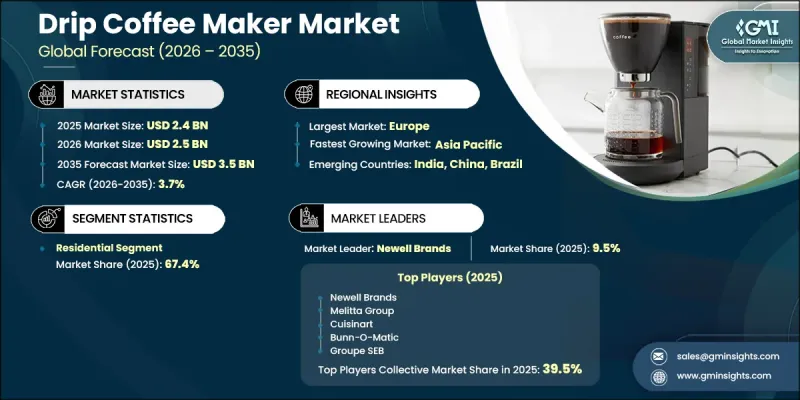
The drip coffee maker market continues to expand as coffee remains one of the most widely consumed beverages worldwide, driving consistent demand for convenient home brewing appliances. Drip coffee makers continue to be a preferred choice among consumers because they offer dependable brewing performance, simple operation, and the ability to prepare multiple servings in a single brewing cycle. Their practicality and ease of use make them well suited for households seeking efficient daily coffee preparation as well as commercial environments requiring consistent beverage output. The market is entering a period of steady growth, supported by rising consumer interest in premium appliances, connected kitchen technologies, and evolving coffee consumption habits across emerging markets. Increasing demand for higher-quality brewing experiences is encouraging consumers to replace conventional coffee makers with models offering improved functionality and enhanced convenience. While home brewing experienced elevated demand during previous years, the market is now progressing through stable long-term growth driven by product innovation, changing consumer preferences, and continued expansion of global coffee consumption.
| Market Scope | |
|---|---|
| Start Year | 2025 |
| Forecast Year | 2026-2035 |
| Start Value | $2.4 Billion |
| Forecast Value | $3.5 Billion |
| CAGR | 3.7% |
The residential drip coffee maker market accounted for 67.4% share in 2025, owing to the widespread habit of preparing coffee at home daily. Consistent household usage creates stable replacement demand, supporting long-term market growth even during periods of economic uncertainty. Consumer purchasing behavior is increasingly shifting toward premium products that deliver enhanced brewing performance, improved convenience, advanced features, and greater product durability. This ongoing transition toward higher-value appliances continues to strengthen demand within the residential segment.
The manual drip coffee maker market generated USD 700 million in 2025. Standard drip coffee makers continue to maintain strong market demand because they offer affordable pricing, user-friendly operation, and dependable brewing performance. Their straightforward functionality and broad consumer acceptance continue to support widespread adoption across both developed and developing markets. Strong demand from value-conscious consumers is expected to sustain the segment's leading position throughout the forecast period.
U.S. Drip Coffee Maker Market accounted for 81.5% share in 2025. The United States remains the largest contributor to regional demand, supported by well-established coffee consumption habits and a mature household appliance market. Strong retail distribution networks, broad product availability, and continued consumer demand across multiple price segments continue to reinforce market growth. Rising interest in premium coffee appliances and smart kitchen products is expected to further support expansion of the U.S. drip coffee maker market over the forecast period.
Key companies operating in the global drip coffee maker market include De'Longhi Group, Hamilton Beach Brands, Versuni (Philips brand), Cuisinart (Conair Corporation), Spectrum Brands Holdings, Panasonic Corporation, Newell Brands (Mr. Coffee), Melitta Group, Bravilor Bonamat, Bunn-O-Matic Corporation (BUNN), Zojirushi Corporation, Groupe SEB, SEVERIN Elektrogerate GmbH, Tiger Corporation, Breville Group, Technivorm (Moccamaster), OXO (Helen of Troy), Ratio Coffee, Wilfa AS, Bonavita (SmartCo), and SMEG S.p.A. Companies operating in the drip coffee maker market are strengthening their market position by expanding product portfolios with premium, energy-efficient, and technologically advanced brewing solutions. Manufacturers continue to invest in product innovation by incorporating smart connectivity, programmable features, enhanced brewing precision, and improved thermal performance to meet evolving consumer preferences. Businesses are also focusing on modern product designs, user-friendly interfaces, and durable materials to enhance customer satisfaction and brand loyalty. Strategic investments in research and development, manufacturing capabilities, and distribution networks enable companies to improve product availability across global markets.
Table of Contents
Chapter 1 Methodology
- 1.1 Research approach
- 1.2 Quality Commitments
- 1.2.1 GMI AI policy & data integrity commitment
- 1.2.1.1 Source consistency protocol
- 1.2.1 GMI AI policy & data integrity commitment
- 1.3 Research Trail & Confidence Scoring
- 1.3.1 Research Trail Components
- 1.3.2 Scoring Components
- 1.4 Data Collection
- 1.4.1 Partial list of primary sources
- 1.5 Data mining sources
- 1.5.1 Paid sources
- 1.5.1.1 Sources, by region
- 1.5.1 Paid sources
- 1.6 Base estimates and calculations
- 1.6.1 Base year calculation for any one approach
- 1.7 Forecast model
- 1.7.1 Quantified market impact analysis
- 1.7.1.1 Mathematical impact of growth parameters on forecast
- 1.7.1 Quantified market impact analysis
- 1.8 Research transparency addendum
- 1.8.1 Source attribution framework
- 1.8.2 Quality assurance metrics
- 1.8.3 Our commitment to trust
Chapter 2 Executive Summary
- 2.1 Industry snapshot
- 2.2 Business trends
- 2.3 Product type trends
- 2.4 Mode of operation trends
- 2.5 Price range trends
- 2.6 Cup capacity trends
- 2.7 Application trends
- 2.8 Distribution channel trends
- 2.9 Regional trends
Chapter 3 Industry Insights
- 3.1 Industry ecosystem and value chain analysis
- 3.1.1 Raw material suppliers (plastics, steel, heating elements, filters)
- 3.1.2 Component manufacturers & OEM assemblers
- 3.1.3 Brand owners & product designers
- 3.1.4 Distribution & retail layer
- 3.1.5 End-user segment map
- 3.2 Industry impact forces
- 3.2.1 Market Driver
- 3.2.2 Market challenges/pitfalls
- 3.2.3 Market opportunities
- 3.3 Growth potential analysis
- 3.4 Industry ecosystem analysis
- 3.5 Regulatory framework
- 3.5.1 Energy efficiency standards (US DOE, EU ecodesign directive)
- 3.5.2 EU deforestation regulation (EUDR) impact on coffee supply chain
- 3.5.3 RoHS & WEEE compliance for electronic components
- 3.5.4 Food safety & material contact regulations by region
- 3.5.5 Labelling & consumer safety standards
- 3.6 Pricing analysis (driven by primary research)
- 3.6.1 Historical price trend analysis (2019-2024)
- 3.6.2 Pricing strategy by player type (premium / value / cost-plus)
- 3.6.3 Price elasticity by product type & end-use segment
- 3.6.4 Retail vs. online price differential analysis
- 3.7 Technology and innovation landscape
- 3.7.1 Evolution of drip coffee maker technology (standard to smart)
- 3.7.2 Precision brewing technology (temperature control, bloom cycle)
- 3.7.3 Smart & IoT-enabled drip coffee maker technology
- 3.7.4 Built-in grinder integration technology
- 3.7.5 SCA certification standards & compliant brewing systems
- 3.7.6 Emerging tech: AI-assisted brew profiling & personalization
- 3.8 Porter's Analysis
- 3.9 PESTEL Analysis
- 3.10 Trade data analysis (driven by paid sources)
- 3.10.1 Import/export volume & value trends (HS code: 85167100)
- 3.10.2 Key trade corridors (China - US/EU, Germany - global) & tariff impact
- 3.11 Impact of AI and generative AI on the market
- 3.11.1 AI-driven disruption of product design & consumer personalization
- 3.11.2 GenAI use cases & adoption roadmap by segment (DTC brands, retailers)
- 3.11.3 Risks, limitations & regulatory considerations
- 3.12 Distribution infrastructure & channel penetration landscape (driven by primary research)
- 3.12.1 Channel coverage by region & format (modern vs. traditional trade) (driven by primary research)
- 3.12.2 Last-mile infrastructure gaps & emerging channel shifts (Q-commerce, social commerce) (driven by primary research)
Chapter 4 Competitive Landscape, 2025
- 4.1 Introduction
- 4.2 Company market share analysis
- 4.2.1 North America
- 4.2.2 Europe
- 4.2.3 APAC
- 4.2.4 LATAM
- 4.2.5 MEA
- 4.3 Company matrix analysis
- 4.4 Competitive analysis of major market players
- 4.5 Competitive positioning matrix
- 4.6 Key developments
- 4.6.1 Mergers & acquisitions
- 4.6.2 Partnerships & collaborations
- 4.6.3 New product launches
- 4.6.4 Expansion plans
Chapter 5 Market Estimates and Forecast, By Product Type, 2022 - 2035 ($ Billion) (Thousand Units)
- 5.1 Key trends
- 5.2 Standard Drip Coffee Makers
- 5.3 Programmable Drip Coffee Makers
- 5.4 Single-Serve Drip Coffee Makers
- 5.5 Portable/Travel Drip Coffee Makers
- 5.6 Advanced-Feature Drip Coffee Makers
Chapter 6 Market Estimates and Forecast, By Mode of Operation, 2022 - 2035 ($ Billion) (Thousand Units)
- 6.1 Key trends
- 6.2 Automatic
- 6.3 Manual
Chapter 7 Market Estimates and Forecast, By Cup Capacity, 2022 - 2035 ($ Billion) (Thousand Units)
- 7.1 Key trends
- 7.2 Up to 10 Cups
- 7.3 10 to 20 Cups
- 7.4 Above 20 Cups
Chapter 8 Market Estimates and Forecast, By Application, 2022 - 2035 ($ Billion) (Thousand Units)
- 8.1 Key trends
- 8.2 Residential
- 8.3 Commercial
Chapter 9 Market Estimates and Forecast, By Distribution Channel, 2022 - 2035 ($ Billion) (Thousand Units)
- 9.1 Key trends
- 9.2 Online
- 9.3 Offline
Chapter 10 Market Estimates and Forecast, By Region, 2022 - 2035 ($ Billion) (Thousand Units)
- 10.1 Key trends
- 10.2 North America
- 10.2.1 US
- 10.2.2 Canada
- 10.3 Europe
- 10.3.1 Germany
- 10.3.2 UK
- 10.3.3 France
- 10.3.4 Italy
- 10.3.5 Spain
- 10.3.6 Netherlands
- 10.4 Asia Pacific
- 10.4.1 China
- 10.4.2 India
- 10.4.3 Japan
- 10.4.4 Australia
- 10.4.5 South Korea
- 10.5 Latin America
- 10.5.1 Brazil
- 10.5.2 Mexico
- 10.6 Middle East and Africa
- 10.6.1 South Africa
- 10.6.2 Saudi Arabia
- 10.6.3 UAE
Chapter 11 Company Profiles
- 11.1 Global Players
- 11.1.1 De'Longhi Group
- 11.1.2 Hamilton Beach Brands
- 11.1.3 Versuni (Philips brand)
- 11.1.4 Cuisinart (Conair Corporation)
- 11.1.5 Spectrum Brands Holdings
- 11.1.6 Panasonic Corporation
- 11.1.7 Newell Brands (Mr. Coffee)
- 11.2 Regional Players
- 11.2.1 Melitta Group
- 11.2.2 Bravilor Bonamat
- 11.2.3 Bunn-O-Matic Corporation (BUNN)
- 11.2.4 Zojirushi Corporation
- 11.2.5 Groupe SEB
- 11.2.6 SEVERIN Elektrogerate GmbH
- 11.2.7 Tiger Corporation
- 11.3 Niche Players
- 11.3.1 Breville Group
- 11.3.2 Technivorm (Moccamaster)
- 11.3.3 OXO (Helen of Troy)
- 11.3.4 Ratio Coffee
- 11.3.5 Wilfa AS
- 11.3.6 Bonavita (SmartCo)
- 11.3.7 SMEG S.p.A.

