PUBLISHER: Global Market Insights Inc. | PRODUCT CODE: 2071388

PUBLISHER: Global Market Insights Inc. | PRODUCT CODE: 2071388
Mattress and Mattress Component Market Opportunity, Growth Drivers, Industry Trend Analysis, and Forecast 2026 - 2035
The Global Mattress and Mattress Component Market was valued at USD 70.1 billion in 2025 and is estimated to grow at a CAGR of 6.6% to reach USD 132.5 billion by 2035.
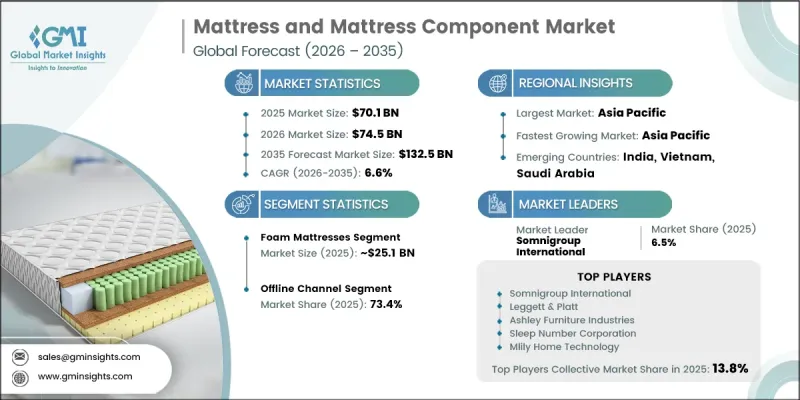
Market expansion is driven by demographic shifts that support consistent replacement cycles, rapid urbanization across developing economies, and a growing consumer emphasis on sleep quality as a core component of overall health and wellness. Recovery in residential construction activity is further reinforcing demand for mattress replacements across both mature and emerging markets. Recognition of sleep deprivation as a significant public health issue has increased consumer awareness, encouraging higher spending on improved sleep products across diverse income groups. Premium and ultra-premium mattress categories are expanding at a faster pace in developed regions such as North America and Europe, while rising middle-class populations in Asia and the Middle East are accelerating adoption of higher-quality mattress systems. Data on household consumption patterns shows that spending on sleep-related products is increasing faster than broader durable goods categories in several leading economies. At the same time, the transition from physical retail to digital sales channels is reshaping pricing structures, brand engagement, and customer acquisition strategies, enabling manufacturers with strong direct-to-consumer capabilities to strengthen long-term market positioning.
| Market Scope | |
|---|---|
| Start Year | 2025 |
| Forecast Year | 2026-2035 |
| Start Value | $70.1 Billion |
| Forecast Value | $132.5 Billion |
| CAGR | 6.6% |
The foam-based mattresses segment accounted for 35.8% share, generating USD 25.1 billion in 2025. Growth is moderated by increasing consumer migration toward hybrid mattress systems and rising input costs associated with key raw materials used in foam production. Cost pressures have notably impacted manufacturers in several developed markets, leading to higher production expenses. Within this category, basic foam products are experiencing slower demand, while enhanced variants with improved cooling, airflow, and antimicrobial properties are gaining stronger traction and outperforming traditional formats.
The offline distribution channel segment held a 73.4% share in 2025, amounting to USD 51.5 billion. Its continued dominance is linked to consumer preference for physical product testing, particularly for high-value purchases where comfort evaluation plays a critical role. However, the channel is gradually losing share to digital platforms as online purchasing adoption increases. Within offline retail, consolidation trends are becoming more visible, with larger organized retailers strengthening their market position through expanded product offerings and improved customer experience strategies, while smaller independent retailers are facing increasing competitive pressure due to shifting consumer buying behavior.
North America Mattress and Mattress Component Market accounted for 30.5% share in 2025, representing USD 21.4 billion. Demand in North America is supported by stable replacement cycles, high consumer awareness of sleep health, and a well-developed retail ecosystem. The region is also experiencing changes in product preference, with increased demand for premium sleep systems and technologically advanced mattress solutions. Evolving distribution dynamics and growing emphasis on direct-to-consumer models are reshaping market competitiveness and influencing long-term industry structure.
Major companies operating in the Global Mattress and Mattress Component Market include Ashley Furniture Industries, Avocado Green Mattress, DeRUCCI, Duroflex, Eight Sleep, Emma Sleep, Hastens, Helix Sleep (3Z Brands), Hilding Anders, King Koil International, Leggett & Platt, Magniflex, Mlily Home Technology Co., Ltd, Pikolin, Relyon, Saatva, Silentnight Group, Sleep Number Corporation, Somnigroup International, Wakefit, and Zinus. Companies in the mattress and mattress component market are focusing on innovation-led growth strategies to strengthen their competitive position. Product development efforts are increasingly centered on hybrid construction, enhanced pressure relief systems, and advanced temperature regulation technologies to improve sleep quality. Manufacturers are also investing in direct-to-consumer business models and digital retail platforms to improve customer engagement and strengthen brand loyalty. Expansion of product portfolios across multiple price segments is helping companies address both value-driven and premium consumer groups. Strategic partnerships with material suppliers and sleep technology firms are supporting continuous product enhancement and differentiation.
Table of Contents
Chapter 1 Methodology & Scope
- 1.1 Research approach
- 1.2 Quality Commitments
- 1.2.1 GMI AI policy & data integrity commitment
- 1.2.1.1 Source consistency protocol
- 1.2.1 GMI AI policy & data integrity commitment
- 1.3 Research Trail & Confidence Scoring
- 1.3.1 Research Trail Components
- 1.3.2 Scoring Components
- 1.4 Data Collection
- 1.4.1 Partial list of primary sources
- 1.5 Data mining sources
- 1.5.1 Paid sources
- 1.5.1.1 Sources, by region
- 1.5.1 Paid sources
- 1.6 Base estimates and calculations
- 1.6.1 Base year calculation for any one approach
- 1.7 Forecast model
- 1.7.1 Quantified market impact analysis
- 1.7.1.1 Mathematical impact of growth parameters on forecast
- 1.7.1 Quantified market impact analysis
- 1.8 Research transparency addendum
- 1.8.1 Source attribution framework
- 1.8.2 Quality assurance metrics
- 1.8.2.1 Our commitment to trust
Chapter 2 Executive Summary
- 2.1 Industry 360° synopsis, 2022 - 2035
- 2.2 Key market trends
- 2.2.1 Region
- 2.2.2 Product Type
- 2.2.3 Component Type
- 2.2.4 Size
- 2.2.5 Price Range
- 2.2.6 End Use
- 2.2.7 Distribution channel
Chapter 3 Industry Insights
- 3.1 Industry ecosystem analysis
- 3.1.1 Supplier landscape
- 3.1.2 Profit margin
- 3.1.3 Value addition at each stage
- 3.1.4 Factor affecting the value chain
- 3.2 Industry impact forces
- 3.2.1 Growth drivers
- 3.2.1.1 Housing market recovery fuels demand for new purchases and replacements
- 3.2.1.2 Growing awareness of sleep health & trend of consumer premiumization
- 3.2.1.3 Surge in DTC & e-commerce channels
- 3.2.1.4 Rising demand from hospitality, healthcare & institutional sectors
- 3.2.2 Industry pitfalls & challenges
- 3.2.2.1 Mid-tier players face pressure from market saturation & consolidation
- 3.2.2.2 Asian-sourced components hit by tariff uncertainty & supply chain cost fluctuations
- 3.2.3 Opportunities
- 3.2.3.1 Integration of smart mattresses & sleep technology boosts premium segment
- 3.2.3.2 Demand for organic, recycled, & eco-certified materials driven by sustainability
- 3.2.1 Growth drivers
- 3.3 Growth potential analysis
- 3.4 Regulatory framework
- 3.4.1 Standards & compliance requirements
- 3.4.2 Regional regulatory frameworks
- 3.4.3 Certification standards
- 3.5 Major market trends and disruptions
- 3.6 Technology/innovation landscape
- 3.6.1 Current trends
- 3.6.2 Emerging trends
- 3.7 Pricing Analysis (driven by primary research)
- 3.7.1 Historical price trend analysis (driven by primary research)
- 3.7.2 Pricing strategy by player type (premium / value / cost-plus) (driven by primary research)
- 3.8 Future market trends
- 3.9 Trade data analysis (driven by paid database) (HS Code- 9404)
- 3.9.1 Import/export volume & value trends (driven by primary research)
- 3.9.2 Key trade corridors & tariff impact (driven by primary research)
- 3.10 Impact of AI & Generative AI on the Market
- 3.10.1 AI-driven disruption of existing business models
- 3.10.2 Gen-AI use cases & adoption roadmap by segment
- 3.10.3 Risks, limitations & regulatory considerations
- 3.11 Porter's analysis
- 3.12 PESTEL analysis
- 3.13 Distribution infrastructure & channel penetration landscape (driven by primary research)
- 3.13.1 Channel coverage by region & format (modern vs. Traditional trade) (driven by primary research)
- 3.13.2 Last-mile infrastructure gaps & emerging channel shifts (DTC, social commerce, pop-up retail) (driven by primary research)
Chapter 4 Competitive Landscape, 2025
- 4.1 Introduction
- 4.2 Company market share analysis
- 4.2.1 By Region
- 4.2.1.1 North America
- 4.2.1.2 Europe
- 4.2.1.3 Asia Pacific
- 4.2.1.4 Latin America
- 4.2.1.5 Middle East and Africa
- 4.2.1 By Region
- 4.3 Company matrix analysis
- 4.4 Competitive analysis of major market players
- 4.5 Competitive positioning matrix
- 4.6 Key developments
- 4.6.1 Mergers & acquisitions
- 4.6.2 Partnerships & collaborations
- 4.6.3 New product launches
- 4.6.4 Expansion plans
Chapter 5 Market Estimates and Forecast, By Product Type, 2022 - 2035 (USD Billion) (Million Units)
- 5.1 Key trends
- 5.2 Foam mattress
- 5.2.1 Memory Foam
- 5.2.2 Gel-Infused Foam
- 5.2.3 Polyurethane Foam
- 5.3 Hybrid mattress
- 5.4 Innerspring mattress
- 5.4.1 Bonnell Coil
- 5.4.2 Pocket Coil
- 5.4.3 Continuous Coil
- 5.4.4 Offset Coil
- 5.5 Latex mattress
- 5.6 Others (waterbed, airbed, etc.)
Chapter 6 Market Estimates and Forecast, By Component Type, 2022 - 2035 (USD Billion) (Million Units)
- 6.1 Key trends
- 6.2 Support Layer
- 6.2.1 Foam
- 6.2.2 Innerspring
- 6.2.3 Latex
- 6.2.4 hybrid
- 6.3 Comfort Layer
- 6.3.1 Insulator Pad
- 6.3.2 Quilt Layer
- 6.3.3 Middle Upholstery
- 6.4 Others
Chapter 7 Market Estimates and Forecast, By Size, 2022 - 2035 (USD Billion) (Million Units)
- 7.1 Key trends
- 7.2 Single size
- 7.3 Twin size
- 7.4 Full or double size
- 7.5 King size
- 7.6 Others
Chapter 8 Market Estimates and Forecast, By Price Range, 2022 - 2035 (USD Billion) (Million Units)
- 8.1 Key trends
- 8.2 Low
- 8.3 Medium
- 8.4 High
Chapter 9 Market Estimates and Forecast, By End Use, 2022 - 2035 (USD Billion) (Million Units)
- 9.1 Key trends
- 9.2 Residential
- 9.3 Commercial
- 9.3.1 Hospitality
- 9.3.2 Healthcare
- 9.3.3 Institutional
- 9.3.4 Others
Chapter 10 Market Estimates and Forecast, By Distribution Channel, 2022 - 2035 (USD Billion) (Million Units)
- 10.1 Key trends
- 10.2 Online
- 10.2.1 E-Commerce
- 10.2.2 Company website
- 10.3 Offline
- 10.3.1 Supermarkets/hypermarkets
- 10.3.2 Specialty stores
- 10.3.3 Others (individual stores, departmental stores, etc.)
Chapter 11 Market Estimates & Forecast, By Region, 2022 - 2035, (USD Billion) (Million Units)
- 11.1 Key trends
- 11.2 North America
- 11.2.1 U.S.
- 11.2.2 Canada
- 11.3 Europe
- 11.3.1 Germany
- 11.3.2 U.K.
- 11.3.3 France
- 11.3.4 Italy
- 11.3.5 Spain
- 11.4 Asia Pacific
- 11.4.1 China
- 11.4.2 India
- 11.4.3 Japan
- 11.4.4 South Korea
- 11.4.5 Australia
- 11.5 Latin America
- 11.5.1 Brazil
- 11.5.2 Mexico
- 11.5.3 Argentina
- 11.6 MEA
- 11.6.1 UAE
- 11.6.2 Saudi Arabia
- 11.6.3 South Africa
Chapter 12 Company Profiles
- 12.1 Global Companies
- 12.1.1 Ashley Furniture Industries
- 12.1.1.1 Business Overview
- 12.1.1.2 Financial Data
- 12.1.1.3 Product Landscape
- 12.1.1.4 Strategic Outlook
- 12.1.1.5 SWOT Analysis
- 12.1.2 DeRUCCI
- 12.1.3 Hilding Anders
- 12.1.4 Leggett & Platt
- 12.1.5 Mlily Home Technology
- 12.1.6 Sleep Number Corporation
- 12.1.7 Somnigroup International
- 12.1.1 Ashley Furniture Industries
- 12.2 Regional Companies
- 12.2.1 Duroflex
- 12.2.2 Hastens
- 12.2.3 King Koil International
- 12.2.4 Magniflex
- 12.2.5 Pikolin
- 12.2.6 Relyon
- 12.2.7 Silentnight Group
- 12.3 Emerging Companies
- 12.3.1 Avocado Green Mattress
- 12.3.2 Eight Sleep
- 12.3.3 Emma Sleep
- 12.3.4 Helix Sleep (3Z Brands)
- 12.3.5 Saatva
- 12.3.6 Wakefit
- 12.3.7 Zinus

