PUBLISHER: Global Market Insights Inc. | PRODUCT CODE: 2071322

PUBLISHER: Global Market Insights Inc. | PRODUCT CODE: 2071322
Machine Tools Market Opportunity, Growth Drivers, Industry Trend Analysis, and Forecast 2026 - 2035
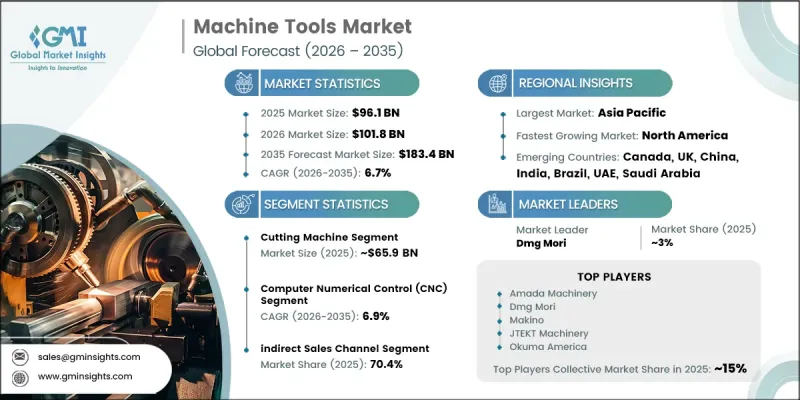
The Global Machine Tools Market was valued at USD 96.1 billion in 2025 and is estimated to grow at a CAGR of 6.7% to reach USD 183.4 billion by 2035.
Growth is strongly supported by the rapid development of industrial infrastructure in emerging economies and the expansion of production ecosystems across Asia and Latin America. Government-backed industrial programs are encouraging domestic manufacturing capabilities, attracting foreign investment, and strengthening production competitiveness. Demand from core industries such as automotive, aerospace, electronics, and medical devices is further accelerating adoption, as these sectors require highly precise, durable, and complex components. Machine tools play a critical role in enabling tight tolerances, advanced geometries, and superior surface finishes essential for modern manufacturing. Increasing use of advanced materials such as high-strength alloys and composites is also driving demand for next-generation machining technologies capable of handling difficult-to-process inputs. The transition toward automation, digital manufacturing, and smart factory environments is further enhancing efficiency and productivity, reinforcing the importance of advanced machine tools in global industrial value chains.
| Market Scope | |
|---|---|
| Start Year | 2025 |
| Forecast Year | 2026-2035 |
| Start Value | $96.1 Billion |
| Forecast Value | $183.4 Billion |
| CAGR | 6.7% |
The cutting machine segment generated USD 65.9 billion in 2025 and is expected to grow at a CAGR of 7.3% through 2035. This segment continues to dominate due to its widespread use in high-precision manufacturing processes, including milling, turning, drilling, and grinding operations. These systems are essential for achieving consistent dimensional accuracy, high-speed production, and superior surface quality. Growing adoption of advanced engineering materials and increasing demand for complex part geometries are further strengthening segment expansion.
The indirect sales channel accounted for 70.4% share in 2025 and is projected to grow at a CAGR of 7% during 2026-2035. This channel remains dominant as distributors, dealers, and third-party suppliers enable manufacturers to reach a wider customer base, particularly small and medium enterprises. These intermediaries also provide essential services such as installation, maintenance, technical training, and after-sales support, which are critical for high-value and technologically advanced machine tools.
United States Machine Tools Market reached USD 21.1 billion in 2025 and is expected to grow at a CAGR of 6% through 2035. Strong demand from industries such as aerospace, automotive, defense, and medical equipment manufacturing is driving consistent market growth. Increasing adoption of smart manufacturing technologies, including CNC automation, robotics integration, and IoT-enabled systems, is improving productivity and operational precision. Ongoing reshoring initiatives and government support for domestic manufacturing are further reinforcing demand for advanced machining solutions.
Key companies operating in the global machine tools market include DMG MORI, Makino, Okuma, Haas Automation, DN Solutions (formerly Doosan Machine Tools), Amada, Hyundai WIA, Chiron Group, Komatsu, Georg Fischer, JTEKT Machinery, Hurco, Dalian Machine Tool Group, Amera-Seiki, Datron AG, Tsugami Corporation, Citizen Machinery, FFG Group (Fair Friend Group), Shenyang Machine Tool Co., SPINNER Werkzeugmaschinen, and Nakamura-Tome Precision Industry. Market participants are strengthening their competitive position through the rapid adoption of automation, digitalization, and smart manufacturing technologies. Companies are heavily investing in CNC systems, robotics integration, and AI-driven machining solutions to improve precision and operational efficiency. Expansion of product portfolios with multi-functional and high-speed machining centers is enhancing application coverage across industries. Strategic collaborations with automotive, aerospace, and industrial manufacturers are enabling long-term supply partnerships. Firms are also focusing on predictive maintenance capabilities and IoT-enabled machine tools to reduce downtime and improve productivity.
Table of Contents
Chapter 1 Methodology & Scope
- 1.1 Market scope and definition
- 1.2 Research design
- 1.2.1 Research approach
- 1.2.2 Data collection methods
- 1.3 Data mining sources
- 1.3.1 Global
- 1.3.2 Regional/Country
- 1.4 Base estimates and calculations
- 1.4.1 Base year calculation
- 1.4.2 Key trends for market estimation
- 1.5 Primary research and validation
- 1.5.1 Primary sources
- 1.6 Forecast model
- 1.7 Research assumptions and limitations
Chapter 2 Executive Summary
- 2.1 Industry 360° synopsis
- 2.2 Key market trends
- 2.2.1 Regional
- 2.2.2 Machine type
- 2.2.3 Operating technology
- 2.2.4 Application
- 2.2.5 End use
- 2.2.6 Distribution channel
Chapter 3 Industry Insights
- 3.1 Industry ecosystem analysis
- 3.1.1 Supplier landscape
- 3.1.2 Profit margin
- 3.1.3 Value addition at each stage
- 3.1.4 Factor affecting the value chain
- 3.2 Industry impact forces
- 3.2.1 Growth drivers
- 3.2.1.1 Rapid industrialization and expansion of manufacturing sectors globally
- 3.2.1.2 Strong demand from automotive, aerospace, electronics, and medical device industries
- 3.2.1.3 Increasing need for high-precision and complex component manufacturing
- 3.2.2 Industry pitfalls & challenges
- 3.2.2.1 High initial investment and capital costs associated with advanced machine tools
- 3.2.2.2 Rising costs of raw materials and components affecting manufacturing expenses
- 3.2.3 Opportunities
- 3.2.3.1 Growing adoption of Industry 4.0 and smart manufacturing solutions
- 3.2.3.2 Increasing demand for automation and robotics in production processes
- 3.2.3.3 Expansion of electric vehicle (EV) manufacturing and related components
- 3.2.1 Growth drivers
- 3.3 Growth potential analysis
- 3.4 Future market trends
- 3.5 Technology and innovation landscape
- 3.5.1 Current technological trends
- 3.5.2 Emerging technologies
- 3.6 Regulatory landscape
- 3.6.1 Standards and compliance requirements
- 3.6.2 Regional regulatory frameworks
- 3.6.3 Certification standards
- 3.7 Trade data analysis (HS Code 8456)
- 3.7.1 Import/export volume & value trends
- 3.7.2 Key trade corridors & tariff impact
- 3.8 Pricing analysis
- 3.8.1 Historical price trend analysis (driven by primary research)
- 3.8.2 Pricing strategy by player type (premium / value / mass market)
- 3.8.3 Price positioning of technology vs traditional products
- 3.8.4 Regional price variations
- 3.9 Impact of AI & generative AI on the market
- 3.9.1 AI-driven disruption of existing business models
- 3.9.2 GenAI use cases & adoption roadmap by segment
- 3.9.3 Risks, limitations & regulatory considerations
- 3.10 Porter's analysis
- 3.11 PESTEL analysis
Chapter 4 Competitive Landscape, 2025
- 4.1 Introduction
- 4.2 Company market share analysis
- 4.2.1 By Region
- 4.2.1.1 North America
- 4.2.1.2 Europe
- 4.2.1.3 Asia Pacific
- 4.2.1.4 Latin America
- 4.2.1.5 Middle East & Africa
- 4.2.1 By Region
- 4.3 Company matrix analysis
- 4.4 Competitive analysis of major market players
- 4.5 Competitive positioning matrix
- 4.6 Key developments
- 4.6.1 Mergers & acquisitions
- 4.6.2 Partnerships & collaborations
- 4.6.3 New product launches
- 4.6.4 Expansion plans
Chapter 5 Market Estimates & Forecast, By Machine Type, 2022 - 2035, (USD Billion) (Million Units)
- 5.1 Key trends
- 5.2 Cutting machine
- 5.2.1 Milling machines
- 5.2.2 Turning machines
- 5.2.3 Grinding machines
- 5.2.4 Drilling machines
- 5.2.5 Others (threading, filling, etc.)
- 5.3 Forming machine
- 5.3.1 Presses
- 5.3.2 Bending machines
- 5.3.3 Punching machines
- 5.3.4 Others (rolling, forging, etc.)
Chapter 6 Market Estimates & Forecast, By Operating Technology, 2022 - 2035, (USD Billion) (Million Units)
- 6.1 Key trends
- 6.2 Computer Numerical Control (CNC)
- 6.3 Conventional
Chapter 7 Market Estimates & Forecast, By Application, 2022 - 2035, (USD Billion) (Million Units)
- 7.1 Key trends
- 7.2 Metalworking
- 7.3 Woodworking
- 7.4 Plastic manufacturing
- 7.5 Others (ceramics & glass fabrication, composites working, etc.)
Chapter 8 Market Estimates & Forecast, By End User, 2022 - 2035, (USD Billion) (Million Units)
- 8.1 Key trends
- 8.2 Aerospace & defense
- 8.3 Automotive
- 8.4 Energy & power
- 8.5 Electronics & semiconductors
- 8.6 Building & construction
- 8.7 Others (healthcare, marine, etc.)
Chapter 9 Market Estimates & Forecast, By Distribution Channel, 2022 - 2035, (USD Billion) (Million Units)
- 9.1 Key trends
- 9.2 Direct sales
- 9.3 Indirect sales
Chapter 10 Market Estimates & Forecast, By Region, 2022 - 2035, (USD Billion) (Million Units)
- 10.1 Key trends
- 10.2 North America
- 10.2.1 U.S.
- 10.2.2 Canada
- 10.3 Europe
- 10.3.1 Germany
- 10.3.2 UK
- 10.3.3 France
- 10.3.4 Italy
- 10.3.5 Spain
- 10.4 Asia Pacific
- 10.4.1 China
- 10.4.2 India
- 10.4.3 Japan
- 10.4.4 South Korea
- 10.4.5 Australia
- 10.4.6 Indonesia
- 10.4.7 Malaysia
- 10.5 Latin America
- 10.5.1 Brazil
- 10.5.2 Mexico
- 10.5.3 Argentina
- 10.6 MEA
- 10.6.1 Saudi Arabia
- 10.6.2 UAE
- 10.6.3 South Africa
Chapter 11 Company Profiles
- 11.1 Top Global Players
- 11.1.1 Amada (Amanda)
- 11.1.2 DMG MORI
- 11.1.3 Makino
- 11.1.4 Okuma
- 11.1.5 Haas Automation
- 11.1.6 Hyundai WIA
- 11.1.7 DN Solutions (formerly Doosan Machine Tools)
- 11.1.8 Georg Fischer
- 11.2 Regional Champions
- 11.2.1 JTEKT Machinery
- 11.2.2 Komatsu
- 11.2.3 Hurco
- 11.2.4 Chiron Group
- 11.2.5 Dalian Machine Tool Group
- 11.2.6 Amera-Seiki
- 11.2.7 Datron AG
- 11.3 Emerging Players
- 11.3.1 Tsugami Corporation
- 11.3.2 Citizen Machinery
- 11.3.3 FFG Group (Fair Friend Group)
- 11.3.4 Shenyang Machine Tool Co.
- 11.3.5 SPINNER Werkzeugmaschinen
- 11.3.6 Nakamura-Tome Precision Industry

