PUBLISHER: Global Market Insights Inc. | PRODUCT CODE: 2071356

PUBLISHER: Global Market Insights Inc. | PRODUCT CODE: 2071356
Bath Toy Market Opportunity, Growth Drivers, Industry Trend Analysis, and Forecast 2026 - 2035
The Global Bath Toy Market was valued at USD 1.5 billion in 2025 and is estimated to grow at a CAGR of 6.2% to reach USD 2.8 billion by 2035.
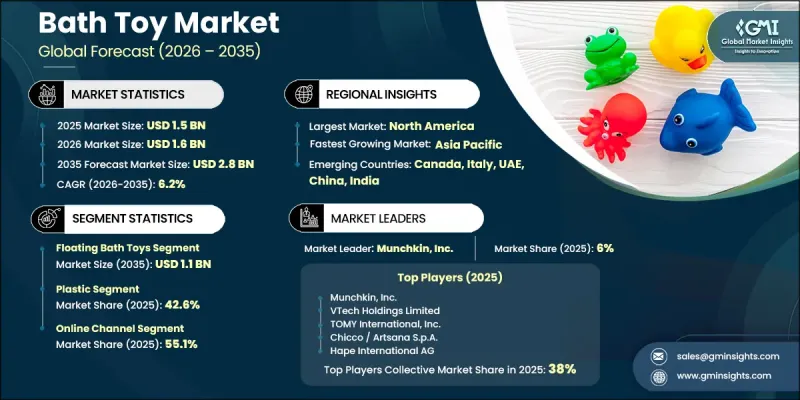
Market expansion is shaped by a combination of child development priorities, evolving parental expectations, and heightened attention to product safety standards. Consumer behavior is increasingly influenced by awareness of material quality, environmental considerations, and broader trends within the toy and childcare ecosystem. While traditional floating toys continue to hold cultural relevance, product demand is steadily shifting toward more interactive, educational, and sustainability-focused designs. Parents are more informed today and actively evaluate bath toys based on safety certifications, developmental value, and material composition, which is reshaping purchasing decisions across both premium and mass-market segments. In parallel, rising disposable incomes and stronger spending on early childhood development are reinforcing steady demand. Digital retail channels are also expanding product accessibility, allowing manufacturers to reach a wider consumer base. As a result, innovation in design, learning-based functionality, and eco-friendly production is becoming central to market competition, positioning bath toys as both recreational and developmental tools within modern childcare routines.
| Market Scope | |
|---|---|
| Start Year | 2025 |
| Forecast Year | 2026-2035 |
| Start Value | $1.5 Billion |
| Forecast Value | $2.8 Billion |
| CAGR | 6.2% |
Educational features are becoming a key growth driver in the bath toy market, as parents increasingly prioritize cognitive and sensory development alongside entertainment. Bath toys are no longer seen only as playful accessories but are also recognized as tools that support early learning, creativity, and motor skill development. This shift in perception is encouraging manufacturers to introduce products that combine fun with structured learning outcomes, thereby strengthening consumer interest in innovative and skill-oriented toy designs.
The floating bath toys segment generated USD 600 million in 2025 and is projected to reach USD 1.1 billion by 2035. Demand for floating toys remains strong among parents who prefer simple and engaging bath-time products for young children. Their popularity is supported by ease of use, safety for infants, and their ability to encourage early water familiarity and playful interaction. These products continue to serve as an introductory category for establishing positive bathing routines among toddlers.
The plastic-based segment held a 42.6% share in 2025. Plastic remains widely used in bath toy manufacturing due to its cost efficiency, durability, and flexibility in design applications. Its ability to be molded into varied shapes and vibrant colors, along with strong water resistance, supports its continued dominance. Manufacturers continue to favor plastic materials as they enable scalable production while maintaining functional and visually appealing product designs.
United States Bath Toy Market held a 79% share in 2025. Market strength in the country is supported by consistent birth rates of approximately 3.6 million annually, creating a stable consumer base for childcare-related products. Strong household spending on child safety and developmental goods further reinforces demand. High product awareness and preference for certified, quality-assured toys continue to sustain strong market penetration across retail and online channels.
Key companies operating in the global bath toy industry include TOMY International, Inc., Hape International AG, Skip Hop, Inc., Infantino, LLC, Chicco / Artsana S.p.A., Mattel, Inc., VTech Holdings Limited, Boon, Inc., Edushape Ltd., Luv n' Care, Ltd., Green Toys, Inc., Maison Battat Inc., Djeco, Playgro Pty Ltd, Munchkin, Inc., Juratoys SAS, Learning Resources Inc., Plan Creations Co., Ltd., WOW Toys, and Yookidoo Ltd. Companies in the bath toy market are increasingly focusing on product innovation, integrating educational and sensory development features into toy designs to enhance value for parents. Many manufacturers are investing in sustainable and non-toxic materials to align with growing environmental awareness and safety expectations. Strengthening digital distribution networks and expanding e-commerce presence has become a priority to improve global reach. Firms are also leveraging strategic partnerships with childcare brands and retailers to improve visibility and market penetration.
Table of Contents
Chapter 1 Research Methodology
- 1.1 Research approach
- 1.2 Quality Commitments
- 1.2.1 GMI AI policy & data integrity commitment
- 1.2.1.1 Source consistency protocol
- 1.2.1 GMI AI policy & data integrity commitment
- 1.3 Research Trail & Confidence Scoring
- 1.3.1 Research Trail Components
- 1.3.2 Scoring Components
- 1.4 Data Collection
- 1.4.1 Partial list of primary sources
- 1.5 Data mining sources
- 1.5.1 Paid sources
- 1.5.1.1 Sources, by region
- 1.5.1 Paid sources
- 1.6 Base estimates and calculations
- 1.6.1 Base year calculation for any one approach
- 1.7 Forecast model
- 1.7.1 Quantified market impact analysis
- 1.7.1.1 Mathematical impact of growth parameters on forecast
- 1.7.1 Quantified market impact analysis
- 1.8 Research transparency addendum
- 1.8.1 Source attribution framework
- 1.8.2 Quality assurance metrics
- 1.8.3 Our commitment to trust
Chapter 2 Executive Summary
- 2.1 Industry 360° synopsis, 2022 - 2035
- 2.2 Key market trends
- 2.2.1 Regional trends
- 2.2.2 Product type trends
- 2.2.3 Material Type trends
- 2.2.4 Price Range trends
- 2.2.5 Age group trends
- 2.2.6 Distribution channel trends
Chapter 3 Industry Insights
- 3.1 Industry ecosystem analysis
- 3.1.1 Factor affecting the value chain
- 3.1.2 Profit margin analysis
- 3.1.3 Disruptions
- 3.1.4 Future outlook
- 3.1.5 Manufacturers
- 3.1.6 Distributors
- 3.2 Supplier landscape
- 3.3 Key news & initiatives
- 3.4 Regulatory landscape
- 3.4.1 EU Toy Safety Directive (ASTM F963, EN 71, ISO 8124)
- 3.4.2 Material Safety & Chemical Compliance (REACH, RoHS, CPSIA)
- 3.4.3 ISO 8124 International Standards
- 3.4.4 Chemical Restrictions (REACH, Prop 65)
- 3.5 Impact forces
- 3.5.1 Growth drivers
- 3.5.2 Industry pitfalls & challenges
- 3.5.3 Opportunities
- 3.6 Pricing analysis, 2025 (driven by primary research)
- 3.6.1 Historical price trend analysis (2022-2025)
- 3.6.2 Pricing strategy by player type (premium/value/cost-plus)
- 3.6.3 Regional price variation analysis
- 3.6.4 Impact of raw material costs on pricing
- 3.7 Consumer buying behavior analysis
- 3.7.1 Demographic trends
- 3.7.2 Factors affecting buying decisions
- 3.7.3 Consumer product adoption
- 3.7.4 Preferred distribution channel
- 3.8 Growth potential analysis
- 3.9 Porter's analysis
- 3.10 PESTEL analysis
- 3.11 Trade data analysis (driven by paid data base)
- 3.11.1 Import/export volume & value trends
- 3.11.2 Key trade corridors & tariff impact
- 3.11.3 Export destination analysis
- 3.11.4 Import source analysis for raw materials
- 3.12 Impact of AI & generative AI on the market
- 3.12.1 AI-driven disruption of existing business models
- 3.12.2 GenAI use cases & adoption roadmap by segment
- 3.12.3 Risks, limitations & regulatory considerations
- 3.13 Distribution infrastructure & channel penetration landscape (driven by primary research)
- 3.13.1 Channel coverage by region & format (modern vs. Traditional trade)
- 3.13.2 Last-mile infrastructure gaps & emerging channel shifts
Chapter 4 Competitive Landscape, 2025
- 4.1 Introduction
- 4.2 Company market share analysis
- 4.3 Company matrix analysis
- 4.4 Competitive analysis of major market players
- 4.5 Competitive positioning matrix
- 4.6 Key developments
- 4.6.1 Mergers & acquisitions
- 4.6.2 Partnerships & collaborations
- 4.6.3 New product launches
- 4.6.4 Expansion plans
Chapter 5 Market Estimates & Forecast, By Product Type, 2022-2035 (USD Billion) (Million Units)
- 5.1 Key Trends
- 5.2 Floating Bath Toys
- 5.3 Suction Bath Toys
- 5.4 Stacking Bath Toys
- 5.5 Creative & Educational Bath Toys
- 5.6 Interactive & Electronic Bath Toys
- 5.7 Others
Chapter 6 Market Estimates & Forecast, By Material Type, 2022-2035 (USD Billion) (Million Units)
- 6.1 Key Trends
- 6.2 Plastic
- 6.3 Rubber & Silicone
- 6.4 Foam
- 6.5 Sustainable & Eco-Friendly
Chapter 7 Market Estimates & Forecast, By Price Range, 2022-2035 (USD Billion) (Million Units)
- 7.1 Key Trends
- 7.2 Low (Under USD 10)
- 7.3 Medium (Under USD 10-USD 30)
- 7.4 High (Above USD 30)
Chapter 8 Market Estimates & Forecast, By Age Group, 2022-2035 (USD Billion) (Million Units)
- 8.1 Key Trends
- 8.2 Under 1 year
- 8.3 1-3 years
- 8.4 Above 3 years
Chapter 9 Market Estimates & Forecast, By Distribution Channel, 2022 - 2035, (USD Billion) (Million Units)
- 9.1 Key trends
- 9.2 Online
- 9.2.1 E-commerce website
- 9.2.2 Company owned website
- 9.3 Offline
- 9.3.1 Hypermarket/supermarket
- 9.3.2 Departmental stores
- 9.3.3 Specialized stores
- 9.3.4 Other retail stores
Chapter 10 Market Estimates & Forecast, By Region, 2022 - 2035, (USD Billion) (Million Units)
- 10.1 Key trends
- 10.2 North America
- 10.2.1 U.S.
- 10.2.2 Canada
- 10.3 Europe
- 10.3.1 Germany
- 10.3.2 U.K.
- 10.3.3 France
- 10.3.4 Italy
- 10.3.5 Spain
- 10.4 Asia Pacific
- 10.4.1 China
- 10.4.2 India
- 10.4.3 Japan
- 10.4.4 South Korea
- 10.4.5 Australia
- 10.5 Latin America
- 10.5.1 Brazil
- 10.5.2 Mexico
- 10.5.3 Argentina
- 10.6 MEA
- 10.6.1 UAE
- 10.6.2 Saudi Arabia
- 10.6.3 South Africa
Chapter 11 Company Profiles (Business Overview, Financial Data, Product Landscape, Strategic Outlook, SWOT Analysis)
- 11.1 Global players
- 11.1.1 Mattel, Inc.
- 11.1.2 VTech Holdings Limited
- 11.1.3 Hape International AG
- 11.1.4 TOMY International, Inc.
- 11.1.5 Munchkin, Inc.
- 11.1.6 Chicco / Artsana S.p.A.
- 11.2 Regional players
- 11.2.1 Maison Battat Inc.
- 11.2.2 Green Toys, Inc.
- 11.2.3 Infantino, LLC
- 11.2.4 Luv n' Care, Ltd.
- 11.2.5 Playgro Pty Ltd.
- 11.2.6 Juratoys SAS
- 11.2.7 Skip Hop, Inc.
- 11.2.8 Learning Resources Inc.
- 11.2.9 Edushape Ltd.
- 11.3 Emerging players
- 11.3.1 Yookidoo Ltd.
- 11.3.2 Boon, Inc.
- 11.3.3 WOW Toys
- 11.3.4 Plan Creations Co., Ltd.
- 11.3.5 Djeco

