PUBLISHER: Global Market Insights Inc. | PRODUCT CODE: 2071397

PUBLISHER: Global Market Insights Inc. | PRODUCT CODE: 2071397
Cobalt-Free Cathode Materials Market Opportunity, Growth Drivers, Industry Trend Analysis, and Forecast 2026 - 2035
The Global Cobalt-Free Cathode Materials Market was valued at USD 11 billion in 2025 and is estimated to grow at a CAGR of 16.4% to reach USD 55.5 billion by 2035.
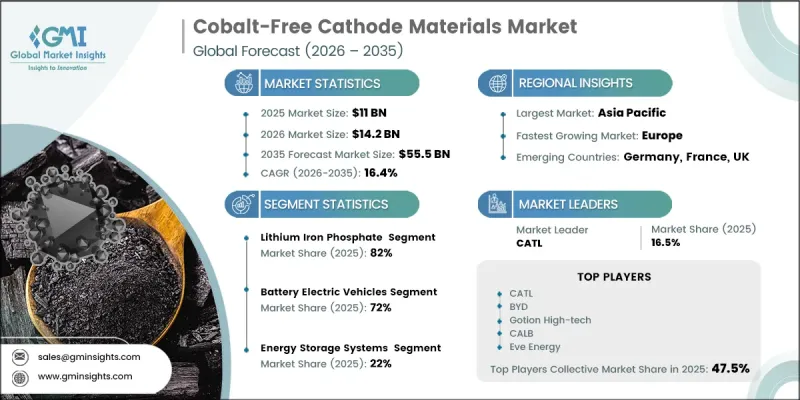
The growth trajectory is driven by a decisive transition away from cobalt-intensive chemistries toward alternatives that eliminate supply chain risk and reduce material costs. Increasing regulatory scrutiny around responsible sourcing, combined with large-scale investments across the battery value chain, continues to accelerate adoption. At the same time, advancements in material engineering have narrowed the performance gap between cobalt-based and cobalt-free solutions, making the latter viable across a wider range of applications. Cost advantages remain a central factor, as cobalt-free chemistries deliver significantly lower cost per kWh while maintaining strong safety and durability characteristics. Growing industrial alignment, improved manufacturing efficiencies, and favorable policy support are collectively reinforcing long-term market expansion.
| Market Scope | |
|---|---|
| Start Year | 2025 |
| Forecast Year | 2026-2035 |
| Start Value | $11 Billion |
| Forecast Value | $55.5 Billion |
| CAGR | 16.4% |
The market is shaped by a structural migration away from traditional cathode compositions toward lithium iron phosphate and manganese-enhanced alternatives that completely remove cobalt dependency. This shift is further supported by tightening compliance requirements and ongoing efforts to reduce exposure to volatile raw material supply chains. Cost competitiveness continues to improve, with lithium iron phosphate offering nearly a 30% lower cost-per-kWh compared to conventional chemistries. Manganese-enriched variants, while slightly more expensive due to processing complexity, still maintain an overall cost advantage when compared to cobalt-containing materials.
The lithium iron phosphate segment accounted for 82% share in 2025, reflecting its strong commercialization and scalability advantages. Its dominance is supported by high thermal stability, improved safety performance, and a well-established supply ecosystem based on widely available raw materials. These characteristics have positioned it as the preferred choice for large-scale adoption, particularly in applications where safety, longevity, and cost efficiency are critical considerations.
The battery electric vehicles segment held 72% share in 2025. Demand within this segment continues to evolve, with clear differentiation emerging between standard-range battery systems and advanced fast-charging solutions. Improvements in material density and charging performance are enabling broader use cases and enhancing overall system efficiency.
North America Cobalt-Free Cathode Materials Market held a 11% share in 2025, yet its strategic importance continues to rise due to increasing domestic investments in battery manufacturing and energy storage infrastructure. The United States remains a key demand hub, supported by rapid growth in large-scale energy storage deployments and rising adoption of electric mobility solutions. Continued policy backing and supply chain localization efforts are expected to further strengthen regional market positioning.
Key participants in the Global Cobalt-Free Cathode Materials Market include BTR New Material Group, Dynanonic Ltd., Nano One Materials Corp., Integrals Power Pte. Ltd., IBU-tec Advanced Materials AG, Mitra Chem Inc., Redoxion Ltd., Sparkz Inc., CATL (Contemporary Amperex Technology Co., Ltd.), BYD Company Limited, and Epsilon Advanced Materials. Companies operating in the cobalt-free cathode materials market are focusing on capacity expansion, vertical integration, and advanced material innovation to strengthen their competitive position. Strategic collaborations across the battery value chain are enabling firms to secure raw material supply and enhance production efficiency. Investments in research and development are driving improvements in energy density, cycle life, and fast-charging capabilities, helping companies differentiate their offerings. Many players are also prioritizing regional manufacturing footprints to align with local policy incentives and reduce supply chain risks. In addition, partnerships with automotive and energy storage stakeholders are supporting long-term demand visibility while accelerating the commercialization of next-generation cathode technologies.
Table of Contents
Chapter 1 Methodology & Scope
- 1.1 Market scope and definition
- 1.2 Research design
- 1.2.1 Research approach
- 1.2.2 Data collection methods
- 1.3 Data mining sources
- 1.3.1 Global
- 1.3.2 Regional/Country
- 1.4 Base estimates and calculations
- 1.4.1 Base year calculation
- 1.4.2 Key trends for market estimation
- 1.5 Primary research and validation
- 1.5.1 Primary sources
- 1.6 Forecast model
- 1.7 Research assumptions and limitations
Chapter 2 Executive Summary
- 2.1 Industry 360° synopsis
- 2.2 Key market trends
- 2.2.1 Regional
- 2.2.2 Material chemistry
- 2.2.3 Application
- 2.2.4 End user industry
- 2.3 TAM Analysis, 2026-2035
- 2.4 CXO perspectives: Strategic imperatives
- 2.4.1 Executive decision points
Chapter 3 Industry Insights
- 3.1 Industry ecosystem analysis
- 3.1.1 Supplier landscape
- 3.1.2 Profit margin
- 3.1.3 Value addition at each stage
- 3.1.4 Factor affecting the value chain
- 3.1.5 Disruptions
- 3.2 Industry impact forces
- 3.2.1 Growth drivers
- 3.2.2 Industry pitfalls and challenges
- 3.2.3 Market opportunities
- 3.3 Growth potential analysis
- 3.4 Regulatory landscape
- 3.4.1 North America
- 3.4.2 Europe
- 3.4.3 Asia Pacific
- 3.4.4 Latin America
- 3.4.5 Middle East & Africa
- 3.5 Porter's analysis
- 3.6 PESTEL analysis
- 3.7 Price trends
- 3.7.1 By region
- 3.7.2 By type
- 3.8 Future market trends
- 3.9 Technology and Innovation landscape
- 3.9.1 Current technological trends
- 3.9.2 Emerging technologies
- 3.10 Patent Landscape
- 3.11 Trade statistics (HS code)
- 3.11.1 Major importing countries
- 3.11.2 Major exporting countries
- 3.12 Sustainability and environmental aspects
- 3.12.1 Sustainable practices
- 3.12.2 Waste reduction strategies
- 3.12.3 Energy efficiency in production
- 3.12.4 Eco-friendly initiatives
- 3.13 Carbon footprint consideration
Chapter 4 Competitive Landscape, 2025
- 4.1 Introduction
- 4.2 Company market share analysis
- 4.2.1 By region
- 4.2.1.1 North America
- 4.2.1.2 Europe
- 4.2.1.3 Asia Pacific
- 4.2.1.4 LATAM
- 4.2.1.5 MEA
- 4.2.1 By region
- 4.3 Company matrix analysis
- 4.4 Competitive analysis of major market players
- 4.5 Competitive positioning matrix
- 4.6 Key developments
- 4.6.1 Mergers & acquisitions
- 4.6.2 Partnerships & collaborations
- 4.6.3 New Product Launches
- 4.6.4 Expansion Plans
Chapter 5 Market Estimates and Forecast, By Material Chemistry Type, 2022-2035 (USD Billion) (Kilo Tons)
- 5.1 Key trends
- 5.2 Lithium iron phosphate (LFP)
- 5.3 Lithium manganese iron phosphate (LMFP)
- 5.4 Nickel-manganese-aluminum oxide (NMA)
- 5.5 High-nickel layered oxides (LNO-based)
- 5.6 Lithium-rich layered oxides (LMR)
- 5.7 Manganese-based spinels (LMO)
- 5.8 Others
Chapter 6 Market Estimates and Forecast, By Application, 2022-2035 (USD Billion) (Kilo Tons)
- 6.1 Key trends
- 6.2 Battery electric vehicles (BEV)
- 6.2.1 Passenger BEV
- 6.2.2 Commercial BEV (Trucks, Buses)
- 6.3 Plug-in hybrid electric vehicles (PHEV)
- 6.4 Stationary energy storage systems (ESS)
- 6.4.1 Grid-scale ESS
- 6.4.2 Commercial & industrial ESS
- 6.4.3 Residential ESS
- 6.5 Consumer electronics
- 6.5.1 Smartphones & tablets
- 6.5.2 Laptops & wearables
- 6.6 Others
Chapter 7 Market Estimates and Forecast, By End User, 2022-2035 (USD Billion) (Kilo Tons)
- 7.1 Key trends
- 7.2 Automotive OEMs
- 7.3 Battery cell manufacturers
- 7.4 Energy storage system integrators
- 7.5 Consumer electronics manufacturers
- 7.6 Others
Chapter 8 Market Estimates and Forecast, By Region, 2022-2035 (USD Billion) (Kilo Tons)
- 8.1 Key trends
- 8.2 North America
- 8.2.1 U.S.
- 8.2.2 Canada
- 8.3 Europe
- 8.3.1 Germany
- 8.3.2 UK
- 8.3.3 France
- 8.3.4 Spain
- 8.3.5 Italy
- 8.3.6 Rest of Europe
- 8.4 Asia Pacific
- 8.4.1 China
- 8.4.2 India
- 8.4.3 Japan
- 8.4.4 Australia
- 8.4.5 South Korea
- 8.4.6 Rest of Asia Pacific
- 8.5 Latin America
- 8.5.1 Brazil
- 8.5.2 Mexico
- 8.5.3 Argentina
- 8.5.4 Rest of Latin America
- 8.6 Middle East and Africa
- 8.6.1 Saudi Arabia
- 8.6.2 South Africa
- 8.6.3 UAE
- 8.6.4 Rest of Middle East and Africa
Chapter 9 Company Profiles
- 9.1 BTR New Material Group
- 9.2 BYD Company Limited
- 9.3 CATL (Contemporary Amperex Technology)
- 9.4 Dynanonic Ltd.
- 9.5 Epsilon Advanced Materials
- 9.6 IBU-tec Advanced Materials AG
- 9.7 IBUvolt Battery Materials GmbH
- 9.8 Integrals Power Pte. Ltd.
- 9.9 Mitra Chem Inc.
- 9.10 Nano One Materials Corp.
- 9.11 Redoxion Ltd.
- 9.12 Sparkz Inc.
- 9.13 Sumitomo Metal Mining Co., Ltd.
- 9.14 Targray Technology International
- 9.15 Umicore N.V.
- 9.16 Western CAM Inc.

