PUBLISHER: Global Market Insights Inc. | PRODUCT CODE: 2083125

PUBLISHER: Global Market Insights Inc. | PRODUCT CODE: 2083125
Biogas Upgrading Technology Market Opportunity, Growth Drivers, Industry Trend Analysis, and Forecast 2026 - 2035
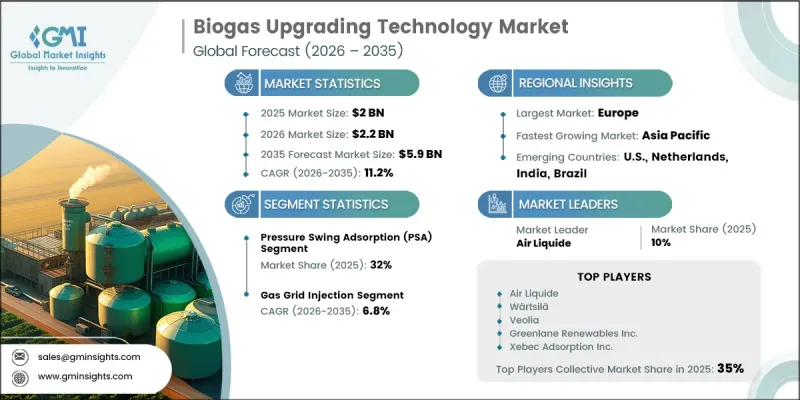
The Global Biogas Upgrading Technology Market was valued at USD 2 billion in 2025 and is estimated to grow at a CAGR of 11.2% to reach USD 5.9 billion.
Growth in the biogas upgrading technology market is fueled by evolving technology adoption patterns and expanding deployment across new geographic markets. Governments across Europe, North America, and selected Asia-Pacific countries are implementing renewable gas targets and biomethane production mandates that are creating long-term demand for upgrading capacity. These policy initiatives are reducing commercial uncertainty for project developers while encouraging investment throughout the value chain, including upgrading equipment and system installations. In addition, the increasing integration of carbon credit mechanisms, renewable gas certification systems, and corporate sustainability commitments is generating additional revenue opportunities for project operators. Enhanced revenue visibility and stronger financial returns are improving project viability, supporting greater capital investment in both medium- and large-scale biomethane upgrading facilities. As renewable energy adoption continues to accelerate globally, the biogas upgrading technology market is expected to benefit from sustained demand and favorable regulatory conditions throughout the forecast period.
| Market Scope | |
|---|---|
| Start Year | 2025 |
| Forecast Year | 2026-2035 |
| Start Value | $2 Billion |
| Forecast Value | $5.9 Billion |
| CAGR | 11.2% |
The pressure swing adsorption (PSA) segment held a 32% share in 2025 and is projected to grow at a CAGR of 8.9% through 2035. This technology separates carbon dioxide from methane through cyclical pressure-based processes utilizing specialized adsorption materials, enabling methane purity levels ranging from 96% to 99% without the use of chemical additives. PSA systems have achieved widespread adoption across biomethane production applications due to their operational reliability, scalability, and ability to deliver high-quality renewable gas output. Continued investment in efficient gas separation technologies is expected to support the segment's strong position within the global market.
The gas grid injection segment held a 39.7% share in 2025, advancing at a CAGR of 6.8% during 2026-2035. This application involves upgrading raw biogas into biomethane that meets required quality standards for integration into natural gas transmission and distribution networks. Supportive regulatory frameworks, favorable network access policies, and incentive programs have encouraged widespread adoption of grid injection projects. As a result, this pathway has become the preferred commercial route for many large-scale biomethane production facilities seeking stable long-term market opportunities.
North America Biogas Upgrading Technology Market accounted for 22% share in 2025 and is projected to grow at a CAGR of 11.5% through 2035. Regional market growth is being supported by renewable fuel policies, increasing investment in low-carbon energy infrastructure, and expanding demand for renewable natural gas. Incentive programs designed to promote renewable fuel production continue to improve project economics and encourage the development of upgrading facilities. The region's strong focus on emissions reduction, energy diversification, and sustainable fuel alternatives is expected to sustain investment momentum and reinforce market growth over the coming decade.
Major companies operating in the global biogas upgrading technology market include Air Liquide, Greenlane Renewables Inc., Pentair plc, Kanadevia Inova AG, DMT Clear Gas Solutions LLC, EnviTec Biogas, Bright Renewables, Malmberg Group, CarboTech AC GmbH, Evonik Industries, and Wartsila. Companies operating in the biogas upgrading technology market are focusing on innovation, strategic partnerships, and geographic expansion to strengthen their competitive position. Significant investments in research and development are enabling market participants to improve upgrading efficiency, enhance methane recovery rates, and reduce operating costs. Many companies are expanding their product portfolios with advanced and scalable solutions designed to meet diverse project requirements. Strategic collaborations with renewable energy developers, utilities, and industrial stakeholders are helping accelerate project deployment and broaden market reach. Firms are also strengthening service capabilities through long-term maintenance agreements, technical support programs, and digital monitoring solutions.
Table of Contents
Chapter 1 Methodology & Scope
- 1.1 Research approach
- 1.2 Quality commitments
- 1.2.1 GMI AI policy & data integrity commitment
- 1.2.1.1 Source consistency protocol
- 1.2.1 GMI AI policy & data integrity commitment
- 1.3 Research trail & confidence scoring
- 1.3.1 Research trail components
- 1.3.2 Scoring components
- 1.4 Data collection
- 1.4.1 Partial list of primary sources
- 1.5 Data mining sources
- 1.5.1 Paid sources
- 1.5.1.1 Sources, by region
- 1.5.1 Paid sources
- 1.6 Base estimates and calculations
- 1.6.1 Base year calculation for any one approach
- 1.7 Market estimates & forecasts parameters
- 1.8 Forecast model
- 1.8.1 Quantified market impact analysis
- 1.8.1.1 Mathematical impact of growth parameters on forecast
- 1.8.1 Quantified market impact analysis
- 1.9 Research transparency addendum
- 1.9.1 Source attribution framework
- 1.9.2 Quality assurance metrics
- 1.9.3 Our commitment to trust
- 1.10 Market definitions
Chapter 2 Executive Summary
- 2.1 Industry synopsis, 2022 - 2035
- 2.1.1 Business trends
- 2.1.2 Technology trends
- 2.1.3 Feedstock trends
- 2.1.4 Application trends
- 2.1.5 Regional trends
Chapter 3 Industry Insights
- 3.1 Industry ecosystem analysis
- 3.1.1 Feedstock & biogas production layer
- 3.1.2 Upgrading technology & equipment layer
- 3.1.3 Gas conditioning & compression layer
- 3.1.4 End-use & distribution layer
- 3.2 Regulatory landscape
- 3.3 Industry impact forces
- 3.3.1 Growth drivers
- 3.3.1.1 Tightening renewable energy mandates
- 3.3.1.2 Rising demand for biomethane as low-carbon fuel
- 3.3.1.3 Carbon credit programmes, green gas guarantees of origin & voluntary corporate decarbonization demand
- 3.3.2 Industry pitfalls and challenges
- 3.3.2.1 High capital intensity & extended payback periods
- 3.3.1 Growth drivers
- 3.4 Growth potential analysis
- 3.5 Porter's analysis
- 3.5.1 Bargaining power of suppliers
- 3.5.2 Bargaining power of buyers
- 3.5.3 Threat of new entrants
- 3.5.4 Threat of substitute
- 3.5.5 Intensity of competitive rivalry
- 3.6 PESTEL analysis
- 3.6.1 Political factors
- 3.6.2 Economic factors
- 3.6.3 Social factors
- 3.6.4 Technological factors
- 3.6.5 Environmental factors
- 3.6.6 Legal factors
- 3.7 Impact of AI and generative AI on the market (Driven by primary research)
- 3.7.1 AI-driven disruption of existing business model
- 3.7.2 GenAI use cases & adoption roadmap
- 3.7.3 Risks, limitations & regulatory considerations for AI in biogas operations
- 3.8 Investment & funding analysis (Driven by primary research)
- 3.8.1 Private equity & venture capital investment trends
- 3.8.2 Government grants, subsidies & incentive programmes
Chapter 4 Competitive Landscape, 2026
- 4.1 Introduction
- 4.2 Company market share analysis, by region, 2025
- 4.2.1 North America
- 4.2.2 Europe
- 4.2.3 Asia Pacific
- 4.2.4 Middle East & Africa
- 4.2.5 Latin America
- 4.3 Competitive analysis of major market players
- 4.4 Competitive positioning matrix
- 4.5 Key developments
- 4.5.1 Mergers & acquisitions
- 4.5.2 Partnerships & collaborations
- 4.5.3 New product launches
- 4.5.4 Expansion plans and funding
- 4.6 Company tier benchmarking
- 4.6.1 Tier classification criteria & qualifying thresholds
- 4.6.2 Tier positioning matrix by revenue, geography & innovation
Chapter 5 Market Size and Forecast, By Technology, 2022 - 2035 (USD Million)
- 5.1 Key trends
- 5.2 Water scrubbing
- 5.3 Chemical scrubbing
- 5.4 Pressure Swing Adsorption (PSA)
- 5.5 Membrane separation
- 5.6 Cryogenic separation
- 5.7 Others
Chapter 6 Market Size and Forecast, By Feedstock, 2022 - 2035 (USD Million)
- 6.1 Key trends
- 6.2 Agricultural residues & energy crops
- 6.3 Animal manure
- 6.4 Food & organic waste
- 6.5 Sewage sludge
- 6.6 Landfill gas
- 6.7 Others
Chapter 7 Market Size and Forecast, By Application, 2022 - 2035 (USD Million)
- 7.1 Key trends
- 7.2 Gas grid injection
- 7.3 Transportation fuel
- 7.4 Electricity & heat generation
- 7.5 Biomethane bottling & industrial use
- 7.6 Others
Chapter 8 Market Size and Forecast, By Region, 2022 - 2035 (USD Million)
- 8.1 Key trends
- 8.2 North America
- 8.2.1 U.S.
- 8.2.2 Canada
- 8.2.3 Mexico
- 8.3 Europe
- 8.3.1 Germany
- 8.3.2 UK
- 8.3.3 France
- 8.3.4 Netherlands
- 8.3.5 Italy
- 8.4 Asia Pacific
- 8.4.1 China
- 8.4.2 India
- 8.4.3 Japan
- 8.4.4 South Korea
- 8.4.5 Australia
- 8.5 Middle East & Africa
- 8.5.1 UAE
- 8.5.2 South Africa
- 8.6 Latin America
- 8.6.1 Brazil
- 8.6.2 Argentina
Chapter 9 Company Profiles
- 9.1 Air Liquide
- 9.2 Anaergia Inc.
- 9.3 Bio Energy
- 9.4 Bright Renewables
- 9.5 CarboTech AC GmbH
- 9.6 DMT Clear Gas Solutions LLC
- 9.7 Ennox Biogas Technology GmbH
- 9.8 EnviTec Biogas
- 9.9 Evonik Industries
- 9.10 FNX LNG
- 9.11 GMT Membrantechnik GmbH
- 9.12 Greenlane Renewables Inc.
- 9.13 Kanadevia Inova AG
- 9.14 Malmberg Group
- 9.15 Memsys GmbH
- 9.16 Pentair plc
- 9.17 Prodeval
- 9.18 Veolia
- 9.19 Wartsila
- 9.20 Xebec Adsorption Inc.

