PUBLISHER: Global Market Insights Inc. | PRODUCT CODE: 2083262

PUBLISHER: Global Market Insights Inc. | PRODUCT CODE: 2083262
Automation Testing Market Opportunity, Growth Drivers, Industry Trend Analysis, and Forecast 2026 - 2035
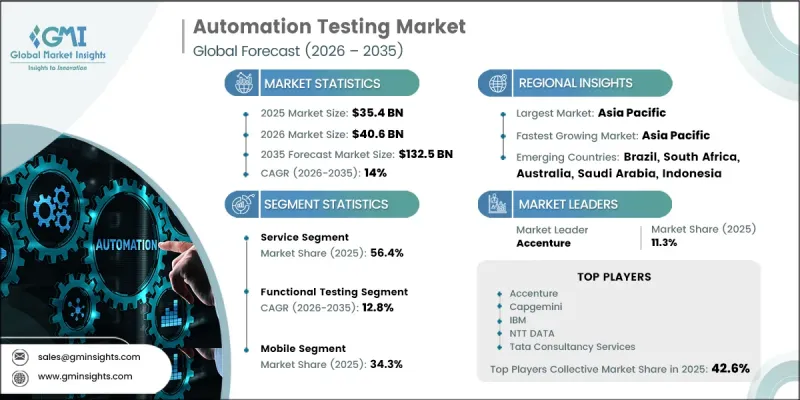
The Global Automation Testing Market was valued at USD 35.4 billion in 2025 and is estimated to grow at a CAGR of 14% to reach USD 132.5 billion in 2035.
The growth momentum is being driven by the increasing integration of automated testing frameworks directly into CI/CD pipelines, enabling continuous validation across development, integration, and deployment stages. Organizations are increasingly deploying cloud-native testing platforms that support scalable execution environments, cross-browser validation, and multi-device testing capabilities, which is significantly improves software release efficiency. Artificial intelligence and machine learning advancements are further transforming the landscape by enabling intelligent test case creation, predictive defect detection, and self-maintaining test scripts that reduce operational overhead. Across industries, automation testing is being widely adopted in banking, financial services, insurance, retail, healthcare, telecom, and IT services to improve software reliability, security, and release speed in highly dynamic digital environments.
| Market Scope | |
|---|---|
| Start Year | 2025 |
| Forecast Year | 2026-2035 |
| Start Value | $35.4 Billion |
| Forecast Value | $132.5 Billion |
| CAGR | 14% |
The functional testing segment accounted for 58.6% share in 2025 and is expected to grow at a CAGR of 12.8% through 2035. This category includes unit testing, system testing, integration testing, smoke testing, and regression testing, all designed to validate that software functions operate in accordance with predefined requirements. Its strong market position is supported by the need for continuous verification of application logic throughout the software development lifecycle. Organizations are increasingly automating these testing processes to enable earlier defect identification, faster feedback cycles, and improved overall development efficiency.
The IT & telecom segment held 26.3% share in 2025, driven by large-scale application development environments, frequent software releases, and highly complex distributed systems. Enterprises in this sector rely heavily on automation testing to validate APIs, cloud-native platforms, applications, and networked infrastructure while ensuring performance stability under high user demand conditions.
China Automation Testing Market held a 41.6% share in 2025, generating USD 3.6 billion. The country's dominance is supported by the rapid expansion of its digital economy, extensive enterprise software development activity, and strong adoption of DevOps and CI/CD methodologies across industries such as financial services, telecommunications, e-commerce, and manufacturing. Organizations across the region are increasingly adopting automated quality assurance frameworks to support faster deployment cycles and large-scale digital transformation initiatives.
Key players involved in the global automation testing market are Accenture, Capgemini, IBM, Tata Consultancy Services (TCS), Infosys, Cognizant, Wipro, HCL Technologies, NTT DATA, and Tech Mahindra are among the key companies operating in the automation testing market. Key strategies adopted by companies in the market focus on strengthening AI-driven testing capabilities that enhance predictive analytics, intelligent test generation, and self-healing automation frameworks. Firms are expanding cloud-based testing platforms to improve scalability, remote accessibility, and distributed execution efficiency. Strategic investments are being made in CI/CD integration tools that enable seamless embedding of testing within development pipelines. Companies are also enhancing partnerships with enterprise clients to deliver customized automation frameworks tailored to industry-specific workflows. In addition, mergers and acquisitions are being used to expand technology portfolios and strengthen geographic reach. Continuous R&D investments are improving support for cross-platform and multi-device testing, while training and consulting services are being expanded to help enterprises accelerate automation adoption and optimize software delivery performance.
Table of Contents
Chapter 1 Research Methodology
- 1.1 Research approach
- 1.2 Quality Commitments
- 1.2.1 GMI AI policy & data integrity commitment
- 1.2.1.1 Source consistency protocol
- 1.2.1 GMI AI policy & data integrity commitment
- 1.3 Research Trail & Confidence Scoring
- 1.3.1 Research Trail Components
- 1.3.2 Scoring Components
- 1.4 Data Collection
- 1.4.1 Partial list of primary sources
- 1.5 Data mining sources
- 1.5.1 Paid sources
- 1.5.1.1 Sources, by region
- 1.5.1 Paid sources
- 1.6 Base estimates and calculations
- 1.6.1 Base year calculation for any one approach
- 1.7 Forecast model
- 1.7.1 Quantified market impact analysis
- 1.7.1.1 Mathematical impact of growth parameters on forecast
- 1.7.1 Quantified market impact analysis
- 1.8 Research transparency addendum
- 1.8.1 Source attribution framework
- 1.8.2 Quality assurance metrics
- 1.8.3 Our commitment to trust
Chapter 2 Executive Summary
- 2.1 Industry 360° synopsis, 2022 - 2035
- 2.2 Key market trends
- 2.2.1 Regional
- 2.2.2 Component
- 2.2.3 Testing Type
- 2.2.4 End point
- 2.2.5 Organization size
- 2.2.6 End Use
- 2.3 TAM Analysis, 2026-2035
- 2.4 CXO perspectives: Strategic imperatives
Chapter 3 Industry Insights
- 3.1 Industry ecosystem analysis
- 3.1.1 Supplier landscape
- 3.1.2 Profit margin analysis
- 3.1.3 Cost structure
- 3.1.4 Value addition at each stage
- 3.1.5 Factor affecting the value chain
- 3.1.6 Disruptions
- 3.2 Industry impact forces
- 3.2.1 Growth drivers
- 3.2.1.1 Increasing adoption of DevOps and CI/CD
- 3.2.1.2 Growing demand for faster time-to-market
- 3.2.1.3 Rising complexity of applications
- 3.2.1.4 Need for improved software quality and reliability
- 3.2.2 Industry pitfalls and challenges
- 3.2.2.1 High initial implementation costs
- 3.2.2.2 Lack of skilled professionals
- 3.2.2.3 Tool integration complexities
- 3.2.2.4 Maintenance of automated test scripts
- 3.2.3 Market opportunities
- 3.2.3.1 Growth in shift-right testing and production monitoring
- 3.2.3.2 Increasing demand for performance and scalability testing
- 3.2.3.3 Adoption of test automation in cybersecurity testing
- 3.2.3.4 Expansion of mobile and cross-platform application testing
- 3.2.1 Growth drivers
- 3.3 Growth potential analysis
- 3.4 Pricing Analysis (Driven by Primary Research)
- 3.4.1 Historical Price Trend Analysis
- 3.4.2 Pricing Strategy by Player Type
- 3.5 Cost breakdown analysis
- 3.6 Regulatory landscape
- 3.6.1 North America
- 3.6.1.1 U.S.: NIST Secure Software Development Framework (SSDF) SP 800-218
- 3.6.1.2 Canada: Personal Information Protection and Electronic Documents Act (PIPEDA)
- 3.6.2 Europe
- 3.6.2.1 Germany: EU General Data Protection Regulation (GDPR)
- 3.6.2.2 France: EU General Data Protection Regulation (GDPR)
- 3.6.2.3 United Kingdom: UK GDPR & Data Protection Act 2018
- 3.6.3 Asia Pacific
- 3.6.3.1 China: Cybersecurity Law (CSL) of the People's Republic of China
- 3.6.3.2 India: Digital Personal Data Protection (DPDP) Act, 2023
- 3.6.3.3 Japan: Act on the Protection of Personal Information (APPI)
- 3.6.4 Latin America
- 3.6.4.1 Brazil: Lei Geral de Protecao de Dados (LGPD)
- 3.6.5 Middle East and Africa
- 3.6.5.1 UAE: Federal Personal Data Protection Law (PDPL) - Federal Decree-Law No. 45 of 2021
- 3.6.1 North America
- 3.7 Porter's analysis
- 3.8 PESTEL analysis
- 3.9 Technology and Innovation Landscape
- 3.9.1 Current technological trends
- 3.9.2 Emerging technologies
- 3.9.2.1 AI-driven test automation
- 3.9.2.2 Machine learning-based testing
- 3.9.2.3 Robotic Process Automation (RPA)
- 3.9.2.4 Low-code/No-code testing platforms
- 3.10 Patent analysis (Driven by Primary Research)
- 3.11 Cost breakdown analysis
- 3.12 Impact of AI & Generative AI on the Market (Driven by Primary Research)
- 3.12.1 AI-Driven Disruption of Existing Business Models
- 3.12.2 GenAI Use Cases & Adoption Roadmap by Segment
- 3.12.3 Risks, Limitations & Regulatory Considerations
- 3.13 Sustainability and environmental aspects
- 3.13.1 Sustainable practices
- 3.13.2 Waste reduction strategies
- 3.13.3 Energy efficiency in production
- 3.13.4 Eco-friendly initiatives
- 3.13.5 Carbon footprint considerations
- 3.14 Forecast assumptions & scenario analysis (Driven by Primary Research)
- 3.14.1 Base Case- Key Macro & Industry Variables Driving CAGR
- 3.14.2 Optimistic Scenarios- Favorable macro and industry tailwinds
- 3.14.3 Pessimistic Scenario - Macroeconomic slowdown or industry headwinds
Chapter 4 Competitive Landscape, 2025
- 4.1 Introduction
- 4.2 Company market share analysis
- 4.2.1 North America
- 4.2.2 Europe
- 4.2.3 Asia Pacific
- 4.2.4 LATAM
- 4.2.5 MEA
- 4.3 Competitive analysis of major market players
- 4.4 Competitive positioning matrix
- 4.5 Key developments
- 4.5.1 Mergers & acquisitions
- 4.5.2 Partnerships & collaborations
- 4.5.3 New Product Launches
- 4.5.4 Expansion Plans and funding
- 4.6 Company tier benchmarking
- 4.6.1 Tier classification criteria & qualifying thresholds
- 4.6.2 Tier positioning matrix by revenue, geography & innovation
Chapter 5 Market Estimates & Forecast, By Component, 2022 - 2035 (USD Bn)
- 5.1 Key trends
- 5.2 Software
- 5.2.1 API Testing Tools
- 5.2.2 Performance Testing Tools
- 5.2.3 Test Management Platforms
- 5.2.4 Code Quality & Static Analysis Tools
- 5.2.5 AI-Native & Intelligent Test Automation Platforms
- 5.2.6 Others
- 5.3 Service
- 5.3.1 Advisory & consulting
- 5.3.2 Planning & development
- 5.3.3 Support & maintenance
- 5.3.4 Documentation & training
- 5.3.5 Implementation
- 5.3.6 Managed
Chapter 6 Market Estimates & Forecast, By Testing Type, 2022 - 2035 (USD Bn)
- 6.1 Key trends
- 6.2 Functional testing
- 6.2.1 Static testing
- 6.2.2 Dynamic testing
- 6.3 Non-functional testing
- 6.3.1 Performance Testing
- 6.3.2 Security Testing
- 6.3.3 Accessibility Testing
- 6.3.4 Compatibility Testing
- 6.3.5 Usability Testing
Chapter 7 Market Estimates & Forecast, By End Point, 2022 - 2035 (USD Bn)
- 7.1 Key trends
- 7.2 Mobile
- 7.3 Web
- 7.4 Desktop
- 7.5 Cloud-Native & API Testing
- 7.6 Embedded software
Chapter 8 Market Estimates & Forecast, By Organization size, 2022 - 2035 (USD Bn)
- 8.1 Key trends
- 8.2 Large Enterprises
- 8.3 Small & Medium Enterprises (SMEs)
Chapter 9 Market Estimates & Forecast, By End use, 2022 - 2035 (USD Bn)
- 9.1 Key trends
- 9.2 IT & Telecom
- 9.3 BFSI
- 9.4 Healthcare
- 9.5 Manufacturing
- 9.6 Retail & E-commerce
- 9.7 Transportation & Logistics
- 9.8 Government & Public Sector
- 9.9 Automotive
- 9.10 Consumer Electronics & Media
- 9.11 Others
Chapter 10 Market Estimates & Forecast, By Region, 2022 - 2035 (USD Bn)
- 10.1 Key trends
- 10.2 North America
- 10.2.1 US
- 10.2.2 Canada
- 10.3 Europe
- 10.3.1 Germany
- 10.3.2 UK
- 10.3.3 France
- 10.3.4 Italy
- 10.3.5 Spain
- 10.3.6 Russia
- 10.3.7 Norway
- 10.3.8 Netherlands
- 10.3.9 Sweden
- 10.4 Asia Pacific
- 10.4.1 China
- 10.4.2 India
- 10.4.3 Japan
- 10.4.4 Australia
- 10.4.5 South Korea
- 10.4.6 Singapore
- 10.4.7 Thailand
- 10.4.8 Indonesia
- 10.4.9 Vietnam
- 10.5 Latin America
- 10.5.1 Brazil
- 10.5.2 Mexico
- 10.5.3 Argentina
- 10.6 MEA
- 10.6.1 South Africa
- 10.6.2 Saudi Arabia
- 10.6.3 UAE
- 10.6.4 Turkey
Chapter 11 Company Profiles
- 11.1 Global Players
- 11.1.1 Accenture
- 11.1.2 Capgemini
- 11.1.3 Cognizant
- 11.1.4 IBM
- 11.1.5 Infosys
- 11.1.6 Tata Consultancy Services
- 11.1.7 NTT DATA
- 11.1.8 HCLTech
- 11.1.9 Wipro
- 11.1.10 Deloitte
- 11.2 Regional players
- 11.2.1 Cigniti Technologies
- 11.2.2 Qualitest
- 11.2.3 Testlio
- 11.2.4 QASource
- 11.2.5 Abstracta
- 11.3 Emerging players
- 11.3.1 BrowserStack
- 11.3.2 LambdaTest
- 11.3.3 Sauce Labs
- 11.3.4 Katalon
- 11.3.5 Testsigma

