PUBLISHER: Mordor Intelligence | PRODUCT CODE: 2116851

PUBLISHER: Mordor Intelligence | PRODUCT CODE: 2116851
US Buy Now Pay Later Services - Market Share Analysis, Industry Trends & Statistics, Growth Forecasts (2026 - 2031)
According to Mordor Intelligence, the buy now, pay later (BNPL) services market size in the United States was valued at USD 170.32 billion in 2025 and estimated to grow from USD 198.21 billion in 2026 to reach USD 423.08 billion by 2031, at a CAGR of 16.39% during the forecast period (2026-2031).
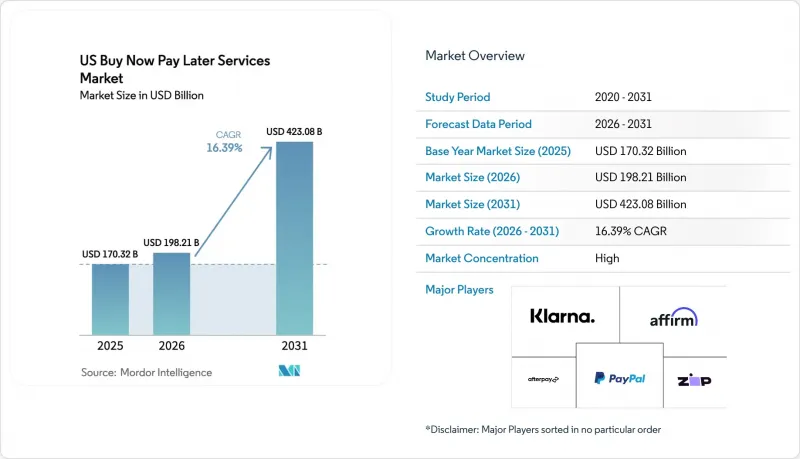
This report is Segmented by Channel (Online and POS), End User Type (Consumer Electronics, Fashion & Apparel, Healthcare and Wellness, Home Improvement, and More), Age Group (Generation Z, Millennials, Generation X, and More), and Provider (Fintechs, Banks, Others). The Market Forecasts are Provided in Terms of Value (USD).
US Buy Now Pay Later Services Market Trends and Insights
Increasing Millennial & Gen Z Preference for Interest-Free Short-Term Credit
Close to 46% of Gen Z consumers used a BNPL option in 2025, nearly doubling their 2023 participation. Short-term installment plans align with young adults' budgeting style, which values predictable repayment schedules and zero-interest costs over revolving balances. Eighty-one percent of Gen Z customers state they will abandon brands that provide poor payment experiences, underscoring the competitive stakes for merchants. The same cohort also ranks payment flexibility as critical in business relationships, signaling spill-over effects into B2B commerce. As Gen Z's earnings rise, their entrenched preference for BNPL is likely to steer broader payment behavior for decades.
Expansion into Non-Retail Verticals such as Healthcare & Travel
Rising out-of-pocket medical expenses have turned healthcare into the fastest-growing vertical for BNPL. Sunbit, for example, partners with roughly 7,300 healthcare providers to fund treatments valued between USD 60 and USD 10,000. Travel has mirrored this momentum, registering a 289% jump in BNPL booking volume in 2024. Consumers using installments spend 70% more per trip, lifting airline, hotel, and OTA revenues. By catering to essential and high-ticket purchases, BNPL platforms diversify revenue beyond discretionary retail and mitigate cyclicality.
Escalating CFPB & State-Level Regulatory Scrutiny on Fee Structures
In May 2024, the Consumer Financial Protection Bureau (CFPB) classified certain digital BNPL loans as "credit cards" under Regulation Z, compelling providers to handle disputes, refunds, and billing statements similarly to card issuers. Although the CFPB announced in April 2025 that it would not prioritize enforcement while reviewing the rule, providers still face compliance investments and potential state-level measures such as New York's proposed Buy Now Pay Later Act. Smaller firms may struggle with added costs, quickening consolidation.
Other drivers and restraints analyzed in the detailed report include:
- Deep Integration with Digital Wallets and POS Systems Boosting Merchant Adoption
- Strategic Partnerships with Major Card Networks Enhancing Distribution Reach
- Rising Delinquency Rates Impacting Provider Profitability
For complete list of drivers and restraints, kindly check the Table Of Contents.
Segment Analysis
The BNPL market size for online commerce totaled 71.35% revenue share in 2025. In-store usage, however, is growing faster at a 19.15% CAGR through 2031, signaling merchants' push to mirror digital flexibility on the sales floor. Retailers deploying unified checkout flows report double-digit conversion gains as shoppers opt for installments on high-ticket items. Hardware integrations with major payment processors simplify rollouts, yet continued user education is required to lift in-aisle visibility.
Omnichannel solutions allow customers to pre-qualify via mobile apps and complete transactions at staffed lanes or self-checkout. The practice is particularly popular in consumer electronics and furniture showrooms where financing decisions occur near physical inventory. The BNPL market stands to capitalize on blended journeys as shoppers browse online, reserve products, and conclude purchases in store. Bridging channels also serves older demographics that prefer brick-and-mortar environments but welcome flexible pay options.
Fashion and apparel retained a 27.85% share of the BNPL market size in 2025. Healthcare is expected to surpass other verticals with a 19.88% CAGR to 2031 on the back of rising medical deductibles and elective-care demand. Sunbit's network of 7,300 dental and medical offices showcases early traction. High-value travel bookings follow closely, benefiting airlines and OTAs that see ticket sizes jump once installments appear at checkout.
Broadening into non-retail arenas stabilizes volume during retail cycles. Home improvement chains are integrating BNPL for appliance replacements and renovation projects, while streaming and gaming brands use installments to lower subscription churn. Such diversification reduces reliance on discretionary apparel spend and positions providers in sectors with structural financing needs.
Complete Report Scope:
- By Channel
- Online
- Point-of-Sale (In-store)
- By End-Use Industry
- Consumer Electronics
- Fashion & Apparel
- Healthcare & Wellness
- Home Improvement
- Travel & Leisure
- Media & Entertainment
- Other End-Use Industries
- By Age Group
- Generation Z (18-28 Years)
- Millennials (29-44 Years)
- Generation X (45-60 Years)
- Baby Boomers (61-79 Years)
- Silent Generation (80 Years and Above)
- By Provider
- Fintechs
- Banks
- Others
List of Companies Covered in this Report:
- Affirm Holdings Inc.
- Klarna Bank AB
- Afterpay Ltd (Block Inc.)
- PayPal Holdings Inc.
- Zip Co Ltd (Quadpay)
- Sezzle Inc.
- Wisetack Inc.
- Splitit Payments Ltd
- Bread Financial Holdings Inc. (Bread Pay)
- Uplift Inc.
- Katapult Holdings Inc.
- Sunbit Inc.
- ChargeAfter Inc.
- Mastercard Inc. (Mastercard Installments)
- Visa Inc. (Visa Installments)
- American Express Co. (Plan It)
- JPMorgan Chase & Co. (My Chase Plan)
- Synchrony Financial (SetPay)
- Citi (Flex Pay)
- Zilch USA Inc.
Additional Benefits:
- The market estimate (ME) sheet in Excel format
- 3 months of analyst support
TABLE OF CONTENTS
1 Introduction
- 1.1 Study Assumptions & Market Definition
- 1.2 Scope of the Study
2 Research Methodology
3 Executive Summary
4 Market Landscape
- 4.1 Market Overview
- 4.2 Market Drivers
- 4.2.1 Increasing Millennial & Gen Z Preference for Interest-Free Short-Term Credit
- 4.2.2 Expansion into Non-Retail Verticals such as Healthcare & Travel
- 4.2.3 Deep Integration with Digital Wallets and POS Systems Boosting Merchant Adoption
- 4.2.4 Strategic Partnerships with Major Card Networks Enhancing Distribution Reach
- 4.2.5 Rising Demand from Sub-prime and Near-prime Consumers Excluded from Traditional Credit Cards Accelerating BNPL Penetration
- 4.3 Market Restraints
- 4.3.1 Escalating CFPB & State-Level Regulatory Scrutiny on Fee Structures
- 4.3.2 Rising Delinquency Rates Impacting Provider Profitability
- 4.3.3 Intensifying Competition from Traditional Card Issuers' Instalment Products
- 4.3.4 Shrinking Merchant Service Fees Are Squeezing BNPL Providers' Profit Margins
- 4.4 Value / Supply-Chain Analysis
- 4.5 Regulatory Outlook
- 4.6 Technological Outlook
- 4.7 Porter's Five Forces Analysis
- 4.7.1 Threat of New Entrants
- 4.7.2 Bargaining Power of Buyers
- 4.7.3 Bargaining Power of Suppliers
- 4.7.4 Threat of Substitutes
- 4.7.5 Competitive Rivalry
5 Market Size & Growth Forecasts (Value)
- 5.1 By Channel
- 5.1.1 Online
- 5.1.2 Point-of-Sale (In-store)
- 5.2 By End-Use Industry
- 5.2.1 Consumer Electronics
- 5.2.2 Fashion & Apparel
- 5.2.3 Healthcare & Wellness
- 5.2.4 Home Improvement
- 5.2.5 Travel & Leisure
- 5.2.6 Media & Entertainment
- 5.2.7 Other End-Use Industries
- 5.3 By Age Group
- 5.3.1 Generation Z (18-28 Years)
- 5.3.2 Millennials (29-44 Years)
- 5.3.3 Generation X (45-60 Years)
- 5.3.4 Baby Boomers (61-79 Years)
- 5.3.5 Silent Generation (80 Years and Above)
- 5.4 By Provider
- 5.4.1 Fintechs
- 5.4.2 Banks
- 5.4.3 Others
6 Competitive Landscape
- 6.1 Market Concentration
- 6.2 Strategic Moves
- 6.3 Market Share Analysis
- 6.4 Company Profiles (includes Global level Overview, Market level overview, Core Segments, Financials as available, Strategic Information, Market Rank/Share for key companies, Products & Services, and Recent Developments)
- 6.4.1 Affirm Holdings Inc.
- 6.4.2 Klarna Bank AB
- 6.4.3 Afterpay Ltd (Block Inc.)
- 6.4.4 PayPal Holdings Inc.
- 6.4.5 Zip Co Ltd (Quadpay)
- 6.4.6 Sezzle Inc.
- 6.4.7 Wisetack Inc.
- 6.4.8 Splitit Payments Ltd
- 6.4.9 Bread Financial Holdings Inc. (Bread Pay)
- 6.4.10 Uplift Inc.
- 6.4.11 Katapult Holdings Inc.
- 6.4.12 Sunbit Inc.
- 6.4.13 ChargeAfter Inc.
- 6.4.14 Mastercard Inc. (Mastercard Installments)
- 6.4.15 Visa Inc. (Visa Installments)
- 6.4.16 American Express Co. (Plan It)
- 6.4.17 JPMorgan Chase & Co. (My Chase Plan)
- 6.4.18 Synchrony Financial (SetPay)
- 6.4.19 Citi (Flex Pay)
- 6.4.20 Zilch USA Inc.
7 Market Opportunities & Future Outlook
- 7.1 White-space & Unmet-Need Assessment

