PUBLISHER: Mordor Intelligence | PRODUCT CODE: 2116578

PUBLISHER: Mordor Intelligence | PRODUCT CODE: 2116578
Middle East And Africa Buy Now Pay Later Services - Market Share Analysis, Industry Trends & Statistics, Growth Forecasts (2026 - 2031)
According to Mordor Intelligence, the Middle East and Africa BNPL market size was valued at USD 24.93 billion in 2025 and estimated to grow from USD 29.28 billion in 2026 to reach USD 65.39 billion by 2031, at a CAGR of 17.45% during the forecast period (2026-2031).
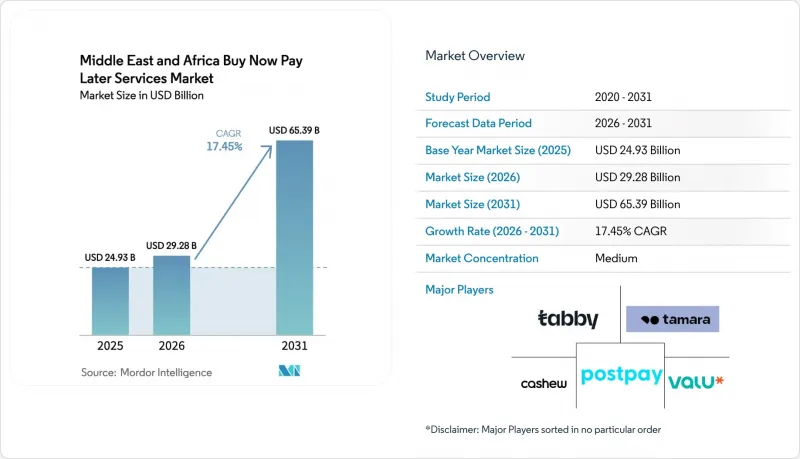
This report is Segmented by Channel (Online and POS), by End-Use Industry (Consumer Electronics, Fashion & Apparel, and More), by Age Group (Generation Z, Millennials, and More), by Provider (Fintechs, Banks, and Others), and by Country (United Arab Emirates, Saudi Arabia, and More). The Market Forecasts are Provided in Terms of Value (USD).
Middle East And Africa Buy Now Pay Later Services Market Trends and Insights
Regulatory Sandboxes & Licensing in KSA & UAE Catalysing BNPL Scale
The Saudi Central Bank issued detailed BNPL rules in December 2023 that formalised capital thresholds and consumer safeguards, prompting investors to fund scale-ups and helping players such as Tamara secure full consumer-finance licences in March 2025. The Central Bank of the UAE followed with revised Finance Companies Regulation in January 2025, allowing Restricted Licence Finance Companies to offer short-term instalment products under clear prudential oversight. These frameworks anchor long-term confidence, create disciplined entry paths for newcomers, and encourage cross-border passporting across the wider GCC. The net effect is a maturing credit alternative that attracts partnerships with banks and global payment processors, driving broader merchant acceptance and deeper consumer trust.
Smartphone Penetration in GCC Fuelling App-based Checkout
Mobile subscriptions exceed population totals in most GCC states, and this ubiquity lets BNPL apps embed directly into retail journeys. Providers optimise for one-tap approval, personalised instalment schedules and loyalty integration, shrinking checkout friction and lifting merchant conversion. Continuous 5G rollout expands bandwidth for richer app experiences, while biometric ID lets new users onboard in minutes. The result is a feedback loop: as mobile commerce climbs, BNPL volumes soar, which in turn nudges more merchants to enable the option across both web and store environments.
Rising Default Rates amid Inflation in Africa
Currency depreciation and higher food prices reduce disposable income, straining borrowers' repayment capacity. Nigerian providers report elevated delinquencies, especially among first-time borrowers. Firms recalibrate scorecards by incorporating macro indicators and sector exposures, which slows approval speed and dampens customer acquisition. Some shift toward secured offers, such as smartphone-backed loans, to preserve asset recovery options. Over time, inflation moderation and richer credit-bureau data should restore growth momentum, but the near-term effect trims overall expansion.
Other drivers and restraints analyzed in the detailed report include:
- Youth-Dominated Demographics Driving Micro-ticket E-commerce Credit
- Merchant Conversion Gains in Fashion & Electronics Boosting Adoption
- Tighter Compliance Costs under 2024 SAMA / UAE Rules
For complete list of drivers and restraints, kindly check the Table Of Contents.
Segment Analysis
Online transactions represented 78.12% of the Middle East and Africa BNPL market share in 2025, supported by frictionless web and in-app integration that aligns with the e-commerce boom. Merchants embrace dynamic instalment messaging to trim abandonment, while gateway providers bundle BNPL buttons alongside cards and wallets. Cross-border platforms funnel regional shoppers onto GCC websites, extending reach for local BNPL offers. The integration of real-time open-banking data further streamlines online risk checks, strengthening approval rates without manual review.
Point-of-sale solutions are projected to grow at 19.65% CAGR, closing the gap as retailers seek seamless omnichannel experiences. Near-field communication, QR codes, and cloud-based POS systems now let sales associates trigger BNPL approvals in seconds. Partnerships such as Checkout.com with Tabby embed the option directly into POS terminals, unlocking physical-store categories like furniture and groceries. As a result, the Middle East and Africa BNPL market size for in-store transactions is expected to multiply through 2031, reflecting consumer demand for payment consistency across all shopping contexts.
Fashion and apparel accounted for 32.85% of the Middle East and Africa BNPL market size in 2025, benefiting from frequent purchase cycles and aspirational buyers. Retailers leverage instalments to upsell premium lines and encourage multi-item baskets, while BNPL apps feature fashion-centric discovery feeds that channel traffic back to merchant sites. Seasonal campaigns around Ramadan and Black Friday amplify volumes, making fashion the bellwether category for new feature rollouts such as instant refunds on returns.
Healthcare and wellness spend is forecast to grow fastest at 21.22% CAGR as consumers embrace instalments for elective surgery, dental work, and preventive packages. Saudi Arabia's push to develop medical tourism under Vision 2030 widens the addressable demand. Providers tailor longer-tenure plans that fit treatment schedules and partner with clinics for on-site sign-ups. These dynamics position healthcare to narrow the volume gap with fashion by decade-end and diversify revenue beyond discretionary retail.
Complete Report Scope:
- By Channel
- Online
- Point-of-Sale (In-store)
- By End-Use Industry
- Consumer Electronics
- Fashion & Apparel
- Healthcare & Wellness
- Home Improvement
- Travel & Leisure
- Media & Entertainment
- Other End-Use Industries
- By Age Group
- Generation Z (18-28 Years)
- Millennials (29-44 Years)
- Generation X (45-60 Years)
- Baby Boomers (61-79 Years)
- Silent Generation (80 Years and Above)
- By Provider
- Fintechs
- Banks
- Others
- By Country
- United Arab Emirates
- Saudi Arabia
- Qatar
- Kuwait
- Oman
- Bahrain
- Egypt
- South Africa
- Nigeria
- Rest of Middle East and Africa
List of Companies Covered in this Report:
- Tabby
- Tamara
- Postpay
- Cashew
- valU
- PayTabs
- Payflex
- PayJustNow
- CredPal
- Blnk
- Sympl
- Foodics
- M-Kopa
- Emirates NBD
- First Abu Dhabi Bank
- Mashreq NeoPay Later
- KCB Group
- JumiaPay
- Airtel Money
- Fawry Banking and Payment Technology Services
Additional Benefits:
- The market estimate (ME) sheet in Excel format
- 3 months of analyst support
TABLE OF CONTENTS
1 Introduction
- 1.1 Study Assumptions & Market Definition
- 1.2 Scope of the Study
2 Research Methodology
3 Executive Summary
4 Market Landscape
- 4.1 Market Overview
- 4.2 Market Drivers
- 4.2.1 Regulatory Sandboxes & Licensing in KSA & UAE Catalysing BNPL Scale
- 4.2.2 Smartphone Penetration in GCC Fuelling App-based Checkout
- 4.2.3 Youth-Dominated Demographics Driving Micro-ticket Ecommerce Credit
- 4.2.4 Merchant Conversion Gains in Fashion & Electronics Boosting Adoption
- 4.2.5 First-credit Access for Africa's Unbanked Population
- 4.2.6 Venture Funding Wave Accelerating Regional Expansion
- 4.3 Market Restraints
- 4.3.1 Rising Default Rates amid Inflation in Africa
- 4.3.2 Tighter Compliance Costs under 2024 SAMA / UAE BNPL Rules
- 4.3.3 Sparse Credit-Bureau Data Hindering Real-time Risk Scoring
- 4.3.4 High Merchant Discount Fees Limiting Adoption in Price-Sensitive Sectors
- 4.4 Value / Supply-Chain Analysis
- 4.5 Regulatory Outlook
- 4.6 Technological Outlook
- 4.7 Porter's Five Forces
- 4.7.1 Bargaining Power of Buyers
- 4.7.2 Bargaining Power of Suppliers
- 4.7.3 Threat of New Entrants
- 4.7.4 Threat of Substitutes
- 4.7.5 Competitive Rivalry
5 Market Size & Growth Forecasts (Value)
- 5.1 By Channel
- 5.1.1 Online
- 5.1.2 Point-of-Sale (In-store)
- 5.2 By End-Use Industry
- 5.2.1 Consumer Electronics
- 5.2.2 Fashion & Apparel
- 5.2.3 Healthcare & Wellness
- 5.2.4 Home Improvement
- 5.2.5 Travel & Leisure
- 5.2.6 Media & Entertainment
- 5.2.7 Other End-Use Industries
- 5.3 By Age Group
- 5.3.1 Generation Z (18-28 Years)
- 5.3.2 Millennials (29-44 Years)
- 5.3.3 Generation X (45-60 Years)
- 5.3.4 Baby Boomers (61-79 Years)
- 5.3.5 Silent Generation (80 Years and Above)
- 5.4 By Provider
- 5.4.1 Fintechs
- 5.4.2 Banks
- 5.4.3 Others
- 5.5 By Country
- 5.5.1 United Arab Emirates
- 5.5.2 Saudi Arabia
- 5.5.3 Qatar
- 5.5.4 Kuwait
- 5.5.5 Oman
- 5.5.6 Bahrain
- 5.5.7 Egypt
- 5.5.8 South Africa
- 5.5.9 Nigeria
- 5.5.10 Rest of Middle East and Africa
6 Competitive Landscape
- 6.1 Market Concentration
- 6.2 Strategic Moves
- 6.3 Market Share Analysis
- 6.4 Company Profiles (includes Global level Overview, Market level overview, Core Segments, Financials as available, Strategic Information, Market Rank/Share for key companies, Products & Services, and Recent Developments)
- 6.4.1 Tabby
- 6.4.2 Tamara
- 6.4.3 Postpay
- 6.4.4 Cashew
- 6.4.5 valU
- 6.4.6 PayTabs
- 6.4.7 Payflex
- 6.4.8 PayJustNow
- 6.4.9 CredPal
- 6.4.10 Blnk
- 6.4.11 Sympl
- 6.4.12 Foodics
- 6.4.13 M-Kopa
- 6.4.14 Emirates NBD
- 6.4.15 First Abu Dhabi Bank
- 6.4.16 Mashreq NeoPay Later
- 6.4.17 KCB Group
- 6.4.18 JumiaPay
- 6.4.19 Airtel Money
- 6.4.20 Fawry Banking and Payment Technology Services
7 Market Opportunities & Future Outlook
- 7.1 White-space & Unmet-need Assessment

