PUBLISHER: Global Market Insights Inc. | PRODUCT CODE: 2083367

PUBLISHER: Global Market Insights Inc. | PRODUCT CODE: 2083367
Biostimulants Market Opportunity, Growth Drivers, Industry Trend Analysis, and Forecast 2026 - 2035
The Global Biostimulants Market was valued at USD 3.9 billion in 2025 and is estimated to grow at a CAGR of 11.5% to reach USD 11.7 billion by 2035.
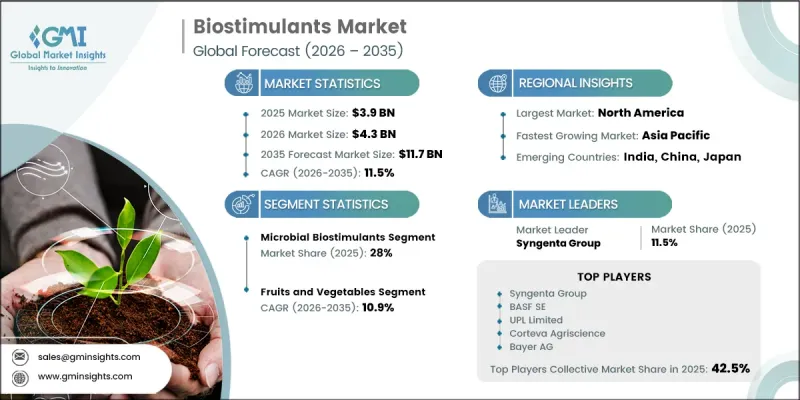
The growth trajectory positions the biostimulants market among the most rapidly expanding segments within the agricultural biologicals industry, significantly outperforming the growth rates observed across many conventional agricultural input categories. Market expansion reflects a broader transformation in crop nutrition and farm management strategies, with producers increasingly prioritizing resource efficiency, crop resilience, and biological enhancement over traditional input-intensive approaches. Growing concerns regarding soil degradation in highly cultivated agricultural regions, combined with evolving regulatory frameworks and increasing awareness of sustainable farming practices, continue to strengthen market demand. Furthermore, the expanding body of evidence demonstrating favorable economic returns from biostimulant applications across diverse crop systems is encouraging broader adoption. Sustainability initiatives throughout the agricultural value chain, together with rising demand for environmentally responsible production methods, are creating favorable market conditions and accelerating the integration of biological solutions into modern crop management programs worldwide.
| Market Scope | |
|---|---|
| Start Year | 2025 |
| Forecast Year | 2026-2035 |
| Start Value | $3.9 Billion |
| Forecast Value | $11.7 Billion |
| CAGR | 11.5% |
The microbial biostimulants segment accounted for 28% share in 2025. Market growth within this segment is driven by increasing recognition of the role beneficial microorganisms play in supporting plant development, nutrient utilization, root performance, and overall crop productivity. Microbial biostimulants function by enhancing biological activity within the soil and root environment, helping improve nutrient availability and promoting healthier plant growth. Rising interest in regenerative agriculture, sustainable crop production, and soil health management is further contributing to the expansion of this segment. As growers seek solutions that improve agricultural productivity while reducing environmental impact, microbial-based products continue to gain traction across a wide range of farming systems and crop categories.
The fruits and vegetables segment held a 55% share in 2025 and is projected to grow at a CAGR of 10.9% through 2035. The segment's strong market position reflects the substantial value growers place on improving crop quality, yield performance, appearance, storage stability, and overall marketability. Because multiple quality attributes directly influence commercial returns within fruit and vegetable production, producers are increasingly incorporating biostimulants into crop management programs to optimize plant performance throughout the growing cycle. The ability of biostimulants to support crop resilience under varying environmental conditions while enhancing productivity continues to drive adoption across intensive horticultural production systems globally. As demand for premium-quality produce increases, the fruit and vegetables segment is expected to remain a key contributor to market growth.
North America Biostimulants Market accounted for 17.8% share in 2025 and is anticipated to grow at a CAGR of 12.2% throughout 2035. The United States remains the primary contributor to regional demand, supported by increasing adoption of sustainable agricultural practices, expanding organic farming activities, and growing interest in biological crop enhancement solutions. The integration of advanced farming technologies is also improving the economic viability of biostimulant applications by enabling more precise crop management decisions. In addition, sustainability objectives established across agricultural supply chains are encouraging the use of environmentally responsible crop inputs, creating favorable conditions for continued market expansion across the region.
Leading companies operating in the Global Biostimulants Market include Syngenta Group, Acadian Seaplants Limited, Bayer AG, UPL Limited, Novonesis Group, BASF SE, Nufarm Limited, FMC Corporation, Koppert B.V., Qingdao Seawin Biotech Group, Sumitomo Chemical Co. Ltd., Valagro SpA, and Corteva Agriscience. Companies participating in the Biostimulants Market are implementing a variety of strategic initiatives to strengthen their competitive positions and expand market share. A major area of focus involves increasing investments in research and development to create innovative biological formulations with improved performance, broader crop applicability, and enhanced environmental sustainability. Strategic acquisitions, partnerships, and collaborations are enabling companies to expand product portfolios, accelerate technology development, and strengthen distribution networks. Market participants are also prioritizing geographic expansion into emerging agricultural regions where demand for sustainable farming solutions is increasing. In addition, companies are investing in farmer education programs, field validation studies, and agronomic support services to improve product awareness and adoption.
Table of Contents
Chapter 1 Methodology & Scope
- 1.1 Market scope and definition
- 1.2 Research design
- 1.2.1 Research approach
- 1.2.2 Data collection methods
- 1.3 Data mining sources
- 1.3.1 Global
- 1.3.2 Regional/Country
- 1.4 Base estimates and calculations
- 1.4.1 Base year calculation
- 1.4.2 Key trends for market estimation
- 1.5 Primary research and validation
- 1.5.1 Primary sources
- 1.6 Forecast model
- 1.7 Research assumptions and limitations
Chapter 2 Executive Summary
- 2.1 Industry 360° synopsis
- 2.2 Key market trends
- 2.2.1 Active Ingredient
- 2.2.2 Crop Type
- 2.2.3 Form
- 2.2.4 Application
- 2.2.5 Regional
- 2.3 TAM Analysis, 2026-2035
- 2.4 CXO perspectives: Strategic imperatives
- 2.5 Future outlook and strategic recommendations
Chapter 3 Industry Insights
- 3.1 Industry ecosystem analysis
- 3.1.1 Supplier landscape
- 3.1.2 Profit margin
- 3.1.3 Value addition at each stage
- 3.1.4 Factor affecting the value chain
- 3.1.5 Disruptions
- 3.2 Industry impact forces
- 3.2.1 Growth drivers
- 3.2.1.1 Rising demand for sustainable agricultural inputs
- 3.2.1.2 Improved crop yield through enhanced efficiency
- 3.2.1.3 Growing adoption in integrated farming systems
- 3.2.2 Industry pitfalls and challenges
- 3.2.2.1 Limited product awareness among small-scale farmers
- 3.2.2.2 Inconsistent performance across varying field conditions
- 3.2.3 Market opportunities
- 3.2.3.1 Expansion in organic farming practices globally
- 3.2.3.2 Innovation in microbial and seaweed formulations
- 3.2.3.3 Increasing adoption across emerging agricultural markets
- 3.2.1 Growth drivers
- 3.3 Growth potential analysis
- 3.4 Regulatory landscape
- 3.4.1 North America
- 3.4.2 Europe
- 3.4.3 Asia Pacific
- 3.4.4 Latin America
- 3.4.5 Middle East & Africa
- 3.5 Porter’s analysis
- 3.6 PESTEL analysis
- 3.7 Technology and innovation landscape
- 3.7.1 Current technological trends
- 3.7.2 Emerging technologies
- 3.8 Price trends
- 3.8.1 By region
- 3.8.2 By Active Ingredient
- 3.9 Future market trends
- 3.10 Patent landscape
- 3.11 Trade statistics (HS code)
- 3.11.1 Major importing countries
- 3.11.2 Major exporting countries
- 3.12 Sustainability and environmental aspects
- 3.12.1 Sustainable practices
- 3.12.2 Waste reduction strategies
- 3.12.3 Energy efficiency in production
- 3.12.4 Eco-friendly initiatives
- 3.13 Carbon footprint consideration
Chapter 4 Competitive Landscape, 2025
- 4.1 Introduction
- 4.2 Company market share analysis
- 4.2.1 By region
- 4.2.1.1 North America
- 4.2.1.2 Europe
- 4.2.1.3 Asia Pacific
- 4.2.1.4 LATAM
- 4.2.1.5 MEA
- 4.2.1 By region
- 4.3 Company matrix analysis
- 4.4 Competitive analysis of major market players
- 4.5 Competitive positioning matrix
- 4.6 Key developments
- 4.6.1 Mergers & acquisitions
- 4.6.2 Partnerships & collaborations
- 4.6.3 New product launches
- 4.6.4 Expansion plans
Chapter 5 Market Estimates and Forecast, By Active Ingredient, 2022-2035 (USD Million) (Kilo Tons)
- 5.1 Key trends
- 5.2 Microbial biostimulants
- 5.2.1 Plant growth-promoting rhizobacteria (PGPR)
- 5.2.1.1 Bacillus
- 5.2.1.2 Pseudomonas
- 5.2.1.3 Azospirillum
- 5.2.1.4 Rhizobium
- 5.2.2 Beneficial fungi
- 5.2.2.1 Arbuscular mycorrhizal fungi (AMF)
- 5.2.2.2 Trichoderma
- 5.2.2.3 Others
- 5.2.1 Plant growth-promoting rhizobacteria (PGPR)
- 5.3 Humic substances
- 5.3.1 Humic acid
- 5.3.2 Fulvic acid
- 5.4 Seaweed extracts
- 5.4.1 Brown algae
- 5.4.2 Ascophyllum nodosum
- 5.4.3 Ecklonia maxima
- 5.4.4 Other seaweed sources
- 5.5 Protein hydrolysates & amino acids
- 5.5.1 Plant-based protein hydrolysates
- 5.5.2 Animal-based protein hydrolysates
- 5.5.3 Free amino acids
- 5.6 Others
Chapter 6 Market Estimates and Forecast, By Crop Type, 2022-2035 (USD Million) (Kilo Tons)
- 6.1 Key trends
- 6.2 Row crops & cereals
- 6.2.1 Corn
- 6.2.2 Wheat
- 6.2.3 Rice
- 6.2.4 Soybean
- 6.2.5 Other cereals & grains
- 6.3 Fruits & vegetables
- 6.3.1 Pome fruits (Apples, Pears)
- 6.3.2 Citrus fruits
- 6.3.3 Berries
- 6.3.4 Root & tuber vegetables
- 6.3.5 Leafy vegetables
- 6.3.6 Other fruits & vegetables
- 6.4 Turf & ornamentals
- 6.4.1 Landscaping & golf courses
- 6.4.2 Ornamental plants & flowers
- 6.5 Others
Chapter 7 Market Estimates and Forecast, By Form, 2022-2035 (USD Million) (Kilo Tons)
- 7.1 Key trends
- 7.2 Liquid
- 7.3 Dry/Granules
Chapter 8 Market Estimates and Forecast, By Application, 2022-2035 (USD Million) (Kilo Tons)
- 8.1 Key trends
- 8.2 Foliar application
- 8.3 Soil application
- 8.4 Seed application
- 8.5 Others
Chapter 9 Market Estimates and Forecast, By Region, 2022-2035 (USD Million) (Kilo Tons)
- 9.1 Key trends
- 9.2 North America
- 9.2.1 U.S.
- 9.2.2 Canada
- 9.3 Europe
- 9.3.1 Germany
- 9.3.2 UK
- 9.3.3 France
- 9.3.4 Spain
- 9.3.5 Italy
- 9.3.6 Rest of Europe
- 9.4 Asia Pacific
- 9.4.1 China
- 9.4.2 India
- 9.4.3 Japan
- 9.4.4 Australia
- 9.4.5 South Korea
- 9.4.6 Rest of Asia Pacific
- 9.5 Latin America
- 9.5.1 Brazil
- 9.5.2 Mexico
- 9.5.3 Argentina
- 9.5.4 Rest of Latin America
- 9.6 Middle East and Africa
- 9.6.1 Saudi Arabia
- 9.6.2 South Africa
- 9.6.3 UAE
- 9.6.4 Rest of Middle East and Africa
Chapter 10 Company Profiles
- 10.1 UPL Limited
- 10.2 BASF SE
- 10.3 Syngenta Group
- 10.4 Corteva Agriscience
- 10.5 FMC Corporation
- 10.6 Bayer AG
- 10.7 Sumitomo Chemical Co., Ltd.
- 10.8 Novonesis Group (formerly Novozymes)
- 10.9 Koppert B.V.
- 10.10 Valagro SpA
- 10.11 Nufarm Limited
- 10.12 Acadian Seaplants Limited
- 10.13 Qingdao Seawin Biotech Group

