PUBLISHER: Global Market Insights Inc. | PRODUCT CODE: 2101631

PUBLISHER: Global Market Insights Inc. | PRODUCT CODE: 2101631
Menopause and Perimenopause Products Market Opportunity, Growth Drivers, Industry Trend Analysis, and Forecast 2026 - 2035
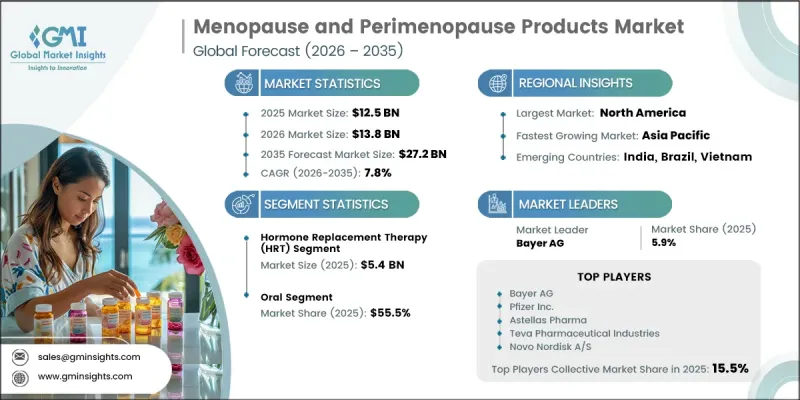
The Global Menopause and Perimenopause Products Market was valued at USD 12.5 billion in 2025 and is estimated to grow at a CAGR of 7.8% to reach USD 27.2 billion by 2035.
Market growth is supported by the increasing number of women entering menopause age groups, greater recognition of menopause-related health needs, and improved acceptance of clinically supported treatment options. Growing awareness around hormone replacement therapy, expanding access to specialized healthcare services, and advancements in digital health solutions are helping address long-standing gaps in menopause management. The market is also benefiting from changing conversations around women's health, which are encouraging more individuals to seek professional support and personalized care solutions. Digital platforms, symptom monitoring tools, and convenient product delivery models are contributing to the development of more accessible menopause care ecosystems. However, differences in insurance coverage, healthcare reimbursement structures, and product accessibility continue to influence adoption patterns across global markets.
| Market Scope | |
|---|---|
| Start Year | 2025 |
| Forecast Year | 2026-2035 |
| Start Value | $12.5 Billion |
| Forecast Value | $27.2 Billion |
| CAGR | 7.8% |
The Hormone Replacement Therapy (HRT) segment generated USD 5.4 billion in 2025. The segment continues to maintain its dominant position due to the established clinical use of hormone-based treatments for managing menopause symptoms through systemic and localized approaches. HRT products include various formulations such as oral therapies, skin-applied treatments, vaginal applications, combined hormone therapies, and selected hormone-based options used for specific symptom management. The long-standing presence of these therapies in clinical practice, along with continued physician familiarity and patient demand, supports sustained segment growth.
The oral segment accounted for 55.5% share in 2025. Oral administration remains the preferred delivery method across hormone replacement therapies and supplement-based menopause products due to its ease of use, widespread acceptance among patients, and familiarity among healthcare providers. Tablets and softgel formats continue to represent major product forms within the supplement category, further strengthening the position of oral solutions in the market.
North America Menopause and Perimenopause Products Market held 33.6% share in 2025. The United States represents the largest contributor within the region, while Canada also maintains a significant market presence supported by comparable demographic trends and healthcare factors. Increasing awareness of menopause management, growing demand for personalized healthcare solutions, and improved availability of treatment options continue to support regional market expansion.
Major players operating in the global menopause and perimenopause products industry are: Theramex Group, Pfizer Inc., Besins Healthcare, Bayer AG, Hisamitsu Pharmaceutical, Astellas Pharma, Novo Nordisk A/S, Gedeon Richter Plc., Teva Pharmaceutical Industries, Mayne Pharma Group, Organon & Co., Amneal Pharmaceuticals, Padagis LLC, Dr. Reddy's Laboratories, Sun Pharmaceutical Industries, Exeltis Healthcare, Schaper & Brummer, and Tsumura & Co. Companies operating in the menopause and perimenopause products market are focusing on product innovation, portfolio diversification, digital healthcare integration, and stronger consumer engagement strategies to improve their market position. Leading organizations are developing advanced hormone therapies, wellness-focused solutions, and personalized care platforms to address evolving consumer needs. Businesses are also investing in research and development activities to improve treatment effectiveness, expand product accessibility, and strengthen clinical support. Strategic collaborations, digital service expansion, and enhanced distribution networks are becoming important approaches for increasing customer reach. Companies are also emphasizing education initiatives and awareness campaigns to encourage earlier consultation and treatment adoption.
Table of Contents
Chapter 1 Methodology & Scope
- 1.1 Research approach
- 1.2 Quality commitments
- 1.2.1 GMI AI policy & data integrity commitment
- 1.2.1.1 Source consistency protocol
- 1.2.1 GMI AI policy & data integrity commitment
- 1.3 Research trail & confidence scoring
- 1.3.1 Research trail components
- 1.3.2 Scoring components
- 1.4 Data collection
- 1.4.1 Partial list of primary sources
- 1.5 Data mining sources
- 1.5.1 Paid sources
- 1.5.1.1 Sources, by region
- 1.5.1 Paid sources
- 1.6 Base estimates and calculations
- 1.6.1 Base year calculation for any one approach
- 1.7 Market estimates & forecasts parameters
- 1.8 Forecast model
- 1.8.1 Quantified market impact analysis
- 1.8.1.1 Mathematical impact of growth parameters on forecast
- 1.8.1 Quantified market impact analysis
- 1.9 Research transparency addendum
- 1.9.1 Source attribution framework
- 1.9.2 Quality assurance metrics
- 1.9.3 Our commitment to trust
Chapter 2 Executive Summary
- 2.1 Industry synopsis, 2022 - 2035
- 2.1.1 Business trends
- 2.1.2 Product type trends
- 2.1.3 Sourcing & certification standard trends
- 2.1.4 Distribution channel trends
- 2.1.5 Regional trends
Chapter 3 Industry Insights
- 3.1 Industry ecosystem analysis
- 3.1.1 Raw material & ingredient suppliers
- 3.1.2 Manufacturers & product developers
- 3.1.3 Regulatory & clinical bodies
- 3.1.4 Distribution & retail networks
- 3.1.5 End-users & patient communities
- 3.1.6 Value chain profitability analysis
- 3.2 Industry impact forces
- 3.2.1 Growth drivers
- 3.2.2 Industry pitfalls and challenges
- 3.2.3 Market opportunities
- 3.3 Growth potential analysis
- 3.4 Regulatory landscape (Driven by primary research)
- 3.4.1 U.S. FDA regulatory landscape (DSHEA, NDA/ANDA, 510(k), HRT labeling)
- 3.4.2 European Medicines Agency (EMA) guidelines for HRT & non-hormonal Rx
- 3.4.3 Asia Pacific regulatory environment (PMDA, CDSCO, TGA)
- 3.4.4 Compounded hormone therapy regulatory oversight & risk
- 3.4.5 Dietary supplement claim regulations & FTC enforcement
- 3.5 Technology landscape
- 3.5.1 Emerging drug classes (neurokinin B antagonists, SERMs, novel HRT formulations)
- 3.5.2 Bioidentical hormone technology advancements
- 3.5.3 Nutraceutical ingredient innovation (phytoestrogens, adaptogens, probiotics)
- 3.5.4 Wearable & remote monitoring technologies
- 3.5.5 Digital therapeutics (DTx) & AI-personalized care platforms
- 3.6 Pricing trend analysis (Driven by primary research)
- 3.6.1 Historical price trend analysis (driven by primary research)
- 3.6.2 Pricing strategy by player type (premium / value / cost-plus) (driven by primary research)
- 3.6.3 Price comparison: branded HRT vs. generic vs. compounded vs. OTC supplement
- 3.6.4 Reimbursement landscape & out-of-pocket cost burden
- 3.7 Future market trends
- 3.8 Porter's analysis
- 3.9 PESTEL analysis
- 3.10 Trade data analysis (driven by paid database) (HS code: 33049990)
- 3.10.1 Import/export volume & value trends by product category
- 3.10.2 Key trade corridors & tariff impact on HRT & supplement markets
- 3.11 Impact of AI & generative AI on the market
- 3.11.1 AI-driven disruption of existing menopause care & product models
- 3.11.2 GenAI use cases & adoption roadmap by segment (drug discovery, symptom tracking, personalized nutrition)
- 3.11.3 Risks, limitations & regulatory considerations for AI-enabled menopause solutions
- 3.12 Treatment infrastructure & clinical adoption landscape
- 3.12.1 Facility & treatment center distribution by region (menopause clinics, OB-GYN practices, integrative health centers) (driven by primary research)
- 3.12.2 Adoption readiness by care setting & payer type (hospital systems, private practice, telehealth, employer benefit plans) (driven by primary research)
Chapter 4 Competitive Landscape, 2025
- 4.1 Introduction
- 4.2 Company market share analysis, by region, 2025
- 4.2.1 North America
- 4.2.2 Europe
- 4.2.3 Asia Pacific
- 4.2.4 Middle East & Africa
- 4.2.5 Latin America
- 4.3 Key developments
- 4.3.1 Key partnerships & collaborations
- 4.3.2 Major M&A activities
- 4.3.3 Product innovations & launches
- 4.3.4 Market expansion strategies
- 4.4 Competitive positioning matrix
Chapter 5 Market Size and Forecast, By Product Type, 2022 - 2035 (USD Billion)
- 5.1 Key trends
- 5.2 Hormone Replacement Therapy (HRT)
- 5.2.1 Estrogen-Only Therapy
- 5.2.2 Progesterone / Progestogen-Only Therapy
- 5.2.3 Combination (Estrogen-Progestogen) Therapy
- 5.2.4 Compounded Hormone Therapy
- 5.3 Non-Hormonal Prescription Treatments
- 5.3.1 Neurokinin B (NKB) Receptor Antagonists (Fezolinetant, Elinzanetant)
- 5.3.2 SSRIs & SNRIs
- 5.3.3 Selective Estrogen Receptor Modulators (SERMs)
- 5.3.4 Others (Gabapentin, Clonidine, Bisphosphonates)
- 5.4 Dietary Supplements & Herbal Remedies
- 5.4.1 Phytoestrogens (Soy Isoflavones, Red Clover, Flaxseed)
- 5.4.2 Botanical Extracts (Black Cohosh, Ashwagandha, Dong Quai, Chasteberry)
- 5.4.3 Vitamins & Minerals (Calcium, Vitamin D, Magnesium, B-Complex)
- 5.5 Probiotics & Specialty Multi-Nutrient Blends
- 5.6 Diagnostic & Monitoring Devices
- 5.6.1 Hormone Test Kits (FSH/LH Home Diagnostics)
- 5.6.2 Wearable Physiological Monitors
- 5.6.3 Digital Diagnostic Platforms & Lab-on-Chip Devices
- 5.7 Digital Health & Telemedicine Solutions
- 5.7.1 Symptom Tracking & Management Apps
- 5.7.2 Telehealth & Virtual Menopause Care Platforms
- 5.7.3 Digital Therapeutics (DTx) Programs
- 5.7.4 AI-Powered Personalized Care Programs
- 5.8 Lifestyle & Wellness Products
- 5.8.1 Vaginal Moisturizers & Lubricants
- 5.8.2 Cooling & Comfort Accessories
- 5.8.3 Non-Digital CBT & Mindfulness Programs
- 5.8.4 Menopause-Specific Skincare & Personal Care
Chapter 6 Market Size and Forecast, By Route of Administration, 2022 - 2035 (USD Billion)
- 6.1 Key trends
- 6.2 Oral
- 6.2.1 Tablets
- 6.2.2 Capsules & Gummies
- 6.2.3 Powders & Functional Beverages
- 6.3 Topical / Transdermal
- 6.3.1 Transdermal Patches
- 6.3.2 Gels & Creams
- 6.3.3 Topical Sprays
- 6.4 Injectable
- 6.4.1 Subcutaneous Injections
- 6.4.2 Intramuscular / Depot Injections
- 6.5 Vaginal
- 6.5.1 Vaginal Rings
- 6.5.2 Vaginal Creams & Suppositories
- 6.5.3 Vaginal Tablets & Inserts
Chapter 7 Market Size and Forecast, By Application, 2022 - 2035 (USD Billion)
- 7.1 Key trends
- 7.2 Vasomotor Symptoms (Hot Flashes & Night Sweats)
- 7.3 Genitourinary Syndrome of Menopause (GSM) & Vaginal Dryness
- 7.4 Mood, Cognitive & Sleep Disorders
- 7.5 Bone Health (Osteoporosis Prevention & Management)
- 7.6 Cardiovascular & Metabolic Health
- 7.7 Others
Chapter 8 Market Size and Forecast, By Menopausal Stage, 2022 - 2035 (USD Billion)
- 8.1 Key trends
- 8.2 Perimenopause
- 8.3 Menopause
- 8.4 Postmenopause
Chapter 9 Market Size and Forecast, By End User, 2022 - 2035 (USD Billion)
- 9.1 Key trends
- 9.2 Hospitals & Healthcare Institutions
- 9.3 Specialty Clinics (Gynecology / Menopause Practices)
- 9.4 Homecare & Self-Managed Consumers
- 9.5 Others
Chapter 10 Market Size and Forecast, By Distribution Channel, 2022 - 2035 (USD Billion)
- 10.1 Key trends
- 10.2 Hospital Pharmacies
- 10.3 Retail Pharmacies & Drug Stores
- 10.4 Online Pharmacies & DTC E-commerce
- 10.5 Supermarkets / Health & Wellness Retail
Chapter 11 Market Size and Forecast, By Region, 2022 - 2035 (USD Billion)
- 11.1 Key trends
- 11.2 North America
- 11.2.1 U.S.
- 11.2.2 Canada
- 11.3 Europe
- 11.3.1 Germany
- 11.3.2 France
- 11.3.3 UK
- 11.3.4 Netherlands
- 11.3.5 Spain
- 11.3.6 Italy
- 11.4 Asia Pacific
- 11.4.1 China
- 11.4.2 Japan
- 11.4.3 South Korea
- 11.4.4 India
- 11.4.5 Australia
- 11.5 Middle East & Africa
- 11.5.1 Saudi Arabia
- 11.5.2 UAE
- 11.5.3 South Africa
- 11.6 Latin America
- 11.6.1 Brazil
- 11.6.2 Argentina
- 11.6.3 Mexico
Chapter 12 Company Profiles
- 12.1 Global Players
- 12.1.1 Bayer AG
- 12.1.2 Pfizer Inc.
- 12.1.3 Teva Pharmaceutical Industries
- 12.1.4 Novo Nordisk A/S
- 12.1.5 Organon & Co.
- 12.1.6 Astellas Pharma
- 12.1.7 Amneal Pharmaceuticals
- 12.2 Regional Players
- 12.2.1 Gedeon Richter Plc.
- 12.2.2 Theramex Group
- 12.2.3 Besins Healthcare
- 12.2.4 Dr. Reddy's Laboratories
- 12.2.5 Sun Pharmaceutical Industries
- 12.2.6 Hisamitsu Pharmaceutical
- 12.2.7 Mayne Pharma Group
- 12.3 Niche & Specialist Players
- 12.3.1 Exeltis Healthcare
- 12.3.2 Padagis LLC
- 12.3.3 Bonafide Health
- 12.3.4 Kindra Inc.
- 12.3.5 Womaness LLC
- 12.3.6 Schaper & Brummer
- 12.3.7 Tsumura & Co.

