PUBLISHER: Mordor Intelligence | PRODUCT CODE: 2113877

PUBLISHER: Mordor Intelligence | PRODUCT CODE: 2113877
North America Beauty And Personal Care Products - Market Share Analysis, Industry Trends & Statistics, Growth Forecasts (2026 - 2031)
According to Mordor Intelligence, the North America beauty and personal care market size reached USD 155.41 billion in 2026 and is projected to expand to USD 182.24 billion by 2031, advancing at a 4.58% CAGR.
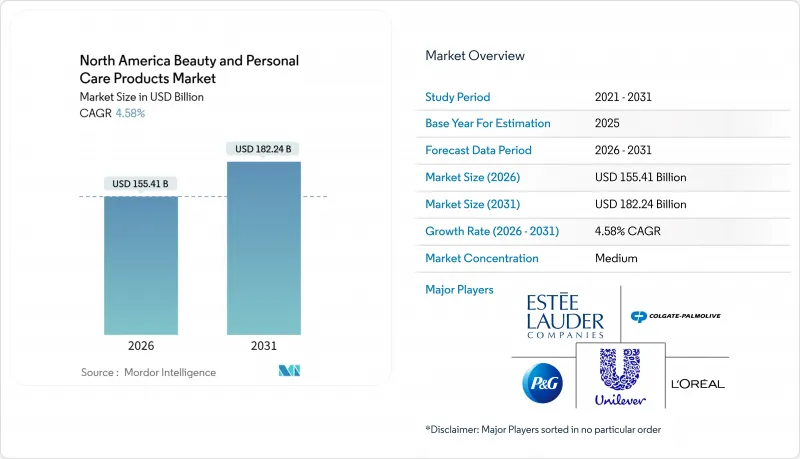
This report is Segmented by Product Type (Personal Care and Cosmetics/Make-up), Category (Premium Products and Mass Products), Ingredients (Conventional/Synthetic and Natural/Organic), Distribution Channel (Specialist Stores, Supermarkets/Hypermarkets, and More), and Geography. The Market Forecasts are Provided in Terms of Value (USD).
North America Beauty And Personal Care Products Market Trends and Insights
Rising Skin and Hair Issues from Pollution and Lifestyle Factors
Urban populations in North America are increasingly affected by oxidative stress caused by particulate matter. According to a May 2025 report from the American Journal of Managed Care, 99% of the global population resides in areas that do not meet WHO air quality standards. Studies show that exposure to fine particulates is linked to a more than 20% increase in facial pigment spots, driving demand for anti-pollution serums and skin barrier-repair formulations. Research published in Frontiers in Pharmacology and the Journal of the European Academy of Dermatology demonstrates that pollutants activate the aryl hydrocarbon receptor, which triggers melanogenesis and collagen degradation. In response, brands are incorporating antioxidants such as niacinamide and resveratrol, positioning these products as daily protective solutions rather than corrective treatments. This trend is particularly evident in metropolitan areas of the United States and Canada, where industrial emissions and commuting patterns intensify exposure. The shift from reactive to preventive skincare habits is extending product lifecycles and increasing average basket values, benefiting both mass-market and premium brands.
Growing Awareness About Oral Hygiene and Dental Health
The oral care market size is driven by increasing awareness of preventive dental health. According to the Centers for Disease Control and Prevention (CDC), more than 21% of United States adults between the ages of 20-64 had untreated cavities in 2024 . These health concerns have led to increased adoption of advanced dental care products, including oscillating and sonic toothbrushes. The market is evolving toward subscription-based models for brush head replacements and oral care products, creating stable revenue streams. The integration of improved battery technology and recyclable materials in oral care products addresses growing environmental concerns. Consumer preference for premium oral care products suggests that North American oral care manufacturers may position their products similarly to skincare offerings, bridging the gap between dental hygiene and beauty products.
Consumer Concerns Over Product Safety and Ingredients
In December 2022, the FDA introduced the Modernization of Cosmetics Regulation Act (MoCRA). By January 2025, the agency's cosmetic database expanded significantly, growing from 35,102 listings to 589,762. This 16-fold increase, driven by enhanced compliance and stricter oversight, included 12,049 registered facilities as of July 2025. While brands face higher costs for safety substantiation and labeling updates, consumers now have access to a searchable database that facilitates ingredient-level research. Similarly, Health Canada requires manufacturers to disclose all ingredients in descending order of predominance and enforces restrictions on certain preservatives, such as parabens and formaldehyde-releasing agents. Social media amplifies isolated adverse events into widespread controversies, often pressuring brands to reformulate or recall products even when incidents lack statistical significance. The growing prevalence of "free-from" claims-such as paraben-free or sulfate-free-creates a negative perception of conventional ingredients, complicating consumer education and driving costly reformulation cycles for brands.
Other drivers and restraints analyzed in the detailed report include:
- Surging Demand for Anti-Aging Products Amid Aging Populations and Preventive Skincare Trends
- Consumers' Inclination Towards Natural and Organic Products
- Counterfeit Products Affecting Brand Reputation
For complete list of drivers and restraints, kindly check the Table Of Contents.
Segment Analysis
In 2025, personal care products accounted for 84.15% of the market share and are expected to grow at a 5.34% CAGR through 2031, surpassing cosmetics. This growth is primarily driven by advancements in oral care and the increasing normalization of men's grooming. Hair care products are addressing urban environmental challenges with anti-pollution shampoos and scalp-health serums. Skin care is segmented into facial, body, and lip-and-nail categories, each tailored to specific consumer habits. Bath and shower products, such as shower gels and soaps, face commoditization challenges but continue to lead in volume within mass channels. Oral care, which includes toothbrushes, toothpastes, mouthwashes, and rinses, has gained momentum from Procter & Gamble's FDA-approved Crest Pro-Health Clinical Plaque Control and Oral-B's AI-powered iO Series 10 toothbrush, launched at CES 2024. Men's grooming products at Bath & Body Works grew by 50% over three years, reflecting a decline in gender-specific purchasing norms. Deodorants and antiperspirants are transitioning to aluminum-free formulations.
Although smaller in scale, cosmetics and makeup products capture aspirational spending and benefit from viral social media trends. Facial cosmetics, such as foundations and concealers, now emphasize skin-like finishes and SPF integration. Eye cosmetics, including mascaras and eyeliners, drive impulse purchases, while lip and nail makeup products maintain high repurchase rates. The FDA's MoCRA implementation has increased compliance costs for color cosmetics due to stricter pigment testing, favoring established companies with in-house laboratories. E.l.f. Beauty is disrupting the cosmetics market with its 100% vegan positioning, proving that ethical formulations can be cost-effective. Fenty Beauty has raised the bar with its inclusive range of over 50 foundation shades, prompting legacy brands to adapt. The personal care segment's strong 5.34% CAGR underscores its broad appeal and resilience.
In 2025, mass products accounted for 72.25% of the market share. However, premium offerings are expected to grow at a 5.48% CAGR through 2031, reflecting a trend toward bifurcation rather than widespread democratization. In 2024, masstige skincare products, typically sold in mass channels but positioned as prestige, grew six times faster than traditional prestige offerings. Baird Equity Research reported a 17% expansion, indicating that consumers are opting for these products without compromising on perceived efficacy. Circana data showed that the United States mass beauty sales increased by 5%, reaching USD 54.5 billion by September 2025. This growth outpaced the 4% rise in prestige sales, which totaled USD 24.1 billion. In response, premium brands are launching tiered product lines and emphasizing dermatologist endorsements to validate their higher price points.
The mass segment thrives on volume and extensive distribution, with supermarkets, hypermarkets, and drugstores serving as key channels for impulse purchases. Retailers like Target and Walmart, through their private-label offerings, may compress margins but simultaneously expand the market by lowering entry barriers. Premium products, on the other hand, are concentrated in specialty stores and online platforms, where curated selections and personalized consultations justify their higher price points. The 5.48% CAGR for premium offerings reflects affluent consumers' willingness to invest in innovation, sustainability certifications, and brand heritage, even as middle-income shoppers gravitate toward masstige alternatives. Meanwhile, Mexico's growing middle class is driving mass-market penetration, while premium imports are gaining traction in urban areas. This division within the category underscores a dual reality: price sensitivity coexists with premiumization, as different consumer groups prioritize distinct value propositions.
Complete Report Scope:
- By Product Type
- Personal Care
- Hair Care
- Shampoo
- Conditioner
- Hair Colourant
- Hair Styling Products
- Others
- Skin Care
- Facial Care Products
- Body Care Products
- Lip and Nail Care Products
- Bath and Shower
- Shower Gels
- Soaps
- Others
- Oral Care
- Toothbrush
- Toothpaste
- Mouthwashes and Rinses
- Others
- Men's Grooming Products
- Deodorants and Antiperspirants
- Perfumes and Fragrances
- Hair Care
- Cosmetics / Make-up Products
- Facial Cosmetics
- Eye Cosmetics
- Lip and Nail Make-up Products
- Personal Care
- By Category
- Premium Products
- Mass Products
- By Ingredients
- Natural/Organic
- Conventional/Synthetic
- By Distribution Channel
- Specialist Stores
- Supermarkets/Hypermarkets
- Online Retail Stores
- Other Distribution Channels
- By Geography
- United States
- Canada
- Mexico
- Rest of North America
List of Companies Covered in this Report:
- L'Oreal S.A.
- Unilever PLC
- Procter & Gamble Company
- Estee Lauder Companies Inc.
- Johnson & Johnson Services Inc.
- Coty Inc.
- Mary Kay Inc.
- Colgate-Palmolive Company
- LVMH Moet Hennessy Louis Vuitton
- Natura & Co Holding S.A.
- Revlon Group Holdings LLC
- e.l.f. Beauty Inc.
- Shiseido Company Ltd.
- Beiersdorf AG
- Henkel AG & Co. KGaA
- Kao Corporation
- Church & Dwight Co. Inc.
- Edgewell Personal Care Company
- The Honest Company Inc.
- Glossier Inc.
- Burt's Bees (The Clorox Company)
- Fenty Beauty LLC
- Anastasia Beverly Hills LLC
- Kylie Cosmetics LLC
Additional Benefits:
- The market estimate (ME) sheet in Excel format
- 3 months of analyst support
TABLE OF CONTENTS
1 INTRODUCTION
- 1.1 Study Assumptions and Market Definition
- 1.2 Scope of the Study
2 RESEARCH METHODOLOGY
3 EXECUTIVE SUMMARY
4 MARKET LANDSCAPE
- 4.1 Market Overview
- 4.2 Market Drivers
- 4.2.1 Rising Skin and Hair Issues From Pollution and Lifestyle Factors
- 4.2.2 Growing Awareness about Oral Hygiene and Dental Health
- 4.2.3 Surging Demand for Anti-Aging Products Amid Aging Populations and Preventive Skincare Trends
- 4.2.4 Consumers' Inclination Towards Natural and Organic Products
- 4.2.5 Awareness of Vegan and Cruelty-Free Beauty Standards
- 4.2.6 Rapid E-Commerce Growth and Enhanced Accessibility
- 4.3 Market Restraints
- 4.3.1 Consumer Concerns Over Product Safety and Ingredients
- 4.3.2 Counterfeit Products Affecting Brand Reputation
- 4.3.3 Supply Chain Disruptions Affecting Boutique and Local Brands
- 4.3.4 Price Sensitivity of Premium Products
- 4.4 Consumer Behaviour Analysis
- 4.5 Technology Outlook
- 4.6 Regulatory Outlook
- 4.7 Value Chain Analysis
- 4.8 Porter's Five Forces Analysis
- 4.8.1 Threat of New Entrants
- 4.8.2 Bargaining Power of Buyers/Consumers
- 4.8.3 Bargaining Power of Suppliers
- 4.8.4 Threat of Substitute Products
- 4.8.5 Intensity of Competitive Rivalry
5 MARKET SIZE AND GROWTH FORECAST (VALUE)
- 5.1 By Product Type
- 5.1.1 Personal Care
- 5.1.1.1 Hair Care
- 5.1.1.1.1 Shampoo
- 5.1.1.1.2 Conditioner
- 5.1.1.1.3 Hair Colourant
- 5.1.1.1.4 Hair Styling Products
- 5.1.1.1.5 Others
- 5.1.1.2 Skin Care
- 5.1.1.2.1 Facial Care Products
- 5.1.1.2.2 Body Care Products
- 5.1.1.2.3 Lip and Nail Care Products
- 5.1.1.3 Bath and Shower
- 5.1.1.3.1 Shower Gels
- 5.1.1.3.2 Soaps
- 5.1.1.3.3 Others
- 5.1.1.4 Oral Care
- 5.1.1.4.1 Toothbrush
- 5.1.1.4.2 Toothpaste
- 5.1.1.4.3 Mouthwashes and Rinses
- 5.1.1.4.4 Others
- 5.1.1.5 Men's Grooming Products
- 5.1.1.6 Deodorants and Antiperspirants
- 5.1.1.7 Perfumes and Fragrances
- 5.1.1.1 Hair Care
- 5.1.2 Cosmetics / Make-up Products
- 5.1.2.1 Facial Cosmetics
- 5.1.2.2 Eye Cosmetics
- 5.1.2.3 Lip and Nail Make-up Products
- 5.1.1 Personal Care
- 5.2 By Category
- 5.2.1 Premium Products
- 5.2.2 Mass Products
- 5.3 By Ingredients
- 5.3.1 Natural/Organic
- 5.3.2 Conventional/Synthetic
- 5.4 By Distribution Channel
- 5.4.1 Specialist Stores
- 5.4.2 Supermarkets/Hypermarkets
- 5.4.3 Online Retail Stores
- 5.4.4 Other Distribution Channels
- 5.5 By Geography
- 5.5.1 United States
- 5.5.2 Canada
- 5.5.3 Mexico
- 5.5.4 Rest of North America
6 COMPETITIVE LANDSCAPE
- 6.1 Market Concentration
- 6.2 Strategic Moves
- 6.3 Market Share Analysis
- 6.4 Company Profiles (includes Global level Overview, Market level overview, Core Segments, Financials as available, Strategic Information, Market Rank/Share for key companies, Products and Services, and Recent Developments)
- 6.4.1 L'Oreal S.A.
- 6.4.2 Unilever PLC
- 6.4.3 Procter & Gamble Company
- 6.4.4 Estee Lauder Companies Inc.
- 6.4.5 Johnson & Johnson Services Inc.
- 6.4.6 Coty Inc.
- 6.4.7 Mary Kay Inc.
- 6.4.8 Colgate-Palmolive Company
- 6.4.9 LVMH Moet Hennessy Louis Vuitton
- 6.4.10 Natura & Co Holding S.A.
- 6.4.11 Revlon Group Holdings LLC
- 6.4.12 e.l.f. Beauty Inc.
- 6.4.13 Shiseido Company Ltd.
- 6.4.14 Beiersdorf AG
- 6.4.15 Henkel AG & Co. KGaA
- 6.4.16 Kao Corporation
- 6.4.17 Church & Dwight Co. Inc.
- 6.4.18 Edgewell Personal Care Company
- 6.4.19 The Honest Company Inc.
- 6.4.20 Glossier Inc.
- 6.4.21 Burt's Bees (The Clorox Company)
- 6.4.22 Fenty Beauty LLC
- 6.4.23 Anastasia Beverly Hills LLC
- 6.4.24 Kylie Cosmetics LLC
7 MARKET OPPORTUNITIES AND FUTURE OUTLOOK

