PUBLISHER: Mordor Intelligence | PRODUCT CODE: 2113820

PUBLISHER: Mordor Intelligence | PRODUCT CODE: 2113820
Beauty And Personal Care Products - Market Share Analysis, Industry Trends & Statistics, Growth Forecasts (2026 - 2031)
According to Mordor Intelligence, the beauty and personal care products market size is expected to grow from USD 605.06 billion in 2025 to USD 636.16 billion in 2026 and is forecast to reach USD 817.35 billion by 2031 at 5.14% CAGR over 2026-2031.
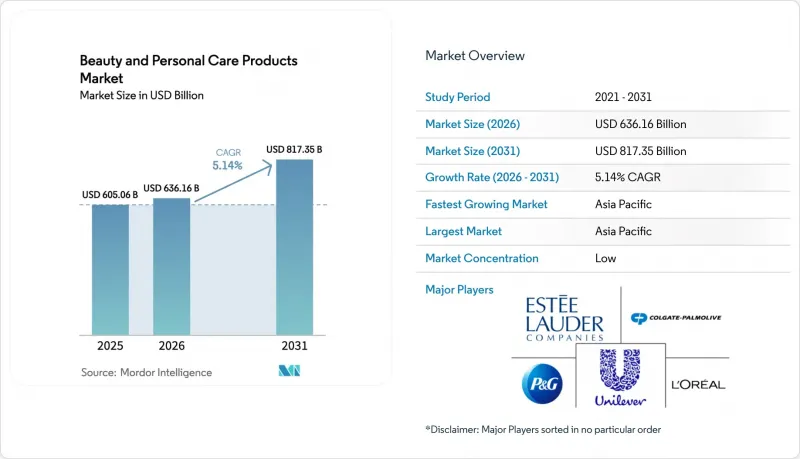
This report is Segmented by Product Type (Personal Care Products, Cosmetics/Makeup Products), Category (Premium Products and Mass Products), Ingredient Type (Natural/Organic, and Conventional/Synthetic), Distribution Channel (Specialty Stores, Supermarkets/Hypermarkets, Online Retail Channels and Other Channels), and Geography. The Market Forecasts are Provided in Terms of Value (USD).
Global Beauty And Personal Care Products Market Trends and Insights
Consumer preference for natural and organic beauty and personal care products
Concerns about the negative effects of chemical ingredients in beauty and personal care products, such as skin irritation, allergies, and hormonal imbalances, have significantly increased. This has driven a growing demand for natural and organic skincare alternatives. Unlike synthetic cosmetics, organic products derived from plant extracts and natural oils provide gentle skincare solutions while offering additional benefits like hydration and nourishment. Consumers are becoming more aware of the importance of ingredient transparency, which has become a key factor influencing their purchasing decisions. They are actively seeking products that clearly list recognizable, plant-based components. In response to this shift in consumer preferences, manufacturers have expanded their product portfolios to include items labeled as organic, vegan, natural, chemical-free, and cruelty-free. This approach addresses both health-related concerns and ethical considerations within the skincare industry. A study conducted by NSF International, a leading global public health and safety organization, and published in March 2025, revealed that 74% of consumers consider organic ingredients essential in personal care products. This finding highlights a clear and growing trend toward clean beauty products. However, the widespread issue of greenwashing, where brands falsely market products as environmentally friendly, and the lack of consumer trust in voluntary organic labels emphasize the need for third-party testing and certification. Such measures are critical to ensuring transparency and building consumer confidence in the authenticity of organic and natural skincare products.
Influence of social media and impact of digital technology on the market
Technological advancements, including smartphones, personal computers, the internet, and e-commerce, have significantly transformed the global beauty and personal care market. Social media platforms have emerged as a critical tool for brands to showcase their products, connect with potential customers, and generate interest in the market. Prominent companies such as L'Oreal, Unilever, and Estee Lauder utilize platforms like Facebook, Instagram, and YouTube to not only launch new products but also engage with consumers through tutorials and promotional campaigns. These platforms have become a cornerstone for brands to build relationships with their audience and foster loyalty in an increasingly digital world. Additionally, companies are implementing influencer marketing strategies to drive brand conversations into the digital space. Influencers, who often have a strong connection with their followers, play a pivotal role in shaping consumer perceptions. A 2024 survey conducted by the University of Portsmouth revealed that 60% of consumers trusted recommendations from influencers, while nearly half of all purchasing decisions were influenced by these endorsements . This type of content has proven to be highly effective in increasing brand visibility and enhancing consumer engagement, particularly among younger demographics who are frequent users of social media platforms.
Availability of counterfeit products impacts market development
Counterfeit goods are posing an escalating challenge to the beauty and personal care sector, with digital channels emerging as the dominant platform for their distribution. These counterfeit products are predominantly found in smaller beauty supply outlets and on e-commerce platforms, where regulatory oversight tends to be less stringent compared to larger retail chains. The widespread availability of discounted options online makes it increasingly difficult for consumers to differentiate between genuine and counterfeit products. This confusion not only risks customer dissatisfaction but also damages the reputation of legitimate brands, potentially impacting their market share and long-term growth. The scale of this issue is highlighted by recent enforcement actions. In October 2025, the United States Customs and Border Protection (CBP) and the United States Food and Drug Administration (FDA) seized 398 shipments containing 8,521 pairs of undeclared or misdeclared contact lenses. Furthermore, officials confiscated 50 additional shipments of misbranded or misdeclared FDA-regulated items, including GLP1 (glucagon-like peptide-1) medications, Botox, dermal fillers, skincare products, and other FDA-prohibited substances. This unchecked distribution of counterfeit goods not only undermines consumer trust but also disrupts market dynamics, creating an uneven competitive landscape for legitimate brands. Addressing this pressing issue requires a collaborative effort among regulatory authorities, e-commerce platforms, and authentic manufacturers to protect consumers and ensure the integrity of the market.
Other drivers and restraints analyzed in the detailed report include:
- Rising demand for men's personal care products
- Increased awareness about oral hygiene among consumers
- High manufacturing costs and raw material expenses limit market growth
For complete list of drivers and restraints, kindly check the Table Of Contents.
Segment Analysis
In 2025, personal care products held a significant 88.45% share of the market, while the cosmetics segment is projected to record a 5.89% CAGR through 2031. This growth is primarily driven by key segments such as oral care, which is evolving from traditional hygiene solutions to advanced formulations that incorporate innovative ingredients like peptides and hydroxyapatite. Additionally, the cosmetics segment is transforming as Generation Z consumers exhibit a strong preference for skincare, with 60% identifying it as their primary beauty-related purchase. The men's grooming category is also expanding its scope, moving beyond conventional offerings to include skincare and color cosmetics. This diversification of product categories highlights the industry's proactive response to shifting consumer demographics and preferences.
The evolution of the market is further characterized by the growing integration of wellness concepts into personal care product formulations, leading to the development of hybrid products that transcend traditional category boundaries. This trend is particularly evident in the skincare segment, where consumer priorities have shifted from corrective treatments to preventative health measures. This change reflects a broader transformation in consumer behavior, emphasizing a holistic approach to health and comprehensive personal care routines. The convergence of beauty and wellness is creating new opportunities for innovation in product development and driving market expansion.
In 2025, mass products hold a commanding 72.37% share of the market, driven by its extensive availability across supermarkets, drugstores, convenience stores, and online platforms. This strong market position is a result of its accessibility, competitive pricing strategies, and widespread acceptance among diverse demographic groups. Despite the dominance of mass products, the premium product segment is poised for significant growth, with a compound annual growth rate (CAGR) of 6.45% projected for the period from 2026 to 2031. The market has demonstrated resilience even during periods of economic uncertainty, as consumers purchasing prestige products also tend to buy mass products, reflecting a value-conscious mindset across different pricing tiers.
Prominent companies, including Unilever, Procter & Gamble Company, and private-label brands, are actively responding to shifting consumer preferences by focusing on the development of ethical and environmentally friendly products. The convergence of mass and premium product categories has intensified competition while simultaneously increasing consumer access to high-quality formulations. Mass Products continues to maintain its leadership through ongoing product innovation and competitive pricing, while the premium segment is experiencing growth driven by the introduction of natural and organic skincare products and the strategic use of beauty influencer marketing. This evolving market dynamic ensures that consumers benefit from broader access to premium-quality formulations while also addressing their practical needs for everyday beauty and personal care solutions.
Complete Report Scope:
- By Product Type
- Personal Care Products
- Hair Care
- Shampoo
- Conditioner
- Hair Colorant
- Hair Styling Products
- Others
- Skin Care
- Facial Care Products
- Body Care Products
- Lip and Nail Care Products
- Bath and Shower
- Shower Gels
- Soaps
- Others
- Oral Care
- Toothbrush
- Toothpaste
- Mouthwashes and Rinses
- Others
- Men's Grooming Products
- Deodorants and Antiperspirants
- Perfumes and Fragrances
- Hair Care
- Cosmetics/Makeup Products
- Facial Cosmetics
- Eye Cosmetics
- Lip and Nail Makeup Products
- Personal Care Products
- By Category
- Premium Products
- Mass Products
- By Ingredient Type
- Natural and Organic
- Conventional/Synthetic
- By Distribution Channel
- Specialty Stores
- Supermarkets/Hypermarkets
- Online Retail Stores
- Other Channels
- By Geography
- North America
- United States
- Canada
- Mexico
- Rest of North America
- Europe
- Germany
- France
- United Kingdom
- Spain
- Netherlands
- Italy
- Sweden
- Poland
- Belgium
- Rest of Europe
- Asia-Pacific
- China
- India
- Japan
- Australia
- South Korea
- Indonesia
- Thailand
- Singapore
- Rest of Asia-Pacific
- South America
- Brazil
- Argentina
- Chile
- Colombia
- Peru
- Rest of South America
- Middle East and Africa
- United Arab Emirates
- South Africa
- Nigeria
- Saudi Arabia
- Egypt
- Morocco
- Turkey
- Rest of Middle East and Africa
- North America
Geography Analysis
Asia-Pacific is projected to lead the market with a 35.39% share by 2025, maintaining the highest growth rate at 7.47% compound annual growth rate (CAGR) through 2031. This growth is driven by increasing disposable incomes, urbanization, and a growing focus on beauty and personal care. The region's rapid digital adoption, particularly through social media platforms, significantly influences product discovery and purchasing decisions among Generation Z consumers. Additionally, K-beauty brands continue to expand their global influence and are expected to implement price adjustments in 2025 to address economic challenges. In India, there is a rising demand for dermatologist-certified hair care products, prompting brands like Schwarzkopf and L'Oreal to introduce nutrient-enriched shampoos containing vitamin B3.
North America remains a strong performer due to its well-established market infrastructure and high per-capita spending on beauty products, despite moderate growth in this mature market. In the United States, consumer preferences are shifting towards clean-label and "free-from" product claims, reflecting a growing focus on self-care. Europe is experiencing steady growth, supported by sustainability initiatives and regulatory frameworks that encourage innovation. France continues to hold its position as a global hub for luxury beauty products. Regulatory changes, such as the implementation of the Modernization of Cosmetics Regulation Act (MoCRA) in the United States and restrictions on per- and polyfluoroalkyl substances (PFAS) in Europe, are reshaping compliance requirements. Meanwhile, digital platforms like Amazon and TikTok Shop are transforming retail models and influencing consumer behavior.
South America and the Middle East and Africa are emerging as high-growth markets with unique characteristics. In Brazil, the beauty market is undergoing significant transformation, driven by the influence of digital media and increased consumer awareness of product formulations. In the Middle East, demand for halal cosmetics is rising, fueled by growing awareness of animal cruelty and adherence to religious principles. Both regions benefit from urbanization and increasing disposable incomes but face challenges such as currency volatility, reliance on imports, and evolving regulatory frameworks. These factors necessitate strategic approaches for market entry and expansion.
- L'Oreal SA
- Unilever PLC
- Procter & Gamble Company
- Beiersdorf AG
- Colgate-Palmolive Company
- The Estee Lauder Companies Inc.
- Shiseido Company, Ltd.
- ITC Limited
- Kenvue Inc.
- Kao Corporation
- Henkel AG & Co. KGaA
- LVMH Moet Hennessy Louis Vuitton SE
- AmorePacific Corporation
- Natura & Co Holding SA
- Revlon Inc.
- Coty Inc.
- Edgewell Personal Care Company
- Mary Kay Inc.
- L'Occitane International SA
- Godrej Consumer Products Ltd.
Additional Benefits:
- The market estimate (ME) sheet in Excel format
- 3 months of analyst support
TABLE OF CONTENTS
1 INTRODUCTION
- 1.1 Study Assumptions and Market Definition
- 1.2 Scope of the Study
2 RESEARCH METHODOLOGY
3 EXECUTIVE SUMMARY
4 MARKET LANDSCAPE
- 4.1 Market Overview
- 4.2 Market Drivers
- 4.2.1 Consumer preference for natural and organic beauty and personal care products
- 4.2.2 Growing demand for anti-aging and age management products
- 4.2.3 Influence of social media and impact of digital technology on the market
- 4.2.4 Rising demand for men's personal care products
- 4.2.5 Digital transformation and virtual try-on
- 4.2.6 Increased awareness about oral hygiene among consumers
- 4.3 Market Restraints
- 4.3.1 Availability of counterfeit products impacts market development
- 4.3.2 Growing concerns over product safety and ingredients
- 4.3.3 Intense market competition leading to price pressure and reduced profit margins
- 4.3.4 High manufacturing costs and raw material expenses limit market growth
- 4.4 Consumer Behavior Analysis
- 4.5 Regulatory Outlook
- 4.6 Porter's Five Forces Analysis
- 4.6.1 Threat of New Entrants
- 4.6.2 Bargaining Power of Buyers/Consumers
- 4.6.3 Bargaining Power of Suppliers
- 4.6.4 Threat of Substitute Products
- 4.6.5 Intensity of Competitive Rivalry
5 MARKET SIZE AND GROWTH FORECASTS (VALUE)
- 5.1 By Product Type
- 5.1.1 Personal Care Products
- 5.1.1.1 Hair Care
- 5.1.1.1.1 Shampoo
- 5.1.1.1.2 Conditioner
- 5.1.1.1.3 Hair Colorant
- 5.1.1.1.4 Hair Styling Products
- 5.1.1.1.5 Others
- 5.1.1.2 Skin Care
- 5.1.1.2.1 Facial Care Products
- 5.1.1.2.2 Body Care Products
- 5.1.1.2.3 Lip and Nail Care Products
- 5.1.1.3 Bath and Shower
- 5.1.1.3.1 Shower Gels
- 5.1.1.3.2 Soaps
- 5.1.1.3.3 Others
- 5.1.1.4 Oral Care
- 5.1.1.4.1 Toothbrush
- 5.1.1.4.2 Toothpaste
- 5.1.1.4.3 Mouthwashes and Rinses
- 5.1.1.4.4 Others
- 5.1.1.5 Men's Grooming Products
- 5.1.1.6 Deodorants and Antiperspirants
- 5.1.1.7 Perfumes and Fragrances
- 5.1.1.1 Hair Care
- 5.1.2 Cosmetics/Makeup Products
- 5.1.2.1 Facial Cosmetics
- 5.1.2.2 Eye Cosmetics
- 5.1.2.3 Lip and Nail Makeup Products
- 5.1.1 Personal Care Products
- 5.2 By Category
- 5.2.1 Premium Products
- 5.2.2 Mass Products
- 5.3 By Ingredient Type
- 5.3.1 Natural and Organic
- 5.3.2 Conventional/Synthetic
- 5.4 By Distribution Channel
- 5.4.1 Specialty Stores
- 5.4.2 Supermarkets/Hypermarkets
- 5.4.3 Online Retail Stores
- 5.4.4 Other Channels
- 5.5 By Geography
- 5.5.1 North America
- 5.5.1.1 United States
- 5.5.1.2 Canada
- 5.5.1.3 Mexico
- 5.5.1.4 Rest of North America
- 5.5.2 Europe
- 5.5.2.1 Germany
- 5.5.2.2 France
- 5.5.2.3 United Kingdom
- 5.5.2.4 Spain
- 5.5.2.5 Netherlands
- 5.5.2.6 Italy
- 5.5.2.7 Sweden
- 5.5.2.8 Poland
- 5.5.2.9 Belgium
- 5.5.2.10 Rest of Europe
- 5.5.3 Asia-Pacific
- 5.5.3.1 China
- 5.5.3.2 India
- 5.5.3.3 Japan
- 5.5.3.4 Australia
- 5.5.3.5 South Korea
- 5.5.3.6 Indonesia
- 5.5.3.7 Thailand
- 5.5.3.8 Singapore
- 5.5.3.9 Rest of Asia-Pacific
- 5.5.4 South America
- 5.5.4.1 Brazil
- 5.5.4.2 Argentina
- 5.5.4.3 Chile
- 5.5.4.4 Colombia
- 5.5.4.5 Peru
- 5.5.4.6 Rest of South America
- 5.5.5 Middle East and Africa
- 5.5.5.1 United Arab Emirates
- 5.5.5.2 South Africa
- 5.5.5.3 Nigeria
- 5.5.5.4 Saudi Arabia
- 5.5.5.5 Egypt
- 5.5.5.6 Morocco
- 5.5.5.7 Turkey
- 5.5.5.8 Rest of Middle East and Africa
- 5.5.1 North America
6 COMPETITIVE LANDSCAPE
- 6.1 Market Concentration
- 6.2 Strategic Moves
- 6.3 Market Share Analysis
- 6.4 Company Profiles (includes Global-level Overview, Market-level Overview, Core Segments, Financials (if available), Strategic Information, Market Rank/Share, Products and Services, Recent Developments)
- 6.4.1 L'Oreal SA
- 6.4.2 Unilever PLC
- 6.4.3 Procter & Gamble Company
- 6.4.4 Beiersdorf AG
- 6.4.5 Colgate-Palmolive Company
- 6.4.6 The Estee Lauder Companies Inc.
- 6.4.7 Shiseido Company, Ltd.
- 6.4.8 ITC Limited
- 6.4.9 Kenvue Inc.
- 6.4.10 Kao Corporation
- 6.4.11 Henkel AG & Co. KGaA
- 6.4.12 LVMH Moet Hennessy Louis Vuitton SE
- 6.4.13 AmorePacific Corporation
- 6.4.14 Natura & Co Holding SA
- 6.4.15 Revlon Inc.
- 6.4.16 Coty Inc.
- 6.4.17 Edgewell Personal Care Company
- 6.4.18 Mary Kay Inc.
- 6.4.19 L'Occitane International SA
- 6.4.20 Godrej Consumer Products Ltd.
7 MARKET OPPORTUNITIES AND FUTURE OUTLOOK

