PUBLISHER: Global Market Insights Inc. | PRODUCT CODE: 2101869

PUBLISHER: Global Market Insights Inc. | PRODUCT CODE: 2101869
Thermal Spray Service Market Opportunity, Growth Drivers, Industry Trend Analysis, and Forecast 2026 - 2035
The Global Thermal Spray Service Market was valued at USD 6.29 billion in 2025 and is estimated to grow at a CAGR of 6.6% to reach USD 12.05 billion by 2035.
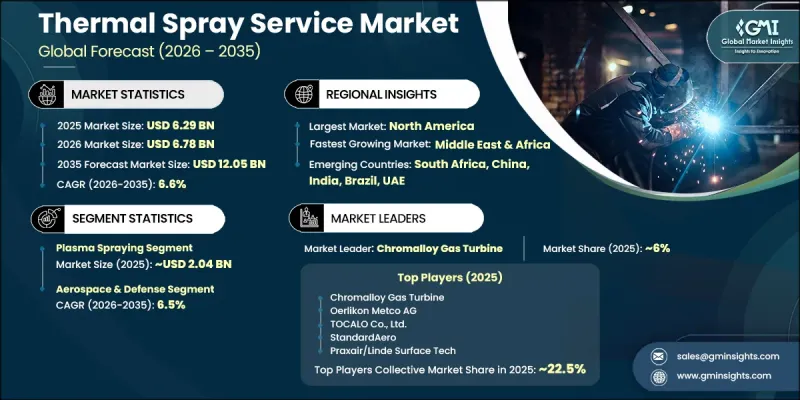
The market is expanding owing to rising demand from energy transition infrastructure and the increasing installation of gas turbines across power generation systems. Growth is also supported by the broader adoption of advanced coating technologies across aerospace, electric vehicle manufacturing, and electronics industries. Service demand is rising across onsite field operations, offsite job shops, and OEM in-house facilities, although growth is increasingly split between highly certified aerospace-focused providers and general industrial coating service suppliers. Cold spray technology is gaining traction due to its ability to deposit materials without exposing substrates to high thermal loads, making it suitable for sensitive components used in EV motors, battery systems, and electrical conductors. Regulatory pressure on hazardous coating materials is accelerating the replacement of legacy processes with advanced alternatives such as high-velocity oxygen fuel coatings. At the same time, aerospace qualification programs and turbine efficiency improvements are driving sustained adoption of thermal barrier coatings across next-generation engine platforms. These combined factors are strengthening long-term demand for high-performance thermal spray services across global industries.
| Market Scope | |
|---|---|
| Start Year | 2025 |
| Forecast Year | 2026-2035 |
| Start Value | $6.29 Billion |
| Forecast Value | $12.05 Billion |
| CAGR | 6.6% |
The plasma spraying segment generated USD 2.04 billion in 2025 and is expected to grow at a CAGR of 5.9% through 2035. This process remains widely used due to its ability to produce durable coating layers with high resistance to heat and mechanical stress. It is extensively applied in high-performance engineering environments where coating integrity and thermal stability are critical for operational efficiency and extended component life.
The gas and steam turbine components application segment accounted for USD 755 million in 2025, representing 60% share. This segment continues to expand as thermal spray coatings are increasingly used for turbine maintenance, efficiency enhancement, and lifecycle extension. Growing investment in power generation infrastructure upgrades and equipment refurbishment programs is further strengthening demand for advanced coating services in this category.
United States Thermal Spray Service Market accounted for 80% share, valued at USD 1.7 billion in 2025. The country remains a major hub for advanced coating services due to its strong aerospace manufacturing base and extensive power generation infrastructure. Continuous maintenance requirements for turbines and high-performance industrial equipment are driving consistent demand for advanced coating applications across multiple end-use industries.
Major companies operating in the global thermal spray service market include Oerlikon Metco AG, TOCALO Co., Ltd., StandardAero, Praxair/Linde Surface Tech., and Chromalloy Gas Turbine. Companies operating in the thermal spray service market are strengthening their market position through investments in advanced coating technologies, automation, and precision engineering capabilities. Service providers are expanding their offerings across cold spray, plasma spray, and high-velocity oxygen fuel processes to address diverse industrial requirements. Many players are enhancing their certification standards, particularly for aerospace and energy applications, to secure long-term contracts with major OEMs. Strategic expansion of service networks, including onsite and offsite capabilities, is improving customer accessibility and reducing turnaround times. Companies are also focusing on R&D initiatives aimed at improving coating performance, durability, and environmental compliance.
Table of Contents
Chapter 1 Methodology & Scope
- 1.1 Market scope and definition
- 1.2 Research design
- 1.2.1 Research approach
- 1.2.2 Data collection methods
- 1.3 Data mining sources
- 1.3.1 Global
- 1.3.2 Regional/Country
- 1.4 Base estimates and calculations
- 1.4.1 Base year calculation
- 1.4.2 Key trends for market estimation
- 1.5 Primary research and validation
- 1.5.1 Primary sources
- 1.6 Forecast model
- 1.7 Research assumptions and limitations
Chapter 2 Executive Summary
- 2.1 Industry 360° synopsis
- 2.2 Key market trends
- 2.2.1 Region
- 2.2.2 Technology
- 2.2.3 Coating Material
- 2.2.4 Service Mode
- 2.2.5 End-use Industry
Chapter 3 Industry Insights
- 3.1 Industry ecosystem analysis
- 3.1.1 Supplier landscape
- 3.1.2 Profit margin
- 3.1.3 Value addition at each stage
- 3.1.4 Factor affecting the value chain
- 3.2 Industry impact forces
- 3.2.1 Growth drivers
- 3.2.1.1 Rising MRO Demand in Aerospace & Defense for Component Life Extension & Overhaul
- 3.2.1.2 Increasing Oil & Gas Infrastructure Investment Driving Demand for Corrosion & Erosion Protection
- 3.2.1.3 Stringent OEM Quality Specifications Accelerating Outsourcing to Certified Job Shops
- 3.2.1.4 Expanding Industrialization in Asia Pacific Boosting Demand for Surface Engineering Services
- 3.2.2 Industry pitfalls & challenges
- 3.2.2.1 High Capital Intensity of Automated Spray Cells & Environmental Control Systems
- 3.2.2.2 Shortage of NADCAP-Qualified Spray Operators & Metallurgical Inspectors
- 3.2.2.3 Tightening VOC, Dust Emission & Environmental Regulations Increasing Compliance Costs
- 3.2.3 Opportunities
- 3.2.3.1 Cold Spray Adoption in EV & E-Mobility for EMI Shielding & Battery Component Restoration
- 3.2.3.2 Growth in Biomedical/Orthopedic Implant Coatings
- 3.2.3.3 Digital Quality Assurance & Platform Economics Enabling Geographic Expansion of Service Networks
- 3.2.3.4 Expansion of Additive Repair & Restoration Services for High-Value Components
- 3.2.1 Growth drivers
- 3.3 Growth potential analysis
- 3.4 Supply Chain Analysis
- 3.4.1 Feedstock Powder Supply Chain
- 3.4.2 Critical Raw Material Dependencies
- 3.4.3 Equipment Supply Chain
- 3.4.4 Supply Chain Disruption Impact Assessment (Post-COVID & Geopolitical)
- 3.5 Future market trends
- 3.6 Technology and innovation landscape
- 3.6.1 Current technological trends
- 3.6.2 Emerging technologies
- 3.7 Regulatory landscape
- 3.7.1 Environmental Regulations
- 3.7.2 Aerospace Certification Standards
- 3.7.3 Worker Safety Regulations
- 3.7.4 REACH Compliance
- 3.7.5 Defense & Government Procurement Requirements
- 3.8 Impact of AI & generative AI on the market
- 3.8.1 AI-Driven Disruption of Existing Thermal Spray Business Models
- 3.8.2 GenAI Use Cases & Adoption Roadmap by Segment (Predictive Maintenance, Process Optimization, Automated Inspection)
- 3.8.3 Risks, Limitations & Regulatory Considerations for AI in Safety-Critical Coatings
- 3.9 Pricing Analysis
- 3.9.1 Historical Price Trend Analysis (Driven by Primary Research)
- 3.9.2 Pricing Strategy by Player Type (Premium / Value / Cost-plus) (Driven by Primary Research)
- 3.9.3 Price Variance by Technology (HVOF vs. Plasma vs. Cold Spray)
- 3.10 Porter’s analysis
- 3.11 PESTEL analysis
Chapter 4 Competitive Landscape, 2025
- 4.1 Introduction
- 4.2 Company market share analysis
- 4.3 Company matrix analysis
- 4.4 Competitive analysis of major market players
- 4.5 Competitive positioning matrix
- 4.6 Key developments
- 4.6.1 Mergers & acquisitions
- 4.6.2 Partnerships & collaborations
- 4.6.3 New product launches
- 4.6.4 Expansion plans
Chapter 5 Market Estimates & Forecast, By Technology, 2022 – 2035, (USD Billion) (Million Units)
- 5.1 Key Trends
- 5.2 HVOF (High Velocity Oxy-Fuel Spraying)
- 5.2.1 Liquid-Fueled HVOF
- 5.2.2 Gas-Fueled HVOF
- 5.3 Plasma Spraying
- 5.3.1 Atmospheric Plasma Spraying (APS)
- 5.3.2 RF/Inductively Coupled Plasma Spraying
- 5.4 Combustion Flame Spraying
- 5.4.1 Powder Flame Spraying
- 5.4.2 Wire/Rod Flame Spraying
- 5.5 Electric Arc Wire Spraying
- 5.6 Vacuum Plasma Spraying (VPS/LPPS)
- 5.7 Cold Spray
- 5.7.1 High-Pressure Cold Spray
- 5.7.2 Low-Pressure Cold Spray
- 5.8 Others (Detonation Spray, Laser Spray)
Chapter 6 Market Estimates & Forecast, By Coating Material, 2022 – 2035, (USD Billion) (Million Units)
- 6.1 Key Trends
- 6.2 Metals & Alloys
- 6.2.1 Nickel-Based Alloys (MCrAlY, Inconel)
- 6.2.2 Cobalt-Based Alloys (Stellite)
- 6.2.3 Aluminum & Zinc (Sacrificial/Corrosion Protection)
- 6.2.4 Copper & Copper Alloys
- 6.2.5 Other Metal Alloys
- 6.3 Ceramics
- 6.3.1 Yttria-Stabilized Zirconia (YSZ)
- 6.3.2 Alumina (Al₂O₃)
- 6.3.3 Chromia (Cr₂O₃)
- 6.3.4 Titania (TiO₂) & Other Oxide Ceramics
- 6.4 Carbides & Cermets
- 6.4.1 Tungsten Carbide–Cobalt (WC-Co)
- 6.4.2 Chromium Carbide–Nickel Chromium (Cr₃C₂-NiCr)
- 6.4.3 Other Carbide Formulations
- 6.5 Polymers
- 6.5.1 PEEK & High-Performance Engineering Polymers
- 6.5.2 Nylon & Polyester-Based Coatings
- 6.6 Composites
- 6.6.1 Metal-Matrix Composites
- 6.6.2 Ceramic-Matrix Composites
- 6.7 Others
Chapter 7 Market Estimates & Forecast, By Service Mode, 2022 – 2035, (USD Billion) (Million Units)
- 7.1 Key Trends
- 7.2 Offsite Services (Job Shop / Fixed Facility)
- 7.2.1 NADCAP-Certified & Aerospace-Qualified Facilities
- 7.2.2 General Industrial Job Shops
- 7.3 Onsite / Field Services
- 7.3.1 Mobile Spray Units for Large Structural Components
- 7.3.2 Onsite Emergency Repair & Restoration Services
- 7.4 In-House OEM Services
- 7.4.1 Captive Spray Cells — Aerospace & Turbine OEMs
Chapter 8 Market Estimates & Forecast, By End-use Industry, 2022 – 2035, (USD Billion) (Million Units)
- 8.1 Key Trends
- 8.2 Aerospace & Defense
- 8.2.1 Commercial Aviation
- 8.2.2 Military & Defense
- 8.2.3 Space & Rocket Propulsion Components
- 8.3 Automotive
- 8.3.1 Powertrain Components
- 8.3.2 Brake & Exhaust System Components
- 8.3.3 Electric Vehicle Components
- 8.4 Oil & Gas
- 8.4.1 Upstream
- 8.4.2 Midstream
- 8.4.3 Downstream
- 8.5 Energy & Power
- 8.5.1 Gas Turbine & Steam Turbine Components
- 8.5.2 Nuclear Power Plant Components
- 8.5.3 Wind Energy
- 8.5.4 Solar & Renewable Energy Equipment
- 8.6 Industrial Machinery & Manufacturing
- 8.6.1 Printing & Paper Mill Rollers
- 8.6.2 Textile & Plastic Processing Machinery
- 8.6.3 Cutting Tools & Dies
- 8.6.4 Pump, Valve & Compressor Components
- 8.7 Healthcare & Biomedical
- 8.7.1 Orthopedic Implants
- 8.7.2 Surgical Instruments & Medical Device Components
- 8.8 Electronics
- 8.8.1 EMI Shielding
- 8.8.2 Semiconductor Equipment Components
- 8.8.3 Thermal Management Substrates
- 8.9 Others (Marine, Construction, Pulp & Paper)
Chapter 9 Market Estimates & Forecast, By Region, 2022 – 2035, (USD Billion) (Million Units)
- 9.1 Key Trends
- 9.2 North America
- 9.2.1 U.S.
- 9.2.2 Canada
- 9.3 Europe
- 9.3.1 Germany
- 9.3.2 France
- 9.3.3 UK
- 9.3.4 Italy
- 9.3.5 Spain
- 9.4 Asia Pacific
- 9.4.1 China
- 9.4.2 Japan
- 9.4.3 India
- 9.4.4 Australia
- 9.4.5 South Korea
- 9.5 Latin America
- 9.5.1 Brazil
- 9.5.2 Mexico
- 9.5.3 Argentina
- 9.6 MEA
- 9.6.1 Saudi Arabia
- 9.6.2 UAE
- 9.6.3 South Africa
Chapter 10 Company Profiles
- 10.1 Global Leaders
- 10.1.1 Oerlikon Metco AG
- 10.1.2 Linde Advanced Material Technologies Inc.
- 10.1.3 Bodycote plc Surface Technology
- 10.1.4 Curtiss-Wright Surface Technologies
- 10.1.5 Chromalloy Gas Turbine LLC
- 10.1.6 TOCALO Co., Ltd.
- 10.1.7 Sulzer AG Services Division
- 10.2 Regional Players
- 10.2.1 A&A Coatings Inc.
- 10.2.2 Castolin Eutectic
- 10.2.3 APT Coating
- 10.2.4 New Metal Surfaces
- 10.2.5 Metallizing Company of India Pvt. Ltd.
- 10.2.6 PM Manufacturing Technologies (PMMT)
- 10.2.7 Sansim
- 10.3 Emerging Players
- 10.3.1 PT Tocalo Surface Technology Indonesia
- 10.3.2 Spraymet Surface Technologies Pvt. Ltd.
- 10.3.3 Flame Spray S.p.A
- 10.3.4 Mathevon Middle East Industry (MME)
- 10.3.5 Thermaspray (Pty) Ltd
- 10.3.6 ACECOAT Co., Ltd.
- 10.3.7 Alatau Flame Spray

