PUBLISHER: Mordor Intelligence | PRODUCT CODE: 2060418

PUBLISHER: Mordor Intelligence | PRODUCT CODE: 2060418
Europe Thermal Spray - Market Share Analysis, Industry Trends & Statistics, Growth Forecasts (2026 - 2031)
According to Mordor Intelligence, the europe thermal spray market size was valued at USD 3.31 billion in 2025 and is estimated to grow from USD 3.44 billion in 2026 to reach USD 4.17 billion by 2031, at a CAGR of 3.91% during the forecast period (2026-2031).
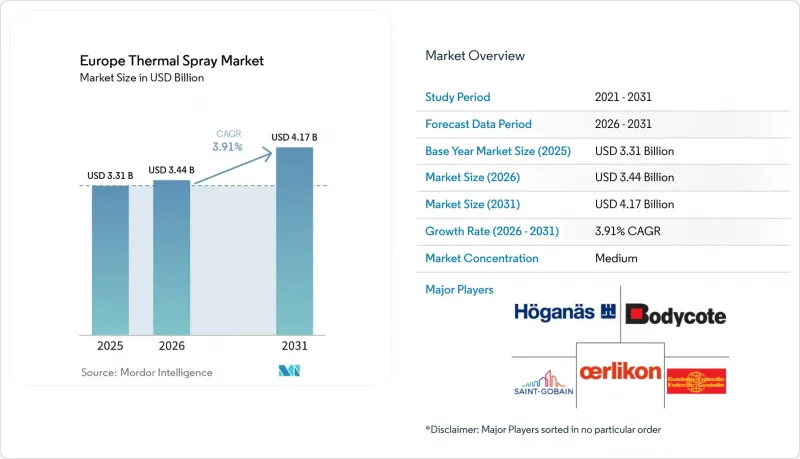
This report is Segmented by Product Type (Coatings, Materials, and Equipment), Process Type (Combustion and Electric Energy), End-User Industry (Aerospace, Industrial Gas Turbines, Automotive, Electronics, Oil and Gas, Medical Devices, Energy and Power, Steel Making, Textile, and Printing and Paper), and Geography (Germany, UK, France, Italy, and More). Market Forecasts are Provided in Value (USD).
Europe Thermal Spray Market Trends and Insights
Medical-Grade Ti and HA Coatings for Implants
With Europe's over-65 population set to reach nearly one-third by 2030, orthopedic and dental implant manufacturers are increasingly adopting plasma-sprayed titanium and hydroxyapatite layers. These advancements are notably shortening healing times and diminishing the necessity for revision surgeries. The evolution of suspension plasma spray now adeptly handles sub-micron HA powders, closely resembling natural bone minerals and adhering to the rigorous ISO 13779-2 certification standards. While reforms tying hospital payments to implant longevity have increased demand, a worrisome trend surfaces: over half of titanium powder is still procured from merely two North American suppliers, amplifying supply vulnerabilities.
EU Decarbonization Mandates for Turbines and Boilers
Operators, under the EU Clean Industrial Deal, face a 2030 deadline for significant emissions reductions. In response, they are retrofitting turbines with gadolinium- and lanthanum-zirconate thermal barrier coatings (TBCs), which are designed to withstand specific volumes of hydrogen blends. Early tests in Dutch combined-cycle plants have highlighted notable durability enhancements. Furthermore, the Energy Performance of Buildings Directive, which emphasizes high boiler efficiency, is accelerating the replacement cycle for MCrAlY bond coats.
High CAPEX of Robot-Integrated Spray Cells
Small shops often find automated cells prohibitively expensive, as they are unable to distribute the costs over sufficient sales. Leasing offers a solution, converting a significant upfront cost (capital expenditure - CAPEX) into a more digestible ongoing expense (operational expenditure - OPEX). However, this convenience comes at a price, as users become tethered to costly consumables, which squeeze their profit margins. Adding to the financial stakes, the swift transition from cold-spray systems to the newer HVAF technology, just a few years apart, amplifies the risks of rapid obsolescence.
Other drivers and restraints analyzed in the detailed report include:
- Rapid Uptake of HVOF Ceramic Coatings for EV Rotors
- Surging Demand for Wear-Resistant Coatings in Wind-Turbine Rebuilds
- Supply Tightness of YSZ and Rare-Earth Oxides
For complete list of drivers and restraints, kindly check the Table Of Contents.
Segment Analysis
In 2025, coatings took center stage in the European thermal spray market, securing a dominant 77.13% share. This dominance highlights the consumable nature of coatings and the aerospace sector's regular overhaul cycles. Meanwhile, the equipment segment is on an upward trajectory, with projections indicating a 3.95% CAGR growth during the forecast period of 2026-2031. This anticipated growth is fueled by OEMs' initiatives to digitize spray cells and integrate real-time diagnostics. The equipment segment of Europe's thermal spray market is set to benefit from Oerlikon's predictive-maintenance modules. These advanced modules not only trigger automatic spare-part orders but also boost aftermarket revenue. Positioned between coatings and equipment, materials are gaining momentum, thanks in part to Hoganas' recent introductions of Amperit 678 and 685. These new materials resonate with the industry's pivot towards reducing nickel and cobalt, a shift driven by REACH mandates.
Price dynamics in the European thermal spray sector showcase a clear disparity. Aerospace TBC powders fetch premium prices, while industrial tungsten-carbide grades are priced more modestly. Additionally, dust-collection systems and gravimetric feeders have evolved from secondary tools to vital compliance instruments. This transformation is primarily attributed to ISO 45001 enforcement, which emphasizes the capture of sub-micron particulates.
Additional Benefits:
- The market estimate (ME) sheet in Excel format
- 3 months of analyst support
TABLE OF CONTENTS
1 Introduction
- 1.1 Study Assumptions and Market Definition
- 1.2 Scope of the Study
2 Research Methodology
3 Executive Summary
4 Market Landscape
- 4.1 Market Overview
- 4.2 Market Drivers
- 4.2.1 Medical-grade Ti and HA coatings for implants
- 4.2.2 EU decarbonisation mandates for turbines and boilers
- 4.2.3 Rapid uptake of HVOF ceramic coatings for EV rotors
- 4.2.4 AI-optimised spray-path algorithms cut scrap
- 4.2.5 Surging demand for wear-resistant coatings in European Union wind-turbine rebuilds
- 4.3 Market Restraints
- 4.3.1 High CAPEX of robot-integrated spray cells
- 4.3.2 Supply tightness of YSZ and rare-earth oxides
- 4.3.3 ESG-driven phase-out of methane fuel in spray booths
- 4.4 Value Chain Analysis
- 4.5 Porter's Five Forces
- 4.5.1 Bargaining Power of Suppliers
- 4.5.2 Bargaining Power of Buyers
- 4.5.3 Threat of New Entrants
- 4.5.4 Threat of Substitutes
- 4.5.5 Competitive Rivalry
5 Market Size and Growth Forecasts (Value)
- 5.1 By Product Type
- 5.1.1 Coatings
- 5.1.2 Materials
- 5.1.2.1 Coating Materials
- 5.1.2.1.1 Powders
- 5.1.2.1.1.1 Ceramics
- 5.1.2.1.1.2 Metals
- 5.1.2.1.1.3 Polymer
- 5.1.2.1.1.4 Other Coating Materials
- 5.1.2.1.1 Powders
- 5.1.2.2 Wires/Rods
- 5.1.2.3 Other Materials
- 5.1.2.1 Coating Materials
- 5.1.3 Thermal-Spray Equipment
- 5.1.3.1 Thermal Spray Coating System
- 5.1.3.2 Dust Collection Equipment
- 5.1.3.3 Spray Gun and Nozzle
- 5.1.3.4 Feeder Equipment
- 5.1.3.5 Spare Parts
- 5.1.3.6 Noise-reducing Enclosure
- 5.1.3.7 Other Thermal Spray Equipment
- 5.2 By Process Type
- 5.2.1 Combustion
- 5.2.2 Electric Energy
- 5.3 By End-user Industry
- 5.3.1 Aerospace
- 5.3.2 Industrial Gas Turbines
- 5.3.3 Automotive
- 5.3.4 Electronics
- 5.3.5 Oil and Gas
- 5.3.6 Medical Devices
- 5.3.7 Energy and Power
- 5.3.8 Steel Making
- 5.3.9 Textile
- 5.3.10 Printing and Paper
- 5.4 By Geography
- 5.4.1 Germany
- 5.4.2 United Kingdom
- 5.4.3 France
- 5.4.4 Italy
- 5.4.5 Spain
- 5.4.6 NORDICS Countries
- 5.4.7 Russia
- 5.4.8 Rest of Europe
6 Competitive Landscape
- 6.1 Market Concentration
- 6.2 Strategic Moves
- 6.3 Market Share(%)/Ranking Analysis
- 6.4 Company Profiles (includes Global Overview, Market Overview, Core Segments, Financials, Strategic Information, Products and Services, Recent Developments)
- 6.4.1 Thermal Spray Powder Companies
- 6.4.1.1 Air Products and Chemicals, Inc.
- 6.4.1.2 AMETEK
- 6.4.1.3 C&M Technologies GmbH
- 6.4.1.4 CASTOLIN EUTECTIC
- 6.4.1.5 CRS Holdings Inc.
- 6.4.1.6 Diffusion Engineers Limited
- 6.4.1.7 Fujimi Corporation
- 6.4.1.8 Global Tungsten & Powders
- 6.4.1.9 H.C. Starck
- 6.4.1.10 HAI Inc
- 6.4.1.11 Hoganas AB
- 6.4.1.12 Kennametl Stellite
- 6.4.1.13 Linde plc
- 6.4.1.14 Metallisation Limited
- 6.4.1.15 OC Oerlikon Management AG
- 6.4.1.16 Saint-Gobain
- 6.4.1.17 Sandvik AB
- 6.4.1.18 The Fisher Barton Group
- 6.4.1.19 Treibacher Industrie AG
- 6.4.2 Thermal Spray Coating Companies
- 6.4.2.1 APS Materials, Inc.
- 6.4.2.2 ARC International
- 6.4.2.3 Bodycote
- 6.4.2.4 CASTOLIN EUTECTIC
- 6.4.2.5 Chromalloy Gas Turbine LLC
- 6.4.2.6 Fujimi Corporation
- 6.4.2.7 Kennametl Stellite
- 6.4.2.8 Linde plc
- 6.4.2.9 Metallisation Limited
- 6.4.2.10 OC Oerlikon Management AG
- 6.4.2.11 Pamarco
- 6.4.2.12 Surface Dynamics
- 6.4.2.13 The Fisher Barton Group
- 6.4.3 Thermal Spray Equipment Companies
- 6.4.3.1 Air Products and Chemicals, Inc.
- 6.4.3.2 Camfil Air Pollution Control
- 6.4.3.3 CASTOLIN EUTECTIC
- 6.4.3.4 Donaldson Company Inc.
- 6.4.3.5 Flame Spray Technologies BV
- 6.4.3.6 GTV-wear GmbH
- 6.4.3.7 HAI Inc
- 6.4.3.8 Kennametl Stellite
- 6.4.3.9 Kurt J. Lesker Company
- 6.4.3.10 Linde plc
- 6.4.3.11 Metallisation Limited
- 6.4.3.12 OC Oerlikon Management AG
- 6.4.3.13 Saint-Gobain
- 6.4.3.14 The Lincoln Electric Company
- 6.4.1 Thermal Spray Powder Companies
7 Market Opportunities and Future Outlook
- 7.1 White-space and unmet-need assessment

