PUBLISHER: Global Market Insights Inc. | PRODUCT CODE: 2109161

PUBLISHER: Global Market Insights Inc. | PRODUCT CODE: 2109161
Solid State Transformers Market Opportunity, Growth Drivers, Industry Trend Analysis, and Forecast 2026 - 2035
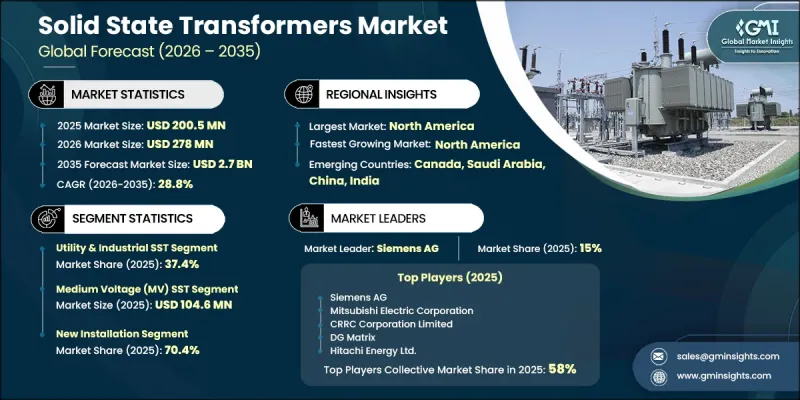
The Global Solid State Transformers Market was valued at USD 200.5 million in 2025 and is estimated to grow at a CAGR of 28.8% to reach USD 2.7 billion by 2035.
Market growth is driven by the ongoing modernization of aging power transmission and distribution infrastructure, increasing deployment of renewable energy systems, and the rising integration of distributed energy resources into electricity networks. Expanding investments in high-power electric vehicle charging infrastructure, greater electrification across transportation and industrial sectors, and continuous progress in wide-bandgap power semiconductor technologies are further accelerating industry development. These technological advancements are enabling more compact, energy-efficient, and intelligent power conversion solutions capable of supporting modern grid requirements. As utilities and industrial operators prioritize grid reliability, digitalization, and operational flexibility, demand for advanced transformer technologies continues to rise. The growing need for efficient power management, enhanced grid resilience, and seamless integration of next-generation energy systems is expected to create significant opportunities for the solid state transformers market throughout the forecast period.
| Market Scope | |
|---|---|
| Start Year | 2025 |
| Forecast Year | 2026-2035 |
| Start Value | $200.5 Million |
| Forecast Value | $2.7 Billion |
| CAGR | 28.8% |
The expansion of the solid state transformers market is closely linked to increasing investments in upgrading and modernizing electricity transmission and distribution infrastructure worldwide. Utilities are steadily transitioning toward digital power networks that require advanced power conversion technologies, real-time voltage regulation, bidirectional power flow, and improved grid reliability. Unlike conventional transformer technologies, solid state transformers are designed to support modern energy distribution requirements through advanced power electronics and intelligent digital controls. In addition, the growing adoption of wide-bandgap semiconductor technologies is improving operational efficiency, increasing power density, reducing energy losses, and enabling higher-frequency operation, all of which continue to strengthen market growth.
The medium voltage (MV) solid state transformers segment generated USD 104.6 million in 2025. The segment is benefiting from increasing deployment across modern power distribution networks, renewable energy integration projects, industrial power systems, and high-capacity electric vehicle charging infrastructure. Medium-voltage solid state transformers provide efficient AC-to-DC power conversion, bidirectional energy flow, superior voltage regulation, and enhanced power quality while supporting the integration of decentralized energy resources. Their compatibility with digitally managed electricity networks and advanced distribution infrastructure continues to reinforce their leading market position.
North America Solid State Transformers Market accounted for 38.9% share in 2025. Regional growth is supported by substantial investments in power grid modernization, renewable energy integration, and the continued expansion of electric vehicle infrastructure. Increasing emphasis on improving electricity network reliability, digital substations, and distributed energy resource integration is creating strong demand for advanced power electronics and solid state transformer technologies across utility and industrial applications. Ongoing investments in research and development focused on wide-bandgap semiconductor technologies, intelligent grid management systems, and next-generation power distribution solutions are expected to further strengthen market expansion across the region.
Major companies operating in the global solid state transformers market include ABB Ltd., CRRC Corporation Limited, DG Matrix, Eaton Corporation plc, Fuji Electric Co., Ltd., GridBridge, Inc., Hitachi Energy Ltd., Hitron Winders, Hyosung Heavy Industries Corporation, Hyperscale Powe, Mitsubishi Electric Corporation, Schneider Electric SE, Siemens AG, Tarxon Power, TBEA Co., Ltd., and Turbo Power Systems Ltd. Companies participating in the solid state transformers market are strengthening their market presence by investing in advanced power electronics, wide-bandgap semiconductor technologies, and intelligent transformer platforms that improve efficiency, reliability, and grid performance. Manufacturers are expanding research and development activities to enhance product capabilities, increase power density, and support digital grid applications. Strategic collaborations with utilities, industrial organizations, and energy technology providers are helping companies accelerate commercialization and broaden their customer base. Businesses are also focusing on expanding manufacturing capacity, improving system integration capabilities, and developing solutions compatible with renewable energy systems, distributed energy resources, and electric vehicle charging infrastructure.
Table of Contents
Chapter 1 Methodology and Scope
- 1.1 Market scope and definition
- 1.2 Research design
- 1.2.1 Research approach
- 1.2.2 Data collection methods
- 1.3 Data mining sources
- 1.3.1 Global
- 1.3.2 Regional/Country
- 1.4 Base estimates and calculations
- 1.4.1 Base year calculation
- 1.4.2 Key trends for market estimation
- 1.5 Primary research and validation
- 1.5.1 Primary sources
- 1.6 Forecast model
- 1.7 Research assumptions and limitations
Chapter 2 Executive Summary
- 2.1 Industry 360° synopsis, 2022 – 2035
- 2.2 Key market trends
- 2.2.1 Product type trends
- 2.2.2 Voltage level trends
- 2.2.3 Power rating trends
- 2.2.4 Deployment trends
- 2.2.5 Application trends
- 2.2.6 Regional trends
- 2.3 TAM Analysis, 2026-2035
- 2.4 CXO perspectives: Strategic imperatives
Chapter 3 Industry Insights
- 3.1 Industry ecosystem analysis
- 3.1.1 Supplier Landscape
- 3.1.2 Profit Margin
- 3.1.3 Cost structure
- 3.1.4 Value addition at each stage
- 3.1.5 Factor affecting the value chain
- 3.1.6 Disruptions
- 3.2 Industry impact forces
- 3.2.1 Growth drivers
- 3.2.1.1 Modernization of aging power grid infrastructure
- 3.2.1.2 Increasing integration of renewable energy and distributed energy resources (DERs)
- 3.2.1.3 Expansion of high-power electric vehicle (EV) charging infrastructure
- 3.2.1.4 Growing electrification across transportation, industrial facilities, and data centers
- 3.2.1.5 Advancements in wide-bandgap (SiC and GaN) power semiconductor technologies
- 3.2.2 Industry pitfalls and challenges
- 3.2.2.1 High cost of wide-bandgap power semiconductor integration
- 3.2.2.2 Complex system design and grid interoperability challenges
- 3.2.3 Market opportunities
- 3.2.3.1 Expansion of smart grids and digital substations
- 3.2.3.2 Growing deployment of renewable energy, battery energy storage systems (BESS), and ultra-fast EV charging infrastructure
- 3.2.1 Growth drivers
- 3.3 Growth potential analysis
- 3.4 Regulatory landscape
- 3.4.1 North America
- 3.4.2 Europe
- 3.4.3 Asia Pacific
- 3.4.4 Latin America
- 3.4.5 Middle East & Africa
- 3.5 Porter’s analysis
- 3.6 PESTEL analysis
- 3.7 Technology and Innovation landscape
- 3.7.1 Current technological trends
- 3.7.2 Emerging technologies
- 3.8 Price trends
- 3.8.1 By region
- 3.8.2 By product
- 3.9 Pricing Strategies
- 3.10 Emerging Business Models
- 3.11 Compliance Requirements
- 3.12 Patent and IP analysis
Chapter 4 Competitive Landscape, 2025
- 4.1 Introduction
- 4.2 Company market share analysis
- 4.2.1 By region
- 4.2.1.1 North America
- 4.2.1.2 Europe
- 4.2.1.3 Asia Pacific
- 4.2.1.4 Latin America
- 4.2.1.5 Middle East & Africa
- 4.2.2 Market concentration analysis
- 4.2.1 By region
- 4.3 Competitive benchmarking of key players
- 4.3.1 Financial performance comparison
- 4.3.1.1 Revenue
- 4.3.1.2 Profit margin
- 4.3.1.3 R&D
- 4.3.2 Product portfolio comparison
- 4.3.2.1 Product range breadth
- 4.3.2.2 Technology
- 4.3.2.3 Innovation
- 4.3.3 Geographic presence comparison
- 4.3.3.1 Global footprint analysis
- 4.3.3.2 Service network coverage
- 4.3.3.3 Market penetration by region
- 4.3.4 Competitive positioning matrix
- 4.3.4.1 Leaders
- 4.3.4.2 Challengers
- 4.3.4.3 Followers
- 4.3.4.4 Niche players
- 4.3.5 Strategic outlook matrix
- 4.3.1 Financial performance comparison
- 4.4 Key developments
- 4.4.1 Mergers and acquisitions
- 4.4.2 Partnerships and collaborations
- 4.4.3 Technological advancements
- 4.4.4 Expansion and investment strategies
- 4.4.5 Digital transformation initiatives
- 4.5 Emerging/ startup competitors landscape
Chapter 5 Market Estimates and Forecast, By Product Type, 2022 – 2035 (USD Million)
- 5.1 Key trends
- 5.2 Distribution SST
- 5.3 Utility & industrial SST
- 5.4 Traction SST
Chapter 6 Market Estimates and Forecast, By Voltage Level, 2022 – 2035 (USD Million)
- 6.1 Key trends
- 6.2 Low voltage (LV) SST
- 6.3 Medium voltage (MV) SST
- 6.4 High voltage (HV) SST
Chapter 7 Market Estimates and Forecast, By Power Rating, 2022 – 2035 (USD Million)
- 7.1 Key trends
- 7.2 Below 100 kVA
- 7.3 100 kVA – 1 MVA
- 7.4 Above 1 MVA
Chapter 8 Market Estimates and Forecast, By Deployment Type, 2022 – 2035 (USD Million)
- 8.1 Key trends
- 8.2 New installation
- 8.3 Retrofit & replacement
Chapter 9 Market Estimates and Forecast, By Application, 2022 – 2035 (USD Million)
- 9.1 Key trends
- 9.2 Utility & smart grid
- 9.3 Renewable energy
- 9.4 Electric vehicle charging infrastructure
- 9.5 Railway & traction
- 9.6 Industrial
- 9.7 Data centers
- 9.8 Others
Chapter 10 Market Estimates and Forecast, By Region, 2022 – 2035 (USD Million)
- 10.1 Key trends
- 10.2 North America
- 10.2.1 U.S.
- 10.2.2 Canada
- 10.3 Europe
- 10.3.1 Germany
- 10.3.2 UK
- 10.3.3 France
- 10.3.4 Spain
- 10.3.5 Italy
- 10.4 Asia Pacific
- 10.4.1 China
- 10.4.2 India
- 10.4.3 Japan
- 10.4.4 Australia
- 10.4.5 South Korea
- 10.5 Latin America
- 10.5.1 Brazil
- 10.5.2 Mexico
- 10.5.3 Argentina
- 10.6 Middle East and Africa
- 10.6.1 South Africa
- 10.6.2 Saudi Arabia
- 10.6.3 UAE
Chapter 11 Company Profiles
- 11.1 Global Key Players
- 11.1.1 Siemens AG
- 11.1.2 Mitsubishi Electric Corporation
- 11.1.3 CRRC Corporation Limited
- 11.1.4 DG Matrix
- 11.1.5 Hitachi Energy Ltd.
- 11.2 Regional key players
- 11.2.1 North America
- 11.2.1.1 ABB Ltd.
- 11.2.1.2 Eaton Corporation plc
- 11.2.2 Asia Pacific
- 11.2.2.1 Hyosung Heavy Industries Corporation
- 11.2.2.2 Fuji Electric Co., Ltd.
- 11.2.2.3 TBEA Co., Ltd.
- 11.2.3 Europe
- 11.2.3.1 Schneider Electric SE
- 11.2.3.2 Turbo Power Systems Ltd.
- 11.2.1 North America
- 11.3 Niche Players/Disruptors
- 11.3.1 GridBridge, Inc.
- 11.3.2 Tarxon Power
- 11.3.3 Hitron Winders
- 11.3.4 Hyperscale Power

