PUBLISHER: MarketsandMarkets | PRODUCT CODE: 1964923
PUBLISHER: MarketsandMarkets | PRODUCT CODE: 1964923
White Oil Market by Grade (Pharmaceutical, Food, Technical), Application (Polymers, Personal Care, Textiles, Pharmaceuticals, Adhesives & Sealants, Food), and Region - Global Forecast to 2030
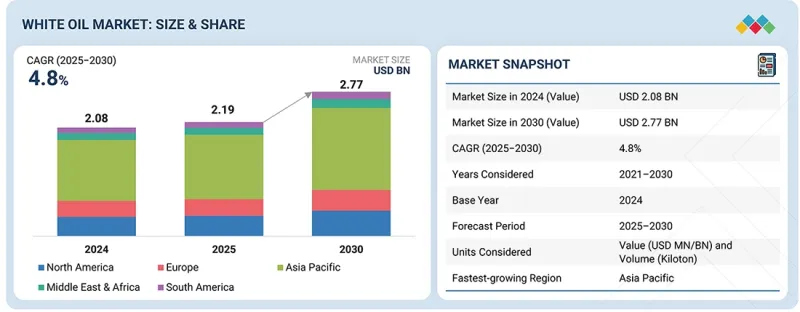
The white oil market is expected to reach USD 2.77 billion by 2030, from USD 2.19 billion in 2025, with a CAGR of 4.8%. This growth is supported by the expansion of industries such as pharmaceuticals, personal care, plastics, and food processing. As healthcare manufacturing continues to rise and quality standards become more stringent, demand for refined, pharmacopeia-grade white oils is increasing.
| Scope of the Report | |
|---|---|
| Years Considered for the Study | 2021-2030 |
| Base Year | 2024 |
| Forecast Period | 2025-2030 |
| Units Considered | Value (USD MN/BN) and Volume (Kiloton) |
| Segments | Grade, Application |
| Regions covered | Asia Pacific, Europe, North America, Middle East & Africa, South America |
At the same time, rising consumption of packaged foods and premium cosmetic products is adding to the need for food- and cosmetic-grade mineral oils. Expanding production of polymers and flexible packaging, especially in emerging economies, is also increasing usage as white oil is widely used as a processing aid and plasticizer.
"By grade, technical-grade white oils rank second in the market."
Technical-grade white oil is refined to a functional purity level suitable for non-food, non-pharmaceutical industrial uses (typically compliant with FDA 21 CFR 178.3620(b) for indirect contact). The product preserves basic white oil properties through its clear appearance, excellent lubricating ability, and capacity to withstand chemical and thermal stress. However, it does not meet the highest purity standards required for food and medical applications. The global market predominantly features technical grade as the most common product because its cost-performance ratio offers favorable financial benefits. It is widely used in various sectors, including plastics, polymers, textiles, adhesives, metalworking fluids, and general manufacturing, where companies need regulatory-grade purity only for essential operations while prioritizing cost and efficiency.
"By application, the personal care segment holds a significant market share."
The personal care industry is propelled by rapid urbanization, rising female workforce participation, and changing consumer habits in emerging economies. Increasing disposable income and purchasing power allow people to buy premium skin and hair care products. White oil is essential in cosmetic products because it effectively moisturizes skin and remains chemically stable while being safe for sensitive skin. It acts as the main ingredient in various products like baby oils, facial lotions, and water-resistant creams because it helps retain moisture without causing skin irritation. Manufacturers now focus on pharmaceutical-grade white oils that meet strict international safety standards due to the rising demand for clean beauty products. T
"North America is the second-largest market for white oil."
The North American white oil market exhibits strong regional ties driven by the demand for high-purity and regulatory-compliant grades, which pharmaceutical companies and advanced polymer packaging require under USMCA trade standards. The market benefits from a solid industrial foundation that stretches from the US Gulf Coast to the Ontario-Quebec corridor in Canada. The US focuses on medical-grade products and e-commerce services, fueling market demand, while Canada produces food-grade lubricants and Mexico develops its domestic drug and snack processing industries. The white oil market continues steady growth because this essential, non-toxic substance plays vital roles in healthcare, food, and consumer goods supply chains that distribute products across North America.
Profile break-up of primary participants for the report:
- By Company Type: Tier 1 - 65%, Tier 2 - 20%, and Tier 3 - 15%
- By Designation: C-Level Executives - 25%, Directors - 30%, and Others - 45%
- By Region: North America - 30%, Asia Pacific - 40%, Europe - 20%, Middle East & Africa - 7%, and South America - 3%
Key players in the white oil market include China Petroleum & Chemical Corporation (Sinopec) (China), Sonneborn LLC (US), Calumet, Inc. (US), Savita Oil Technologies Limited (India), Gandhar Oil Refinery (India) Limited (India), and others. These companies have adopted various strategies, such as acquisitions and agreements, to expand their market share and increase revenue.
Research Coverage:
The report defines segments and projects the size of the white oil market based on grade, application, and region. It strategically profiles key players and thoroughly analyzes their market share and core competencies. It also tracks and examines competitive developments and other initiatives they undertake in the market.
Reasons to Buy the Report:
The report aims to assist market leaders and new entrants by providing close estimates of revenue figures for the white oil market and its segments. It also helps stakeholders gain a deeper understanding of the competitive landscape, acquire valuable insights to strengthen their market positions, and develop effective go-to-market strategies. Additionally, it enables stakeholders to gauge the market's pulse and offers information on key drivers, restraints, challenges, and opportunities.
The report provides insights into the following pointers:
- Analysis of key drivers (high demand for white oil in various applications), restraints (availability of substitutes), opportunities (extensive use of specialty-grade white oil in separator manufacturing), and challenges (volatility in raw material prices and strict regulations and quality standards) influencing the growth of the white oil market.
- Product Development/Innovation: Detailed insights into upcoming technologies and R&D activities in the white oil market.
- Market Development: Comprehensive information about lucrative markets - the report analyzes the white oil market across varied regions.
- Market Diversification: Exhaustive information about new products, various types, untapped geographies, recent developments, and investments in the white oil market.
- Competitive Assessment: In-depth assessment of market shares, growth strategies, and product offerings of leading players such as China Petroleum & Chemical Corporation (Sinopec) (China), Sonneborn LLC (US), Calumet, Inc. (US), Savita Oil Technologies Limited (India), and Gandhar Oil Refinery (India) Limited (India).
TABLE OF CONTENTS
1 INTRODUCTION
- 1.1 STUDY OBJECTIVES
- 1.2 MARKET DEFINITION
- 1.3 STUDY SCOPE
- 1.3.1 MARKETS COVERED AND REGIONAL SCOPE
- 1.3.2 INCLUSIONS AND EXCLUSIONS
- 1.3.3 YEARS CONSIDERED
- 1.4 CURRENCY CONSIDERED
- 1.5 UNIT CONSIDERED
- 1.6 STAKEHOLDERS
2 EXECUTIVE SUMMARY
- 2.1 KEY INSIGHTS AND MARKET HIGHLIGHTS
- 2.2 KEY MARKET PARTICIPANTS: MAPPING OF STRATEGIC DEVELOPMENTS
- 2.3 DISRUPTIVE TRENDS IN WHITE OIL MARKET
- 2.4 HIGH-GROWTH SEGMENTS
- 2.5 REGIONAL SNAPSHOT: MARKET SIZE, GROWTH RATE, AND FORECAST
3 PREMIUM INSIGHTS
- 3.1 ATTRACTIVE OPPORTUNITIES FOR PLAYERS IN WHITE OIL MARKET
- 3.2 WHITE OIL MARKET, BY GRADE
- 3.3 WHITE OIL MARKET, BY APPLICATION
- 3.4 WHITE OIL MARKET, BY COUNTRY
4 MARKET OVERVIEW
- 4.1 INTRODUCTION
- 4.2 MARKET DYNAMICS
- 4.2.1 DRIVERS
- 4.2.1.1 High demand for white oil in various applications
- 4.2.2 RESTRAINTS
- 4.2.2.1 Availability of substitutes
- 4.2.3 OPPORTUNITIES
- 4.2.3.1 Extensive use of specialty-grade white oils in separator manufacturing
- 4.2.4 CHALLENGES
- 4.2.4.1 Volatility in raw material prices
- 4.2.4.2 Stringent regulations and quality standards
- 4.2.1 DRIVERS
- 4.3 UNMET NEEDS AND WHITE SPACES
- 4.3.1 UNMET NEEDS IN WHITE OIL MARKET
- 4.3.2 WHITE SPACES
- 4.4 INTERCONNECTED MARKETS AND CROSS-SECTOR OPPORTUNITIES
- 4.4.1 INTERCONNECTED MARKETS
- 4.4.2 CROSS-SECTOR OPPORTUNITIES
- 4.5 EMERGING BUSINESS MODELS AND ECOSYSTEM SHIFTS
- 4.5.1 EMERGING BUSINESS MODELS
- 4.5.2 ECOSYSTEM SHIFTS
- 4.6 STRATEGIC MOVES BY TIER-1/2/3 PLAYERS
5 INDUSTRY TRENDS
- 5.1 PORTER'S FIVE FORCES ANALYSIS
- 5.1.1 BARGAINING POWER OF SUPPLIERS
- 5.1.2 BARGAINING POWER OF BUYERS
- 5.1.3 THREAT OF NEW ENTRANTS
- 5.1.4 THREAT OF SUBSTITUTES
- 5.1.5 INTENSITY OF COMPETITIVE RIVALRY
- 5.2 MACROECONOMIC OUTLOOK
- 5.2.1 GDP TRENDS AND FORECAST
- 5.2.2 TRENDS IN GLOBAL WHITE OIL INDUSTRY
- 5.3 VALUE CHAIN ANALYSIS
- 5.3.1 RESEARCH AND DEVELOPMENT (~15%)
- 5.3.2 RAW MATERIAL SOURCING (~25%)
- 5.3.3 MANUFACTURING (~40%)
- 5.3.4 DISTRIBUTION (~10%)
- 5.3.5 END USE (~10%)
- 5.4 ECOSYSTEM ANALYSIS
- 5.5 PRICING ANALYSIS
- 5.5.1 AVERAGE SELLING PRICE OF WHITE OIL OFFERED BY KEY PLAYERS, 2024
- 5.5.2 AVERAGE SELLING PRICE TREND, BY REGION, 2022-2024
- 5.6 TRADE DATA
- 5.6.1 IMPORT SCENARIO (HS CODE 2709)
- 5.6.2 EXPORT SCENARIO (HS CODE 2709)
- 5.7 KEY CONFERENCES AND EVENTS, 2026-2027
- 5.8 TRENDS/DISRUPTIONS INFLUENCING CUSTOMER BUSINESS
- 5.9 INVESTMENT AND FUNDING SCENARIO
- 5.10 IMPACT OF 2025 US TARIFF
- 5.10.1 KEY TARIFF RATES
- 5.10.2 PRICE IMPACT ANALYSIS
- 5.10.3 IMPACT ON COUNTRIES/REGIONS
- 5.10.3.1 US
- 5.10.3.2 Europe
- 5.10.3.3 Asia Pacific
- 5.10.4 IMPACT ON END-USE INDUSTRIES
- 5.10.4.1 Adhesives
- 5.10.4.2 Pharmaceuticals
- 5.10.4.3 Personal care
- 5.10.4.4 Food
- 5.10.4.5 Textiles
- 5.10.4.6 Polymers
6 TECHNOLOGICAL ADVANCEMENTS, AI-DRIVEN IMPACT, PATENTS, INNOVATIONS, AND FUTURE APPLICATIONS
- 6.1 KEY TECHNOLOGIES
- 6.1.1 WAX HYDROTREATMENT
- 6.2 COMPLEMENTARY TECHNOLOGIES
- 6.2.1 TWO-STAGE HYDROTREATING
- 6.3 TECHNOLOGY/PRODUCT ROADMAP
- 6.3.1 SHORT-TERM (2025-2027): PROCESS OPTIMIZATION AND SUPPLY CHAIN SECURITY
- 6.3.2 MID-TERM (2027-2030): SUSTAINABLE MATERIAL INNOVATION AND PERFORMANCE ENHANCEMENT
- 6.3.3 LONG-TERM (2030-2035+): CIRCULARITY, DECARBONIZATION, AND NEXT-GENERATION BATTERY CHEMISTRIES
- 6.4 PATENT ANALYSIS
- 6.5 FUTURE APPLICATIONS
- 6.5.1 PHARMACEUTICALS & MEDICAL APPLICATIONS: DRUG FORMULATIONS, TOPICAL THERAPEUTICS, AND MEDICAL DEVICES
- 6.5.2 PERSONAL CARE & COSMETICS: BABY CARE, SENSITIVE SKIN FORMULATIONS, AND PREMIUM COSMETICS
- 6.5.3 FOOD PROCESSING & PACKAGING: FOOD-GRADE LUBRICANTS, COATINGS, AND RELEASE AGENTS
- 6.5.4 CROP PROTECTION & AGRICULTURE: SPRAY OILS, ADJUVANTS, AND PESTICIDE CARRIERS
- 6.6 IMPACT OF GEN AI
- 6.7 SUCCESS STORIES AND REAL-WORLD APPLICATIONS
- 6.7.1 CHEVRON LUMMUS GLOBAL: WORLD'S LARGEST ALL-HYDROPROCESSING WHITE OIL UNIT
- 6.7.2 SONNEBORN LLC: FORMULATING FLEXIBILITY AND SUSTAINABILITY
- 6.7.3 SHELL: REVOLUTIONIZING PURITY WITH GTL TECHNOLOGY
7 REGULATORY LANDSCAPE AND SUSTAINABILITY INITIATIVES
- 7.1 REGIONAL REGULATIONS AND COMPLIANCE
- 7.1.1 REGULATORY BODIES, GOVERNMENT AGENCIES, AND OTHER ORGANIZATIONS
- 7.1.2 INDUSTRY STANDARDS
- 7.2 SUSTAINABILITY INITIATIVES
- 7.2.1 CARBON IMPACT REDUCTION
- 7.2.2 ECO-APPLICATIONS
- 7.3 SUSTAINABILITY IMPACT AND REGULATORY POLICY INITIATIVES
- 7.4 CERTIFICATIONS, LABELING, AND ECO-STANDARDS
8 CUSTOMER LANDSCAPE AND BUYER BEHAVIOR
- 8.1 DECISION-MAKING PROCESS
- 8.2 KEY STAKEHOLDERS IN BUYING PROCESS AND THEIR EVALUATION CRITERIA
- 8.2.1 KEY STAKEHOLDERS IN BUYING PROCESS
- 8.2.2 BUYING CRITERIA
- 8.3 ADOPTION BARRIERS AND INTERNAL CHALLENGES
- 8.4 UNMET NEEDS OF END-USE INDUSTRIES
- 8.5 MARKET PROFITABILITY
- 8.5.1 REVENUE POTENTIAL
- 8.5.2 COST DYNAMICS
- 8.5.3 MARGIN OPPORTUNITIES IN KEY APPLICATIONS
9 WHITE OIL MARKET, BY GRADE
- 9.1 INTRODUCTION
- 9.2 FOOD
- 9.2.1 STRINGENT FOOD-SAFETY NORMS AND EXPANSION OF PROCESSED FOODS TO DRIVE MARKET
- 9.3 PHARMACEUTICAL
- 9.3.1 EXTENSIVE USE OF WHITE OIL IN PERSONAL CARE, SKINCARE, AND COSMETIC PRODUCTS TO DRIVE MARKET
- 9.4 TECHNICAL
- 9.4.1 SURGE IN PLASTIC PROCESSING AND POLYMER PRODUCTION TO DRIVE MARKET
10 WHITE OIL MARKET, BY APPLICATION
- 10.1 INTRODUCTION
- 10.2 ADHESIVES & SEALANTS
- 10.2.1 GROWTH IN PACKAGING, LABELING, AND HYGIENE PRODUCT INDUSTRIES TO DRIVE MARKET
- 10.3 PHARMACEUTICALS
- 10.3.1 NEED FOR HIGH-PURITY EXCIPIENTS IN PHARMACEUTICAL FORMULATIONS TO DRIVE MARKET
- 10.4 PERSONAL CARE
- 10.4.1 HIGH DEMAND FOR SKIN-SAFE AND INERT INGREDIENTS TO DRIVE MARKET
- 10.5 FOOD
- 10.5.1 INCREASED PROCESSED AND PACKAGED FOOD CONSUMPTION TO DRIVE MARKET
- 10.6 TEXTILES
- 10.6.1 COST-EFFECTIVENESS AND PROVEN COMPATIBILITY WITH TEXTILE MACHINERY TO DRIVE MARKET
- 10.7 POLYMERS
- 10.7.1 STEADY RISE IN GLOBAL PLASTIC OUTPUT TO DRIVE MARKET
- 10.8 OTHER APPLICATIONS
11 WHITE OIL MARKET, BY REGION
- 11.1 INTRODUCTION
- 11.2 ASIA PACIFIC
- 11.2.1 CHINA
- 11.2.1.1 Expanding polymer exports and booming pharmaceuticals and personal care industries to drive market
- 11.2.2 JAPAN
- 11.2.2.1 Rise of food processing and personal care applications to drive market
- 11.2.3 INDIA
- 11.2.3.1 Rapid expansion of pharma, agriculture, and cosmetic industries to drive market
- 11.2.4 SOUTH KOREA
- 11.2.4.1 Surge in pharmaceutical, cosmetic, and food manufacturing to drive market
- 11.2.5 INDONESIA
- 11.2.5.1 Growing plastic and packaging industry to drive market
- 11.2.6 REST OF ASIA PACIFIC
- 11.2.1 CHINA
- 11.3 EUROPE
- 11.3.1 GERMANY
- 11.3.1.1 Well-established cosmetics & personal care industries and high-volume textile processing to drive market
- 11.3.2 UK
- 11.3.2.1 Rise in agri-food processing, textile trade flow, and personal care manufacturing to drive market
- 11.3.3 FRANCE
- 11.3.3.1 Revitalization of domestic textiles and leadership in luxury cosmetics to drive market
- 11.3.4 ITALY
- 11.3.4.1 Prevalence of cosmetics and agri-food industries to drive market
- 11.3.5 SPAIN
- 11.3.5.1 Increasing demand for skincare, haircare, and beauty products to drive market
- 11.3.6 REST OF EUROPE
- 11.3.1 GERMANY
- 11.4 NORTH AMERICA
- 11.4.1 US
- 11.4.1.1 Premium skincare trends and pharmaceutical manufacturing expansion to drive market
- 11.4.2 CANADA
- 11.4.2.1 Proximity to major pharmaceutical, food processing, and polymer clusters to drive market
- 11.4.3 MEXICO
- 11.4.3.1 Domestic push into pharma and food manufacturing to drive market
- 11.4.1 US
- 11.5 MIDDLE EAST & AFRICA
- 11.5.1 GCC
- 11.5.1.1 Saudi Arabia
- 11.5.1.1.1 Food industry expansion, petrochemical integration, and pharma localization to drive market
- 11.5.1.2 UAE
- 11.5.1.2.1 Diversification strategy toward downstream manufacturing and consumer industries to drive market
- 11.5.1.3 Rest of GCC
- 11.5.1.1 Saudi Arabia
- 11.5.2 SOUTH AFRICA
- 11.5.2.1 Booming beauty and pharma industries to drive market
- 11.5.3 REST OF MIDDLE EAST & AFRICA
- 11.5.1 GCC
- 11.6 SOUTH AMERICA
- 11.6.1 BRAZIL
- 11.6.1.1 Premiumization trends and strong domestic demand in beauty segment to drive market
- 11.6.2 ARGENTINA
- 11.6.2.1 Robust pharmaceutical manufacturing base to drive market
- 11.6.3 REST OF SOUTH AMERICA
- 11.6.1 BRAZIL
12 COMPETITIVE LANDSCAPE
- 12.1 INTRODUCTION
- 12.2 KEY PLAYER STRATEGIES/RIGHT TO WIN, 2021-2025
- 12.3 REVENUE ANALYSIS, 2020-2024
- 12.4 MARKET SHARE ANALYSIS, 2024
- 12.4.1 CHINA PETROLEUM & CHEMICAL CORPORATION (CHINA)
- 12.4.2 SONNEBORN LLC (US)
- 12.4.3 CALUMET, INC. (US)
- 12.4.4 SAVITA OIL TECHNOLOGIES LIMITED (INDIA)
- 12.4.5 GANDHAR OIL REFINERY (INDIA) LIMITED (INDIA)
- 12.5 BRAND/PRODUCT COMPARISON
- 12.6 COMPANY VALUATION AND FINANCIAL METRICS
- 12.7 COMPANY EVALUATION MATRIX: KEY PLAYERS, 2024
- 12.7.1 STARS
- 12.7.2 EMERGING LEADERS
- 12.7.3 PERVASIVE PLAYERS
- 12.7.4 PARTICIPANTS
- 12.7.5 COMPANY FOOTPRINT: KEY PLAYERS, 2024
- 12.7.5.1 Company footprint
- 12.7.5.2 Region Footprint
- 12.7.5.3 Grade footprint
- 12.7.5.4 Application footprint
- 12.8 COMPANY EVALUATION MATRIX: START-UPS/SMES, 2024
- 12.8.1 PROGRESSIVE COMPANIES
- 12.8.2 RESPONSIVE COMPANIES
- 12.8.3 DYNAMIC COMPANIES
- 12.8.4 STARTING BLOCKS
- 12.8.5 COMPETITIVE BENCHMARKING: START-UPS/SMES, 2024
- 12.8.5.1 List of start-ups/SMEs
- 12.8.5.2 Competitive benchmarking of start-ups/SMEs
- 12.9 COMPETITIVE SCENARIO
- 12.9.1 DEALS
- 12.9.2 EXPANSIONS
13 COMPANY PROFILES
- 13.1 KEY PLAYERS
- 13.1.1 CHINA PETROLEUM & CHEMICAL CORPORATION
- 13.1.1.1 Business overview
- 13.1.1.2 Products offered
- 13.1.1.3 MnM view
- 13.1.1.3.1 Right to win
- 13.1.1.3.2 Strategic choices
- 13.1.1.3.3 Weaknesses and competitive threats
- 13.1.2 SONNEBORN LLC
- 13.1.2.1 Business overview
- 13.1.2.2 Products offered
- 13.1.2.3 MnM view
- 13.1.2.3.1 Right to win
- 13.1.2.3.2 Strategic choices
- 13.1.2.3.3 Weaknesses and competitive threats
- 13.1.3 CALUMET, INC.
- 13.1.3.1 Business overview
- 13.1.3.2 Products offered
- 13.1.3.3 Recent developments
- 13.1.3.3.1 Deals
- 13.1.3.4 MnM view
- 13.1.3.4.1 Right to win
- 13.1.3.4.2 Strategic choices
- 13.1.3.4.3 Weaknesses and competitive threats
- 13.1.4 SAVITA OIL TECHNOLOGIES LIMITED
- 13.1.4.1 Business overview
- 13.1.4.2 Products offered
- 13.1.4.3 MnM view
- 13.1.4.3.1 Right to win
- 13.1.4.3.2 Strategic choices
- 13.1.4.3.3 Weaknesses and competitive threats
- 13.1.5 GANDHAR OIL REFINERY (INDIA) LIMITED
- 13.1.5.1 Business overview
- 13.1.5.2 Products offered
- 13.1.5.3 MnM view
- 13.1.5.3.1 Right to win
- 13.1.5.3.2 Strategic choices
- 13.1.5.3.3 Weaknesses and competitive threats
- 13.1.6 EXXON MOBIL CORPORATION
- 13.1.6.1 Business overview
- 13.1.6.2 Products offered
- 13.1.6.3 Recent developments
- 13.1.6.3.1 Deals
- 13.1.7 ENEOS
- 13.1.7.1 Business overview
- 13.1.7.2 Products offered
- 13.1.8 SHELL
- 13.1.8.1 Business overview
- 13.1.8.2 Products offered
- 13.1.8.3 Recent developments
- 13.1.8.3.1 Deals
- 13.1.9 PETRONAS LUBRICANTS INTERNATIONAL
- 13.1.9.1 Business overview
- 13.1.9.2 Products offered
- 13.1.10 H&R GROUP
- 13.1.10.1 Business overview
- 13.1.10.2 Products offered
- 13.1.11 TOTALENERGIES
- 13.1.11.1 Business overview
- 13.1.11.2 Products offered
- 13.1.12 ENILIVE S.P.A.
- 13.1.12.1 Business overview
- 13.1.12.2 Products offered
- 13.1.13 SASOL LIMITED
- 13.1.13.1 Business overview
- 13.1.13.2 Products offered
- 13.1.14 APAR PETROLEUM SPECIALITIES FZE
- 13.1.14.1 Business overview
- 13.1.14.2 Products offered
- 13.1.14.3 Recent developments
- 13.1.14.3.1 Expansions
- 13.1.15 PANAMA PETROCHEM LIMITED
- 13.1.15.1 Business overview
- 13.1.15.2 Products offered
- 13.1.16 ATLANTIC PERFORMANCE OILS
- 13.1.16.1 Business overview
- 13.1.16.2 Products offered
- 13.1.17 COLUMBIA PETRO CHEM PVT. LTD.
- 13.1.17.1 Business overview
- 13.1.17.2 Products offered
- 13.1.18 PEAK LUBRICANTS
- 13.1.18.1 Business overview
- 13.1.18.2 Products offered
- 13.1.19 ADINATH CHEMICALS
- 13.1.19.1 Business overview
- 13.1.19.2 Products offered
- 13.1.20 ADDINOL
- 13.1.20.1 Business overview
- 13.1.20.2 Products offered
- 13.1.21 AXXONOIL SRL
- 13.1.21.1 Business overview
- 13.1.21.2 Products offered
- 13.1.22 AMARIS CHEMICAL SOLUTIONS
- 13.1.22.1 Business overview
- 13.1.22.2 Products offered
- 13.1.23 RENKERT OIL
- 13.1.23.1 Business overview
- 13.1.23.2 Products offered
- 13.1.24 PETRO-CANADA LUBRICANTS INC.
- 13.1.24.1 Business overview
- 13.1.24.2 Products offered
- 13.1.24.3 Recent developments
- 13.1.24.3.1 Deals
- 13.1.25 SEOJIN CHEMICAL CO., LTD.
- 13.1.25.1 Business overview
- 13.1.25.2 Products offered
- 13.1.26 OLEOTECNICA S.P.A.
- 13.1.26.1 Business overview
- 13.1.26.2 Products offered
- 13.1.1 CHINA PETROLEUM & CHEMICAL CORPORATION
- 13.2 OTHER PLAYERS
- 13.2.1 NANDAN PETROCHEM LTD.
- 13.2.2 LODHA PETRO
- 13.2.3 ROYAL GLOBAL ENERGY
- 13.2.4 MASTEROL FOODS PTY. LTD.
14 RESEARCH METHODOLOGY
- 14.1 RESEARCH DATA
- 14.1.1 SECONDARY DATA
- 14.1.1.1 List of secondary sources
- 14.1.1.2 Key data from secondary sources
- 14.1.2 PRIMARY DATA
- 14.1.2.1 List of primary interview participants (demand and supply sides)
- 14.1.2.2 Key data from primary sources
- 14.1.2.3 Insights from industry experts
- 14.1.2.4 Breakdown of primary interviews
- 14.1.1 SECONDARY DATA
- 14.2 MARKET SIZE ESTIMATION
- 14.2.1 BOTTOM-UP APPROACH
- 14.2.2 TOP-DOWN APPROACH
- 14.3 DEMAND-SIDE ANALYSIS
- 14.4 SUPPLY-SIDE ANALYSIS
- 14.4.1 CALCULATIONS FOR SUPPLY-SIDE ANALYSIS
- 14.5 GROWTH FORECAST
- 14.6 DATA TRIANGULATION
- 14.7 FACTOR ANALYSIS
- 14.8 RESEARCH ASSUMPTIONS
- 14.9 RESEARCH LIMITATIONS
- 14.10 RISK ASSESSMENT
15 APPENDIX
- 15.1 DISCUSSION GUIDE
- 15.2 KNOWLEDGESTORE: MARKETSANDMARKETS' SUBSCRIPTION PORTAL
- 15.3 CUSTOMIZATION OPTIONS
- 15.4 RELATED REPORTS
- 15.5 AUTHOR DETAILS
List of Tables
- TABLE 1 STRATEGIC MOVES BY TIER-1/2/3 PLAYERS
- TABLE 2 IMPACT OF PORTER'S FIVE FORCES
- TABLE 3 REAL GDP GROWTH (ANNUAL PERCENTAGE CHANGE), BY COUNTRY, 2022-2024 (%)
- TABLE 4 UNEMPLOYMENT RATE, BY COUNTRY, 2022-2024 (%)
- TABLE 5 INFLATION RATE, AVERAGE CONSUMER PRICES, BY COUNTRY, 2022-2024 (%)
- TABLE 6 FOREIGN DIRECT INVESTMENT, BY REGION, 2022-2023 (USD BILLION)
- TABLE 7 ROLE OF COMPANIES IN ECOSYSTEM
- TABLE 8 AVERAGE SELLING PRICE OF WHITE OIL OFFERED BY KEY PLAYERS, 2024 (USD/TON)
- TABLE 9 AVERAGE SELLING PRICE TREND, BY REGION, 2022-2024 (USD/TON)
- TABLE 10 IMPORT DATA FOR HS CODE 2709-COMPLIANT PRODUCTS, BY COUNTRY, 2021-2024 (USD THOUSAND)
- TABLE 11 EXPORT DATA FOR HS CODE 2709-COMPLIANT PRODUCTS, BY COUNTRY, 2021-2024 (USD THOUSAND)
- TABLE 12 KEY CONFERENCES AND EVENTS, 2026-2027
- TABLE 13 PATENT ANALYSIS
- TABLE 14 NORTH AMERICA: REGULATORY BODIES, GOVERNMENT AGENCIES, AND OTHER ORGANIZATIONS
- TABLE 15 EUROPE: REGULATORY BODIES, GOVERNMENT AGENCIES, AND OTHER ORGANIZATIONS
- TABLE 16 ASIA PACIFIC: REGULATORY BODIES, GOVERNMENT AGENCIES, AND OTHER ORGANIZATIONS
- TABLE 17 GLOBAL INDUSTRY STANDARDS
- TABLE 18 CERTIFICATIONS, LABELING, AND ECO-STANDARDS
- TABLE 19 INFLUENCE OF STAKEHOLDERS ON BUYING PROCESS FOR TOP THREE APPLICATIONS (%)
- TABLE 20 KEY BUYING CRITERIA FOR TOP THREE APPLICATIONS
- TABLE 21 UNMET NEEDS OF END-USE INDUSTRIES
- TABLE 22 WHITE OIL MARKET, BY GRADE, 2021-2024 (KILOTON)
- TABLE 23 WHITE OIL MARKET, BY GRADE, 2025-2030 (KILOTON)
- TABLE 24 WHITE OIL MARKET, BY APPLICATION, 2021-2024 (USD MILLION)
- TABLE 25 WHITE OIL MARKET, BY APPLICATION, 2025-2030 (USD MILLION)
- TABLE 26 WHITE OIL MARKET, BY APPLICATION, 2021-2024 (KILOTON)
- TABLE 27 WHITE OIL MARKET, BY APPLICATION, 2025-2030 (KILOTON)
- TABLE 28 ADHESIVES & SEALANTS: WHITE OIL MARKET, BY REGION, 2021-2024 (KILOTON)
- TABLE 29 ADHESIVES & SEALANTS: WHITE OIL MARKET, BY REGION, 2025-2030 (KILOTON)
- TABLE 30 PHARMACEUTICALS: WHITE OIL MARKET, BY REGION, 2021-2024 (KILOTON)
- TABLE 31 PHARMACEUTICALS: WHITE OIL MARKET, BY REGION, 2025-2030 (KILOTON)
- TABLE 32 PERSONAL CARE: WHITE OIL MARKET, BY REGION, 2021-2024 (KILOTON)
- TABLE 33 PERSONAL CARE: WHITE OIL MARKET, BY REGION, 2025-2030 (KILOTON)
- TABLE 34 FOOD: WHITE OIL MARKET, BY REGION, 2021-2024 (KILOTON)
- TABLE 35 FOOD: WHITE OIL MARKET, BY REGION, 2025-2030 (KILOTON)
- TABLE 36 TEXTILES: WHITE OIL MARKET, BY REGION, 2021-2024 (KILOTON)
- TABLE 37 TEXTILES: WHITE OIL MARKET, BY REGION, 2025-2030 (KILOTON)
- TABLE 38 POLYMERS: WHITE OIL MARKET, BY REGION, 2021-2024 (KILOTON)
- TABLE 39 POLYMERS: WHITE OIL MARKET, BY REGION, 2025-2030 (KILOTON)
- TABLE 40 OTHER APPLICATIONS: WHITE OIL MARKET, BY REGION, 2021-2024 (KILOTON)
- TABLE 41 OTHER APPLICATIONS: WHITE OIL MARKET, BY REGION, 2025-2030 (KILOTON)
- TABLE 42 WHITE OIL MARKET, BY REGION, 2021-2024 (USD MILLION)
- TABLE 43 WHITE OIL MARKET, BY REGION, 2025-2030 (USD MILLION)
- TABLE 44 WHITE OIL MARKET, BY REGION, 2021-2024 (KILOTON)
- TABLE 45 WHITE OIL MARKET, BY REGION, 2025-2030 (KILOTON)
- TABLE 46 ASIA PACIFIC: WHITE OIL MARKET, BY COUNTRY, 2021-2024 (USD MILLION)
- TABLE 47 ASIA PACIFIC: WHITE OIL MARKET, BY COUNTRY, 2025-2030 (USD MILLION)
- TABLE 48 ASIA PACIFIC: WHITE OIL MARKET, BY COUNTRY, 2021-2024 (KILOTON)
- TABLE 49 ASIA PACIFIC: WHITE OIL MARKET, BY COUNTRY, 2025-2030 (KILOTON)
- TABLE 50 ASIA PACIFIC: WHITE OIL MARKET, BY GRADE, 2021-2024 (KILOTON)
- TABLE 51 ASIA PACIFIC: WHITE OIL MARKET, BY GRADE, 2025-2030 (KILOTON)
- TABLE 52 ASIA PACIFIC: WHITE OIL MARKET, BY APPLICATION, 2021-2024 (KILOTON)
- TABLE 53 ASIA PACIFIC: WHITE OIL MARKET, BY APPLICATION, 2025-2030 (KILOTON)
- TABLE 54 CHINA: WHITE OIL MARKET, BY APPLICATION, 2021-2024 (KILOTON)
- TABLE 55 CHINA: WHITE OIL MARKET, BY APPLICATION, 2025-2030 (KILOTON)
- TABLE 56 JAPAN: WHITE OIL MARKET, BY APPLICATION, 2021-2024 (KILOTON)
- TABLE 57 JAPAN: WHITE OIL MARKET, BY APPLICATION, 2025-2030 (KILOTON)
- TABLE 58 INDIA: WHITE OIL MARKET, BY APPLICATION, 2021-2024 (KILOTON)
- TABLE 59 INDIA: WHITE OIL MARKET, BY APPLICATION, 2025-2030 (KILOTON)
- TABLE 60 SOUTH KOREA: WHITE OIL MARKET, BY APPLICATION, 2021-2024 (KILOTON)
- TABLE 61 SOUTH KOREA: WHITE OIL MARKET, BY APPLICATION, 2025-2030 (KILOTON)
- TABLE 62 INDONESIA: WHITE OIL MARKET, BY APPLICATION, 2021-2024 (KILOTON)
- TABLE 63 INDONESIA: WHITE OIL MARKET, BY APPLICATION, 2025-2030 (KILOTON)
- TABLE 64 REST OF ASIA PACIFIC: WHITE OIL MARKET, BY APPLICATION, 2021-2024 (KILOTON)
- TABLE 65 REST OF ASIA PACIFIC: WHITE OIL MARKET, BY APPLICATION, 2025-2030 (KILOTON)
- TABLE 66 EUROPE: WHITE OIL MARKET, BY COUNTRY, 2021-2024 (USD MILLION)
- TABLE 67 EUROPE: WHITE OIL MARKET, BY COUNTRY, 2025-2030 (USD MILLION)
- TABLE 68 EUROPE: WHITE OIL MARKET, BY COUNTRY, 2021-2024 (KILOTON)
- TABLE 69 EUROPE: WHITE OIL MARKET, BY COUNTRY, 2025-2030 (KILOTON)
- TABLE 70 EUROPE: WHITE OIL MARKET, BY GRADE, 2021-2024 (KILOTON)
- TABLE 71 EUROPE: WHITE OIL MARKET, BY GRADE, 2025-2030 (KILOTON)
- TABLE 72 EUROPE: WHITE OIL MARKET, BY APPLICATION, 2021-2024 (KILOTON)
- TABLE 73 EUROPE: WHITE OIL MARKET, BY APPLICATION, 2025-2030 (KILOTON)
- TABLE 74 GERMANY: WHITE OIL MARKET, BY APPLICATION, 2021-2024 (KILOTON)
- TABLE 75 GERMANY: WHITE OIL MARKET, BY APPLICATION, 2025-2030 (KILOTON)
- TABLE 76 UK: WHITE OIL MARKET, BY APPLICATION, 2021-2024 (KILOTON)
- TABLE 77 UK: WHITE OIL MARKET, BY APPLICATION, 2025-2030 (KILOTON)
- TABLE 78 FRANCE: WHITE OIL MARKET, BY APPLICATION, 2021-2024 (KILOTON)
- TABLE 79 FRANCE: WHITE OIL MARKET, BY APPLICATION, 2025-2030 (KILOTON)
- TABLE 80 ITALY: WHITE OIL MARKET, BY APPLICATION, 2021-2024 (KILOTON)
- TABLE 81 ITALY: WHITE OIL MARKET, BY APPLICATION, 2025-2030 (KILOTON)
- TABLE 82 SPAIN: WHITE OIL MARKET, BY APPLICATION, 2021-2024 (KILOTON)
- TABLE 83 SPAIN: WHITE OIL MARKET, BY APPLICATION, 2025-2030 (KILOTON)
- TABLE 84 REST OF EUROPE: WHITE OIL MARKET, BY APPLICATION, 2021-2024 (KILOTON)
- TABLE 85 REST OF EUROPE: WHITE OIL MARKET, BY APPLICATION, 2025-2030 (KILOTON)
- TABLE 86 NORTH AMERICA: WHITE OIL MARKET, BY COUNTRY, 2021-2024 (USD MILLION)
- TABLE 87 NORTH AMERICA: WHITE OIL MARKET, BY COUNTRY, 2025-2030 (USD MILLION)
- TABLE 88 NORTH AMERICA: WHITE OIL MARKET, BY COUNTRY, 2021-2024 (KILOTON)
- TABLE 89 NORTH AMERICA: WHITE OIL MARKET, BY COUNTRY, 2025-2030 (KILOTON)
- TABLE 90 NORTH AMERICA: WHITE OIL MARKET, BY GRADE, 2021-2024 (KILOTON)
- TABLE 91 NORTH AMERICA: WHITE OIL MARKET, BY GRADE, 2025-2030 (KILOTON)
- TABLE 92 NORTH AMERICA: WHITE OIL MARKET, BY APPLICATION, 2021-2024 (KILOTON)
- TABLE 93 NORTH AMERICA: WHITE OIL MARKET, BY APPLICATION, 2025-2030 (KILOTON)
- TABLE 94 US: WHITE OIL MARKET, BY APPLICATION, 2021-2024 (KILOTON)
- TABLE 95 US: WHITE OIL MARKET, BY APPLICATION, 2025-2030 (KILOTON)
- TABLE 96 CANADA: WHITE OIL MARKET, BY APPLICATION, 2021-2024 (KILOTON)
- TABLE 97 CANADA: WHITE OIL MARKET, BY APPLICATION, 2025-2030 (KILOTON)
- TABLE 98 MEXICO: WHITE OIL MARKET, BY APPLICATION, 2021-2024 (KILOTON)
- TABLE 99 MEXICO: WHITE OIL MARKET, BY APPLICATION, 2025-2030 (KILOTON)
- TABLE 100 MIDDLE EAST & AFRICA: WHITE OIL MARKET, BY COUNTRY, 2021-2024 (USD MILLION)
- TABLE 101 MIDDLE EAST & AFRICA: WHITE OIL MARKET, BY COUNTRY, 2025-2030 (USD MILLION)
- TABLE 102 MIDDLE EAST & AFRICA: WHITE OIL MARKET, BY COUNTRY, 2021-2024 (KILOTON)
- TABLE 103 MIDDLE EAST & AFRICA: WHITE OIL MARKET, BY COUNTRY, 2025-2030 (KILOTON)
- TABLE 104 MIDDLE EAST & AFRICA: WHITE OIL MARKET, BY GRADE, 2021-2024 (KILOTON)
- TABLE 105 MIDDLE EAST & AFRICA: WHITE OIL MARKET, BY GRADE, 2025-2030 (KILOTON)
- TABLE 106 MIDDLE EAST & AFRICA: WHITE OIL MARKET, BY APPLICATION, 2021-2024 (KILOTON)
- TABLE 107 MIDDLE EAST & AFRICA: WHITE OIL MARKET, BY APPLICATION, 2025-2030 (KILOTON)
- TABLE 108 SAUDI ARABIA: WHITE OIL MARKET, BY APPLICATION, 2021-2024 (KILOTON)
- TABLE 109 SAUDI ARABIA: WHITE OIL MARKET, BY APPLICATION, 2025-2030 (KILOTON)
- TABLE 110 UAE: WHITE OIL MARKET, BY APPLICATION, 2021-2024 (KILOTON)
- TABLE 111 UAE: WHITE OIL MARKET, BY APPLICATION, 2025-2030 (KILOTON)
- TABLE 112 REST OF GCC: WHITE OIL MARKET, BY APPLICATION, 2021-2024 (KILOTON)
- TABLE 113 REST OF GCC: WHITE OIL MARKET, BY APPLICATION, 2025-2030 (KILOTON)
- TABLE 114 SOUTH AFRICA: WHITE OIL MARKET, BY APPLICATION, 2021-2024 (KILOTON)
- TABLE 115 SOUTH AFRICA: WHITE OIL MARKET, BY APPLICATION, 2025-2030 (KILOTON)
- TABLE 116 REST OF MIDDLE EAST & AFRICA: WHITE OIL MARKET, BY APPLICATION, 2021-2024 (KILOTON)
- TABLE 117 REST OF MIDDLE EAST & AFRICA: WHITE OIL MARKET, BY APPLICATION, 2025-2030 (KILOTON)
- TABLE 118 SOUTH AMERICA: WHITE OIL MARKET, BY COUNTRY, 2021-2024 (USD MILLION)
- TABLE 119 SOUTH AMERICA: WHITE OIL MARKET, BY COUNTRY, 2025-2030 (USD MILLION)
- TABLE 120 SOUTH AMERICA: WHITE OIL MARKET, BY COUNTRY, 2021-2024 (KILOTON)
- TABLE 121 SOUTH AMERICA: WHITE OIL MARKET, BY COUNTRY, 2025-2030 (KILOTON)
- TABLE 122 SOUTH AMERICA: WHITE OIL MARKET, BY GRADE, 2021-2024 (KILOTON)
- TABLE 123 SOUTH AMERICA: WHITE OIL MARKET, BY GRADE, 2025-2030 (KILOTON)
- TABLE 124 SOUTH AMERICA: WHITE OIL MARKET, BY APPLICATION, 2021-2024 (KILOTON)
- TABLE 125 SOUTH AMERICA: WHITE OIL MARKET, BY APPLICATION, 2025-2030 (KILOTON)
- TABLE 126 BRAZIL: WHITE OIL MARKET, BY APPLICATION, 2021-2024 (KILOTON)
- TABLE 127 BRAZIL: WHITE OIL MARKET, BY APPLICATION, 2025-2030 (KILOTON)
- TABLE 128 ARGENTINA: WHITE OIL MARKET, BY APPLICATION, 2021-2024 (KILOTON)
- TABLE 129 ARGENTINA: WHITE OIL MARKET, BY APPLICATION, 2025-2030 (KILOTON)
- TABLE 130 REST OF SOUTH AMERICA: WHITE OIL MARKET, BY APPLICATION, 2021-2024 (KILOTON)
- TABLE 131 REST OF SOUTH AMERICA: WHITE OIL MARKET, BY APPLICATION, 2025-2030 (KILOTON)
- TABLE 132 KEY PLAYER STRATEGIES/RIGHT TO WIN, 2021-2025
- TABLE 133 WHITE OIL MARKET: DEGREE OF COMPETITION, 2024
- TABLE 134 REGION FOOTPRINT
- TABLE 135 GRADE FOOTPRINT
- TABLE 136 APPLICATION FOOTPRINT
- TABLE 137 LIST OF START-UPS/SMES
- TABLE 138 COMPETITIVE BENCHMARKING OF START-UPS/SMES
- TABLE 139 WHITE OIL MARKET: DEALS, 2021-2025
- TABLE 140 WHITE OIL MARKET: EXPANSIONS, 2021-2025
- TABLE 141 CHINA PETROLEUM & CHEMICAL CORPORATION: COMPANY OVERVIEW
- TABLE 142 CHINA PETROLEUM & CHEMICAL CORPORATION: PRODUCTS OFFERED
- TABLE 143 SONNEBORN LLC: COMPANY OVERVIEW
- TABLE 144 SONNEBORN LLC: PRODUCTS OFFERED
- TABLE 145 CALUMET, INC.: COMPANY OVERVIEW
- TABLE 146 CALUMET, INC.: PRODUCTS OFFERED
- TABLE 147 CALUMET, INC.: DEALS
- TABLE 148 SAVITA OIL TECHNOLOGIES LIMITED: COMPANY OVERVIEW
- TABLE 149 SAVITA OIL TECHNOLOGIES LIMITED: PRODUCTS OFFERED
- TABLE 150 GANDHAR OIL REFINERY (INDIA) LIMITED: COMPANY OVERVIEW
- TABLE 151 GANDHAR OIL REFINERY (INDIA) LIMITED: PRODUCTS OFFERED
- TABLE 152 EXXON MOBIL CORPORATION: COMPANY OVERVIEW
- TABLE 153 EXXON MOBIL CORPORATION: PRODUCTS OFFERED
- TABLE 154 EXXON MOBIL CORPORATION: DEALS
- TABLE 155 ENEOS: COMPANY OVERVIEW
- TABLE 156 ENEOS: PRODUCTS OFFERED
- TABLE 157 SHELL: COMPANY OVERVIEW
- TABLE 158 SHELL: PRODUCTS OFFERED
- TABLE 159 SHELL: DEALS
- TABLE 160 PETRONAS LUBRICANTS INTERNATIONAL: COMPANY OVERVIEW
- TABLE 161 PETRONAS LUBRICANTS INTERNATIONAL: PRODUCTS OFFERED
- TABLE 162 H&R GROUP: COMPANY OVERVIEW
- TABLE 163 H&R GROUP: PRODUCTS OFFERED
- TABLE 164 TOTALENERGIES: COMPANY OVERVIEW
- TABLE 165 TOTALENERGIES: PRODUCTS OFFERED
- TABLE 166 ENILIVE S.P.A.: COMPANY OVERVIEW
- TABLE 167 ENILIVE S.P.A.: PRODUCTS OFFERED
- TABLE 168 SASOL LIMITED: COMPANY OVERVIEW
- TABLE 169 SASOL LIMITED: PRODUCTS OFFERED
- TABLE 170 APAR PETROLEUM SPECIALITIES FZE: COMPANY OVERVIEW
- TABLE 171 APAR PETROLEUM SPECIALITIES FZE: PRODUCTS OFFERED
- TABLE 172 APAR PETROLEUM SPECIALITIES FZE: EXPANSIONS
- TABLE 173 PANAMA PETROCHEM LIMITED: COMPANY OVERVIEW
- TABLE 174 PANAMA PETROCHEM LIMITED: PRODUCTS OFFERED
- TABLE 175 ATLANTIC PERFORMANCE OILS: COMPANY OVERVIEW
- TABLE 176 ATLANTIC PERFORMANCE OILS: PRODUCTS OFFERED
- TABLE 177 COLUMBIA PETRO CHEM PVT. LTD.: COMPANY OVERVIEW
- TABLE 178 COLUMBIA PETRO CHEM PVT. LTD.: PRODUCTS OFFERED
- TABLE 179 PEAK LUBRICANTS: COMPANY OVERVIEW
- TABLE 180 PEAK LUBRICANTS: PRODUCTS OFFERED
- TABLE 181 ADINATH CHEMICALS: COMPANY OVERVIEW
- TABLE 182 ADINATH CHEMICALS: PRODUCTS OFFERED
- TABLE 183 ADDINOL: COMPANY OVERVIEW
- TABLE 184 ADDINOL: PRODUCTS OFFERED
- TABLE 185 AXXONOIL SRL: COMPANY OVERVIEW
- TABLE 186 AXXONOIL SRL: PRODUCTS OFFERED
- TABLE 187 AMARIS CHEMICAL SOLUTIONS: COMPANY OVERVIEW
- TABLE 188 AMARIS CHEMICAL SOLUTIONS: PRODUCTS OFFERED
- TABLE 189 RENKERT OIL: COMPANY OVERVIEW
- TABLE 190 RENKERT OIL: PRODUCTS OFFERED
- TABLE 191 PETRO-CANADA LUBRICANTS INC.: COMPANY OVERVIEW
- TABLE 192 PETRO-CANADA LUBRICANTS INC.: PRODUCTS OFFERED
- TABLE 193 PETRO-CANADA LUBRICANTS INC.: DEALS
- TABLE 194 SEOJIN CHEMICAL CO., LTD.: COMPANY OVERVIEW
- TABLE 195 SEOJIN CHEMICAL CO., LTD.: PRODUCTS OFFERED
- TABLE 196 OLEOTECNICA S.P.A.: COMPANY OVERVIEW
- TABLE 197 OLEOTECNICA S.P.A.: PRODUCTS OFFERED
- TABLE 198 NANDAN PETROCHEM LTD.: COMPANY OVERVIEW
- TABLE 199 LODHA PETRO: COMPANY OVERVIEW
- TABLE 200 ROYAL GLOBAL ENERGY: COMPANY OVERVIEW
- TABLE 201 MASTEROL FOODS PTY. LTD.: COMPANY OVERVIEW
List of Figures
- FIGURE 1 WHITE OIL MARKET SEGMENTATION
- FIGURE 2 MARKET SCENARIO
- FIGURE 3 GLOBAL WHITE OIL MARKET, 2025-2030
- FIGURE 4 MAJOR STRATEGIES ADOPTED BY KEY PLAYERS IN WHITE OIL MARKET
- FIGURE 5 DISRUPTIONS INFLUENCING GROWTH OF WHITE OIL MARKET
- FIGURE 6 HIGH-GROWTH SEGMENTS IN WHITE OIL MARKET
- FIGURE 7 ASIA PACIFIC TO EXHIBIT FASTEST GROWTH DURING FORECAST PERIOD
- FIGURE 8 INCREASING DEMAND FROM PERSONAL CARE, POLYMER, AND OTHER APPLICATIONS TO DRIVE MARKET
- FIGURE 9 PHARMACEUTICAL TO BE LARGEST SEGMENT DURING FORECAST PERIOD
- FIGURE 10 POLYMERS TO SECURE LEADING POSITION DURING FORECAST PERIOD
- FIGURE 11 CHINA TO BE FASTEST-GROWING MARKET DURING FORECAST PERIOD
- FIGURE 12 WHITE OIL MARKET DYNAMICS
- FIGURE 13 GLOBAL EV SALES, 2020-2024 (MILLION UNITS)
- FIGURE 14 PORTER'S FIVE FORCES ANALYSIS
- FIGURE 15 VALUE CHAIN ANALYSIS
- FIGURE 16 ECOSYSTEM ANALYSIS
- FIGURE 17 AVERAGE SELLING PRICE TREND, BY REGION, 2022-2024 (USD/TON)
- FIGURE 18 IMPORT DATA FOR HS CODE 2709-COMPLIANT PRODUCTS, BY COUNTRY, 2021-2024 (USD THOUSAND)
- FIGURE 19 EXPORT DATA FOR HS CODE 2709-COMPLIANT PRODUCTS, BY COUNTRY, 2021-2024 (USD THOUSAND)
- FIGURE 20 TRENDS/DISRUPTIONS INFLUENCING CUSTOMER BUSINESS
- FIGURE 21 INVESTMENT AND FUNDING SCENARIO, 2021-2026
- FIGURE 22 PATENT ANALYSIS
- FIGURE 23 FUTURE APPLICATIONS OF WHITE OIL
- FIGURE 24 DECISION-MAKING FACTORS
- FIGURE 25 INFLUENCE OF STAKEHOLDERS ON BUYING PROCESS FOR TOP THREE APPLICATIONS
- FIGURE 26 KEY BUYING CRITERIA FOR TOP THREE APPLICATIONS
- FIGURE 27 ADOPTION BARRIERS AND INTERNAL CHALLENGES
- FIGURE 28 WHITE OIL MARKET, BY GRADE, 2025-2030 (KILOTON)
- FIGURE 29 WHITE OIL MARKET, BY APPLICATION, 2025-2030 (USD MILLION)
- FIGURE 30 WHITE OIL MARKET, BY REGION, 2025-2030 (USD MILLION)
- FIGURE 31 ASIA PACIFIC: WHITE OIL MARKET SNAPSHOT
- FIGURE 32 EUROPE: WHITE OIL MARKET SNAPSHOT
- FIGURE 33 NORTH AMERICA: WHITE OIL MARKET SNAPSHOT
- FIGURE 34 REVENUE ANALYSIS OF TOP LISTED PUBLIC PLAYERS, 2020-2024 (USD BILLION)
- FIGURE 35 MARKET SHARE ANALYSIS OF KEY PLAYERS, 2024
- FIGURE 36 BRAND/PRODUCT COMPARISON
- FIGURE 37 FINANCIAL METRICS (EV/EBITDA)
- FIGURE 38 COMPANY VALUATION (EV/REVENUE)
- FIGURE 39 YEAR-TO-DATE (YTD) PRICE TOTAL RETURN AND FIVE-YEAR STOCK BETA
- FIGURE 40 COMPANY EVALUATION MATRIX (KEY PLAYERS), 2024
- FIGURE 41 COMPANY FOOTPRINT
- FIGURE 42 COMPANY EVALUATION MATRIX (START-UPS/SMES), 2024
- FIGURE 43 CHINA PETROLEUM & CHEMICAL CORPORATION: COMPANY SNAPSHOT
- FIGURE 44 CALUMET, INC.: COMPANY SNAPSHOT
- FIGURE 45 GANDHAR OIL REFINERY (INDIA) LIMITED: COMPANY SNAPSHOT
- FIGURE 46 EXXON MOBIL CORPORATION: COMPANY SNAPSHOT
- FIGURE 47 ENEOS: COMPANY SNAPSHOT
- FIGURE 48 SHELL: COMPANY SNAPSHOT
- FIGURE 49 PETRONAS LUBRICANTS INTERNATIONAL: COMPANY SNAPSHOT
- FIGURE 50 H&R GROUP: COMPANY SNAPSHOT
- FIGURE 51 TOTALENERGIES: COMPANY SNAPSHOT
- FIGURE 52 ENILIVE S.P.A.: COMPANY SNAPSHOT
- FIGURE 53 SASOL LIMITED: COMPANY SNAPSHOT
- FIGURE 54 APAR PETROLEUM SPECIALITIES FZE: COMPANY SNAPSHOT
- FIGURE 55 PANAMA PETROCHEM LIMITED: COMPANY SNAPSHOT
- FIGURE 56 RESEARCH DESIGN
- FIGURE 57 MARKET SIZE ESTIMATION METHODOLOGY: BOTTOM-UP APPROACH
- FIGURE 58 MARKET SIZE ESTIMATION METHODOLOGY: TOP-DOWN APPROACH
- FIGURE 59 METHODOLOGY USED FOR SUPPLY-SIDE SIZING OF WHITE OIL MARKET
- FIGURE 60 DATA TRIANGULATION

