PUBLISHER: MarketsandMarkets | PRODUCT CODE: 2098110
PUBLISHER: MarketsandMarkets | PRODUCT CODE: 2098110
Pet Treats Market by Pet Type (Dogs, Cats, Others), Ingredient Source (Animal-based, Plant-based, Alternative Proteins), Product Type, Function, Manufacturing Process, Distribution Channel, and Region - Forecast to 2031
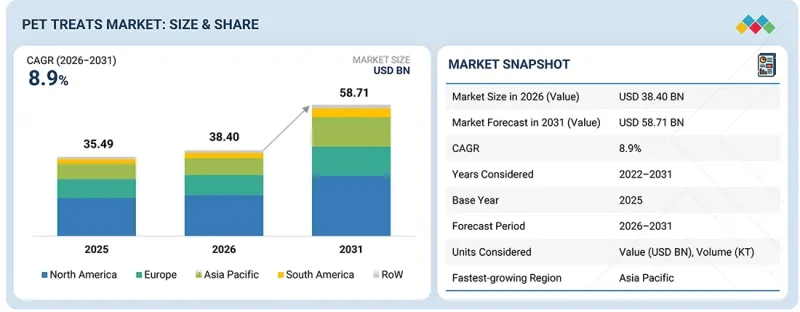
The pet treats market is expected to grow from USD 38.40 billion in 2026 to USD 58.71 billion by 2031, at a CAGR of 8.9%. The pet treats market is projected to see significant growth in the coming years. This expansion is driven by an increasing number of pet owners, rising trends in pet humanization, and a substantial increase in consumer spending on premium pet nutrition products. As pet owners increasingly view their pets as family members, demand for indulgent, healthy, and clean-label treats is rising.
| Scope of the Report | |
|---|---|
| Years Considered for the Study | 2022-2031 |
| Base Year | 2025 |
| Forecast Period | 2026-2031 |
| Units Considered | Value (USD Million) and Volume (KT) |
| Segments | By Product Type, Function, Pet Type, Distribution Channel, Ingredient Source, Manufacturing Process, and Region |
| Regions covered | North America, Europe, Asia Pacific, South America, and the RoW |
Moreover, growing awareness of pet wellness, preventive healthcare, and nutritional needs is influencing consumer demand for treats made with high-quality ingredients, functional additives, and targeted health benefits. The rising popularity of natural, clean-label, and minimally processed pet treats is further contributing to market growth in both developed and emerging pet product markets.
Manufacturers are continuously adapting to changing requirements and investing in product innovation across multiple categories, including jerky treats, freeze-dried treats, dental chews, soft and chewy treats, natural chews, and functional wellness treats. There is a growing focus on incorporating ingredients that support digestive, immune, and skin & coat health, as well as dental hygiene and stress management for pets. The use of advanced processing technologies, such as freeze-drying, air-drying, and cold processing, is enabling manufacturers to preserve nutritional value while meeting consumer demand for premium products.
Additionally, the growth of e-commerce channels, the expansion of pet specialty retail networks, and the rising demand for sustainable and alternative protein-based treats are creating new growth opportunities for market participants. However, challenges such as fluctuating raw material costs, regulatory compliance requirements, product recalls, and increasing competition among brands may impact market growth.
"By product type, the jerky & meat-based treats segment is expected to account for the largest share of the pet treats market."
Jerky & meat-based treats are expected to account for the largest share of the pet treats market in 2026 and to grow steadily over the forecast period. The dominance of this segment is primarily due to an increase in consumers' preference for high-protein, natural, and minimally processed pet treats that closely align with and support the pet's biological dietary needs. Pet owners are also beginning to view meat-based treats as a healthier alternative to other treat formats, citing better taste, higher protein content, and simplified ingredient lists. The rise in premium pet nutrition and clean-label trends is also expected to promote usage for both dogs and cats.
Manufacturers continue to expand their offerings with single-protein, grain-free, limited-ingredient, and novel-protein treats to cater to evolving consumer preferences and pets with food sensitivities. Products containing chicken, beef, salmon, duck, turkey, venison, and other premium proteins continue to gain popularity in the market. In addition, as more consumers are willing to pay a premium for quality and purpose-driven pet products and demand for natural training and reward treats grows, this segment is poised to lead during the forecast period.
"By manufacturing process, the freeze-dried segment is expected to be the fastest-growing during the forecast period."
The freeze-dried segment is expected to grow at the fastest rate over the forecast period, driven by rising consumer demand for minimally processed, natural, healthy, and premium pet treats. Freeze-dried treats preserve nutritional value and retain the taste, aroma, and texture of ingredients, while extending shelf life. They retain key nutrients without the need for artificial preservatives. As more consumers become concerned about ingredients and processing methods, freeze-dried treats are becoming increasingly popular among pet owners.
Manufacturers are further expanding their single-ingredient treat range, raw-inspired recipes, functional products, and innovative protein offerings. The segment will benefit from the growing consumer popularity of raw feeding and biologically appropriate diets. As the availability of freeze-dried pet products increases at specialty retailers and online, and as consumer awareness of their nutritional benefits grows, strong growth is expected in this market. Additionally, investments in freeze-drying capacity and manufacturing technology will contribute to the expansion of this segment.
"By distribution channel, the e-commerce segment is expected to be the fastest-growing during the forecast period."
The E-commerce category is expected to grow at the fastest CAGR during the forecast period, driven by consumers' growing adoption of digital channels, convenient purchasing habits, and the increased availability of pet care products online. Pet owners are increasingly turning to online channels to access a wider variety of pet treats, compare products, and verify that ingredient claims hold up, all while taking advantage of subscription services and recurring delivery programs. Increased smartphone penetration, integrated digital payment systems, and direct-to-consumer business models are driving online pet treat sales in developed and emerging markets alike.
To build the required brand presence online, manufacturers are increasingly investing in online marketing, brand-owned websites, subscription services, and collaborations with large online retailers. Online shopping platforms also provide consumers with easier access to premium, niche, and specialty treat brands that they might not find in retail outlets. Additionally, growing consumer desire for convenience, home delivery services, and more tailored product suggestions should help drive channel growth. As the worldwide digital retail infrastructure continues to develop, e-commerce is forecast to become one of the largest distribution channels in the pet treats market.
"By pet type, the dogs segment is expected to account for the largest share of the pet treats market."
Dogs are forecast to hold the largest share in 2031, owing to their much larger population, which implies greater use of treats and a more extensive range of products compared with other companion animals. Dog owners frequently use treats for a variety of reasons, including training, behavior reinforcement, enrichment, functional use, and dental benefits, and therefore require a much larger and more consistent use of treats than other companion animals. This is further supported by the far greater range of treats, such as jerky treats, dental chews, soft treats, biscuits, natural chews, and functional supplements, available to cater to the dog treats market.
Additionally, the dog treats segment is witnessing growth in the humanization of pets and rising expenditure on premium dog nutrition, prompting consumers to buy higher-value treats with health and wellness benefits. Companies are continually expanding their ranges of innovative products designed for specific ages and life stages, breeds and sizes of dogs, tastes, and health concerns. The ever-increasing popularity of treats made with natural and limited ingredients, freeze-dried products, and functional treats will be a positive factor supporting continued growth in the dog treats segment and maintaining its dominant position during the forecast period.
"By function, the immune support segment is expected to be the fastest-growing during the forecast period."
The immune support segment is expected to register the highest growth rate during the forecast period, driven by growing consumer focus on preventive pet healthcare and overall wellness. Consumers increasingly prefer to support long-term health through higher-quality nutrition, which has increased demand for treats containing immune-boosting prebiotics and probiotics, as well as other herbs, vitamins, antioxidants, and minerals. Greater consumer knowledge of nutrition and immunology is also encouraging the uptake of immune-promoting health treats.
Manufacturers are increasingly developing multifunctional treats that combine immune support with additional benefits such as digestive health, skin and coat support, and overall vitality, while maintaining the palatability of pet treats. The growing influence of veterinary recommendations, the increasing prevalence of age-related health concerns, and rising demand for functional nutrition products are encouraging manufacturers to research and invest in this category. Furthermore, the global expansion of premium and wellness-focused pet care trends is expected to drive continued investment in immune-supporting formulations, making this one of the most attractive growth opportunities within the pet treats market.
"By ingredient source, the animal-based segment is expected to account for the largest share of the pet treats market."
Animal-based treats are expected to account for the largest share of the pet treats market in 2026, owing to their high protein content, superior palatability, and strong alignment with the natural dietary preferences of companion animals. High-quality nutrition and culturally popular choices among pet owners have supported the use of animal-based ingredients such as chicken, beef, turkey, duck, lamb, fish, and organ meats in the formulation of most dog and cat treats worldwide. The evolution of biologically appropriate feeding practices and rising consumer proclivity for protein-dense, unprocessed foods have also supported increased demand for animal-based treats in both the canine and feline categories.
Manufacturers are increasingly expanding their pet treat portfolios with premium products, including jerky treats, freeze-dried meat treats, air-dried treats, natural chews, and single-ingredient formulations, to meet consumer demand for transparency and ingredient quality. In addition, the rising popularity of high-protein treats, limited-ingredient recipes, and novel protein sources such as venison, rabbit, bison, and salmon is supporting product diversification within the segment. As pet owners continue to prioritize nutritional quality, taste appeal, and functional benefits, animal-based treats are expected to maintain their dominant position in the global pet treats market throughout the forecast period.
In-depth interviews have been conducted with chief executive officers (CEOs), directors, and other executives from various key organizations operating in the pet treats market.
- By Company Type: Tier 1 - 30%, Tier 2 - 25%, and Tier 3 - 45%
- By Designation: CXOs - 25%, Managers - 35%, Others - 40%
- By Region: North America - 20%, Europe - 30%, Asia Pacific - 35%, South America - 10%, and the Rest of the World -5%
Prominent companies in the market include Nestle Purina PetCare (Switzerland), Mars, Incorporated and its Affiliates (US), General Mills Inc. (US), The J.M. Smucker Company (US), Colgate-Palmolive (US), Wellness Pet Company LLC (US), and Spectrum Brands (US).
Research Coverage
This research report categorizes the pet treats market by, product type (jerky & meat-based treats, dental treats & chews, biscuits, cookies & bakery treats, soft & chewy treats, natural chews, lickable & creamy treats, other product types), function (digestive health, skin & coat health, dental health, immune support, indulgence & reward, calming & stress relief, other functions), pet type (dogs, cats, other pet types), ingredient source (animal-based, plant-based, alternative proteins sources), manufacturing process (baked, extruded, freeze-dried, dehydrated, air-dried raw/frozen processed, frozen processed), distribution channel (supermarkets & hypermarkets, veterinary clinics, pet specialty stores, e-commerce, other distribution channels), and region (North America, Europe, Asia Pacific, South America, and the Rest of the World).
The report's scope encompasses detailed information on the major factors, including drivers, restraints, challenges, and opportunities, that influence the growth of the pet treats industry. A thorough analysis of the key industry players has been carried out to provide insights into their business, services, key strategies, contracts, partnerships, agreements, service launches, mergers & acquisitions, and recent developments associated with the pet treats market. This report provides a competitive analysis of emerging startups in the pet treats market ecosystem. Furthermore, the study covers industry-specific trends, including technology analysis, ecosystem & market mapping, and patent & regulatory landscape, among others.
Reasons to Buy This Report
The report provides market leaders/new entrants with the closest approximations of revenue numbers for the overall pet treats market and its subsegments. It will help stakeholders understand the competitive landscape and gain more insights to better position their businesses and plan suitable go-to-market strategies. The report also helps stakeholders understand the pulse of the market and provides them with information on key market drivers, restraints, challenges, and opportunities.
The report provides insights into the following pointers:
- Analysis of key drivers (rising pet humanization and increasing consumer spending on premium pet food & treats), restraints (rising raw material and protein ingredient price volatility increasing manufacturing costs for pet treat producers), opportunities (growing consumer preference for natural, clean-label, and alternative protein-based pet treats creating new product development opportunities), and challenges (maintaining product safety, quality consistency, and shelf stability across premium processing technologies) influencing the growth of the pet treats market
- Product Development/Innovation: Detailed insights into research & development activities and new product launches in the pet treats market
- Market Development: Comprehensive information about the lucrative market analysis of pet treats across varied regions
- Market Diversification: Exhaustive information about new product sources, untapped geographies, recent developments, and investments in the pet treats market
- Competitive Assessment: In-depth assessment of market shares, growth strategies, product offerings, brand/product comparison, and product footprints of leading players such as Nestle Purina PetCare (Switzerland), Mars, Incorporated and its Affiliates (US), General Mills Inc. (US), The J.M. Smucker Company (US), Colgate-Palmolive (US), Wellness Pet Company LLC (US), Spectrum Brands (US), Simmons Pet Food (US), Freshpet (Netherlands), Stella & Chewy's (US), Virbac (France), Fromm Family Foods, LLC. (US), Vital Essentials (US), PureBites (US), and Central Garden & Pet (US) in the pet treats market.
TABLE OF CONTENTS
1 INTRODUCTION
- 1.1 STUDY OBJECTIVES
- 1.2 MARKET DEFINITION
- 1.3 STUDY SCOPE AND SEGMENTATION
- 1.3.1 MARKETS COVERED AND REGIONAL SCOPE
- 1.3.2 INCLUSIONS AND EXCLUSIONS
- 1.3.3 YEARS CONSIDERED
- 1.3.4 CURRENCY CONSIDERED
- 1.3.5 UNIT CONSIDERED
- 1.4 STAKEHOLDERS
2 EXECUTIVE SUMMARY
- 2.1 MARKET HIGHLIGHTS AND KEY INSIGHTS
- 2.2 KEY MARKET PARTICIPANTS: MAPPING OF STRATEGIC DEVELOPMENTS
- 2.3 DISRUPTIVE TRENDS IN PET TREATS MARKET
- 2.4 HIGH-GROWTH SEGMENTS
- 2.5 REGIONAL SNAPSHOT: MARKET SIZE, GROWTH RATE, AND FORECAST
3 PREMIUM INSIGHTS
- 3.1 ATTRACTIVE OPPORTUNITIES FOR PLAYERS IN PET TREATS MARKET
- 3.2 PET TREATS MARKET, BY DISTRIBUTION CHANNEL AND REGION
- 3.3 PET TREATS MARKET, BY INGREDIENT SOURCE
- 3.4 PET TREATS MARKET, BY FUNCTION
- 3.5 PET TREATS MARKET, BY PRODUCT TYPE
- 3.6 PET TREATS MARKET, BY PET TYPE
- 3.7 PET TREATS MARKET, BY COUNTRY
4 MARKET OVERVIEW
- 4.1 INTRODUCTION
- 4.2 MARKET DYNAMICS
- 4.2.1 DRIVERS
- 4.2.1.1 Rising pet humanization and increasing consumer spending on premium pet food
- 4.2.1.2 Growing demand for functional and health-oriented pet treats driven by preventive pet healthcare
- 4.2.1.3 Premiumization and increased willingness to spend on pet nutrition
- 4.2.2 RESTRAINTS
- 4.2.2.1 Rising raw material and protein ingredient price volatility
- 4.2.2.2 Intensifying food safety regulatory burden and recall frequency
- 4.2.2.3 Consumer price sensitivity and structural trade-down threat
- 4.2.3 OPPORTUNITIES
- 4.2.3.1 Growing consumer preference for natural, clean-label, and alternative protein-based pet treats
- 4.2.3.2 Increasing demand for personalized, life-stage, and functional nutrition
- 4.2.4 CHALLENGES
- 4.2.4.1 Maintaining product safety, quality consistency, and shelf stability across premium processing technologies
- 4.2.4.2 Increasing complexity in supply chain traceability and sustainable ingredient sourcing
- 4.2.1 DRIVERS
- 4.3 UNMET NEEDS AND WHITE SPACES
- 4.3.1 UNMET NEEDS IN PET TREATS
- 4.3.2 WHITE SPACE OPPORTUNITIES
- 4.4 INTERCONNECTED MARKETS AND CROSS-SECTOR OPPORTUNITIES
- 4.4.1 INTERCONNECTED MARKETS
- 4.4.2 CROSS-SECTOR OPPORTUNITIES
- 4.5 STRATEGIC MOVES BY TIER-1/2/3 PLAYERS
- 4.5.1 KEY MOVES AND STRATEGIC FOCUS
5 INDUSTRY TRENDS
- 5.1 INTENSITY OF COMPETITIVE RIVALRY
- 5.2 BARGAINING POWER OF SUPPLIERS
- 5.3 BARGAINING POWER OF BUYERS
- 5.4 THREAT OF SUBSTITUTES
- 5.5 THREAT OF NEW ENTRANTS
- 5.6 MACROECONOMICS OUTLOOK
- 5.6.1 INTRODUCTION
- 5.6.1.1 Macroeconomic indicators
- 5.6.1.1.1 GDP trends and forecast
- 5.6.1.1.2 Pet ownership and consumer spending industry trends
- 5.6.1.1.3 Animal protein and meat industry trends
- 5.6.1.1 Macroeconomic indicators
- 5.6.1 INTRODUCTION
- 5.7 VALUE CHAIN ANALYSIS
- 5.7.1 RAW MATERIAL & INGREDIENT SOURCING
- 5.7.2 INGREDIENT PROCESSING & SOURCING
- 5.7.3 TREAT MANUFACTURING, QUALITY & REGULATORY COMPLIANCE
- 5.7.4 PACKAGING & DISTRIBUTION
- 5.7.5 END USERS
- 5.8 ECOSYSTEM ANALYSIS
- 5.8.1 RAW MATERIAL SUPPLIERS
- 5.8.2 PET TREATS MANUFACTURERS
- 5.9 PRICING ANALYSIS
- 5.9.1 INTRODUCTION
- 5.9.2 INDICATIVE PRICE TREND AMONG MARKET PLAYERS
- 5.9.3 AVERAGE SELLING PRICE (ASP) TREND, BY REGION, 2022-2025 (USD/TONS)
- 5.9.4 AVERAGE SELLING PRICE (ASP) TREND, BY PRODUCT TYPE, 2022-2025 (USD/TONS)
- 5.10 TRADE ANALYSIS
- 5.10.1 IMPORT ANALYSIS: DOG OR CAT FOOD
- 5.10.2 EXPORT ANALYSIS: DOG OR CAT FOOD
- 5.11 KEY CONFERENCES AND EVENTS, 2026-2027
- 5.12 TRENDS/DISRUPTIONS IMPACTING CUSTOMER BUSINESS
- 5.13 INVESTMENT AND FUNDING SCENARIO
- 5.14 CASE STUDY ANALYSIS
- 5.14.1 WELLNESS PET COMPANY - WHIMZEES NATURAL DENTAL TREATS FOR CATS
- 5.14.2 PUREBITES INC. - EXPANSION OF FREEZE-DRIED MANUFACTURING CAPABILITIES
- 5.15 IMPACT OF 2025 US TARIFF - PET TREATS MARKET
- 5.15.1 INTRODUCTION
- 5.15.2 PRICE IMPACT ANALYSIS
- 5.16 IMPACT ON COUNTRIES/REGIONS
- 5.16.1 US
- 5.16.2 EUROPE
- 5.16.3 ASIA PACIFIC
- 5.17 IMPACT ON END USE INDUSTRIES
6 TECHNOLOGY ADVANCEMENTS, AI-DRIVEN IMPACT, PATENTS, INNOVATIONS, AND FUTURE APPLICATIONS
- 6.1 TECHNOLOGY ANALYSIS
- 6.1.1 KEY TECHNOLOGIES
- 6.1.1.1 Cold-press extrusion technology
- 6.1.1.2 High-pressure processing (HPP)
- 6.1.1.3 Spray-drying and microencapsulation technologies
- 6.1.1.4 Near-infrared (NIR) spectroscopy
- 6.1.2 COMPLEMENTARY ANALYSIS
- 6.1.2.1 Blockchain traceability technology
- 6.1.2.2 Internet of Things (IoT)-enabled smart manufacturing
- 6.1.2.3 Augmented reality (AR) and QR code-enabled packaging
- 6.1.2.4 Cloud-based ERP and supply chain management systems
- 6.1.3 ADJACENT TECHNOLOGIES
- 6.1.3.1 Precision fermentation technology
- 6.1.3.2 Cultivated meat technology
- 6.1.4 TECHNOLOGY/PRODUCT ROADMAP
- 6.1.4.1 Short-term | Process optimization & premium product expansion
- 6.1.4.2 Mid-term | Personalization & sustainable ingredient integration
- 6.1.4.3 Long-term | Biotechnology & hyper-personalized nutrition
- 6.1.1 KEY TECHNOLOGIES
- 6.2 PATENT ANALYSIS
- 6.3 FUTURE APPLICATIONS
- 6.3.1 AI-DRIVEN PERSONALIZED PET NUTRITION: ENABLING PRECISION TREAT RECOMMENDATIONS
- 6.3.2 CULTIVATED MEAT INGREDIENTS: ADVANCING SUSTAINABLE ANIMAL PROTEIN
- 6.3.3 PRECISION FERMENTATION: TRANSFORMING FUNCTIONAL PET NUTRITION
- 6.3.4 SMART PACKAGING & DIGITAL TRACEABILITY: IMPROVING CONSUMER TRANSPARENCY
- 6.3.5 3D PRINTING FOR CUSTOMIZED PET TREATS: SUPPORTING PRECISION NUTRITION
- 6.4 IMPACT OF GENERATIVE AI ON PET TREATS MARKET
- 6.4.1 INTRODUCTION
- 6.4.2 CASE STUDIES OF AI IMPLEMENTATION IN PET TREATS MARKET
- 6.5 INTERCONNECTED ADJACENT ECOSYSTEM AND IMPACT ON MARKET PLAYERS
7 REGULATORY LANDSCAPE AND SUSTAINABILITY INITIATIVES
- 7.1 REGIONAL REGULATIONS AND COMPLIANCE
- 7.2 REGULATORY BODIES, GOVERNMENT AGENCIES, AND OTHER ORGANIZATIONS
- 7.2.1 INDUSTRY STANDARDS
- 7.2.2 LABELING REQUIREMENTS AND CLAIMS
- 7.2.3 ANTICIPATED REGULATORY CHANGES IN NEXT 5-10 YEARS
- 7.2.3.1 Enhanced ingredient traceability and supply chain transparency
- 7.2.3.2 Greater harmonization of global pet food standards
- 7.2.3.3 Stricter sustainability and responsible sourcing requirements
- 7.2.3.4 Digital compliance, smart traceability, and recall management
- 7.2.3.5 Expanded regulation of novel ingredients and functional claims
- 7.2.3.6 Strengthened labeling and consumer transparency requirements
- 7.3 SUSTAINABILITY INITIATIVES
- 7.3.1 SUSTAINABLE SOURCING
- 7.3.2 CARBON FOOTPRINT REDUCTION INITIATIVES
- 7.3.3 CIRCULAR ECONOMY APPROACHES
- 7.4 IMPACT OF REGULATORY POLICIES ON SUSTAINABILITY INITIATIVES
- 7.5 CERTIFICATIONS, LABELING, ECO-STANDARDS
8 CUSTOMER LANDSCAPE AND BUYER BEHAVIOR
- 8.1 DECISION-MAKING PROCESS
- 8.2 KEY STAKEHOLDERS INVOLVED IN BUYING PROCESS AND THEIR EVALUATION CRITERIA
- 8.2.1 KEY STAKEHOLDERS IN BUYING PROCESS
- 8.2.2 BUYING CRITERIA
- 8.3 ADOPTION BARRIERS AND INTERNAL CHALLENGES
- 8.4 UNMET NEEDS OF VARIOUS APPLICATION INDUSTRIES ACROSS SUPPLY CHAIN
- 8.5 MARKET PROFITABILITY
- 8.6 REVENUE POTENTIAL
- 8.6.1 COST DYNAMICS
- 8.6.2 MARGIN OPPORTUNITIES, BY PRODUCT TYPE
9 PET TREATS MARKET, BY MANUFACTURING PROCESS
- 9.1 INTRODUCTION
- 9.2 BAKED
- 9.2.1 COST-EFFECTIVE PRODUCTION AND BROAD PRODUCT VERSATILITY MAINTAIN MARKET LEADERSHIP
- 9.3 EXTRUDED
- 9.3.1 HIGH MANUFACTURING EFFICIENCY AND PRODUCT CUSTOMIZATION SUPPORT WIDESPREAD ADOPTION
- 9.4 FREEZE-DRIED
- 9.4.1 MINIMAL PROCESSING AND MAXIMUM NUTRIENT RETENTION DRIVE PREMIUM SEGMENT GROWTH
- 9.5 DEHYDRATED
- 9.5.1 BALANCED COST, NATURAL PROCESSING, AND HIGH PRODUCT QUALITY SUPPORT MARKET EXPANSION
- 9.6 AIR-DRIED
- 9.6.1 LOW-TEMPERATURE PROCESSING AND CLEAN-LABEL POSITIONING STRENGTHEN PREMIUM MARKET DEMAND
- 9.7 FROZEN PROCESSED
- 9.7.1 RAW-INSPIRED NUTRITION AND FRESH INGREDIENT QUALITY DRIVE NICHE PREMIUM GROWTH
10 PET TREATS MARKET, BY PRODUCT TYPE
- 10.1 INTRODUCTION
- 10.2 JERKY & MEAT-BASED TREATS
- 10.2.1 HIGH-PROTEIN NUTRITION AND MINIMALLY PROCESSED FORMULATIONS DRIVE MARKET LEADERSHIP
- 10.3 DENTAL TREATS & CHEWS
- 10.3.1 PREVENTIVE ORAL HEALTHCARE AND FUNCTIONAL FORMULATIONS SUPPORT SUSTAINED MARKET GROWTH
- 10.4 BISCUITS, COOKIES, & BAKERY TREATS
- 10.4.1 WIDESPREAD CONSUMER ACCEPTANCE AND PRODUCT VERSATILITY SUPPORT SUSTAINED MARKET DEMAND
- 10.5 SOFT & CHEWY TREATS
- 10.5.1 HIGH PALATABILITY AND FUNCTIONAL FORMULATIONS EXPAND APPLICATIONS ACROSS LIFE STAGES
- 10.6 NATURAL CHEWS
- 10.6.1 CLEAN-LABEL INGREDIENTS AND LONG-LASTING CHEWING EXPERIENCE DRIVE PREMIUM DEMAND
- 10.7 LICKABLE & CREAMY TREATS
- 10.7.1 INTERACTIVE FEEDING EXPERIENCES AND FUNCTIONAL DELIVERY FORMATS ACCELERATE MARKET GROWTH
- 10.8 OTHER PRODUCT TYPES
11 PET TREATS MARKET, BY PET TYPE
- 11.1 INTRODUCTION
- 11.2 DOGS
- 11.2.1 LARGE PET POPULATION, HIGH TREAT CONSUMPTION, AND PREMIUMIZATION DRIVE MARKET LEADERSHIP
- 11.3 CATS
- 11.3.1 GROWING FELINE HUMANIZATION AND FUNCTIONAL NUTRITION FUEL MARKET EXPANSION
- 11.4 OTHER PET TYPES
12 PET TREATS MARKET, BY FUNCTION
- 12.1 INTRODUCTION
- 12.2 DIGESTIVE HEALTH
- 12.2.1 GROWING EMPHASIS ON GUT HEALTH AND MICROBIOME SUPPORT DRIVING FUNCTIONAL TREAT INNOVATION
- 12.3 SKIN & COAT HEALTH
- 12.3.1 PREMIUM NUTRITION AND ESSENTIAL FATTY ACIDS SUPPORT HEALTHIER SKIN AND COAT CONDITION
- 12.4 INDULGENCE & REWARD
- 12.4.1 HUMANIZATION OF PETS AND POSITIVE REINFORCEMENT PRACTICES DRIVE DEMAND FOR REWARD-BASED TREATS
- 12.5 DENTAL HEALTH
- 12.5.1 INCREASING ORAL HEALTH AWARENESS AND VETERINARY RECOMMENDATIONS STRENGTHEN MARKET GROWTH
- 12.6 CALMING & STRESS RELIEF
- 12.6.1 INCREASING BEHAVIORAL WELLNESS CONCERNS ACCELERATE DEMAND FOR CALMING FUNCTIONAL TREATS
- 12.7 IMMUNE SUPPORT
- 12.7.1 RISING PREVENTIVE HEALTHCARE AWARENESS DRIVES ADOPTION OF IMMUNE-SUPPORTING FUNCTIONAL TREATS
- 12.8 OTHER FUNCTIONS
13 PET TREATS MARKET, BY INGREDIENT SOURCE
- 13.1 INTRODUCTION
- 13.2 ANIMAL-BASED
- 13.2.1 HIGH PALATABILITY AND SUPERIOR NUTRITIONAL QUALITY MAINTAIN MARKET LEADERSHIP
- 13.3 PLANT-BASED
- 13.3.1 CLEAN-LABEL TRENDS AND SUSTAINABILITY DRIVE ADOPTION OF PLANT-BASED INGREDIENTS
- 13.4 ALTERNATIVE PROTEINS
- 13.4.1 SUSTAINABLE PROTEIN INNOVATION AND NOVEL INGREDIENT DEVELOPMENT EXPAND FUTURE GROWTH OPPORTUNITIES
14 PET TREATS MARKET, BY DISTRIBUTION CHANNEL
- 14.1 INTRODUCTION
- 14.2 E-COMMERCE
- 14.2.1 DIGITAL COMMERCE, SUBSCRIPTION MODELS, AND DIRECT-TO-CONSUMER BRANDS ACCELERATE CHANNEL GROWTH
- 14.3 PET SPECIALTY STORES
- 14.3.1 SPECIALIZED PRODUCT ASSORTMENTS AND EXPERT GUIDANCE SUPPORT PREMIUM PET TREAT SALES
- 14.4 SUPERMARKETS & HYPERMARKETS
- 14.4.1 EXTENSIVE RETAIL REACH AND CONVENIENCE SHOPPING MAINTAIN CHANNEL LEADERSHIP
- 14.5 VETERINARY CLINICS
- 14.5.1 PROFESSIONAL RECOMMENDATIONS AND THERAPEUTIC NUTRITION DRIVE SPECIALIZED MARKET GROWTH
- 14.6 OTHER DISTRIBUTION CHANNELS
15 PET TREATS MARKET, BY REGION
- 15.1 INTRODUCTION
- 15.2 NORTH AMERICA
- 15.2.1 US
- 15.2.1.1 High pet ownership and premiumization drive continued market leadership
- 15.2.2 CANADA
- 15.2.2.1 Growing demand for natural and clean-label pet treats supports market expansion
- 15.2.3 MEXICO
- 15.2.3.1 Rising pet ownership and premium pet care adoption create strong growth opportunities
- 15.2.1 US
- 15.3 EUROPE
- 15.3.1 GERMANY
- 15.3.1.1 Premium pet nutrition and strong retail infrastructure support market leadership
- 15.3.2 UK
- 15.3.2.1 Functional pet nutrition and digital retail expansion accelerate market development
- 15.3.3 FRANCE
- 15.3.3.1 Humanization of pets and premium product adoption drive market growth
- 15.3.4 ITALY
- 15.3.4.1 Increasing pet humanization and premiumization support market expansion
- 15.3.5 SPAIN
- 15.3.5.1 Rising pet ownership and modern retail development strengthen market demand
- 15.3.6 REST OF EUROPE
- 15.3.1 GERMANY
- 15.4 ASIA PACIFIC
- 15.4.1 CHINA
- 15.4.1.1 Expanding pet ownership and premium pet care drive strong market growth
- 15.4.2 INDIA
- 15.4.2.1 Rising pet humanization and growing middle-class income accelerate market development
- 15.4.3 JAPAN
- 15.4.3.1 Aging pet population and premium nutrition support high-value market growth
- 15.4.4 AUSTRALIA AND NEW ZEALAND
- 15.4.4.1 Premium pet ownership and natural ingredient preferences support market expansion
- 15.4.5 REST OF ASIA PACIFIC
- 15.4.1 CHINA
- 15.5 SOUTH AMERICA
- 15.5.1 BRAZIL
- 15.5.1.1 Large pet population and expanding premium pet care drive market leadership
- 15.5.2 ARGENTINA
- 15.5.2.1 Strong meat industry and growing premiumization support market development
- 15.5.3 REST OF SOUTH AMERICA
- 15.5.1 BRAZIL
- 15.6 REST OF THE WORLD
- 15.6.1 MIDDLE EAST
- 15.6.1.1 Rising pet ownership and premium pet care adoption drive market expansion
- 15.6.2 AFRICA
- 15.6.2.1 Growing urbanization and modern pet care trends create long-term market opportunities
- 15.6.1 MIDDLE EAST
16 COMPETITIVE LANDSCAPE
- 16.1 OVERVIEW
- 16.2 KEY PLAYER COMPETITIVE STRATEGIES/RIGHT TO WIN, 2021-2026
- 16.3 SEGMENTAL REVENUE ANALYSIS, 2023-2025
- 16.4 MARKET SHARE ANALYSIS, 2025
- 16.4.1 BRAND COMPARISON
- 16.4.2 MARS, INCORPORATED (PEDIGREE)
- 16.4.3 NESTLE PURINA
- 16.4.4 GENERAL MILLS, INC. (BLUE BUFFALO)
- 16.4.5 THE J.M. SMUCKER COMPANY (MILK-BONE)
- 16.4.6 COLGATE-PALMOLIVE COMPANY (HILL'S PET NUTRITION)
- 16.5 COMPANY EVALUATION MATRIX: KEY PLAYERS, 2025
- 16.5.1 STARS
- 16.5.2 EMERGING LEADERS
- 16.5.3 PERVASIVE PLAYERS
- 16.5.4 PARTICIPANTS
- 16.5.5 COMPANY FOOTPRINT: KEY PLAYERS, 2025
- 16.5.5.1 Company footprint
- 16.5.5.2 Region footprint
- 16.5.5.3 Function footprint
- 16.5.5.4 Product type footprint
- 16.6 COMPANY EVALUATION MATRIX: STARTUPS/SMES, 2025
- 16.6.1 PROGRESSIVE COMPANIES
- 16.6.2 RESPONSIVE COMPANIES
- 16.6.3 DYNAMIC COMPANIES
- 16.6.4 STARTING BLOCKS
- 16.6.5 COMPETITIVE BENCHMARKING: KEY STARTUPS/SMES, 2025
- 16.6.5.1 Detailed list of key startups/SMEs
- 16.6.5.2 Competitive benchmarking of key startups/SMEs
- 16.7 COMPANY VALUATION AND FINANCIAL METRICS
- 16.7.1 COMPANY VALUATION
- 16.7.2 EV/EBITDA
- 16.8 COMPETITIVE SCENARIO
- 16.8.1 PRODUCT LAUNCHES
- 16.8.2 DEALS
- 16.8.3 EXPANSIONS
17 COMPANY PROFILES
- 17.1 KEY PLAYERS
- 17.1.1 NESTLE PURINA
- 17.1.1.1 Business overview
- 17.1.1.2 Products/Solutions/Services offered
- 17.1.1.3 Recent developments
- 17.1.1.3.1 Deals
- 17.1.1.3.2 Expansions
- 17.1.1.4 MnM view
- 17.1.1.4.1 Right to win
- 17.1.1.4.2 Strategic choices
- 17.1.1.4.3 Weaknesses and competitive threats
- 17.1.2 MARS, INCORPORATED
- 17.1.2.1 Business overview
- 17.1.2.2 Products/Solutions/Services offered
- 17.1.2.3 Recent developments
- 17.1.2.3.1 Deals
- 17.1.2.3.2 Expansions
- 17.1.2.4 MnM view
- 17.1.2.4.1 Right to win
- 17.1.2.4.2 Strategic choices
- 17.1.2.4.3 Weaknesses and competitive threats
- 17.1.3 GENERAL MILLS, INC.
- 17.1.3.1 Business overview
- 17.1.3.2 Products/Solutions/Services offered
- 17.1.3.3 Recent developments
- 17.1.3.3.1 Deals
- 17.1.3.4 MnM view
- 17.1.3.4.1 Right to win
- 17.1.3.4.2 Strategic choices
- 17.1.3.4.3 Weaknesses and competitive threats
- 17.1.4 THE J.M. SMUCKER COMPANY
- 17.1.4.1 Business overview
- 17.1.4.2 Products/Solutions/Services offered
- 17.1.4.3 Recent developments
- 17.1.4.4 MnM view
- 17.1.4.4.1 Right to win
- 17.1.4.4.2 Strategic choices
- 17.1.4.4.3 Weaknesses and competitive threats
- 17.1.5 COLGATE-PALMOLIVE COMPANY
- 17.1.5.1 Business overview
- 17.1.5.2 Products/Solutions/Services offered
- 17.1.5.3 Recent developments
- 17.1.5.3.1 Deals
- 17.1.5.4 MnM view
- 17.1.5.4.1 Right to win
- 17.1.5.4.2 Strategic choices
- 17.1.5.4.3 Weaknesses and competitive threats
- 17.1.6 SPECTRUM BRANDS HOLDINGS, INC.
- 17.1.6.1 Business overview
- 17.1.6.2 Products/Solutions/Services offered
- 17.1.6.3 Recent developments
- 17.1.6.4 MnM view
- 17.1.7 FRESHPET
- 17.1.7.1 Business overview
- 17.1.7.2 Products/Solutions/Services offered
- 17.1.7.3 Recent developments
- 17.1.7.3.1 Product launches
- 17.1.7.4 MnM view
- 17.1.8 FROMM FAMILY FOODS, LLC
- 17.1.8.1 Business overview
- 17.1.8.2 Products/Solutions/Services offered
- 17.1.8.3 Recent developments
- 17.1.8.3.1 Product launches
- 17.1.8.4 MnM view
- 17.1.9 VIRBAC
- 17.1.9.1 Business overview
- 17.1.9.2 Products/Solutions/Services offered
- 17.1.9.3 Recent developments
- 17.1.9.3.1 Expansions
- 17.1.9.4 MnM view
- 17.1.10 VITAL ESSENTIALS
- 17.1.10.1 Business overview
- 17.1.10.2 Products/Solutions/Services offered
- 17.1.10.3 Recent developments
- 17.1.10.3.1 Product launches
- 17.1.10.4 MnM view
- 17.1.11 WELLNESS PET, LLC
- 17.1.11.1 Business overview
- 17.1.11.2 Products/Solutions/Services offered
- 17.1.11.3 Recent developments
- 17.1.11.3.1 Product launches
- 17.1.11.3.2 Deals
- 17.1.11.4 MnM view
- 17.1.12 CENTRAL GARDEN & PET COMPANY
- 17.1.12.1 Business overview
- 17.1.12.2 Products/Solutions/Services offered
- 17.1.12.3 Recent developments
- 17.1.12.3.1 Product launches
- 17.1.12.3.2 Deals
- 17.1.12.4 MnM view
- 17.1.13 UNICHARM CORPORATION
- 17.1.13.1 Business overview
- 17.1.13.2 Products/Solutions/Services offered
- 17.1.13.3 Recent developments
- 17.1.13.3.1 Deals
- 17.1.13.3.2 Expansions
- 17.1.13.4 MnM view
- 17.1.14 STELLA & CHEWY'S
- 17.1.14.1 Business overview
- 17.1.14.2 Products/Solutions/Services offered
- 17.1.14.3 Recent developments
- 17.1.14.3.1 Deals
- 17.1.14.3.2 Expansions
- 17.1.14.4 MnM view
- 17.1.15 PUREBITES INC.
- 17.1.15.1 Business overview
- 17.1.15.2 Products/Solutions/Services offered
- 17.1.15.3 Recent developments
- 17.1.15.3.1 Deals
- 17.1.15.4 MnM view
- 17.1.1 NESTLE PURINA
- 17.2 STARTUPS/SMES
- 17.2.1 JINX
- 17.2.1.1 Business overview
- 17.2.1.2 Products/Solutions/Services offered
- 17.2.1.3 Recent developments
- 17.2.1.4 MnM view
- 17.2.2 OPEN FARM
- 17.2.2.1 Business overview
- 17.2.2.2 Products/Solutions/Services offered
- 17.2.2.3 Recent developments
- 17.2.2.3.1 Product launches
- 17.2.2.3.2 Deals
- 17.2.2.4 MnM view
- 17.2.3 THE HONEST KITCHEN
- 17.2.3.1 Business overview
- 17.2.3.2 Products/Solutions/Services offered
- 17.2.3.3 Recent developments
- 17.2.3.3.1 Deals
- 17.2.3.4 MnM view
- 17.2.4 BOCCE'S BAKERY
- 17.2.4.1 Business overview
- 17.2.4.2 Products/Solutions/Services offered
- 17.2.4.3 Recent developments
- 17.2.4.4 MnM view
- 17.2.5 SUNSHINE MILLS, INC.
- 17.2.5.1 Business overview
- 17.2.5.2 Products/Solutions/Services offered
- 17.2.5.3 Recent developments
- 17.2.5.4 MnM view
- 17.2.6 SHAMELESS PETS
- 17.2.7 JIMINY'S
- 17.2.8 CHIPPIN
- 17.2.9 OH NORMAN!
- 17.2.10 LORD JAMESON
- 17.2.1 JINX
18 RESEARCH METHODOLOGY
- 18.1 RESEARCH DATA
- 18.1.1 SECONDARY DATA
- 18.1.1.1 Key data from secondary sources
- 18.1.2 PRIMARY DATA
- 18.1.2.1 Key data from primary sources
- 18.1.2.2 Breakdown of primary profiles
- 18.1.2.3 Key insights from industry experts
- 18.1.1 SECONDARY DATA
- 18.2 MARKET SIZE ESTIMATION
- 18.2.1 TOP-DOWN APPROACH
- 18.2.2 SUPPLY-SIDE ANALYSIS
- 18.2.3 BOTTOM-UP APPROACH (DEMAND SIDE)
- 18.3 DATA TRIANGULATION AND MARKET BREAKUP
- 18.4 RESEARCH ASSUMPTIONS
- 18.5 RESEARCH LIMITATIONS AND RISK ASSESSMENT
19 ADJACENT AND RELATED MARKETS
- 19.1 INTRODUCTION
- 19.2 RESEARCH LIMITATIONS
- 19.3 PET DIETARY SUPPLEMENTS MARKET
- 19.3.1 MARKET DEFINITION
- 19.3.2 MARKET OVERVIEW
- 19.4 PET FOOD INGREDIENTS MARKET
- 19.4.1 MARKET DEFINITION
- 19.4.2 MARKET OVERVIEW
20 APPENDIX
- 20.1 DISCUSSION GUIDE
- 20.2 KNOWLEDGESTORE: MARKETSANDMARKETS' SUBSCRIPTION PORTAL
- 20.3 CUSTOMIZATION OPTIONS
- 20.4 RELATED REPORTS
List of Tables
- TABLE 1 USD EXCHANGE RATES, 2021-2025
- TABLE 2 PET TREATS MARKET: PORTER'S FIVE FORCES ANALYSIS
- TABLE 3 ROLE OF COMPANIES IN ECOSYSTEM
- TABLE 4 AVERAGE SELLING PRICE (ASP) TREND, BY REGION, 2022-2025 (USD/TONS)
- TABLE 5 AVERAGE SELLING PRICE (ASP) TREND, BY PRODUCT TYPE, 2022-2025 (USD/TONS)
- TABLE 6 TOP IMPORTERS OF DOG OR CAT FOOD, 2021-2025
- TABLE 7 TOP EXPORTERS OF DOG OR CAT FOOD, 2021-2025
- TABLE 8 PET TREATS MARKET: LIST OF KEY CONFERENCES AND EVENTS, 2026-2027
- TABLE 9 PATENTS PERTAINING TO PET TREATS MARKET, 2021-2026
- TABLE 10 PET TREATS MARKET: CASE STUDIES RELATED TO GEN AI IMPLEMENTATION
- TABLE 11 INTERCONNECTED ADJACENT ECOSYSTEM AND IMPACT ON MARKET PLAYERS
- TABLE 12 NORTH AMERICA: LIST OF REGULATORY BODIES, GOVERNMENT AGENCIES, AND OTHER ORGANIZATIONS
- TABLE 13 EUROPE: LIST OF REGULATORY BODIES, GOVERNMENT AGENCIES, AND OTHER ORGANIZATIONS
- TABLE 14 ASIA PACIFIC: LIST OF REGULATORY BODIES, GOVERNMENT AGENCIES, AND OTHER ORGANIZATIONS
- TABLE 15 SOUTH AMERICA: LIST OF REGULATORY BODIES, GOVERNMENT AGENCIES, AND OTHER ORGANIZATIONS
- TABLE 16 INTERNATIONAL: LIST OF REGULATORY BODIES, GOVERNMENT AGENCIES, AND OTHER ORGANIZATIONS
- TABLE 17 GLOBAL INDUSTRY STANDARDS IN PET TREATS MARKET
- TABLE 18 LABELING REQUIREMENTS AND CLAIMS IN PET TREATS MARKET
- TABLE 19 CERTIFICATIONS, LABELING, AND ECO-STANDARDS IN PET TREATS MARKET
- TABLE 20 INFLUENCE OF STAKEHOLDERS ON BUYING PROCESS FOR KEY PRODUCT TYPES
- TABLE 21 KEY BUYING CRITERIA FOR TOP PRODUCT TYPES
- TABLE 22 UNMET NEEDS IN PET TREATS MARKET, BY APPLICATION INDUSTRIES ACROSS SUPPLY CHAIN
- TABLE 23 COST DYNAMICS IN PET TREATS MARKET
- TABLE 24 MARGIN OPPORTUNITIES IN PET TREATS MARKET, BY PRODUCT TYPE
- TABLE 25 PET TREATS MARKET, BY PRODUCT TYPE, 2022-2025 (USD MILLION)
- TABLE 26 PET TREATS MARKET, BY PRODUCT TYPE, 2026-2031 (USD MILLION)
- TABLE 27 PET TREATS MARKET, BY PRODUCT TYPE, 2022-2025 (KT)
- TABLE 28 PET TREATS MARKET, BY PRODUCT TYPE, 2026-2031 (KT)
- TABLE 29 JERKY & MEAT-BASED TREATS: PET TREATS MARKET, BY REGION, 2022-2025 (USD MILLION)
- TABLE 30 JERKY & MEAT-BASED TREATS: PET TREATS MARKET, BY REGION, 2026-2031 (USD MILLION)
- TABLE 31 JERKY & MEAT-BASED TREATS: PET TREATS MARKET, BY REGION, 2022-2025 (KT)
- TABLE 32 JERKY & MEAT-BASED TREATS: PET TREATS MARKET, BY REGION, 2026-2031 (KT)
- TABLE 33 DENTAL TREATS & CHEWS: PET TREATS MARKET, BY REGION, 2022-2025 (USD MILLION)
- TABLE 34 DENTAL TREATS & CHEWS: PET TREATS MARKET, BY REGION, 2026-2031 (USD MILLION)
- TABLE 35 DENTAL TREATS & CHEWS: PET TREATS MARKET, BY REGION, 2022-2025 (KT)
- TABLE 36 DENTAL TREATS & CHEWS: PET TREATS MARKET, BY REGION, 2026-2031 (KT)
- TABLE 37 BISCUITS, COOKIES, & BAKERY TREATS: PET TREATS MARKET, BY REGION, 2022-2025 (USD MILLION)
- TABLE 38 BISCUITS, COOKIES, & BAKERY TREATS: PET TREATS MARKET, BY REGION, 2026-2031 (USD MILLION)
- TABLE 39 BISCUITS, COOKIES, & BAKERY TREATS: PET TREATS MARKET, BY REGION, 2022-2025 (KT)
- TABLE 40 BISCUITS, COOKIES, & BAKERY TREATS: PET TREATS MARKET, BY REGION, 2026-2031 (KT)
- TABLE 41 SOFT & CHEWY TREATS: PET TREATS MARKET, BY REGION, 2022-2025 (USD MILLION)
- TABLE 42 SOFT & CHEWY TREATS: PET TREATS MARKET, BY REGION, 2026-2031 (USD MILLION)
- TABLE 43 SOFT & CHEWY TREATS: PET TREATS MARKET, BY REGION, 2022-2025 (KT)
- TABLE 44 SOFT & CHEWY TREATS: PET TREATS MARKET, BY REGION, 2026-2031 (KT)
- TABLE 45 NATURAL CHEWS: PET TREATS MARKET, BY REGION, 2022-2025 (USD MILLION)
- TABLE 46 NATURAL CHEWS: PET TREATS MARKET, BY REGION, 2026-2031 (USD MILLION)
- TABLE 47 NATURAL CHEWS: PET TREATS MARKET, BY REGION, 2022-2025 (KT)
- TABLE 48 NATURAL CHEWS: PET TREATS MARKET, BY REGION, 2026-2031 (KT)
- TABLE 49 LICKABLE & CREAMY TREATS: PET TREATS MARKET, BY REGION, 2022-2025 (USD MILLION)
- TABLE 50 LICKABLE & CREAMY TREATS: PET TREATS MARKET, BY REGION, 2026-2031 (USD MILLION)
- TABLE 51 LICKABLE & CREAMY TREATS: PET TREATS MARKET, BY REGION, 2022-2025 (KT)
- TABLE 52 LICKABLE & CREAMY TREATS: PET TREATS MARKET, BY REGION, 2026-2031 (KT)
- TABLE 53 OTHER PRODUCT TYPES: PET TREATS MARKET, BY REGION, 2022-2025 (USD MILLION)
- TABLE 54 OTHER PRODUCT TYPES: PET TREATS MARKET, BY REGION, 2026-2031 (USD MILLION)
- TABLE 55 OTHER PRODUCT TYPES: PET TREATS MARKET, BY REGION, 2022-2025 (KT)
- TABLE 56 OTHER PRODUCT TYPES: PET TREATS MARKET, BY REGION, 2026-2031 (KT)
- TABLE 57 PET TREATS MARKET, BY PET TYPE, 2022-2025 (USD MILLION)
- TABLE 58 PET TREATS MARKET, BY PET TYPE, 2026-2031 (USD MILLION)
- TABLE 59 DOGS: PET TREATS MARKET, BY REGION, 2022-2025 (USD MILLION)
- TABLE 60 DOGS: PET TREATS MARKET, BY REGION, 2026-2031 (USD MILLION)
- TABLE 61 CATS: PET TREATS MARKET, BY REGION, 2022-2025 (USD MILLION)
- TABLE 62 CATS: PET TREATS MARKET, BY REGION, 2026-2031 (USD MILLION)
- TABLE 63 OTHER PET TYPES: PET TREATS MARKET, BY REGION, 2022-2025 (USD MILLION)
- TABLE 64 OTHER PET TYPES: PET TREATS MARKET, BY REGION, 2026-2031 (USD MILLION)
- TABLE 65 PET TREATS MARKET, BY FUNCTION, 2022-2025 (USD MILLION)
- TABLE 66 PET TREATS MARKET, BY FUNCTION, 2026-2031 (USD MILLION)
- TABLE 67 DIGESTIVE HEALTH: PET TREATS MARKET, BY REGION, 2022-2025 (USD MILLION)
- TABLE 68 DIGESTIVE HEALTH: PET TREATS MARKET, BY REGION, 2026-2031 (USD MILLION)
- TABLE 69 SKIN & COAT HEALTH: PET TREATS MARKET, BY REGION, 2022-2025 (USD MILLION)
- TABLE 70 SKIN & COAT HEALTH: PET TREATS MARKET, BY REGION, 2026-2031 (USD MILLION)
- TABLE 71 INDULGENCE & REWARD: PET TREATS MARKET, BY REGION, 2022-2025 (USD MILLION)
- TABLE 72 INDULGENCE & REWARD: PET TREATS MARKET, BY REGION, 2026-2031 (USD MILLION)
- TABLE 73 DENTAL HEALTH: PET TREATS MARKET, BY REGION, 2022-2025 (USD MILLION)
- TABLE 74 DENTAL HEALTH: PET TREATS MARKET, BY REGION, 2026-2031 (USD MILLION)
- TABLE 75 CALMING & STRESS RELIEF: PET TREATS MARKET, BY REGION, 2022-2025 (USD MILLION)
- TABLE 76 CALMING & STRESS RELIEF: PET TREATS MARKET, BY REGION, 2026-2031 (USD MILLION)
- TABLE 77 IMMUNE SUPPORT: PET TREATS MARKET, BY REGION, 2022-2025 (USD MILLION)
- TABLE 78 IMMUNE SUPPORT: PET TREATS MARKET, BY REGION, 2026-2031 (USD MILLION)
- TABLE 79 OTHER FUNCTIONS: PET TREATS MARKET, BY REGION, 2022-2025 (USD MILLION)
- TABLE 80 OTHER FUNCTIONS: PET TREATS MARKET, BY REGION, 2026-2031 (USD MILLION)
- TABLE 81 PET TREATS MARKET, BY INGREDIENT SOURCE, 2022-2025 (USD MILLION)
- TABLE 82 PET TREATS MARKET, BY INGREDIENT SOURCE, 2026-2031 (USD MILLION)
- TABLE 83 ANIMAL-BASED: PET TREATS MARKET, BY REGION, 2022-2025 (USD MILLION)
- TABLE 84 ANIMAL-BASED: PET TREATS MARKET, BY REGION, 2026-2031 (USD MILLION)
- TABLE 85 PLANT-BASED: PET TREATS MARKET, BY REGION, 2022-2025 (USD MILLION)
- TABLE 86 PLANT-BASED: PET TREATS MARKET, BY REGION, 2026-2031 (USD MILLION)
- TABLE 87 ALTERNATIVE PROTEINS: PET TREATS MARKET, BY REGION, 2022-2025 (USD MILLION)
- TABLE 88 ALTERNATIVE PROTEINS: PET TREATS MARKET, BY REGION, 2026-2031 (USD MILLION)
- TABLE 89 PET TREATS MARKET, BY DISTRIBUTION CHANNEL, 2022-2025 (USD MILLION)
- TABLE 90 PET TREATS MARKET, BY DISTRIBUTION CHANNEL, 2026-2031 (USD MILLION)
- TABLE 91 E-COMMERCE: PET TREATS MARKET, BY REGION, 2022-2025 (USD MILLION)
- TABLE 92 E-COMMERCE: PET TREATS MARKET, BY REGION, 2026-2031 (USD MILLION)
- TABLE 93 PET SPECIALTY STORES: PET TREATS MARKET, BY REGION, 2022-2025 (USD MILLION)
- TABLE 94 PET SPECIALTY STORES: PET TREATS MARKET, BY REGION, 2026-2031 (USD MILLION)
- TABLE 95 SUPERMARKETS & HYPERMARKETS: PET TREATS MARKET, BY REGION, 2022-2025 (USD MILLION)
- TABLE 96 SUPERMARKETS & HYPERMARKETS: PET TREATS MARKET, BY REGION, 2026-2031 (USD MILLION)
- TABLE 97 VETERINARY CLINICS: PET TREATS MARKET, BY REGION, 2022-2025 (USD MILLION)
- TABLE 98 VETERINARY CLINICS: PET TREATS MARKET, BY REGION, 2026-2031 (USD MILLION)
- TABLE 99 OTHER DISTRIBUTION CHANNELS: PET TREATS MARKET, BY REGION, 2022-2025 (USD MILLION)
- TABLE 100 OTHER DISTRIBUTION CHANNELS: PET TREATS MARKET, BY REGION, 2026-2031 (USD MILLION)
- TABLE 101 PET TREATS MARKET, BY REGION, 2022-2025 (USD MILLION)
- TABLE 102 PET TREATS MARKET, BY REGION, 2026-2031 (USD MILLION)
- TABLE 103 PET TREATS MARKET, BY REGION, 2022-2025 (KT)
- TABLE 104 PET TREATS MARKET, BY REGION, 2026-2031 (KT)
- TABLE 105 NORTH AMERICA: PET TREATS MARKET, BY COUNTRY, 2022-2025 (USD MILLION)
- TABLE 106 NORTH AMERICA: PET TREATS MARKET, BY COUNTRY, 2026-2031 (USD MILLION)
- TABLE 107 NORTH AMERICA: PET TREATS MARKET, BY INGREDIENT SOURCE, 2022-2025 (USD MILLION)
- TABLE 108 NORTH AMERICA: PET TREATS MARKET, BY INGREDIENT SOURCE, 2026-2031 (USD MILLION)
- TABLE 109 NORTH AMERICA: PET TREATS MARKET, BY PRODUCT TYPE, 2022-2025 (USD MILLION)
- TABLE 110 NORTH AMERICA: PET TREATS MARKET, BY PRODUCT TYPE, 2026-2031 (USD MILLION)
- TABLE 111 NORTH AMERICA: PET TREATS MARKET, BY PRODUCT TYPE, 2022-2025 (KT)
- TABLE 112 NORTH AMERICA: PET TREATS MARKET, BY PRODUCT TYPE, 2026-2031 (KT)
- TABLE 113 NORTH AMERICA: PET TREATS MARKET, BY PET TYPE, 2022-2025 (USD MILLION)
- TABLE 114 NORTH AMERICA: PET TREATS MARKET, BY PET TYPE, 2026-2031 (USD MILLION)
- TABLE 115 NORTH AMERICA: PET TREATS MARKET, BY DISTRIBUTION CHANNEL, 2022-2025 (USD MILLION)
- TABLE 116 NORTH AMERICA: PET TREATS MARKET, BY DISTRIBUTION CHANNEL, 2026-2031 (USD MILLION)
- TABLE 117 NORTH AMERICA: PET TREATS MARKET, BY FUNCTION, 2022-2025 (USD MILLION)
- TABLE 118 NORTH AMERICA: PET TREATS MARKET, BY FUNCTION, 2026-2031 (USD MILLION)
- TABLE 119 US: PET TREATS MARKET, BY PRODUCT TYPE, 2022-2025 (USD MILLION)
- TABLE 120 US: PET TREATS MARKET, BY PRODUCT TYPE, 2026-2031 (USD MILLION)
- TABLE 121 CANADA: PET TREATS MARKET, BY PRODUCT TYPE, 2022-2025 (USD MILLION)
- TABLE 122 CANADA: PET TREATS MARKET, BY PRODUCT TYPE, 2026-2031 (USD MILLION)
- TABLE 123 MEXICO: PET TREATS MARKET, BY PRODUCT TYPE, 2022-2025 (USD MILLION)
- TABLE 124 MEXICO: PET TREATS MARKET, BY PRODUCT TYPE, 2026-2031 (USD MILLION)
- TABLE 125 EUROPE: PET TREATS MARKET, BY COUNTRY, 2022-2025 (USD MILLION)
- TABLE 126 EUROPE: PET TREATS MARKET, BY COUNTRY, 2026-2031 (USD MILLION)
- TABLE 127 EUROPE: PET TREATS MARKET, BY INGREDIENT SOURCE, 2022-2025 (USD MILLION)
- TABLE 128 EUROPE: PET TREATS MARKET, BY INGREDIENT SOURCE, 2026-2031 (USD MILLION)
- TABLE 129 EUROPE: PET TREATS MARKET, BY PRODUCT TYPE, 2022-2025 (USD MILLION)
- TABLE 130 EUROPE: PET TREATS MARKET, BY PRODUCT TYPE, 2026-2031 (USD MILLION)
- TABLE 131 EUROPE: PET TREATS MARKET, BY PRODUCT TYPE, 2022-2025 (KT)
- TABLE 132 EUROPE: PET TREATS MARKET, BY PRODUCT TYPE, 2026-2031 (KT)
- TABLE 133 EUROPE: PET TREATS MARKET, BY PET TYPE, 2022-2025 (USD MILLION)
- TABLE 134 EUROPE: PET TREATS MARKET, BY PET TYPE, 2026-2031 (USD MILLION)
- TABLE 135 EUROPE: PET TREATS MARKET, BY DISTRIBUTION CHANNEL, 2022-2025 (USD MILLION)
- TABLE 136 EUROPE: PET TREATS MARKET, BY DISTRIBUTION CHANNEL, 2026-2031 (USD MILLION)
- TABLE 137 EUROPE: PET TREATS MARKET, BY FUNCTION, 2022-2025 (USD MILLION)
- TABLE 138 EUROPE: PET TREATS MARKET, BY FUNCTION, 2026-2031 (USD MILLION)
- TABLE 139 GERMANY: PET TREATS MARKET, BY PRODUCT TYPE, 2022-2025 (USD MILLION)
- TABLE 140 GERMANY: PET TREATS MARKET, BY PRODUCT TYPE, 2026-2031 (USD MILLION)
- TABLE 141 UK: PET TREATS MARKET, BY PRODUCT TYPE, 2022-2025 (USD MILLION)
- TABLE 142 UK: PET TREATS MARKET, BY PRODUCT TYPE, 2026-2031 (USD MILLION)
- TABLE 143 FRANCE: PET TREATS MARKET, BY PRODUCT TYPE, 2022-2025 (USD MILLION)
- TABLE 144 FRANCE: PET TREATS MARKET, BY PRODUCT TYPE, 2026-2031 (USD MILLION)
- TABLE 145 ITALY: PET TREATS MARKET, BY PRODUCT TYPE, 2022-2025 (USD MILLION)
- TABLE 146 ITALY: PET TREATS MARKET, BY PRODUCT TYPE, 2026-2031 (USD MILLION)
- TABLE 147 SPAIN: PET TREATS MARKET, BY PRODUCT TYPE, 2022-2025 (USD MILLION)
- TABLE 148 SPAIN: PET TREATS MARKET, BY PRODUCT TYPE, 2026-2031 (USD MILLION)
- TABLE 149 REST OF EUROPE: PET TREATS MARKET, BY PRODUCT TYPE, 2022-2025 (USD MILLION)
- TABLE 150 REST OF EUROPE: PET TREATS MARKET, BY PRODUCT TYPE, 2026-2031 (USD MILLION)
- TABLE 151 ASIA PACIFIC: PET TREATS MARKET, BY COUNTRY, 2022-2025 (USD MILLION)
- TABLE 152 ASIA PACIFIC: PET TREATS MARKET, BY COUNTRY, 2026-2031 (USD MILLION)
- TABLE 153 ASIA PACIFIC: PET TREATS MARKET, BY INGREDIENT SOURCE, 2022-2025 (USD MILLION)
- TABLE 154 ASIA PACIFIC: PET TREATS MARKET, BY INGREDIENT SOURCE, 2026-2031 (USD MILLION)
- TABLE 155 ASIA PACIFIC: PET TREATS MARKET, BY PRODUCT TYPE, 2022-2025 (USD MILLION)
- TABLE 156 ASIA PACIFIC: PET TREATS MARKET, BY PRODUCT TYPE, 2026-2031 (USD MILLION)
- TABLE 157 ASIA PACIFIC: PET TREATS MARKET, BY PRODUCT TYPE, 2022-2025 (KT)
- TABLE 158 ASIA PACIFIC: PET TREATS MARKET, BY PRODUCT TYPE, 2026-2031 (KT)
- TABLE 159 ASIA PACIFIC: PET TREATS MARKET, BY PET TYPE, 2022-2025 (USD MILLION)
- TABLE 160 ASIA PACIFIC: PET TREATS MARKET, BY PET TYPE, 2026-2031 (USD MILLION)
- TABLE 161 ASIA PACIFIC: PET TREATS MARKET, BY DISTRIBUTION CHANNEL, 2022-2025 (USD MILLION)
- TABLE 162 ASIA PACIFIC: PET TREATS MARKET, BY DISTRIBUTION CHANNEL, 2026-2031 (USD MILLION)
- TABLE 163 ASIA PACIFIC: PET TREATS MARKET, BY FUNCTION, 2022-2025 (USD MILLION)
- TABLE 164 ASIA PACIFIC: PET TREATS MARKET, BY FUNCTION, 2026-2031 (USD MILLION)
- TABLE 165 CHINA: PET TREATS MARKET, BY PRODUCT TYPE, 2022-2025 (USD MILLION)
- TABLE 166 CHINA: PET TREATS MARKET, BY PRODUCT TYPE, 2026-2031 (USD MILLION)
- TABLE 167 INDIA: PET TREATS MARKET, BY PRODUCT TYPE, 2022-2025 (USD MILLION)
- TABLE 168 INDIA: PET TREATS MARKET, BY PRODUCT TYPE, 2026-2031 (USD MILLION)
- TABLE 169 JAPAN: PET TREATS MARKET, BY PRODUCT TYPE, 2022-2025 (USD MILLION)
- TABLE 170 JAPAN: PET TREATS MARKET, BY PRODUCT TYPE, 2026-2031 (USD MILLION)
- TABLE 171 AUSTRALIA AND NEW ZEALAND: PET TREATS MARKET, BY PRODUCT TYPE, 2022-2025 (USD MILLION)
- TABLE 172 AUSTRALIA AND NEW ZEALAND: PET TREATS MARKET, BY PRODUCT TYPE, 2026-2031 (USD MILLION)
- TABLE 173 REST OF ASIA PACIFIC: PET TREATS MARKET, BY PRODUCT TYPE, 2022-2025 (USD MILLION)
- TABLE 174 REST OF ASIA PACIFIC: PET TREATS MARKET, BY PRODUCT TYPE, 2026-2031 (USD MILLION)
- TABLE 175 SOUTH AMERICA: PET TREATS MARKET, BY COUNTRY, 2022-2025 (USD MILLION)
- TABLE 176 SOUTH AMERICA: PET TREATS MARKET, BY COUNTRY, 2026-2031 (USD MILLION)
- TABLE 177 SOUTH AMERICA: PET TREATS MARKET, BY INGREDIENT SOURCE, 2022-2025 (USD MILLION)
- TABLE 178 SOUTH AMERICA: PET TREATS MARKET, BY INGREDIENT SOURCE, 2026-2031 (USD MILLION)
- TABLE 179 SOUTH AMERICA: PET TREATS MARKET, BY PRODUCT TYPE, 2022-2025 (USD MILLION)
- TABLE 180 SOUTH AMERICA: PET TREATS MARKET, BY PRODUCT TYPE, 2026-2031 (USD MILLION)
- TABLE 181 SOUTH AMERICA: PET TREATS MARKET, BY PRODUCT TYPE, 2022-2025 (KT)
- TABLE 182 SOUTH AMERICA: PET TREATS MARKET, BY PRODUCT TYPE, 2026-2031 (KT)
- TABLE 183 SOUTH AMERICA: PET TREATS MARKET, BY PET TYPE, 2022-2025 (USD MILLION)
- TABLE 184 SOUTH AMERICA: PET TREATS MARKET, BY PET TYPE, 2026-2031 (USD MILLION)
- TABLE 185 SOUTH AMERICA: PET TREATS MARKET, BY DISTRIBUTION CHANNEL, 2022-2025 (USD MILLION)
- TABLE 186 SOUTH AMERICA: PET TREATS MARKET, BY DISTRIBUTION CHANNEL, 2026-2031 (USD MILLION)
- TABLE 187 SOUTH AMERICA: PET TREATS MARKET, BY FUNCTION, 2022-2025 (USD MILLION)
- TABLE 188 SOUTH AMERICA: PET TREATS MARKET, BY FUNCTION, 2026-2031 (USD MILLION)
- TABLE 189 BRAZIL: PET TREATS MARKET, BY PRODUCT TYPE, 2022-2025 (USD MILLION)
- TABLE 190 BRAZIL: PET TREATS MARKET, BY PRODUCT TYPE, 2026-2031 (USD MILLION)
- TABLE 191 ARGENTINA: PET TREATS MARKET, BY PRODUCT TYPE, 2022-2025 (USD MILLION)
- TABLE 192 ARGENTINA: PET TREATS MARKET, BY PRODUCT TYPE, 2026-2031 (USD MILLION)
- TABLE 193 REST OF SOUTH AMERICA: PET TREATS MARKET, BY PRODUCT TYPE, 2022-2025 (USD MILLION)
- TABLE 194 REST OF SOUTH AMERICA: PET TREATS MARKET, BY PRODUCT TYPE, 2026-2031 (USD MILLION)
- TABLE 195 REST OF THE WORLD: PET TREATS MARKET, BY REGION, 2022-2025 (USD MILLION)
- TABLE 196 REST OF THE WORLD: PET TREATS MARKET, BY REGION, 2026-2031 (USD MILLION)
- TABLE 197 REST OF THE WORLD: PET TREATS MARKET, BY INGREDIENT SOURCE, 2022-2025 (USD MILLION)
- TABLE 198 REST OF THE WORLD: PET TREATS MARKET, BY INGREDIENT SOURCE, 2026-2031 (USD MILLION)
- TABLE 199 REST OF THE WORLD: PET TREATS MARKET, BY PRODUCT TYPE, 2022-2025 (USD MILLION)
- TABLE 200 REST OF THE WORLD: PET TREATS MARKET, BY PRODUCT TYPE, 2026-2031 (USD MILLION)
- TABLE 201 REST OF THE WORLD: PET TREATS MARKET, BY PRODUCT TYPE, 2022-2025 (KT)
- TABLE 202 REST OF THE WORLD: PET TREATS MARKET, BY PRODUCT TYPE, 2026-2031 (KT)
- TABLE 203 REST OF THE WORLD: PET TREATS MARKET, BY PET TYPE, 2022-2025 (USD MILLION)
- TABLE 204 REST OF THE WORLD: PET TREATS MARKET, BY PET TYPE, 2026-2031 (USD MILLION)
- TABLE 205 REST OF THE WORLD: PET TREATS MARKET, BY DISTRIBUTION CHANNEL, 2022-2025 (USD MILLION)
- TABLE 206 REST OF THE WORLD: PET TREATS MARKET, BY DISTRIBUTION CHANNEL, 2026-2031 (USD MILLION)
- TABLE 207 REST OF THE WORLD: PET TREATS MARKET, BY FUNCTION, 2022-2025 (USD MILLION)
- TABLE 208 REST OF THE WORLD: PET TREATS MARKET, BY FUNCTION, 2026-2031 (USD MILLION)
- TABLE 209 MIDDLE EAST: PET TREATS MARKET, BY PRODUCT TYPE, 2022-2025 (USD MILLION)
- TABLE 210 MIDDLE EAST: PET TREATS MARKET, BY PRODUCT TYPE, 2026-2031 (USD MILLION)
- TABLE 211 AFRICA: PET TREATS MARKET, BY PRODUCT TYPE, 2022-2025 (USD MILLION)
- TABLE 212 AFRICA: PET TREATS MARKET, BY PRODUCT TYPE, 2026-2031 (USD MILLION)
- TABLE 213 OVERVIEW OF STRATEGIES ADOPTED BY KEY VENDORS OF PET TREATS, 2021-2026
- TABLE 214 PET TREATS MARKET: DEGREE OF COMPETITION
- TABLE 215 PET TREATS MARKET: REGION FOOTPRINT
- TABLE 216 PET TREATS MARKET: FUNCTION FOOTPRINT
- TABLE 217 PET TREATS MARKET: PRODUCT TYPE FOOTPRINT
- TABLE 218 PET TREATS MARKET: COMPETITIVE BENCHMARKING OF KEY STARTUPS/SMES
- TABLE 219 PET TREATS MARKET: PRODUCT LAUNCHES, 2021-JUNE 2026
- TABLE 220 PET TREATS MARKET: DEALS, 2021-JUNE 2026
- TABLE 221 PET TREATS MARKET: EXPANSIONS, 2021-JUNE 2026
- TABLE 222 NESTLE PURINA: COMPANY OVERVIEW
- TABLE 223 NESTLE PURINA: PRODUCTS/SOLUTIONS/SERVICES OFFERED
- TABLE 224 NESTLE PURINA: DEALS
- TABLE 225 NESTLE PURINA: EXPANSIONS
- TABLE 226 MARS, INCORPORATED: COMPANY OVERVIEW
- TABLE 227 MARS, INCORPORATED: PRODUCTS/SOLUTIONS/SERVICES OFFERED
- TABLE 228 MARS, INCORPORATED: DEALS
- TABLE 229 MARS, INCORPORATED: EXPANSIONS
- TABLE 230 GENERAL MILLS, INC.: COMPANY OVERVIEW
- TABLE 231 GENERAL MILLS, INC.: PRODUCTS/SOLUTIONS/SERVICES OFFERED
- TABLE 232 GENERAL MILLS, INC.: DEALS
- TABLE 233 THE J.M. SMUCKER COMPANY: COMPANY OVERVIEW
- TABLE 234 THE J.M. SMUCKER COMPANY: PRODUCTS/SOLUTIONS/SERVICES OFFERED
- TABLE 235 COLGATE-PALMOLIVE COMPANY: COMPANY OVERVIEW
- TABLE 236 COLGATE-PALMOLIVE COMPANY: PRODUCTS/SOLUTIONS/SERVICES OFFERED
- TABLE 237 COLGATE-PALMOLIVE COMPANY: DEALS
- TABLE 238 SPECTRUM BRANDS HOLDINGS, INC.: COMPANY OVERVIEW
- TABLE 239 SPECTRUM BRANDS HOLDINGS, INC.: PRODUCTS/SOLUTIONS/SERVICES OFFERED
- TABLE 240 FRESHPET: COMPANY OVERVIEW
- TABLE 241 FRESHPET: PRODUCTS/SOLUTIONS/SERVICES OFFERED
- TABLE 242 FRESHPET: PRODUCT LAUNCHES
- TABLE 243 FROMM FAMILY FOODS, LLC: COMPANY OVERVIEW
- TABLE 244 FROMM FAMILY FOODS, LLC: PRODUCTS/SOLUTIONS/SERVICES OFFERED
- TABLE 245 FROMM FAMILY FOODS: PRODUCT LAUNCHES
- TABLE 246 VIRBAC: COMPANY OVERVIEW
- TABLE 247 VIRBAC: PRODUCTS/SOLUTIONS/SERVICES OFFERED
- TABLE 248 VIRBAC: EXPANSIONS
- TABLE 249 VITAL ESSENTIALS: COMPANY OVERVIEW
- TABLE 250 VITAL ESSENTIALS: PRODUCTS/SOLUTIONS/SERVICES OFFERED
- TABLE 251 VITAL ESSENTIALS: PRODUCT LAUNCHES
- TABLE 252 WELLNESS PET, LLC: COMPANY OVERVIEW
- TABLE 253 WELLNESS PET, LLC: PRODUCTS/SOLUTIONS/SERVICES OFFERED
- TABLE 254 WELLNESS PET, LLC: PRODUCT LAUNCHES
- TABLE 255 WELLNESS PET, LLC: DEALS
- TABLE 256 CENTRAL GARDEN & PET COMPANY: COMPANY OVERVIEW
- TABLE 257 CENTRAL GARDEN & PET COMPANY: PRODUCTS/SOLUTIONS/SERVICES OFFERED
- TABLE 258 CENTRAL GARDEN & PET COMPANY: PRODUCT LAUNCHES
- TABLE 259 CENTRAL GARDEN & PET COMPANY: DEALS
- TABLE 260 UNICHARM CORPORATION: COMPANY OVERVIEW
- TABLE 261 UNICHARM CORPORATION: PRODUCTS/SOLUTIONS/SERVICES OFFERED
- TABLE 262 UNICHARM CORPORATION: DEALS
- TABLE 263 UNICHARM CORPORATION: EXPANSIONS
- TABLE 264 STELLA & CHEWY'S: COMPANY OVERVIEW
- TABLE 265 STELLA & CHEWY'S: PRODUCTS/SOLUTIONS/SERVICES OFFERED
- TABLE 266 STELLA & CHEWY'S: DEALS
- TABLE 267 STELLA & CHEWY'S: EXPANSIONS
- TABLE 268 PUREBITES INC.: COMPANY OVERVIEW
- TABLE 269 PUREBITES INC.: PRODUCTS/SOLUTIONS/SERVICES OFFERED
- TABLE 270 PUREBITES INC.: DEALS
- TABLE 271 JINX: COMPANY OVERVIEW
- TABLE 272 JINX: PRODUCTS/SOLUTIONS/SERVICES OFFERED
- TABLE 273 OPEN FARM: COMPANY OVERVIEW
- TABLE 274 OPEN FARM: PRODUCTS/SOLUTIONS/SERVICES OFFERED
- TABLE 275 OPEN FARM: PRODUCT LAUNCHES
- TABLE 276 OPEN FARM: DEALS
- TABLE 277 THE HONEST KITCHEN: COMPANY OVERVIEW
- TABLE 278 THE HONEST KITCHEN: PRODUCTS/SOLUTIONS/SERVICES OFFERED
- TABLE 279 THE HONEST KITCHEN: DEALS
- TABLE 280 BOCCE'S BAKERY: COMPANY OVERVIEW
- TABLE 281 BOCCE'S BAKERY: PRODUCTS/SOLUTIONS/SERVICES OFFERED
- TABLE 282 SUNSHINE MILLS, INC.: COMPANY OVERVIEW
- TABLE 283 SUNSHINE MILLS, INC.: PRODUCTS/SOLUTIONS/SERVICES OFFERED
- TABLE 284 SHAMELESS PETS: COMPANY OVERVIEW
- TABLE 285 JIMINY'S: COMPANY OVERVIEW
- TABLE 286 CHIPPIN: COMPANY OVERVIEW
- TABLE 287 OH NORMAN!: COMPANY OVERVIEW
- TABLE 288 LORD JAMESON: COMPANY OVERVIEW
- TABLE 289 MARKETS ADJACENT TO PET TREATS MARKET
- TABLE 290 PET DIETARY SUPPLEMENTS MARKET, BY PET TYPE, 2021-2024 (USD MILLION)
- TABLE 291 PET DIETARY SUPPLEMENTS MARKET, BY PET TYPE, 2025-2030 (USD MILLION)
- TABLE 292 PET FOOD INGREDIENTS MARKET, BY FORM, 2019-2022 (USD MILLION)
- TABLE 293 PET FOOD INGREDIENTS MARKET, BY FORM, 2023-2028 (USD MILLION)
List of Figures
- FIGURE 1 MARKET SCENARIO
- FIGURE 2 PET TREATS MARKET, 2022-2031
- FIGURE 3 MAJOR STRATEGIES ADOPTED BY KEY PLAYERS IN PET TREATS MARKET, 2021-JUNE 2026
- FIGURE 4 DISRUPTIONS INFLUENCING GROWTH OF PET TREATS MARKET
- FIGURE 5 PET TREATS MARKET: HIGH-GROWTH SEGMENTS, 2026-2031
- FIGURE 6 ASIA PACIFIC TO REGISTER HIGHEST CAGR DURING FORECAST PERIOD
- FIGURE 7 RISING DEMAND FOR PREMIUM, FUNCTIONAL, AND NATURAL PET TREATS TO CREATE LUCRATIVE OPPORTUNITIES FOR MARKET PLAYERS
- FIGURE 8 PET SPECIALTY STORES SEGMENT AND NORTH AMERICA TO ACCOUNT FOR LARGEST MARKET SHARES IN 2026
- FIGURE 9 ANIMAL-BASED SEGMENT TO DOMINATE MARKET IN 2026
- FIGURE 10 INDULGENCE & REWARD SEGMENT TO ACCOUNT FOR LARGEST MARKET SHARE IN 2026
- FIGURE 11 JERKY & MEAT-BASED TREATS SEGMENT TO ACCOUNT FOR LARGEST MARKET SHARE IN 2026
- FIGURE 12 DOGS SEGMENT TO ACCOUNT FOR LARGEST MARKET SHARE IN 2026
- FIGURE 13 US TO ACCOUNT FOR LARGEST MARKET SHARE IN 2026
- FIGURE 14 PET TREATS MARKET: DRIVERS, RESTRAINTS, OPPORTUNITIES, AND CHALLENGES
- FIGURE 15 PET TREATS MARKET: PORTER'S FIVE FORCES ANALYSIS
- FIGURE 16 GDP TRENDS AND FORECAST OF MAJOR ECONOMIES, 2023-2030 (USD BILLION)
- FIGURE 17 US PET INDUSTRY TOTAL EXPENDITURES, 2018-2025 (USD BILLION)
- FIGURE 18 PET TREATS MARKET: VALUE CHAIN ANALYSIS
- FIGURE 19 PET TREATS MARKET: ECOSYSTEM ANALYSIS
- FIGURE 20 AVERAGE SELLING PRICE (ASP) TREND, BY REGION, 2022-2025 (USD/TONS)
- FIGURE 21 IMPORT OF HS CODE 230910, BY KEY COUNTRY, 2021-2025 (USD MILLION)
- FIGURE 22 EXPORT OF HS CODE 230910, BY KEY COUNTRY, 2021-2025 (USD MILLION)
- FIGURE 23 TRENDS/DISRUPTIONS INFLUENCING CUSTOMER BUSINESS
- FIGURE 24 INVESTMENT AND FUNDING SCENARIO
- FIGURE 25 NUMBER OF PATENTS APPLIED AND GRANTED, 2016-2026
- FIGURE 26 FUTURE APPLICATIONS
- FIGURE 27 PET TREATS MARKET DECISION-MAKING FACTORS
- FIGURE 28 INFLUENCE OF STAKEHOLDERS ON BUYING PROCESS FOR KEY PRODUCT TYPES
- FIGURE 29 KEY BUYING CRITERIA FOR TOP PRODUCT TYPES
- FIGURE 30 ADOPTION BARRIERS AND INTERNAL CHALLENGES
- FIGURE 31 PET TREATS MARKET, BY PRODUCT TYPE, 2026 VS. 2031
- FIGURE 32 PET TREATS MARKET, BY PET TYPE, 2026 VS. 2031
- FIGURE 33 PET TREATS MARKET, BY FUNCTION, 2026 VS. 2031
- FIGURE 34 PET TREATS MARKET, BY INGREDIENT SOURCE, 2026 VS. 2031
- FIGURE 35 PET TREATS MARKET, BY DISTRIBUTION CHANNEL, 2026 VS. 2031
- FIGURE 36 INDIA TO RECORD FASTEST GROWTH DURING FORECAST PERIOD
- FIGURE 37 NORTH AMERICA: PET TREATS MARKET SNAPSHOT
- FIGURE 38 ASIA PACIFIC: PET TREATS MARKET SNAPSHOT
- FIGURE 39 SEGMENTAL REVENUE ANALYSIS OF KEY COMPANIES, 2023-2025 (USD BILLION)
- FIGURE 40 SHARE OF LEADING COMPANIES IN PET TREATS MARKET, 2025
- FIGURE 41 COMPARATIVE ANALYSIS OF VENDOR BRANDS
- FIGURE 42 PET TREATS MARKET: COMPANY EVALUATION MATRIX (KEY PLAYERS), 2025
- FIGURE 43 PET TREATS MARKET: COMPANY FOOTPRINT
- FIGURE 44 PET TREATS MARKET: COMPANY EVALUATION MATRIX (STARTUPS/SMES), 2025
- FIGURE 45 PET TREATS MARKET: DETAILED LIST OF KEY STARTUPS/SMES
- FIGURE 46 COMPANY VALUATION OF KEY PET TREATS VENDORS
- FIGURE 47 EV/EBITDA OF KEY COMPANIES
- FIGURE 48 NESTLE PURINA: COMPANY SNAPSHOT
- FIGURE 49 GENERAL MILLS, INC.: COMPANY SNAPSHOT
- FIGURE 50 THE J.M. SMUCKER COMPANY: COMPANY SNAPSHOT
- FIGURE 51 COLGATE-PALMOLIVE COMPANY: COMPANY SNAPSHOT
- FIGURE 52 SPECTRUM BRANDS HOLDINGS, INC.: COMPANY SNAPSHOT
- FIGURE 53 FRESHPET: COMPANY SNAPSHOT
- FIGURE 54 VIRBAC: COMPANY SNAPSHOT
- FIGURE 55 CENTRAL GARDEN & PET COMPANY: COMPANY SNAPSHOT
- FIGURE 56 UNICHARM CORPORATION: COMPANY SNAPSHOT
- FIGURE 57 PET TREATS MARKET: RESEARCH DESIGN
- FIGURE 58 BREAKDOWN OF PRIMARY INTERVIEWS: BY COMPANY TYPE, DESIGNATION, AND REGION
- FIGURE 59 MARKET SIZE ESTIMATION METHODOLOGY: TOP-DOWN APPROACH
- FIGURE 60 SUPPLY-SIDE ANALYSIS: SOURCES OF INFORMATION AT EVERY STEP
- FIGURE 61 PET TREATS MARKET SIZE ESTIMATION: BOTTOM-UP APPROACH
- FIGURE 62 DATA TRIANGULATION

