PUBLISHER: MarketsandMarkets | PRODUCT CODE: 2181752

PUBLISHER: MarketsandMarkets | PRODUCT CODE: 2181752
Food Emulsifiers Market by Type, Source, Application, Function, and Region - Global Forecast to 2031
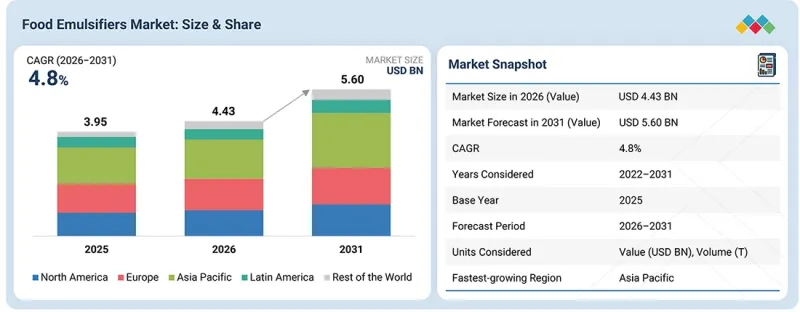
The food emulsifiers market is estimated at USD 4.43 billion in 2026 and is projected to reach USD 5.60 billion by 2031, at a CAGR of 4.8% from 2026 to 2031.
| Scope of the Report | |
|---|---|
| Years Considered for the Study | 2022-2031 |
| Base Year | 2025 |
| Forecast Period | 2026-2031 |
| Units Considered | Value (USD Million) and Volume (KT) |
| Segments | Type, Source, Application, Function, and Region |
| Regions covered | North America, Europe, Asia Pacific, Latin America, Rest of the World |
"Mono- and Diglycerides Drive Market Growth Through Versatile Emulsification Properties and Widespread Food Applications"
Mono- and diglycerides hold a dominant share of the global food emulsifiers market because they are widely used in bakery, confectionery, dairy, processed foods, and convenience products. Their strong emulsifying, stabilizing, and texture-enhancing properties make them highly versatile and cost-effective for food manufacturers. In addition, their ability to improve product consistency, shelf life, and processing performance supports their widespread adoption across various food applications.
"Bakery Products Dominate the Food Emulsifiers Market Through Extensive Use in Diverse Bakery Applications"
Bakery products represent the dominant application segment in the food emulsifiers market, driven by the widespread use of emulsifiers in bread, cakes, pastries, biscuits, and other bakery products. Emulsifiers improve dough handling, texture, volume, softness, moisture retention, and overall product stability while helping extend shelf life. Growing consumption of packaged and convenience bakery products, along with rising demand for consistent quality and freshness, continues to drive the widespread adoption of food emulsifiers in the bakery industry.
"Confectionery Products Dominate Lecithin Applications, Supported by Its Versatile Functional Properties"
Confectionery products represent the largest application segment for lecithin in the food emulsifiers market because of its extensive use in chocolates, coatings, fillings, caramels, and other confectionery products. Lecithin improves emulsification, viscosity control, dispersion, and texture while reducing the need for additional fats during processing. Its ability to enhance product consistency, processing efficiency, and shelf life makes it an important ingredient in confectionery manufacturing. Rising consumption of chocolates and premium confectionery products further supports the strong demand for lecithin in this application segment.
"Asia Pacific Dominates the Food Emulsifiers Market and Registers the Fastest Growth"
Asia Pacific represents the dominant and fastest-growing region in the food emulsifiers market, supported by rapid population growth, urbanization, and rising disposable incomes across countries such as China, India, Japan, and Southeast Asian economies. Increasing consumption of processed, packaged, convenience, bakery, confectionery, and dairy products is driving demand for food emulsifiers across the region. In addition, expanding food-processing industries, changing consumer lifestyles, and growing demand for functional and high-quality food products are further strengthening the market. The presence of a large consumer base and increasing investments by food manufacturers make Asia Pacific a key growth region for food emulsifiers.
In-depth interviews have been conducted with chief executive officers (CEOs), directors, and other executives from various key organizations operating in the food emulsifiers market.
- By Company Type: Tier 1 - 30%, Tier 2 - 25%, and Tier 3 - 45%
- By Designation: CXOs - 25%, Managers - 35%, Others - 40%
- By Region: North America - 20%, Europe - 30%, Asia Pacific - 35%, Latin America - 10%, and Rest of the World - 5%
Prominent companies in the market include ADM (US), Cargill, Incorporated (US), International Flavors & Fragrances (US), Ingredion (US), Kerry Group plc. (Ireland), Palsgaard (Denmark), Riken Vitamin Co., Ltd. (Japan), Foodchem International Corporation (China), ABF (UK), Louis Dreyfus Company (Netherlands), Croda International Plc (UK), Fine Organic Industries Limited (India), Stepan Company (US), American Lecithin Company (US), GSI (Malaysia), Lasenor Emul, S.L. (Spain), and others.
Research Coverage
This research report categorizes the food emulsifiers market by type (lecithin, mono- & diglycerides, mono- & diglycerides derivatives, sorbitan esters, polysorbates, stearoyl lactylates, polyglycerol esters, other types), source (plant source, animal source), application (bakery products, dairy, dairy alternatives & frozen desserts, confectionery products, convenience foods, meat & meat products, other applications), function (emulsification, starch complexing, protein interaction, aeration and stabilization, crystal modification, oil structuring, lubrication and processing aids), and region (North America, Europe, Asia Pacific, Latin America, Rest of the World).
The report covers major factors, including drivers, restraints, challenges, and opportunities, that influence the growth of the food emulsifiers industry. A thorough analysis of the key industry players has been done to provide insights into their business, services, key strategies, contracts, partnerships, agreements, product launches, mergers & acquisitions, and recent developments associated with the food emulsifiers market. This report provides a competitive analysis of emerging startups in the food emulsifiers market ecosystem. The study also covers industry-specific trends, including technology analysis, ecosystem & market mapping and the patent & regulatory landscape, among others.
Reasons to Buy This Report
The report provides market leaders/new entrants with the closest available revenue estimates for the overall food emulsifiers market and its subsegments. It helps stakeholders understand the competitive landscape and gain insights to better position their businesses and plan suitable go-to-market strategies. The report also helps stakeholders understand the market pulse and provides information on key market drivers, restraints, challenges, and opportunities.
The report provides insights into the following pointers:
- Analysis of key drivers (Rising consumption of processed and convenience foods, Expansion of bakery and confectionery products), restraints (Volatility in the price and availability of plant-based raw materials, Performance variability of natural emulsifiers), opportunities (Product innovations to promote better stabilization properties and lower cost, Development of specialized emulsifier blends), and challenges (Balancing functionality with clean-label expectations, Growing scrutiny of food additives and potential health concerns)
- Product Development/Innovation: Detailed insights into research & development activities and product launches in the food emulsifiers market
- Market Development: Comprehensive information about lucrative markets, analysis of food emulsifiers across varied regions
- Market Diversification: Exhaustive information about new product sources, untapped geographies, recent developments, and investments in the food emulsifiers market
- Competitive Assessment: In-depth assessment of market shares, growth strategies, product offerings, brand/product comparison, and product footprints of leading players such as ADM (US), Cargill, Incorporated (US), International Flavors & Fragrances (US), Ingredion (US), Kerry Group plc (Ireland), Palsgaard (Denmark), Riken Vitamin Co., Ltd. (Japan), Foodchem International Corporation (China), ABF (UK), Louis Dreyfus Company (Netherlands), Croda International Plc (UK), Fine Organic Industries Limited (India), Stepan Company (US), American Lecithin Company (US), GSI (Malaysia), Lasenor Emul, S.L. (Spain), and other players in the food emulsifiers market.
TABLE OF CONTENTS
1 INTRODUCTION
- 1.1 STUDY OBJECTIVES
- 1.2 MARKET DEFINITION
- 1.3 STUDY SCOPE
- 1.3.1 MARKETS COVERED AND REGIONS CONSIDERED
- 1.3.2 INCLUSIONS AND EXCLUSIONS
- 1.3.3 YEARS CONSIDERED
- 1.3.4 CURRENCY CONSIDERED
- 1.3.5 UNITS CONSIDERED
- 1.4 STAKEHOLDERS
- 1.5 SUMMARY OF CHANGES
2 EXECUTIVE SUMMARY
- 2.1 MARKET HIGHLIGHTS AND KEY INSIGHTS
- 2.2 KEY MARKET PARTICIPANTS: MAPPING OF STRATEGIC DEVELOPMENTS
- 2.3 DISRUPTIVE TRENDS IN FOOD EMULSIFIERS MARKET
- 2.4 HIGH-GROWTH SEGMENTS
- 2.5 REGIONAL SNAPSHOT: MARKET SIZE, GROWTH RATE, AND FORECAST
3 PREMIUM INSIGHTS
- 3.1 ATTRACTIVE OPPORTUNITIES FOR PLAYERS IN FOOD EMULSIFIERS MARKET
- 3.2 FOOD EMULSIFIERS MARKET, BY TYPE AND REGION
- 3.3 FOOD EMULSIFIERS MARKET, BY TOP 3 TYPES
- 3.4 FOOD EMULSIFIERS MARKET, BY SOURCE
- 3.5 FOOD EMULSIFIERS MARKET, BY APPLICATIONS
- 3.6 FOOD EMULSIFIERS MARKET, BY COUNTRY
4 MARKET OVERVIEW
- 4.1 INTRODUCTION
- 4.2 MARKET DYNAMICS
- 4.2.1 DRIVERS
- 4.2.1.1 Rising consumption of processed and convenience foods
- 4.2.1.2 Expansion of bakery and confectionery products
- 4.2.1.3 Increasing need for longer product shelf life and texture retention
- 4.2.1.4 Increasing demand for natural food additives and growing consumer awareness regarding clean label products
- 4.2.2 RESTRAINTS
- 4.2.2.1 Volatility in the price and availability of plant-based raw materials
- 4.2.2.2 Performance variability of natural emulsifiers
- 4.2.2.3 Health concerns associated with soy and other allergen products
- 4.2.3 OPPORTUNITIES
- 4.2.3.1 Product innovations to promote better stabilization properties and lower costs
- 4.2.3.2 Development of specialized emulsifier blends
- 4.2.3.3 Multifunctional emulsifiers for product reformulation
- 4.2.3.4 Emerging-market food manufacturing expansion
- 4.2.4 CHALLENGES
- 4.2.4.1 Balancing functionality with clean-label expectations
- 4.2.4.2 Growing Scrutiny of Food Additives and Potential Health Concerns
- 4.2.1 DRIVERS
- 4.3 UNMET NEEDS AND WHITE SPACES
- 4.3.1 UNMET NEEDS IN THE FOOD EMULSIFIERS
- 4.3.2 WHITE SPACE OPPORTUNITIES
- 4.4 INTERCONNECTED MARKETS AND CROSS-SECTOR OPPORTUNITIES
- 4.4.1 INTERCONNECTED MARKETS
- 4.4.2 CROSS SECTOR OPPORTUNITIES
- 4.5 STRATEGIC MOVES BY TIER-1/2/3 PLAYERS
5 INDUSTRY TRENDS
- 5.1 PORTER'S FIVE FORCES ANALYSIS
- 5.1.1 INTENSITY OF COMPETITIVE RIVALRY
- 5.1.2 BARGAINING POWER OF SUPPLIERS
- 5.1.3 BARGAINING POWER OF BUYERS
- 5.1.4 THREAT OF SUBSTITUTES
- 5.1.5 THREAT OF NEW ENTRANTS
- 5.2 MACROECONOMICS OUTLOOK
- 5.2.1 INTRODUCTION
- 5.2.1.1 Macroeconomic Indicators
- 5.2.1.1.1 Rising real household disposable income supports food consumption and premiumization
- 5.2.1.1.2 Declining Food Inflation Supports Consumer Spending on Processed Foods
- 5.2.1.1 Macroeconomic Indicators
- 5.2.1 INTRODUCTION
- 5.3 VALUE CHAIN ANALYSIS
- 5.3.1 RESEARCH & PRODUCT DEVELOPMENT
- 5.3.2 RAW MATERIAL SOURCING
- 5.3.3 EMULSIFIER MANUFACTURING, FORMULATION & PROCESSING
- 5.3.4 DISTRIBUTION, STORAGE & SUPPLY CHAIN MANAGEMENT
- 5.3.5 END-USE INDUSTRIES & COMMERCIAL APPLICATIONS
- 5.4 ECOSYSTEM/MARKET MAP ANALYSES
- 5.4.1 DEMAND SIDE
- 5.4.2 SUPPLY SIDE
- 5.5 PRICING ANALYSIS
- 5.5.1 INTRODUCTION
- 5.5.2 INDICATIVE PRICE TREND AMONG MARKET PLAYERS
- 5.5.3 INDICATIVE AVERAGE SELLING PRICE (ASP) TREND BY REGION, 2025 (USD/TONS)
- 5.5.4 INDICATIVE AVERAGE SELLING PRICE (ASP) TREND BY TYPE, 2025 (USD/TONS)
- 5.6 TRADE ANALYSIS
- 5.6.1 IMPORT ANALYSIS: FOOD EMULSIFIERS
- 5.6.2 EXPORT ANALYSIS: FOOD EMULSIFIERS
- 5.7 KEY CONFERENCES AND EVENTS, 2026-2027
- 5.8 TRENDS/DISRUPTIONS IMPACTING CUSTOMER BUSINESS
- 5.9 INVESTMENT AND FUNDING SCENARIO
- 5.10 CASE STUDY ANALYSIS
- 5.10.1 PALSGAARD - EGG REDUCTION IN INDUSTRIAL CAKE PRODUCTION
- 5.10.2 KERRY - PUREMUL AS A REPLACEMENT FOR SUNFLOWER LECITHIN
- 5.10.3 INGREDION - Q-NATURALE 200 V FOR STABLE NON-ALCOHOLIC BEVERAGES
- 5.11 IMPACT OF 2025 US TARIFF -FOOD EMULSIFIERS MARKET
- 5.11.1 INTRODUCTION
- 5.11.2 PRICE IMPACT ANALYSIS
- 5.11.3 IMPACT ON COUNTRIES/REGIONS
- 5.11.3.1 US
- 5.11.3.2 Europe
- 5.11.3.3 Asia Pacific
- 5.11.4 IMPACT ON END USE INDUSTRIES
6 TECHNOLOGY ADVANCEMENTS, AI-DRIVEN IMPACT, PATENTS, INNOVATIONS, AND FUTURE APPLICATIONS
- 6.1 TECHNOLOGY ANALYSIS
- 6.1.1 KEY TECHNOLOGIES
- 6.1.1.1 Esterification and transesterification Technology
- 6.1.1.2 Fat splitting and glycerolysis
- 6.1.1.3 Lecithin extraction and modification
- 6.1.2 COMPLEMENTARY ANALYSIS
- 6.1.2.1 Blending and formulation technology
- 6.1.2.2 High-shear mixing and homogenization
- 6.1.3 ADJACENT TECHNOLOGIES
- 6.1.3.1 Extrusion and Granulation Technology
- 6.1.3.2 Spray Drying and Microencapsulation Technology
- 6.1.3.3 Pickering Emulsion Technology
- 6.1.4 TECHNOLOGY/PRODUCT ROADMAP
- 6.1.4.1 Short-Term | Process Optimization & Functional Enhancement
- 6.1.4.2 Mid-Term | Sustainable Emulsifier Manufacturing
- 6.1.4.3 Long-Term | Next-Generation Emulsifier Systems
- 6.1.1 KEY TECHNOLOGIES
- 6.2 PATENT ANALYSIS
- 6.3 FUTURE APPLICATIONS
- 6.3.1 PLANT PROTEIN BASED EMULSIFIERS: SUPPORTING THE EXPANSION OF PLANT BASED FOODS
- 6.3.2 EMULSIFIER BASED FAT REPLACEMENT: ENABLING LOW FAT AND HEALTH ORIENTED FOOD FORMULATIONS
- 6.3.3 AGRI FOOD BY PRODUCT DERIVED EMULSIFIERS: SUPPORTING CIRCULAR AND SUSTAINABLE FOOD PRODUCTION
- 6.4 IMPACT OF GENERATIVE AI ON OVERALL FOOD ADDITIVE MARKET
- 6.4.1 INTRODUCTION
- 6.4.2 TOP USE CASES AND MARKET POTENTIAL
- 6.4.3 BEST PRACTICES IN FOOD ADDITIVE INDUSTRY
- 6.4.4 CASE STUDIES OF AI IMPLEMENTATION IN THE FOOD ADDITIVE MARKET
- 6.4.5 INTERCONNECTED ADJACENT ECOSYSTEM AND IMPACT ON MARKET PLAYERS
- 6.4.6 CLIENTS' READINESS TO ADOPT GENERATIVE AI FOR FOOD ADDITIVE PRODUCTION
7 SUSTAINABILITY AND REGULATORY LANDSCAPE
- 7.1 REGIONAL REGULATIONS AND COMPLIANCE
- 7.1.1 REGULATORY BODIES, GOVERNMENT AGENCIES, AND OTHER ORGANIZATIONS
- 7.1.2 INDUSTRY STANDARDS
- 7.1.3 LABELING REQUIREMENTS AND CLAIMS
- 7.1.4 ANTICIPATED REGULATORY CHANGES IN NEXT 5-10 YEARS
- 7.1.4.1 Enhanced Traceability and Raw Material Transparency Requirements
- 7.1.4.2 Greater Harmonization of Food Additive Standards and Conditions of Use
- 7.1.4.3 Stricter Sustainability and Responsible Sourcing Requirements
- 7.1.4.4 Digital Traceability, Smart Quality Monitoring, and Compliance Automation
- 7.1.4.5 Increased Focus on Food Additive Safety, Exposure Assessment, and Use Levels
- 7.1.4.6 Expanded Labeling Requirements for Source, Allergen, and Consumer Transparency Claims
- 7.2 SUSTAINABILITY INITIATIVES
- 7.2.1 SUSTAINABLE SOURCING
- 7.2.2 CARBON FOOTPRINT REDUCTION INITIATIVES
- 7.2.3 CIRCULAR ECONOMY APPROACHES
- 7.3 SUSTAINABILITY IMPACT AND REGULATORY POLICY INITIATIVES
- 7.4 CERTIFICATIONS, LABELING, ECO-STANDARDS
8 CUSTOMER LANDSCAPE AND BUYER BEHAVIOR
- 8.1 DECISION-MAKING PROCESS
- 8.2 KEY STAKEHOLDERS AND BUYING CRITERIA
- 8.2.1 KEY STAKEHOLDERS IN BUYING PROCESS
- 8.2.2 BUYING CRITERIA
- 8.3 ADOPTION BARRIERS AND INTERNAL CHALLENGES
- 8.4 UNMET NEEDS OF VARIOUS APPLICATION INDUSTRIES ACROSS THE SUPPLY CHAIN
- 8.5 MARKET PROFITABILITY
- 8.6 REVENUE POTENTIAL
- 8.6.1 COST DYNAMICS
- 8.6.2 MARGIN OPPORTUNITIES, BY KEY EMULSIFIER TYPES
9 FOOD EMULSIFIERS MARKET, BY TYPE
- 9.1 INTRODUCTION
- 9.2 LECITHIN
- 9.2.1 BROAD FUNCTIONALITY AND DIVERSE APPLICATIONS TO DRIVE LECITHIN GROWTH IN THE FOOD EMULSIFIERS MARKET
- 9.2.2 OILED LECITHIN
- 9.2.3 DE-OILED LECITHIN
- 9.3 MONO- & DIGLYCERIDES
- 9.3.1 MONO- AND DIGLYCERIDES TO IMPROVE PRODUCT STABILITY AND TEXTURE
- 9.4 MONO- & DIGLYCERIDES DERIVATIVES
- 9.4.1 SPECIALIZED MONO- AND DIGLYCERIDE DERIVATIVES TO DRIVE DEMAND THROUGH TARGETED FUNCTIONALITY ACROSS FOOD APPLICATIONS
- 9.4.2 DATEM - DIACETYL TARTARIC ACID ESTERS OF MONO- AND DIGLYCERIDES
- 9.4.3 ACETEM - ACETIC ACID ESTERS OF MONO- AND DIGLYCERIDES
- 9.4.4 CITREM - CITRIC ACID ESTERS OF MONO- AND DIGLYCERIDES
- 9.4.5 LACTEM - LACTIC ACID ESTERS OF MONO- AND DIGLYCERIDES
- 9.4.6 OTHER MONO- AND DIGLYCERIDE DERIVATIVES
- 9.5 SORBITAN ESTERS
- 9.5.1 SORBITAN ESTERS TO SUPPORT EMULSIFICATION AND STABILITY ACROSS FOOD APPLICATIONS
- 9.6 POLYSORBATES
- 9.6.1 POLYSORBATES TO PROVIDE EFFECTIVE EMULSIFICATION AND STABILITY IN FOOD FORMULATIONS
- 9.7 STEAROYL LACTYLATES
- 9.7.1 STEAROYL LACTYLATES TO IMPROVE EMULSIFICATION, DOUGH STRENGTH, AND PRODUCT STABILITY
- 9.8 POLYGLYCEROL ESTERS
- 9.8.1 POLYGLYCEROL ESTERS TO PROVIDE VERSATILE EMULSIFICATION AND STABILIZATION IN FOOD FORMULATIONS
- 9.9 OTHER TYPES
- 9.9.1 OTHER EMULSIFIERS TO PROVIDE SPECIALIZED FUNCTIONALITY ACROSS FOOD APPLICATIONS
10 FOOD EMULSIFIERS MARKET, BY APPLICATION
- 10.1 INTRODUCTION
- 10.2 BAKERY PRODUCTS
- 10.3 DAIRY, DAIRY ALTERNATIVES & FROZEN DESSERTS
- 10.4 CONFECTIONERY PRODUCTS
- 10.5 CONVENIENCE FOODS
- 10.6 MEAT & MEAT PRODUCTS
- 10.7 OTHER APPLICATIONS
11 FOOD EMULSIFIERS MARKET, BY SOURCE
- 11.1 INTRODUCTION
- 11.2 PLANT SOURCE
- 11.2.1 PLANT-BASED EMULSIFIERS GAIN MOMENTUM AS CLEAN-LABEL AND SUSTAINABLE FOOD FORMULATIONS EXPAND
- 11.3 ANIMAL SOURCE
- 11.3.1 ANIMAL-DERIVED EMULSIFIERS RETAIN NICHE IMPORTANCE IN TRADITIONAL FOOD APPLICATIONS DESPITE THE SHIFT TOWARD PLANT-BASED ALTERNATIVES
12 FOOD EMULSIFIERS MARKET, BY FUNCTION
- 12.1 INTRODUCTION
- 12.2 EMULSIFICATION
- 12.3 STARCH COMPLEXING
- 12.4 PROTEIN INTERACTION
- 12.5 AERATION AND STABILIZATION
- 12.6 CRYSTAL MODIFICATION
- 12.7 OIL STRUCTURING
- 12.8 LUBRICATION AND PROCESSING AIDS
13 FOOD EMULSIFIERS MARKET, BY REGION
- 13.1 INTRODUCTION
- 13.2 NORTH AMERICA
- 13.2.1 US
- 13.2.1.1 Growing plant-based consumption strengthens the application potential of plant sourced emulsifiers
- 13.2.2 CANADA
- 13.2.2.1 Expanding packaged food production and accelerating plant ased adoption are strengthening demand for food emulsifiers in Canada
- 13.2.1 US
- 13.3 EUROPE
- 13.3.1 GERMANY
- 13.3.1.1 Germany's growing convenience food production and shift toward plant-based diets are expanding demand for food emulsifiers.
- 13.3.2 UK
- 13.3.2.1 The UK's high bakery penetration, export oriented food industry, and continued product reformulation are creating diverse applications for food emulsifiers
- 13.3.3 FRANCE
- 13.3.3.1 France's diversified food processing industry, export strength, and expanding plant-based sector are broadening opportunities for food emulsifiers
- 13.3.4 ITALY
- 13.3.4.1 Italy's expanding food processing and bakery sectors are creating strong opportunities for food emulsifiers
- 13.3.5 SPAIN
- 13.3.5.1 Spain's expanding food processing and frozen bakery sectors are strengthening demand for functional food emulsifiers
- 13.3.6 REST OF EUROPE
- 13.3.6.1 Diverse food-processing industries and evolving product formulations to expand applications for food emulsifiers
- 13.3.1 GERMANY
- 13.4 ASIA PACIFIC
- 13.4.1 CHINA
- 13.4.1.1 China's expanding food processing and prepared food sectors are broadening applications and supporting demand for food emulsifiers
- 13.4.2 INDIA
- 13.4.2.1 India's expanding food processing and packaged food industries are broadening applications for food emulsifiers
- 13.4.3 JAPAN
- 13.4.3.1 Japan's expanding prepared-food sector is broadening applications and supporting demand for food emulsifiers
- 13.4.4 SOUTH KOREA
- 13.4.4.1 Expanding food production and growing demand for value-added foods are driving broader applications for food emulsifiers
- 13.4.5 AUSTRALIA & NEW ZEALAND
- 13.4.5.1 Expanding food manufacturing and export oriented processing are strengthening demand for food emulsifiers across the region
- 13.4.6 REST OF ASIA PACIFIC
- 13.4.6.1 Expanding food processing and evolving consumer preferences to broaden applications for food emulsifiers across the region
- 13.4.1 CHINA
- 13.5 LATIN AMERICA
- 13.5.1 BRAZIL
- 13.5.1.1 Diversified food-processing industry and continued industrial investment to drive food emulsifier demand in Brazil
- 13.5.2 MEXICO
- 13.5.2.1 A strong food-processing base and rising demand for value-added foods are expanding applications for food emulsifiers in Mexico
- 13.5.3 ARGENTINA
- 13.5.3.1 Strong food processing and expanding agro-industrial production are broadening applications for food emulsifiers in Argentina
- 13.5.4 REST OF LATIN AMERICA
- 13.5.4.1 Diversifying food production and evolving formulations are broadening applications for food emulsifiers across the region
- 13.5.1 BRAZIL
- 13.6 REST OF THE WORLD (ROW)
- 13.6.1 GROWING FOOD DEMAND AND MODERNIZING FOOD SYSTEMS TO BROADEN APPLICATIONS FOR FOOD EMULSIFIERS ACROSS THE REGION
- 13.6.2 MIDDLE EAST
- 13.6.2.1 Rapid expansion of packaged food and foodservice industries to drive food emulsifier demand in the Middle East
- 13.6.3 AFRICA
- 13.6.3.1 Expansion of Food Processing Supporting Food Emulsifiers Market Growth
14 COMPETITIVE LANDSCAPE
- 14.1 OVERVIEW
- 14.2 KEY PLAYER STRATEGIES/RIGHT TO WIN
- 14.3 REVENUE ANALYSIS, 2023-2025
- 14.4 MARKET SHARE ANALYSIS, 2025
- 14.5 COMPANY VALUATION AND FINANCIAL METRICS
- 14.5.1 COMPANY VALUATION
- 14.5.2 EV/EBITDA
- 14.6 BRAND COMPARISON
- 14.7 COMPANY EVALUATION MATRIX: KEY PLAYERS, 2025
- 14.7.1 STARS
- 14.7.2 EMERGING LEADERS
- 14.7.3 PERVASIVE PLAYERS
- 14.7.4 PARTICIPANTS
- 14.7.5 COMPANY FOOTPRINT: FOOD EMULSIFIERS MARKET KEY PLAYERS, 2025
- 14.7.5.1 Company footprint
- 14.7.5.2 Region footprint
- 14.7.5.3 Type Footprint
- 14.7.5.4 Application Footprint
- 14.8 COMPANY EVALUATION MATRIX: STARTUPS/SMES, 2025
- 14.8.1 PROGRESSIVE COMPANIES
- 14.8.2 RESPONSIVE COMPANIES
- 14.8.3 DYNAMIC COMPANIES
- 14.8.4 STARTING BLOCKS
- 14.8.5 COMPETITIVE BENCHMARKING: KEY STARTUPS/SMES, 2025
- 14.8.5.1 Detailed list of key startups/SMEs
- 14.8.5.2 Competitive benchmarking of key startups/SMEs
- 14.9 COMPETITIVE SCENARIO AND TRENDS
- 14.9.1 PRODUCT LAUNCHES
- 14.9.2 DEALS
- 14.9.3 EXPANSIONS
- 14.9.4 OTHERS
15 COMPANY PROFILES
- 15.1 KEY PLAYERS
- 15.1.1 ADM
- 15.1.1.1 Business overview
- 15.1.1.2 Products/Solutions/Services offered
- 15.1.1.3 Recent developments
- 15.1.1.3.1 Deals
- 15.1.1.4 MnM view
- 15.1.1.4.1 Key strengths
- 15.1.1.4.2 Strategic choices
- 15.1.1.4.3 Weaknesses and competitive threats
- 15.1.2 CARGILL, INCORPORATED
- 15.1.2.1 Business overview
- 15.1.2.2 Products/Solutions/Services offered
- 15.1.2.3 MnM view
- 15.1.2.3.1 Key strengths
- 15.1.2.3.2 Strategic choices
- 15.1.2.3.3 Weaknesses and competitive threats
- 15.1.3 INTERNATIONAL FLAVORS & FRAGRANCES INC.
- 15.1.3.1 Business overview
- 15.1.3.2 Products/Solutions/Services offered
- 15.1.3.3 Recent developments
- 15.1.3.3.1 Deals
- 15.1.3.4 MnM view
- 15.1.3.4.1 Key strengths
- 15.1.3.4.2 Strategic choices
- 15.1.3.4.3 Weaknesses and competitive threats
- 15.1.4 INGREDION
- 15.1.4.1 Business overview
- 15.1.4.2 Products/Solutions/Services offered
- 15.1.4.3 Recent developments
- 15.1.4.3.1 Deals
- 15.1.4.4 MnM view
- 15.1.4.4.1 Key strengths
- 15.1.4.4.2 Strategic choices
- 15.1.4.4.3 Weaknesses and competitive threats
- 15.1.5 KERRY GROUP PLC
- 15.1.5.1 Business overview
- 15.1.5.2 Products/Solutions/Services offered
- 15.1.5.3 Recent developments
- 15.1.5.3.1 Deals
- 15.1.5.4 MnM view
- 15.1.5.4.1 Key strengths
- 15.1.5.4.2 Strategic choices
- 15.1.5.4.3 Weaknesses and competitive threats
- 15.1.6 CRODA INTERNATIONAL PLC
- 15.1.6.1 Business overview
- 15.1.6.2 Products/Solutions/Services offered
- 15.1.6.3 MnM view
- 15.1.7 PALSGAARD
- 15.1.7.1 Business overview
- 15.1.7.2 Products/Solutions/Services offered
- 15.1.7.3 Recent developments
- 15.1.7.3.1 Expansions
- 15.1.7.4 MnM view
- 15.1.8 RIKEN VITAMIN CO., LTD.
- 15.1.8.1 Business overview
- 15.1.8.2 Products/Solutions/Services offered
- 15.1.8.3 MnM view
- 15.1.9 FOODCHEM INTERNATIONAL CORPORATION
- 15.1.9.1 Business overview
- 15.1.9.2 Products/Solutions/Services offered
- 15.1.9.3 MnM view
- 15.1.10 ABF INGREDIENTS
- 15.1.10.1 Business overview
- 15.1.10.2 Products/Solutions/Services offered
- 15.1.10.3 MnM view
- 15.1.11 FINE ORGANIC INDUSTRIES LIMITED
- 15.1.11.1 Business overview
- 15.1.11.2 Products/Solutions/Services offered
- 15.1.11.3 Recent developments
- 15.1.11.3.1 Expansions
- 15.1.11.4 MnM view
- 15.1.12 LOUIS DREYFUS COMPANY
- 15.1.12.1 Business overview
- 15.1.12.2 Products/Solutions/Services offered
- 15.1.12.3 Recent developments
- 15.1.12.3.1 Deals
- 15.1.12.4 MnM view
- 15.1.13 STEPAN COMPANY
- 15.1.13.1 Business overview
- 15.1.13.2 Products/Solutions/Services offered
- 15.1.13.3 Recent developments
- 15.1.13.4 MnM view
- 15.1.14 AMERICAN LECITHIN COMPANY
- 15.1.14.1 Business overview
- 15.1.14.2 Products/Solutions/Services offered
- 15.1.14.3 MnM view
- 15.1.15 GSI
- 15.1.15.1 Business overview
- 15.1.15.2 Products/Solutions/Services offered
- 15.1.15.3 MnM view
- 15.1.1 ADM
- 15.2 OTHER PLAYERS
- 15.2.1 LASENOR EMUL, S.L.
- 15.2.1.1 Business overview
- 15.2.1.2 Products/Solutions/Services offered
- 15.2.1.3 MnM view
- 15.2.2 ESTELLE CHEMICALS PVT. LTD
- 15.2.2.1 Business overview
- 15.2.2.2 Products/Solutions/Services offered
- 15.2.2.3 Recent developments
- 15.2.2.3.1 Product Launches
- 15.2.2.4 MnM view
- 15.2.3 MITSUBISHI CHEMICAL GROUP CORPORATION
- 15.2.3.1 Business overview
- 15.2.3.2 Products/Solutions/Services offered
- 15.2.3.3 Recent developments
- 15.2.3.3.1 Expansions
- 15.2.3.4 MnM view
- 15.2.4 LECICO GMBH
- 15.2.4.1 Business overview
- 15.2.4.2 Products/Solutions/Services offered
- 15.2.4.3 Recent developments
- 15.2.4.3.1 Others
- 15.2.4.4 MnM view
- 15.2.5 SPELL FOOD CHEMICALS PVT. LTD.
- 15.2.5.1 Business overview
- 15.2.5.2 Products/Solutions/Services offered
- 15.2.5.3 MnM view
- 15.2.6 MUSIM MAS GROUP
- 15.2.7 LECILITE INGREDIENTS PVT LTD
- 15.2.8 HENAN CHEMSINO INDUSTRY CO., LTD. (CHEMSINO)
- 15.2.9 AMITEX - AGRO PRODUCTS PVT. LTD.
- 15.2.10 DYNA GLYCOLS PVT. LTD.
- 15.2.1 LASENOR EMUL, S.L.
16 RESEARCH METHODOLOGY
- 16.1 RESEARCH DATA
- 16.1.1 SECONDARY DATA
- 16.1.1.1 Key data from secondary sources
- 16.1.2 PRIMARY DATA
- 16.1.2.1 Key data from primary sources
- 16.1.2.2 Breakdown of primary profiles
- 16.1.2.3 Key insights from industry experts
- 16.1.1 SECONDARY DATA
- 16.2 MARKET SIZE ESTIMATION
- 16.2.1 TOP-DOWN APPROACH
- 16.2.2 SUPPLY-SIDE ANALYSIS
- 16.2.3 BOTTOM-UP APPROACH (DEMAND SIDE)
- 16.3 DATA TRIANGULATION AND MARKET BREAKUP
- 16.4 RESEARCH ASSUMPTIONS
- 16.5 RESEARCH LIMITATIONS AND RISK ASSESSMENT
17 ADJACENT AND RELATED MARKETS
- 17.1 INTRODUCTION
- 17.2 RESEARCH LIMITATIONS
- 17.3 FOOD ADDITIVES MARKET
- 17.3.1 MARKET DEFINITION
- 17.3.2 MARKET OVERVIEW
- 17.4 FOOD ADDITIVES MARKET, BY FORM
- 17.5 LECITHIN AND PHOSPHOLIPIDS MARKET
- 17.5.1 MARKET DEFINITION
- 17.5.2 MARKET OVERVIEW
- 17.6 LECITHIN AND PHOSPHOLIPIDS MARKET, BY NATURE
18 APPENDIX
- 18.1 DISCUSSION GUIDE
- 18.2 KNOWLEDGESTORE: MARKETSANDMARKETS' SUBSCRIPTION PORTAL
- 18.3 CUSTOMIZATION OPTIONS
- 18.4 RELATED REPORTS
List of Tables
- TABLE 1 USD EXCHANGE RATES, 2021-2025
- TABLE 2 KEY MOVES AND STRATEGIC FOCUS
- TABLE 3 FOOD EMULSIFIERS MARKET: PORTER'S FIVE FORCES ANALYSIS
- TABLE 4 FOOD EMULSIFIERS MARKET: SUPPLY CHAIN (ECOSYSTEM)
- TABLE 5 INDICATIVE AVERAGE SELLING PRICE (ASP) TREND BY REGION, 2025 (USD/TONS)
- TABLE 6 INDICATIVE AVERAGE SELLING PRICE (ASP) TREND BY TYPE, 2025 (USD/TONS)
- TABLE 7 TOP IMPORTERS OF FOOD EMULSIFIERS, 2021-2025, USD MILLION
- TABLE 8 TOP EXPORTERS OF FOOD EMULSIFIERS, 2021-2025, USD MILLION
- TABLE 9 FOOD EMULSIFIERS MARKET: LIST OF KEY CONFERENCES AND EVENTS, 2026-2027
- TABLE 10 PATENTS PERTAINING TO FOOD EMULSIFIER MARKET, 2022-2026
- TABLE 11 TOP USE CASES AND MARKET POTENTIAL
- TABLE 12 BEST PRACTICES: COMPANIES IMPLEMENTING USE CASES
- TABLE 13 FOOD ADDITIVE MARKET: CASE STUDIES RELATED TO GEN AI IMPLEMENTATION
- TABLE 14 INTERCONNECTED ADJACENT ECOSYSTEM AND IMPACT ON MARKET PLAYERS
- TABLE 23 INFLUENCE OF STAKEHOLDERS ON BUYING PROCESS FOR KEY PRODUCT TYPES
- TABLE 24 KEY BUYING CRITERIA FOR TOP PRODUCT TYPES
- TABLE 25 UNMET NEEDS IN FOOD EMULSIFIERS MARKET, BY APPLICATION INDUSTRIES ACROSS THE SUPPLY CHAIN
- TABLE 26 COST DYNAMICS IN FOOD EMULSIFIERS MARKET
- TABLE 27 MARGIN OPPORTUNITIES IN FOOD EMULSIFIERS MARKET, BY KEY EMULSIFIER TYPES
- TABLE 28 FOOD EMULSIFIERS MARKET, BY TYPE, 2022-2025 (USD MILLION)
- TABLE 29 FOOD EMULSIFIERS MARKET, BY TYPE, 2026-2031 (USD MILLION)
- TABLE 30 FOOD EMULSIFIERS MARKET, BY TYPE, 2022-2025 (KT)
- TABLE 31 FOOD EMULSIFIERS MARKET, BY TYPE, 2026-2031 (KT)
- TABLE 32 LECITHIN: FOOD EMULSIFIERS MARKET, BY REGION, 2022-2025 (USD MILLION)
- TABLE 33 LECITHIN: FOOD EMULSIFIERS MARKET, BY REGION, 2026-2031 (USD MILLION)
- TABLE 34 LECITHIN: FOOD EMULSIFIERS MARKET, BY REGION, 2022-2025 (KT)
- TABLE 35 LECITHIN: FOOD EMULSIFIERS MARKET, BY REGION, 2026-2031 (KT)
- TABLE 36 LECITHIN: FOOD EMULSIFIERS MARKET, BY APPLICATION, 2022-2025 (USD MILLION)
- TABLE 37 LECITHIN: FOOD EMULSIFIERS MARKET, BY APPLICATION, 2026-2031 (USD MILLION)
- TABLE 38 LECITHIN: FOOD EMULSIFIERS MARKET, BY APPLICATION, 2022-2025 (KT)
- TABLE 39 LECITHIN: FOOD EMULSIFIERS MARKET, BY APPLICATION, 2026-2031 (KT)
- TABLE 40 LECITHIN: FOOD EMULSIFIERS MARKET, BY SUBTYPE, 2022-2025 (USD MILLION)
- TABLE 41 LECITHIN: FOOD EMULSIFIERS MARKET, BY SUBTYPE, 2026-2031 (USD MILLION)
- TABLE 42 LECITHIN: FOOD EMULSIFIERS MARKET, BY SUBTYPE, 2022-2025 (KT)
- TABLE 43 LECITHIN: FOOD EMULSIFIERS MARKET, BY SUBTYPE, 2026-2031 (KT)
- TABLE 44 OILED LECITHIN: FOOD EMULSIFIERS MARKET, BY REGION, 2022-2025 (USD MILLION)
- TABLE 45 OILED LECITHIN: FOOD EMULSIFIERS MARKET, BY REGION, 2026-2031 (USD MILLION)
- TABLE 46 OILED LECITHIN: FOOD EMULSIFIERS MARKET, BY REGION, 2022-2025 (KT)
- TABLE 47 OILED LECITHIN: FOOD EMULSIFIERS MARKET, BY REGION, 2026-2031 (KT)
- TABLE 48 DE-OILED LECITHIN: FOOD EMULSIFIERS MARKET, BY REGION, 2022-2025 (USD MILLION)
- TABLE 49 DE- OILED LECITHIN: FOOD EMULSIFIERS MARKET, BY REGION, 2026-2031 (USD MILLION)
- TABLE 50 DE-OILED LECITHIN: FOOD EMULSIFIERS MARKET, BY REGION, 2022-2025 (KT)
- TABLE 51 DE-OILED LECITHIN: FOOD EMULSIFIERS MARKET, BY REGION, 2026-2031 (KT)
- TABLE 52 MONO- & DIGLYCERIDES: FOOD EMULSIFIERS MARKET, BY REGION, 2022-2025 (USD MILLION)
- TABLE 53 MONO- & DIGLYCERIDES: FOOD EMULSIFIERS MARKET, BY REGION, 2026-2031 (USD MILLION)
- TABLE 54 MONO- & DIGLYCERIDES: FOOD EMULSIFIERS MARKET, BY REGION, 2022-2025 (KT)
- TABLE 55 MONO- & DIGLYCERIDES: FOOD EMULSIFIERS MARKET, BY REGION, 2026-2031 (KT)
- TABLE 56 MONO- & DIGLYCERIDES: FOOD EMULSIFIERS MARKET, BY APPLICATION, 2022-2025 (USD MILLION)
- TABLE 57 MONO- & DIGLYCERIDES: FOOD EMULSIFIERS MARKET, BY APPLICATION, 2026-2031 (USD MILLION)
- TABLE 58 MONO- & DIGLYCERIDES: FOOD EMULSIFIERS MARKET, BY APPLICATION, 2022-2025 (KT)
- TABLE 59 MONO- & DIGLYCERIDES: FOOD EMULSIFIERS MARKET, BY APPLICATION, 2026-2031 (KT)
- TABLE 60 MONO- & DIGLYCERIDES DERIVATIVES: FOOD EMULSIFIERS MARKET, BY REGION, 2022-2025 (USD MILLION)
- TABLE 61 MONO- & DIGLYCERIDES DERIVATIVES: FOOD EMULSIFIERS MARKET, BY REGION, 2026-2031 (USD MILLION)
- TABLE 62 MONO- & DIGLYCERIDES DERIVATIVES: FOOD EMULSIFIERS MARKET, BY REGION, 2022-2025 (KT)
- TABLE 63 MONO- & DIGLYCERIDES DERIVATIVES: FOOD EMULSIFIERS MARKET, BY REGION, 2026-2031 (KT)
- TABLE 64 MONO- & DIGLYCERIDES DERIVATIVES: FOOD EMULSIFIERS MARKET, BY APPLICATION, 2022-2025 (USD MILLION)
- TABLE 65 MONO- & DIGLYCERIDES DERIVATIVES: FOOD EMULSIFIERS MARKET, BY APPLICATION, 2026-2031 (USD MILLION)
- TABLE 66 MONO- & DIGLYCERIDES DERIVATIVES: FOOD EMULSIFIERS MARKET, BY APPLICATION, 2022-2025 (KT)
- TABLE 67 MONO- & DIGLYCERIDES DERIVATIVES: FOOD EMULSIFIERS MARKET, BY APPLICATION, 2026-2031 (KT)
- TABLE 68 MONO- & DIGLYCERIDES DERIVATIVES: FOOD EMULSIFIERS MARKET, BY SUBTYPE, 2022-2025 (USD MILLION)
- TABLE 69 MONO- & DIGLYCERIDES DERIVATIVES: FOOD EMULSIFIERS MARKET, BY SUBTYPE, 2026-2031 (USD MILLION)
- TABLE 70 MONO- & DIGLYCERIDES DERIVATIVES: FOOD EMULSIFIERS MARKET, BY SUBTYPE, 2022-2025 (KT)
- TABLE 71 MONO- & DIGLYCERIDES DERIVATIVES: FOOD EMULSIFIERS MARKET, BY SUBTYPE, 2026-2031 (KT)
- TABLE 72 DATEM: FOOD EMULSIFIERS MARKET, BY REGION, 2022-2025 (USD MILLION)
- TABLE 73 DATEM: FOOD EMULSIFIERS MARKET, BY REGION, 2026-2031 (USD MILLION)
- TABLE 74 DATEM: FOOD EMULSIFIERS MARKET, BY REGION, 2022-2025 (KT)
- TABLE 75 DATEM: FOOD EMULSIFIERS MARKET, BY REGION, 2026-2031 (KT)
- TABLE 76 ACETEM: FOOD EMULSIFIERS MARKET, BY REGION, 2022-2025 (USD MILLION)
- TABLE 77 ACETEM: FOOD EMULSIFIERS MARKET, BY REGION, 2026-2031 (USD MILLION)
- TABLE 78 ACETEM: FOOD EMULSIFIERS MARKET, BY REGION, 2022-2025 (KT)
- TABLE 79 ACETEM: FOOD EMULSIFIERS MARKET, BY REGION, 2026-2031 (KT)
- TABLE 80 CITREM: FOOD EMULSIFIERS MARKET, BY REGION, 2022-2025 (USD MILLION)
- TABLE 81 CITREM: FOOD EMULSIFIERS MARKET, BY REGION, 2026-2031 (USD MILLION)
- TABLE 82 CITREM: FOOD EMULSIFIERS MARKET, BY REGION, 2022-2025 (KT)
- TABLE 83 CITREM: FOOD EMULSIFIERS MARKET, BY REGION, 2026-2031 (KT)
- TABLE 84 LACTEM: FOOD EMULSIFIERS MARKET, BY REGION, 2022-2025 (USD MILLION)
- TABLE 85 LACTEM: FOOD EMULSIFIERS MARKET, BY REGION, 2026-2031 (USD MILLION)
- TABLE 86 LACTEM: FOOD EMULSIFIERS MARKET, BY REGION, 2022-2025 (KT)
- TABLE 87 LACTEM: FOOD EMULSIFIERS MARKET, BY REGION, 2026-2031 (KT)
- TABLE 88 OTHER MONO- AND DIGLYCERIDE DERIVATIVES: FOOD EMULSIFIERS MARKET, BY REGION, 2022-2025 (USD MILLION)
- TABLE 89 OTHER MONO- AND DIGLYCERIDE DERIVATIVES: FOOD EMULSIFIERS MARKET, BY REGION, 2026-2031 (USD MILLION)
- TABLE 90 OTHER MONO- AND DIGLYCERIDE DERIVATIVES: FOOD EMULSIFIERS MARKET, BY REGION, 2022-2025 (KT)
- TABLE 91 OTHER MONO- AND DIGLYCERIDE DERIVATIVES: FOOD EMULSIFIERS MARKET, BY REGION, 2026-2031 (KT)
- TABLE 92 SORBITAN ESTERS: FOOD EMULSIFIERS MARKET, BY REGION, 2022-2025 (USD MILLION)
- TABLE 93 SORBITAN ESTERS: FOOD EMULSIFIERS MARKET, BY REGION, 2026-2031 (USD MILLION)
- TABLE 94 SORBITAN ESTERS: FOOD EMULSIFIERS MARKET, BY REGION, 2022-2025 (KT)
- TABLE 95 SORBITAN ESTERS: FOOD EMULSIFIERS MARKET, BY REGION, 2026-2031 (KT)
- TABLE 96 SORBITAN ESTERS: FOOD EMULSIFIERS MARKET, BY APPLICATION, 2022-2025 (USD MILLION)
- TABLE 97 SORBITAN ESTERS: FOOD EMULSIFIERS MARKET, BY APPLICATION, 2026-2031 (USD MILLION)
- TABLE 98 SORBITAN ESTERS: FOOD EMULSIFIERS MARKET, BY APPLICATION, 2022-2025 (KT)
- TABLE 99 SORBITAN ESTERS: FOOD EMULSIFIERS MARKET, BY APPLICATION, 2026-2031 (KT)
- TABLE 100 POLYSORBATES: FOOD EMULSIFIERS MARKET, BY REGION, 2022-2025 (USD MILLION)
- TABLE 101 POLYSORBATES: FOOD EMULSIFIERS MARKET, BY REGION, 2026-2031 (USD MILLION)
- TABLE 102 POLYSORBATES: FOOD EMULSIFIERS MARKET, BY REGION, 2022-2025 (KT)
- TABLE 103 POLYSORBATES: FOOD EMULSIFIERS MARKET, BY REGION, 2026-2031 (KT)
- TABLE 104 POLYSORBATES: FOOD EMULSIFIERS MARKET, BY APPLICATION, 2022-2025 (USD MILLION)
- TABLE 105 POLYSORBATES: FOOD EMULSIFIERS MARKET, BY APPLICATION, 2026-2031 (USD MILLION)
- TABLE 106 POLYSORBATES: FOOD EMULSIFIERS MARKET, BY APPLICATION, 2022-2025 (KT)
- TABLE 107 POLYSORBATES: FOOD EMULSIFIERS MARKET, BY APPLICATION, 2026-2031 (KT)
- TABLE 108 STEAROYL LACTYLATES: FOOD EMULSIFIERS MARKET, BY REGION, 2022-2025 (USD MILLION)
- TABLE 109 STEAROYL LACTYLATES: FOOD EMULSIFIERS MARKET, BY REGION, 2026-2031 (USD MILLION)
- TABLE 110 STEAROYL LACTYLATES: FOOD EMULSIFIERS MARKET, BY REGION, 2022-2025 (KT)
- TABLE 111 STEAROYL LACTYLATES: FOOD EMULSIFIERS MARKET, BY REGION, 2026-2031 (KT)
- TABLE 112 STEAROYL LACTYLATES: FOOD EMULSIFIERS MARKET, BY APPLICATION, 2022-2025 (USD MILLION)
- TABLE 113 STEAROYL LACTYLATES: FOOD EMULSIFIERS MARKET, BY APPLICATION, 2026-2031 (USD MILLION)
- TABLE 114 STEAROYL LACTYLATES: FOOD EMULSIFIERS MARKET, BY APPLICATION, 2022-2025 (KT)
- TABLE 115 STEAROYL LACTYLATES: FOOD EMULSIFIERS MARKET, BY APPLICATION, 2026-2031 (KT)
- TABLE 116 POLYGLYCEROL ESTERS: FOOD EMULSIFIERS MARKET, BY REGION, 2022-2025 (USD MILLION)
- TABLE 117 POLYGLYCEROL ESTERS: FOOD EMULSIFIERS MARKET, BY REGION, 2026-2031 (USD MILLION)
- TABLE 118 POLYGLYCEROL ESTERS: FOOD EMULSIFIERS MARKET, BY REGION, 2022-2025 (KT)
- TABLE 119 POLYGLYCEROL ESTERS: FOOD EMULSIFIERS MARKET, BY REGION, 2026-2031 (KT)
- TABLE 120 POLYGLYCEROL ESTERS: FOOD EMULSIFIERS MARKET, BY APPLICATION, 2022-2025 (USD MILLION)
- TABLE 121 POLYGLYCEROL ESTERS: FOOD EMULSIFIERS MARKET, BY APPLICATION, 2026-2031 (USD MILLION)
- TABLE 122 POLYGLYCEROL ESTERS: FOOD EMULSIFIERS MARKET, BY APPLICATION, 2022-2025 (KT)
- TABLE 123 POLYGLYCEROL ESTERS: FOOD EMULSIFIERS MARKET, BY APPLICATION, 2026-2031 (KT)
- TABLE 124 OTHER TYPES: FOOD EMULSIFIERS MARKET, BY REGION, 2022-2025 (USD MILLION)
- TABLE 125 OTHER TYPES: FOOD EMULSIFIERS MARKET, BY REGION, 2026-2031 (USD MILLION)
- TABLE 126 OTHER TYPES: FOOD EMULSIFIERS MARKET, BY REGION, 2022-2025 (KT)
- TABLE 127 OTHER TYPES: FOOD EMULSIFIERS MARKET, BY REGION, 2026-2031 (KT)
- TABLE 128 OTHER TYPES: FOOD EMULSIFIERS MARKET, BY APPLICATION, 2022-2025 (USD MILLION)
- TABLE 129 OTHER TYPES: FOOD EMULSIFIERS MARKET, BY APPLICATION, 2026-2031 (USD MILLION)
- TABLE 130 OTHER TYPES: FOOD EMULSIFIERS MARKET, BY APPLICATION, 2022-2025 (KT)
- TABLE 131 OTHER TYPES: FOOD EMULSIFIERS MARKET, BY APPLICATION, 2026-2031 (KT)
- TABLE 132 FOOD EMULSIFIERS MARKET, BY APPLICATION, 2022-2025 (USD MILLION)
- TABLE 133 FOOD EMULSIFIERS MARKET, BY APPLICATION, 2026-2031 (USD MILLION)
- TABLE 134 FOOD EMULSIFIERS MARKET, BY APPLICATION, 2022-2025 (KT)
- TABLE 135 FOOD EMULSIFIERS MARKET, BY APPLICATION, 2026-2031 (KT)
- TABLE 136 BAKERY PRODUCTS: FOOD EMULSIFIERS MARKET, BY REGION, 2022-2025 (USD MILLION)
- TABLE 137 BAKERY PRODUCTS: FOOD EMULSIFIERS MARKET, BY REGION, 2026-2031 (USD MILLION)
- TABLE 138 BAKERY PRODUCTS: FOOD EMULSIFIERS MARKET, BY REGION, 2022-2025 (KT)
- TABLE 139 BAKERY PRODUCTS: FOOD EMULSIFIERS MARKET, BY REGION, 2026-2031 (KT)
- TABLE 140 DAIRY, DAIRY ALTERNATIVES & FROZEN DESSERTS: FOOD EMULSIFIERS MARKET, BY REGION, 2022-2025 (USD MILLION)
- TABLE 141 DAIRY, DAIRY ALTERNATIVES & FROZEN DESSERTS: FOOD EMULSIFIERS MARKET, BY REGION, 2026-2031 (USD MILLION)
- TABLE 142 DAIRY, DAIRY ALTERNATIVES & FROZEN DESSERTS: FOOD EMULSIFIERS MARKET, BY REGION, 2022-2025 (KT)
- TABLE 143 DAIRY, DAIRY ALTERNATIVES & FROZEN DESSERTS: FOOD EMULSIFIERS MARKET, BY REGION, 2026-2031 (KT)
- TABLE 144 CONFECTIONERY PRODUCTS: FOOD EMULSIFIERS MARKET, BY REGION, 2022-2025 (USD MILLION)
- TABLE 145 CONFECTIONERY PRODUCTS: FOOD EMULSIFIERS MARKET, BY REGION, 2026-2031 (USD MILLION)
- TABLE 146 CONFECTIONERY PRODUCTS: FOOD EMULSIFIERS MARKET, BY REGION, 2022-2025 (KT)
- TABLE 147 CONFECTIONERY PRODUCTS: FOOD EMULSIFIERS MARKET, BY REGION, 2026-2031 (KT)
- TABLE 148 CONVENIENCE FOODS: FOOD EMULSIFIERS MARKET, BY REGION, 2022-2025 (USD MILLION)
- TABLE 149 CONVENIENCE FOODS: FOOD EMULSIFIERS MARKET, BY REGION, 2026-2031 (USD MILLION)
- TABLE 150 CONVENIENCE FOODS: FOOD EMULSIFIERS MARKET, BY REGION, 2022-2025 (KT)
- TABLE 151 CONVENIENCE FOODS: FOOD EMULSIFIERS MARKET, BY REGION, 2026-2031 (KT)
- TABLE 152 MEAT & MEAT PRODUCTS: FOOD EMULSIFIERS MARKET, BY REGION, 2022-2025 (USD MILLION)
- TABLE 153 MEAT & MEAT PRODUCTS: FOOD EMULSIFIERS MARKET, BY REGION, 2026-2031 (USD MILLION)
- TABLE 154 MEAT & MEAT PRODUCTS: FOOD EMULSIFIERS MARKET, BY REGION, 2022-2025 (KT)
- TABLE 155 MEAT & MEAT PRODUCTS: FOOD EMULSIFIERS MARKET, BY REGION, 2026-2031 (KT)
- TABLE 156 OTHER APPLICATIONS: FOOD EMULSIFIERS MARKET, BY REGION, 2022-2025 (USD MILLION)
- TABLE 157 OTHER APPLICATIONS: FOOD EMULSIFIERS MARKET, BY REGION, 2026-2031 (USD MILLION)
- TABLE 158 OTHER APPLICATIONS: FOOD EMULSIFIERS MARKET, BY REGION, 2022-2025 (KT)
- TABLE 159 OTHER APPLICATIONS: FOOD EMULSIFIERS MARKET, BY REGION, 2026-2031 (KT)
- TABLE 160 FOOD EMULSIFIERS MARKET, BY SOURCE, 2022-2025 (USD MILLION)
- TABLE 161 FOOD EMULSIFIERS MARKET, BY SOURCE, 2026-2031 (USD MILLION)
- TABLE 162 FOOD EMULSIFIERS MARKET, BY SOURCE, 2022-2025 (KT)
- TABLE 163 FOOD EMULSIFIERS MARKET, BY SOURCE, 2026-2031 (KT)
- TABLE 164 PLANT SOURCE: FOOD EMULSIFIERS MARKET, BY REGION, 2022-2025 (USD MILLION)
- TABLE 165 PLANT SOURCE: FOOD EMULSIFIERS MARKET, BY REGION, 2026-2031 (USD MILLION)
- TABLE 166 PLANT SOURCE: FOOD EMULSIFIERS MARKET, BY REGION, 2022-2025 (KT)
- TABLE 167 PLANT SOURCE: FOOD EMULSIFIERS MARKET, BY REGION, 2026-2031 (KT)
- TABLE 168 ANIMAL SOURCE: FOOD EMULSIFIERS MARKET, BY REGION, 2022-2025 (USD MILLION)
- TABLE 169 ANIMAL SOURCE: FOOD EMULSIFIERS MARKET, BY REGION, 2026-2031 (USD MILLION)
- TABLE 170 ANIMAL SOURCE: FOOD EMULSIFIERS MARKET, BY REGION, 2022-2025 (KT)
- TABLE 171 ANIMAL SOURCE: FOOD EMULSIFIERS MARKET, BY REGION, 2026-2031 (KT)
- TABLE 172 FOOD EMULSIFIERS MARKET, BY REGION, 2022-2025 (USD MILLION)
- TABLE 173 FOOD EMULSIFIERS MARKET, BY REGION, 2026-2031 (USD MILLION)
- TABLE 174 FOOD EMULSIFIERS MARKET, BY REGION, 2022-2025 (KT)
- TABLE 175 FOOD EMULSIFIERS MARKET, BY REGION, 2026-2031 (KT)
- TABLE 176 NORTH AMERICA: FOOD EMULSIFIERS MARKET, BY COUNTRY, 2022-2025 (USD MILLION)
- TABLE 177 NORTH AMERICA: FOOD EMULSIFIERS MARKET, BY COUNTRY, 2026-2031 (USD MILLION)
- TABLE 178 NORTH AMERICA: FOOD EMULSIFIERS MARKET, BY COUNTRY, 2022-2025 (KT)
- TABLE 179 NORTH AMERICA: FOOD EMULSIFIERS MARKET, BY COUNTRY, 2026-2031 (KT)
- TABLE 180 NORTH AMERICA: FOOD EMULSIFIERS MARKET, BY TYPE, 2022-2025 (USD MILLION)
- TABLE 181 NORTH AMERICA: FOOD EMULSIFIERS MARKET, BY TYPE, 2026-2031 (USD MILLION)
- TABLE 182 NORTH AMERICA: FOOD EMULSIFIERS MARKET, BY TYPE, 2022-2025 (KT)
- TABLE 183 NORTH AMERICA: FOOD EMULSIFIERS MARKET, BY TYPE, 2026-2031 (KT)
- TABLE 184 NORTH AMERICA: FOOD EMULSIFIERS MARKET, BY LECITHIN TYPE, 2022-2025 (USD MILLION)
- TABLE 185 NORTH AMERICA: FOOD EMULSIFIERS MARKET, BY LECITHIN TYPE, 2026-2031 (USD MILLION)
- TABLE 186 NORTH AMERICA: FOOD EMULSIFIERS MARKET, BY LECITHIN TYPE, 2022-2025 (KT)
- TABLE 187 NORTH AMERICA: FOOD EMULSIFIERS MARKET, BY LECITHIN TYPE, 2026-2031 (KT)
- TABLE 188 NORTH AMERICA: FOOD EMULSIFIERS MARKET, BY MONO-& DIGLYCERIDES DERIVATIVES TYPE, 2022-2025 (USD MILLION)
- TABLE 189 NORTH AMERICA: FOOD EMULSIFIERS MARKET, BY MONO-& DIGLYCERIDES DERIVATIVES TYPE, 2026-2031 (USD MILLION)
- TABLE 190 NORTH AMERICA: FOOD EMULSIFIERS MARKET, BY MONO-& DIGLYCERIDES DERIVATIVES TYPE, 2022-2025 (KT)
- TABLE 191 NORTH AMERICA: FOOD EMULSIFIERS MARKET, BY MONO-& DIGLYCERIDES DERIVATIVES TYPE, 2026-2031 (KT)
- TABLE 192 NORTH AMERICA: FOOD EMULSIFIERS MARKET, BY APPLICATION, 2022-2025 (USD MILLION)
- TABLE 193 NORTH AMERICA: FOOD EMULSIFIERS MARKET, BY APPLICATION, 2026-2031 (USD MILLION)
- TABLE 194 NORTH AMERICA: FOOD EMULSIFIERS MARKET, BY APPLICATION, 2022-2025 (KT)
- TABLE 195 NORTH AMERICA: FOOD EMULSIFIERS MARKET, BY APPLICATION, 2026-2031 (KT)
- TABLE 196 NORTH AMERICA: FOOD EMULSIFIERS MARKET, BY SOURCE, 2022-2025 (USD MILLION)
- TABLE 197 NORTH AMERICA: FOOD EMULSIFIERS MARKET, BY SOURCE, 2026-2031 (USD MILLION)
- TABLE 198 NORTH AMERICA: FOOD EMULSIFIERS MARKET, BY SOURCE, 2022-2025 (KT)
- TABLE 199 NORTH AMERICA: FOOD EMULSIFIERS MARKET, BY SOURCE, 2026-2031 (KT)
- TABLE 200 US: FOOD EMULSIFIERS MARKET, BY APPLICATION, 2022-2025 (USD MILLION)
- TABLE 201 US: FOOD EMULSIFIERS MARKET, BY APPLICATION, 2026-2031 (USD MILLION)
- TABLE 202 CANADA: FOOD EMULSIFIERS MARKET, BY APPLICATION, 2022-2025 (USD MILLION)
- TABLE 203 CANADA: FOOD EMULSIFIERS MARKET, BY APPLICATION, 2026-2031 (USD MILLION)
- TABLE 204 EUROPE: FOOD EMULSIFIERS MARKET, BY COUNTRY, 2022-2025 (USD MILLION)
- TABLE 205 EUROPE: FOOD EMULSIFIERS MARKET, BY COUNTRY, 2026-2031 (USD MILLION)
- TABLE 206 EUROPE: FOOD EMULSIFIERS MARKET, BY COUNTRY, 2022-2025 (KT)
- TABLE 207 EUROPE: FOOD EMULSIFIERS MARKET, BY COUNTRY, 2026-2031 (KT)
- TABLE 208 EUROPE: FOOD EMULSIFIERS MARKET, BY TYPE, 2022-2025 (USD MILLION)
- TABLE 209 EUROPE: FOOD EMULSIFIERS MARKET, BY TYPE, 2026-2031 (USD MILLION)
- TABLE 210 EUROPE: FOOD EMULSIFIERS MARKET, BY TYPE, 2022-2025 (KT)
- TABLE 211 EUROPE: FOOD EMULSIFIERS MARKET, BY TYPE, 2026-2031 (KT)
- TABLE 212 EUROPE: FOOD EMULSIFIERS MARKET, BY LECITHIN TYPE, 2022-2025 (USD MILLION)
- TABLE 213 EUROPE: FOOD EMULSIFIERS MARKET, BY LECITHIN TYPE, 2026-2031 (USD MILLION)
- TABLE 214 EUROPE: FOOD EMULSIFIERS MARKET, BY LECITHIN TYPE, 2022-2025 (KT)
- TABLE 215 EUROPE: FOOD EMULSIFIERS MARKET, BY LECITHIN TYPE, 2026-2031 (KT)
- TABLE 216 EUROPE: FOOD EMULSIFIERS MARKET, BY MONO-& DIGLYCERIDES DERIVATIVES TYPE, 2022-2025 (USD MILLION)
- TABLE 217 EUROPE: FOOD EMULSIFIERS MARKET, BY MONO-& DIGLYCERIDES DERIVATIVES TYPE, 2026-2031 (USD MILLION)
- TABLE 218 EUROPE: FOOD EMULSIFIERS MARKET, BY MONO-& DIGLYCERIDES DERIVATIVES TYPE, 2022-2025 (KT)
- TABLE 219 EUROPE: FOOD EMULSIFIERS MARKET, BY MONO-& DIGLYCERIDES DERIVATIVES TYPE, 2026-2031 (KT)
- TABLE 220 EUROPE: FOOD EMULSIFIERS MARKET, BY APPLICATION, 2022-2025 (USD MILLION)
- TABLE 221 EUROPE: FOOD EMULSIFIERS MARKET, BY APPLICATION, 2026-2031 (USD MILLION)
- TABLE 222 EUROPE: FOOD EMULSIFIERS MARKET, BY APPLICATION, 2022-2025 (KT)
- TABLE 223 EUROPE: FOOD EMULSIFIERS MARKET, BY APPLICATION, 2026-2031 (KT)
- TABLE 224 EUROPE: FOOD EMULSIFIERS MARKET, BY SOURCE, 2022-2025 (USD MILLION)
- TABLE 225 EUROPE: FOOD EMULSIFIERS MARKET, BY SOURCE, 2026-2031 (USD MILLION)
- TABLE 226 EUROPE: FOOD EMULSIFIERS MARKET, BY SOURCE, 2022-2025 (KT)
- TABLE 227 EUROPE: FOOD EMULSIFIERS MARKET, BY SOURCE, 2026-2031 (KT)
- TABLE 228 GERMANY: FOOD EMULSIFIERS MARKET, BY APPLICATION, 2022-2025 (USD MILLION)
- TABLE 229 GERMANY: FOOD EMULSIFIERS MARKET, BY APPLICATION, 2026-2031 (USD MILLION)
- TABLE 230 UK: FOOD EMULSIFIERS MARKET, BY APPLICATION, 2022-2025 (USD MILLION)
- TABLE 231 UK: FOOD EMULSIFIERS MARKET, BY APPLICATION, 2026-2031 (USD MILLION)
- TABLE 232 FRANCE: FOOD EMULSIFIERS MARKET, BY APPLICATION, 2022-2025 (USD MILLION)
- TABLE 233 FRANCE: FOOD EMULSIFIERS MARKET, BY APPLICATION, 2026-2031 (USD MILLION)
- TABLE 234 ITALY: FOOD EMULSIFIERS MARKET, BY APPLICATION, 2022-2025 (USD MILLION)
- TABLE 235 ITALY: FOOD EMULSIFIERS MARKET, BY APPLICATION, 2026-2031 (USD MILLION)
- TABLE 236 SPAIN: FOOD EMULSIFIERS MARKET, BY APPLICATION, 2022-2025 (USD MILLION)
- TABLE 237 SPAIN: FOOD EMULSIFIERS MARKET, BY APPLICATION, 2026-2031 (USD MILLION)
- TABLE 238 REST OF EUROPE: FOOD EMULSIFIERS MARKET, BY APPLICATION, 2022-2025 (USD MILLION)
- TABLE 239 REST OF EUROPE: FOOD EMULSIFIERS MARKET, BY APPLICATION, 2026-2031 (USD MILLION)
- TABLE 240 ASIA PACIFIC: FOOD EMULSIFIERS MARKET, BY COUNTRY, 2022-2025 (USD MILLION)
- TABLE 241 ASIA PACIFIC: FOOD EMULSIFIERS MARKET, BY COUNTRY, 2026-2031 (USD MILLION)
- TABLE 242 ASIA PACIFIC: FOOD EMULSIFIERS MARKET, BY COUNTRY, 2022-2025 (KT)
- TABLE 243 ASIA PACIFIC: FOOD EMULSIFIERS MARKET, BY COUNTRY, 2026-2031 (KT)
- TABLE 244 ASIA PACIFIC: FOOD EMULSIFIERS MARKET, BY TYPE, 2022-2025 (USD MILLION)
- TABLE 245 ASIA PACIFIC: FOOD EMULSIFIERS MARKET, BY TYPE, 2026-2031 (USD MILLION)
- TABLE 246 ASIA PACIFIC: FOOD EMULSIFIERS MARKET, BY TYPE, 2022-2025 (KT)
- TABLE 247 ASIA PACIFIC: FOOD EMULSIFIERS MARKET, BY TYPE, 2026-2031 (KT)
- TABLE 248 ASIA PACIFIC: FOOD EMULSIFIERS MARKET, BY LECITHIN TYPE, 2022-2025 (USD MILLION)
- TABLE 249 ASIA PACIFIC: FOOD EMULSIFIERS MARKET, BY LECITHIN TYPE, 2026-2031 (USD MILLION)
- TABLE 250 ASIA PACIFIC: FOOD EMULSIFIERS MARKET, BY LECITHIN TYPE, 2022-2025 (KT)
- TABLE 251 ASIA PACIFIC: FOOD EMULSIFIERS MARKET, BY LECITHIN TYPE, 2026-2031 (KT)
- TABLE 252 ASIA PACIFIC: FOOD EMULSIFIERS MARKET, BY MONO-& DIGLYCERIDES DERIVATIVES TYPE, 2022-2025 (USD MILLION)
- TABLE 253 ASIA PACIFIC: FOOD EMULSIFIERS MARKET, BY MONO-& DIGLYCERIDES DERIVATIVES TYPE, 2026-2031 (USD MILLION)
- TABLE 254 ASIA PACIFIC: FOOD EMULSIFIERS MARKET, BY MONO-& DIGLYCERIDES DERIVATIVES TYPE, 2022-2025 (KT)
- TABLE 255 ASIA PACIFIC: FOOD EMULSIFIERS MARKET, BY MONO-& DIGLYCERIDES DERIVATIVES TYPE, 2026-2031 (KT)
- TABLE 256 ASIA PACIFIC: FOOD EMULSIFIERS MARKET, BY APPLICATION, 2022-2025 (USD MILLION)
- TABLE 257 ASIA PACIFIC: FOOD EMULSIFIERS MARKET, BY APPLICATION, 2026-2031 (USD MILLION)
- TABLE 258 ASIA PACIFIC: FOOD EMULSIFIERS MARKET, BY APPLICATION, 2022-2025 (KT)
- TABLE 259 ASIA PACIFIC: FOOD EMULSIFIERS MARKET, BY APPLICATION, 2026-2031 (KT)
- TABLE 260 ASIA PACIFIC: FOOD EMULSIFIERS MARKET, BY SOURCE, 2022-2025 (USD MILLION)
- TABLE 261 ASIA PACIFIC: FOOD EMULSIFIERS MARKET, BY SOURCE, 2026-2031 (USD MILLION)
- TABLE 262 ASIA PACIFIC: FOOD EMULSIFIERS MARKET, BY SOURCE, 2022-2025 (KT)
- TABLE 263 ASIA PACIFIC: FOOD EMULSIFIERS MARKET, BY SOURCE, 2026-2031 (KT)
- TABLE 264 CHINA: FOOD EMULSIFIERS MARKET, BY APPLICATION, 2022-2025 (USD MILLION)
- TABLE 265 CHINA: FOOD EMULSIFIERS MARKET, BY APPLICATION, 2026-2031 (USD MILLION)
- TABLE 266 INDIA: FOOD EMULSIFIERS MARKET, BY APPLICATION, 2022-2025 (USD MILLION)
- TABLE 267 INDIA: FOOD EMULSIFIERS MARKET, BY APPLICATION, 2026-2031 (USD MILLION)
- TABLE 268 JAPAN: FOOD EMULSIFIERS MARKET, BY APPLICATION, 2022-2025 (USD MILLION)
- TABLE 269 JAPAN: FOOD EMULSIFIERS MARKET, BY APPLICATION, 2026-2031 (USD MILLION)
- TABLE 270 SOUTH KOREA: FOOD EMULSIFIERS MARKET, BY APPLICATION, 2022-2025 (USD MILLION)
- TABLE 271 SOUTH KOREA: FOOD EMULSIFIERS MARKET, BY APPLICATION, 2026-2031 (USD MILLION)
- TABLE 272 AUSTRALIA & NEW ZEALAND: FOOD EMULSIFIERS MARKET, BY APPLICATION, 2022-2025 (USD MILLION)
- TABLE 273 AUSTRALIA & NEW ZEALAND: FOOD EMULSIFIERS MARKET, BY APPLICATION, 2026-2031 (USD MILLION)
- TABLE 274 REST OF ASIA PACIFIC: FOOD EMULSIFIERS MARKET, BY APPLICATION, 2022-2025 (USD MILLION)
- TABLE 275 REST OF ASIA PACIFIC: FOOD EMULSIFIERS MARKET, BY APPLICATION, 2026-2031 (USD MILLION)
- TABLE 276 LATIN AMERICA: FOOD EMULSIFIERS MARKET, BY COUNTRY, 2022-2025 (USD MILLION)
- TABLE 277 LATIN AMERICA: FOOD EMULSIFIERS MARKET, BY COUNTRY, 2026-2031 (USD MILLION)
- TABLE 278 LATIN AMERICA: FOOD EMULSIFIERS MARKET, BY COUNTRY, 2022-2025 (KT)
- TABLE 279 LATIN AMERICA: FOOD EMULSIFIERS MARKET, BY COUNTRY, 2026-2031 (KT)
- TABLE 280 LATIN AMERICA: FOOD EMULSIFIERS MARKET, BY TYPE, 2022-2025 (USD MILLION)
- TABLE 281 LATIN AMERICA: FOOD EMULSIFIERS MARKET, BY TYPE, 2026-2031 (USD MILLION)
- TABLE 282 LATIN AMERICA: FOOD EMULSIFIERS MARKET, BY TYPE, 2022-2025 (KT)
- TABLE 283 LATIN AMERICA: FOOD EMULSIFIERS MARKET, BY TYPE, 2026-2031 (KT)
- TABLE 284 LATIN AMERICA: FOOD EMULSIFIERS MARKET, BY LECITHIN TYPE, 2022-2025 (USD MILLION)
- TABLE 285 LATIN AMERICA: FOOD EMULSIFIERS MARKET, BY LECITHIN TYPE, 2026-2031 (USD MILLION)
- TABLE 286 LATIN AMERICA: FOOD EMULSIFIERS MARKET, BY LECITHIN TYPE, 2022-2025 (KT)
- TABLE 287 LATIN AMERICA: FOOD EMULSIFIERS MARKET, BY LECITHIN TYPE, 2026-2031 (KT)
- TABLE 288 LATIN AMERICA: FOOD EMULSIFIERS MARKET, BY MONO-& DIGLYCERIDES DERIVATIVES TYPE, 2022-2025 (USD MILLION)
- TABLE 289 LATIN AMERICA: FOOD EMULSIFIERS MARKET, BY MONO-& DIGLYCERIDES DERIVATIVES TYPE, 2026-2031 (USD MILLION)
- TABLE 290 LATIN AMERICA: FOOD EMULSIFIERS MARKET, BY MONO-& DIGLYCERIDES DERIVATIVES TYPE, 2022-2025 (KT)
- TABLE 291 LATIN AMERICA: FOOD EMULSIFIERS MARKET, BY MONO-& DIGLYCERIDES DERIVATIVES TYPE, 2026-2031 (KT)
- TABLE 292 LATIN AMERICA: FOOD EMULSIFIERS MARKET, BY APPLICATION, 2022-2025 (USD MILLION)
- TABLE 293 LATIN AMERICA: FOOD EMULSIFIERS MARKET, BY APPLICATION, 2026-2031 (USD MILLION)
- TABLE 294 LATIN AMERICA: FOOD EMULSIFIERS MARKET, BY APPLICATION, 2022-2025 (KT)
- TABLE 295 LATIN AMERICA: FOOD EMULSIFIERS MARKET, BY APPLICATION, 2026-2031 (KT)
- TABLE 296 LATIN AMERICA: FOOD EMULSIFIERS MARKET, BY SOURCE, 2022-2025 (USD MILLION)
- TABLE 297 LATIN AMERICA: FOOD EMULSIFIERS MARKET, BY SOURCE, 2026-2031 (USD MILLION)
- TABLE 298 LATIN AMERICA: FOOD EMULSIFIERS MARKET, BY SOURCE, 2022-2025 (KT)
- TABLE 299 LATIN AMERICA: FOOD EMULSIFIERS MARKET, BY SOURCE, 2026-2031 (KT)
- TABLE 300 BRAZIL: FOOD EMULSIFIERS MARKET, BY APPLICATION, 2022-2025 (USD MILLION)
- TABLE 301 BRAZIL: FOOD EMULSIFIERS MARKET, BY APPLICATION, 2026-2031 (USD MILLION)
- TABLE 302 MEXICO: FOOD EMULSIFIERS MARKET, BY APPLICATION, 2022-2025 (USD MILLION)
- TABLE 303 MEXICO: FOOD EMULSIFIERS MARKET, BY APPLICATION, 2026-2031 (USD MILLION)
- TABLE 304 ARGENTINA: FOOD EMULSIFIERS MARKET, BY APPLICATION, 2022-2025 (USD MILLION)
- TABLE 305 ARGENTINA: FOOD EMULSIFIERS MARKET, BY APPLICATION, 2026-2031 (USD MILLION)
- TABLE 306 REST OF LATIN AMERICA: FOOD EMULSIFIERS MARKET, BY APPLICATION, 2022-2025 (USD MILLION)
- TABLE 307 REST OF LATIN AMERICA: FOOD EMULSIFIERS MARKET, BY APPLICATION, 2026-2031 (USD MILLION)
- TABLE 308 REST OF THE WORLD: FOOD EMULSIFIERS MARKET, BY REGION, 2022-2025 (USD MILLION)
- TABLE 309 REST OF THE WORLD: FOOD EMULSIFIERS MARKET, BY REGION, 2026-2031 (USD MILLION)
- TABLE 310 REST OF THE WORLD: FOOD EMULSIFIERS MARKET, BY TYPE, 2022-2025 (USD MILLION)
- TABLE 311 REST OF THE WORLD: FOOD EMULSIFIERS MARKET, BY TYPE, 2026-2031 (USD MILLION)
- TABLE 312 REST OF THE WORLD: FOOD EMULSIFIERS MARKET, BY TYPE, 2022-2025 (KT)
- TABLE 313 REST OF THE WORLD: FOOD EMULSIFIERS MARKET, BY TYPE, 2026-2031 (KT)
- TABLE 314 REST OF THE WORLD: FOOD EMULSIFIERS MARKET, BY LECITHIN TYPE, 2022-2025 (USD MILLION)
- TABLE 315 REST OF THE WORLD: FOOD EMULSIFIERS MARKET, BY LECITHIN TYPE, 2026-2031 (USD MILLION)
- TABLE 316 REST OF THE WORLD: FOOD EMULSIFIERS MARKET, BY LECITHIN TYPE, 2022-2025 (KT)
- TABLE 317 REST OF THE WORLD: FOOD EMULSIFIERS MARKET, BY LECITHIN TYPE, 2026-2031 (KT)
- TABLE 318 REST OF THE WORLD: FOOD EMULSIFIERS MARKET, BY MONO-& DIGLYCERIDES DERIVATIVES TYPE, 2022-2025 (USD MILLION)
- TABLE 319 REST OF THE WORLD: FOOD EMULSIFIERS MARKET, BY MONO-& DIGLYCERIDES DERIVATIVES TYPE, 2026-2031 (USD MILLION)
- TABLE 320 REST OF THE WORLD: FOOD EMULSIFIERS MARKET, BY MONO-& DIGLYCERIDES DERIVATIVES TYPE, 2022-2025 (KT)
- TABLE 321 REST OF THE WORLD: FOOD EMULSIFIERS MARKET, BY MONO-& DIGLYCERIDES DERIVATIVES TYPE, 2026-2031 (KT)
- TABLE 322 REST OF THE WORLD: FOOD EMULSIFIERS MARKET, BY APPLICATION, 2022-2025 (USD MILLION)
- TABLE 323 REST OF THE WORLD: FOOD EMULSIFIERS MARKET, BY APPLICATION, 2026-2031 (USD MILLION)
- TABLE 324 REST OF THE WORLD: FOOD EMULSIFIERS MARKET, BY APPLICATION, 2022-2025 (KT)
- TABLE 325 REST OF THE WORLD: FOOD EMULSIFIERS MARKET, BY APPLICATION, 2026-2031 (KT)
- TABLE 326 REST OF THE WORLD: FOOD EMULSIFIERS MARKET, BY SOURCE, 2022-2025 (USD MILLION)
- TABLE 327 REST OF THE WORLD: FOOD EMULSIFIERS MARKET, BY SOURCE, 2026-2031 (USD MILLION)
- TABLE 328 REST OF THE WORLD: FOOD EMULSIFIERS MARKET, BY SOURCE, 2022-2025 (KT)
- TABLE 329 REST OF THE WORLD: FOOD EMULSIFIERS MARKET, BY SOURCE, 2026-2031 (KT)
- TABLE 330 MIDDLE EAST: FOOD EMULSIFIERS MARKET, BY APPLICATION, 2022-2025 (USD MILLION)
- TABLE 331 MIDDLE EAST: FOOD EMULSIFIERS MARKET, BY APPLICATION, 2026-2031 (USD MILLION)
- TABLE 332 AFRICA: FOOD EMULSIFIERS MARKET, BY APPLICATION, 2022-2025 (USD MILLION)
- TABLE 333 AFRICA: FOOD EMULSIFIERS MARKET, BY APPLICATION, 2026-2031 (USD MILLION)
- TABLE 345 ADM: BUSINESS OVERVIEW
- TABLE 346 ADM: PRODUCTS OFFERED
- TABLE 347 ADM: DEALS
- TABLE 348 CARGILL, INCORPORATED: BUSINESS OVERVIEW
- TABLE 349 CARGILL, INCORPORATED: PRODUCTS OFFERED
- TABLE 350 INTERNATIONAL FLAVORS & FRAGRANCES INC.: BUSINESS OVERVIEW
- TABLE 351 INTERNATIONAL FLAVORS & FRAGRANCES INC: PRODUCTS OFFERED
- TABLE 352 INTERNATIONAL FLAVORS & FRAGRANCES INC.: DEALS
- TABLE 353 INGREDION: BUSINESS OVERVIEW
- TABLE 354 INGREDION: PRODUCTS OFFERED
- TABLE 355 INGREDION: DEALS
- TABLE 356 KERRY GROUP PLC: BUSINESS OVERVIEW
- TABLE 357 KERRY GROUP PLC: PRODUCTS OFFERED
- TABLE 358 KERRY GROUP PLC: DEALS
- TABLE 359 CRODA INTERNATIONAL PLC: BUSINESS OVERVIEW
- TABLE 360 CRODA INTERNATIONAL PLC: PRODUCTS OFFERED
- TABLE 361 PALSGAARD: BUSINESS OVERVIEW
- TABLE 362 PALSGAARD: PRODUCTS OFFERED
- TABLE 363 PALSGAARD: EXPANSION
- TABLE 364 RIKEN VITAMIN CO., LTD.: BUSINESS OVERVIEW
- TABLE 365 RIKEN VITAMIN CO., LTD.: PRODUCTS OFFERED
- TABLE 366 FOODCHEM INTERNATIONAL CORPORATION: BUSINESS OVERVIEW
- TABLE 367 FOODCHEM INTERNATIONAL CORPORATION: PRODUCTS OFFERED
- TABLE 368 ABF INGREDIENTS: BUSINESS OVERVIEW
- TABLE 369 ABF INGREDIENTS: PRODUCTS OFFERED
- TABLE 370 FINE ORGANICS: BUSINESS OVERVIEW
- TABLE 371 FINE ORGANICS: PRODUCTS OFFERED
- TABLE 372 FINE ORGANICS: EXPANSION
- TABLE 373 LOUIS DREYFUS COMPANY: BUSINESS OVERVIEW
- TABLE 374 LOUIS DREYFUS COMPANY: PRODUCTS OFFERED
- TABLE 375 LOUIS DREYFUS COMPANY: DEALS
- TABLE 376 STEPAN COMPANY: BUSINESS OVERVIEW
- TABLE 377 STEPAN COMPANY: PRODUCTS OFFERED
- TABLE 378 AMERICAN LECITHIN COMPANY: BUSINESS OVERVIEW
- TABLE 379 AMERICAN LECITHIN COMPANY: PRODUCTS OFFERED
- TABLE 380 GSI: BUSINESS OVERVIEW
- TABLE 381 GSI: PRODUCTS OFFERED
- TABLE 382 LASENOR EMUL, S.L.: BUSINESS OVERVIEW
- TABLE 383 LASENOR EMUL, S.L.: PRODUCTS OFFERED
- TABLE 384 ESTELLE CHEMICALS PVT. LTD: BUSINESS OVERVIEW
- TABLE 385 ESTELLE CHEMICALS PVT. LTD: PRODUCTS OFFERED
- TABLE 386 ESTELLE CHEMICALS PVT. LTD.: PRODUCT LAUNCHES
- TABLE 387 MITSUBISHI CHEMICAL GROUP CORPORATION: BUSINESS OVERVIEW
- TABLE 388 MITSUBISHI CHEMICAL CORPORATION: PRODUCTS OFFERED
- TABLE 389 MITSUBISHI CHEMICAL GROUP CORPORATION: EXPANSIONS
- TABLE 390 LECICO GMBH: BUSINESS OVERVIEW
- TABLE 391 LECICO GMBH: PRODUCTS OFFERED
- TABLE 392 LECICO GMBH: OTHERS
- TABLE 393 SPELL FOOD CHEMICALS PVT. LTD.: BUSINESS OVERVIEW
- TABLE 394 SPELL FOOD CHEMICALS PVT. LTD.: PRODUCTS OFFERED
- TABLE 395 MUSIM MAS GROUP: BUSINESS OVERVIEW
- TABLE 396 LECILITE INGREDIENTS PVT LTD: BUSINESS OVERVIEW
- TABLE 397 HENAN CHEMSINO INDUSTRY CO., LTD. (CHEMSINO): BUSINESS OVERVIEW
- TABLE 398 AMITEX - AGRO PRODUCTS PVT. LTD.: BUSINESS OVERVIEW
- TABLE 399 DYNA GLYCOLS PVT. LTD: BUSINESS OVERVIEW
- TABLE 400 ADJACENT MARKETS TO FOOD EMULSIFIERS MARKET
- TABLE 401 FOOD ADDITIVES MARKET, BY FORM, 2019-2022 (USD MILLION)
- TABLE 402 FOOD ADDITIVES MARKET, BY FORM, 2023-2028 (USD MILLION)
- TABLE 403 LECITHIN AND PHOSPHOLIPIDS MARKET, BY NATURE, 2018-2021 (USD MILLION)
- TABLE 404 LECITHIN AND PHOSPHOLIPIDS MARKET, BY NATURE, 2022-2027 (USD MILLION)
List of Figures
- FIGURE 1 MARKET SCENARIO
- FIGURE 2 FOOD EMULSIFIERS MARKET, 2022-2031, (USD BILLION)
- FIGURE 3 MAJOR STRATEGIES ADOPTED BY KEY PLAYERS IN FOOD EMULSIFIERS MARKET, JANUARY 2021-MARCH 2026
- FIGURE 4 DISRUPTIONS INFLUENCING GROWTH OF FOOD EMULSIFIERS MARKET
- FIGURE 5 FOOD EMULSIFIERS MARKET: HIGH-GROWTH SEGMENTS, 2026-2031
- FIGURE 6 ASIA PACIFIC TO REGISTER HIGHEST CAGR DURING FORECAST PERIOD
- FIGURE 7 RISING DEMAND FOR APPLICATION-SPECIFIC AND MULTIFUNCTIONAL EMULSIFIERS TO CREATE NEW GROWTH OPPORTUNITIES IN FOOD EMULSIFIERS MARKET
- FIGURE 8 MONO- & DIGLYCERIDES TYPE SEGMENT AND ASIA PACIFIC REGION TO ACCOUNT FOR LARGEST MARKET SHARES IN 2026
- FIGURE 9 MONO- & DIGLYCERIDES TYPE SEGMENT TO LEAD MARKET IN 2026
- FIGURE 10 PLANT SOURCE OF FOOD EMULSIFIERS MARKET TO ACCOUNT FOR A LARGER MARKET SHARE IN 2026
- FIGURE 11 BAKERY PRODUCTS TO DOMINATE MARKET IN 2026
- FIGURE 12 US TO ACCOUNT FOR LARGEST MARKET SHARE IN 2026
- FIGURE 13 FOOD EMULSIFIERS MARKET DYNAMICS
- FIGURE 14 FOOD EMULSIFIERS MARKET: PORTER'S FIVE FORCES ANALYSIS
- FIGURE 15 HOUSEHOLD DISPOSABLE INCOME PER PERSON IN SELECTED OECD ECONOMIES, 2025
- FIGURE 16 FOOD EMULSIFIERS MARKET: VALUE CHAIN ANALYSIS
- FIGURE 17 FOOD EMULSIFIERS MARKET ECOSYSTEM MAP
- FIGURE 19 INDICATIVE AVERAGE SELLING PRICE (ASP) TREND BY REGION, 2025 (USD/TONS)
- FIGURE 20 INDICATIVE AVERAGE SELLING PRICE (ASP) TREND BY TYPE, 2025 (USD/TONS)
- FIGURE 21 IMPORT OF HS CODE 292320, BY KEY COUNTRY, 2021-2025 (USD MILLION)
- FIGURE 22 EXPORT OF HS CODE 292320, BY KEY COUNTRY, 2021-2025 (USD MILLION)
- FIGURE 23 TRENDS/DISRUPTIONS INFLUENCING CUSTOMER BUSINESS
- FIGURE 24 INVESTMENT AND FUNDING SCENARIO
- FIGURE 25 NUMBER OF PATENTS GRANTED BETWEEN 2016 AND 2026
- FIGURE 26 FUTURE APPLICATIONS
- FIGURE 27 SUCCESS STORIES AND REAL-WORLD APPLICATIONS
- FIGURE 28 FOOD EMULSIFIERS MARKET DECISION-MAKING FACTORS
- FIGURE 29 INFLUENCE OF STAKEHOLDERS ON BUYING PROCESS FOR KEY PRODUCT TYPES
- FIGURE 30 KEY BUYING CRITERIA FOR TOP PRODUCT TYPES
- FIGURE 31 ADOPTION BARRIERS AND INTERNAL CHALLENGES
- FIGURE 32 FOOD EMULSIFIERS MARKET, BY TYPE, 2026 VS. 2031 (USD MILLION)
- FIGURE 33 FOOD EMULSIFIERS MARKET, BY APPLICATION, 2026 VS. 2031 (USD MILLION)
- FIGURE 34 FOOD EMULSIFIERS MARKET, BY SOURCE, 2026 VS. 2031 (USD MILLION)
- FIGURE 35 FOOD EMULSIFIERS MARKET, BY KEY COUNTRY, 2026-2031 (USD MILLION)
- FIGURE 36 EUROPE: FOOD EMULSIFIERS MARKET SNAPSHOT
- FIGURE 37 ASIA PACIFIC: FOOD EMULSIFIERS MARKET SNAPSHOT
- FIGURE 38 REVENUE ANALYSIS FOR KEY COMPANIES, 2023-2025 (USD BILLION)
- FIGURE 39 SHARE OF LEADING COMPANIES IN FOOD EMULSIFIERS MARKET, 2025
- FIGURE 40 COMPANY VALUATION OF FOOD EMULSIFIERS MANUFACTURER
- FIGURE 41 EV/EBITDA OF KEY COMPANIES
- FIGURE 42 BRAND COMPARISON ANALYSIS, BY TYPE
- FIGURE 43 FOOD EMULSIFIERS MARKET: COMPANY EVALUATION MATRIX (KEY PLAYERS), 2025
- FIGURE 44 COMPANY FOOTPRINT
- FIGURE 45 FOOD EMULSIFIERS MARKET: COMPANY EVALUATION MATRIX (STARTUPS/SMES), 2025
- FIGURE 46 ADM: COMPANY SNAPSHOT
- FIGURE 47 CARGILL, INCORPORATED: COMPANY SNAPSHOT
- FIGURE 48 INTERNATIONAL FLAVORS & FRAGRANCES INC.: COMPANY SNAPSHOT
- FIGURE 49 INGREDION: COMPANY SNAPSHOT
- FIGURE 50 KERRY GROUP PLC: COMPANY SNAPSHOT
- FIGURE 51 CRODA INTERNATIONAL PLC: COMPANY SNAPSHOT
- FIGURE 52 RIKEN VITAMIN CO., LTD.: COMPANY SNAPSHOT
- FIGURE 53 ABF INGREDIENTS: COMPANY SNAPSHOT
- FIGURE 54 FINE ORGANICS: COMPANY SNAPSHOT
- FIGURE 55 LOUIS DREYFUS COMPANY: COMPANY SNAPSHOT
- FIGURE 56 STEPAN COMPANY: COMPANY SNAPSHOT
- FIGURE 57 MITSUBISHI CHEMICAL CORPORATION: COMPANY SNAPSHOT
- FIGURE 58 FOOD EMULSIFIERS MARKET: RESEARCH DESIGN
- FIGURE 59 BREAKDOWN OF PRIMARY INTERVIEWS: BY COMPANY TYPE, DESIGNATION, AND REGION
- FIGURE 60 MARKET SIZE ESTIMATION METHODOLOGY: TOP-DOWN APPROACH
- FIGURE 61 SUPPLY-SIDE ANALYSIS: SOURCES OF INFORMATION AT EVERY STEP
- FIGURE 62 FOOD EMULSIFIERS MARKET SIZE ESTIMATION: BOTTOM-UP APPROACH
- FIGURE 63 DATA TRIANGULATION

