PUBLISHER: Mordor Intelligence | PRODUCT CODE: 2113544

PUBLISHER: Mordor Intelligence | PRODUCT CODE: 2113544
Africa Food Emulsifiers - Market Share Analysis, Industry Trends & Statistics, Growth Forecasts (2026 - 2031)
According to Mordor Intelligence, the Africa food emulsifiers market size was valued at USD 250.64 million in 2025 and estimated to grow from USD 272.09 million in 2026 to reach USD 410.27 million by 2031, at a CAGR of 8.56% during the forecast period (2026-2031).
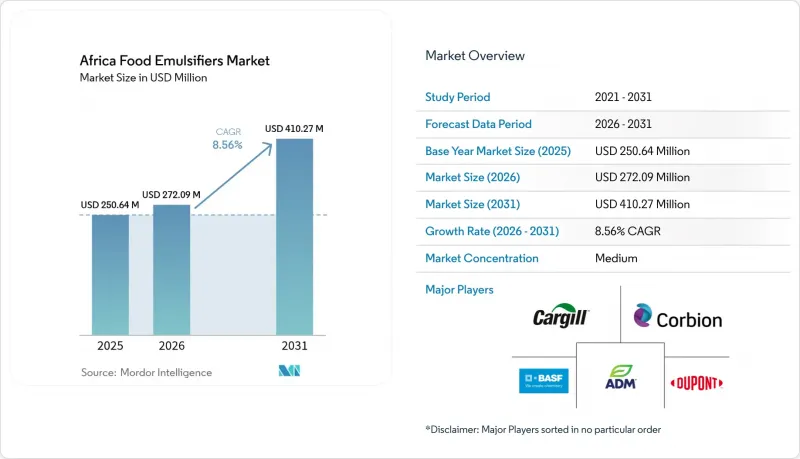
This report is Segmented by Product Type (Mono-Diglycerides and Derivatives, Lecithin, Sorbate Esters, and Other Emulsifiers), by Application (Bakery and Confectionery, Dairy and Desserts, Beverages, Meat and Meat Products, Soups, Sauces, and Dressings, and Other Applications), and by Geography (South Africa, Egypt, Nigeria, and Rest of Africa). The Market Forecasts are Provided in Terms of Value (USD).
Africa Food Emulsifiers Market Trends and Insights
Rising demand for processed and convenience foods
The increasing demand for processed and convenience foods across Africa is a key driver of the food emulsifiers market's growth. Factors such as rapid urbanization, rising disposable incomes, and busier lifestyles are contributing to higher consumption of packaged snacks, sauces, ready meals, and other shelf-stable products. These products depend on emulsifiers to maintain texture, stability, and shelf life. As manufacturers scale up production to meet this demand, the need for functional ingredients such as emulsifiers, stabilizers, and thickeners is increasing, creating opportunities for ingredient suppliers across the continent.In South Africa, this trend is further supported by the structure and scale of the food and beverage industry. The sector is one of the most diversified manufacturing segments in the country, dominated by a few large firms with significant domestic market influence. According to the Trade and Industrial Policy Strategy 2025 report, the food processing sector alone comprises over 1,800 companies . This concentration of large manufacturers, along with a broad network of smaller processors, drives demand for high-quality emulsifiers that ensure consistent product quality, shelf stability, and innovation in processed and convenience foods.
Rapid penetration of industrial bread lines across West Africa
West Africa's bakery market is undergoing rapid industrialization. In July 2024, Buhler and Flour Mills of Nigeria inaugurated a Grains Application Centre in Lagos to pilot high-throughput milling and baking technologies for local and regional clients. This facility, along with Buhler's Grains Processing Innovation Centre in Kano and SnackFix modular lines for small and medium enterprises, highlights a transition from artisanal to automated bread production. This shift necessitates consistent emulsifier performance in high-speed dough mixing and proofing processes. Industrial bread production requires emulsifiers that ensure rapid hydration, gluten strengthening, and crumb softening on a large scale. While mono- and diglycerides are well-suited for these functions, enzyme-modified lecithins present additional opportunities by reducing dough stickiness and improving machinability. Flour Mills of Nigeria has committed USD 1 billion to capacity expansion, while JBS has invested USD 2.5 billion in Nigerian food manufacturing, both focusing on processed foods where emulsifiers play a critical role in formulation . The strategic implication for emulsifier suppliers is clear: those who establish technical support and blending facilities near these new industrial bread lines, providing just-in-time delivery and application labs, are likely to gain a significant competitive advantage as processors aim to minimize working capital tied up in imported ingredients.
High import reliance and price volatility of imported mono and diglycerides
Africa's emulsifier supply chain heavily relies on imports from Europe and Asia, making processors vulnerable to foreign exchange fluctuations and freight-rate volatility. Mono- and diglycerides, which accounted for 39.24% of the product-type share in 2024, are primarily imported. The depreciation of the Nigerian naira and Egyptian pound in 2024 increased landed costs by 20% to 35%, despite stable ex-works prices in Europe. A key challenge is the lack of backward integration into emulsifier manufacturing within Africa. The continent has no mono-diglyceride production facilities, and efforts to establish local production are hindered by the high capital costs of esterification reactors and distillation columns. This creates a persistent cost disadvantage compared to processors in Asia or Latin America, who source emulsifiers domestically. Consequently, there is a structural incentive to substitute mono-diglycerides with locally available alternatives, such as lecithin or enzyme-modified starches, even if their technical performance is inferior.
Other drivers and restraints analyzed in the detailed report include:
- Increased adoption of clean-label and plant-derived emulsifiers
- Investments in food manufacturing capacity in Nigeria, Kenya, and South Africa
- Price sensitivity among consumers restricting premium formulation adoption
For complete list of drivers and restraints, kindly check the Table Of Contents.
Segment Analysis
Mono- and diglycerides accounted for 38.67% of the Africa food emulsifiers market share in 2025. However, lecithin is expected to surpass the overall compound annual growth rate (CAGR) of 8.56%, with a projected growth rate of 8.74% through 2031. The increasing demand for clean-label products in South Africa and Egypt, combined with untapped crushing capacity in Kenya, is improving local supply prospects. Multinational companies are blending lecithin with gums to optimize cost and functionality, highlighting how performance blends are challenging the long-standing dominance of the mono- and diglycerides category. As regional crushers enhance refining processes, locally sourced lecithin could reduce price disparities and support longer-term supply contracts within the Africa food emulsifiers market.
Manufacturers targeting price-sensitive mass markets are likely to continue relying on mono- and diglycerides for their dough conditioning and antistaling properties. However, premium bakers, confectioners, and dairy producers are increasingly turning to lecithin to meet export standards and enhance label appeal. Wilmar's specialty fats line in North Africa and Tate & Lyle's expanded hydrocolloid offerings are facilitating the development of multifunctional systems that offset the higher costs associated with phospholipids. Consequently, competition within the Africa food emulsifiers market is shifting from individual ingredients to integrated solutions.
Complete Report Scope:
- By Product Type
- Mono-Diglycerides and Derivatives
- Lecithin
- Sorbate Esters
- Other Emulsifier
- By Application
- Bakery and Confectionery
- Dairy and Desserts
- Beverages
- Meat and Meat Products
- Soups, Sauces, and Dressings
- Other Applications
- By Geography
- South Africa
- Egypt
- Nigeria
- Rest of Africa
List of Companies Covered in this Report:
- Cargill Inc.
- Archer Daniels Midland Company (ADM)
- Kerry Group plc
- DuPont de Nemours, Inc.
- Corbion N.V.
- Palsgaard A/S
- BASF SE
- Ingredion Incorporated
- AAK AB
- Riken Vitamin Co., Ltd.
- Lecico GmbH
- Tate & Lyle PLC
- Fine Organics Industries Ltd.
- Wilmar International Limited
- Brenntag AG
- Batory Foods
- Danlink Ingredients (Pty) Ltd
- Food Specialities Ltd (Kenya)
- Clover S.A.
- Siha Uganda Ltd
Additional Benefits:
- The market estimate (ME) sheet in Excel format
- 3 months of analyst support
TABLE OF CONTENTS
1 INTRODUCTION
- 1.1 Study Assumptions and Market Definition
- 1.2 Scope of the Study
2 RESEARCH METHODOLOGY
3 EXECUTIVE SUMMARY
4 MARKET LANDSCAPE
- 4.1 Market Overview
- 4.2 Market Drivers
- 4.2.1 Rising demand for processed and convenience foods
- 4.2.2 Rapid penetration of industrial bread lines across West Africa
- 4.2.3 Increased adoption of clean-label and plant-derived emulsifiers
- 4.2.4 Investments in food manufacturing capacity in Nigeria, Kenya, and South Africa
- 4.2.5 Price advantages of locally crushed soy-lecithin in East Africa
- 4.2.6 Growing demand for emulsifier blends for cost optimization in food processing
- 4.3 Market Restraints
- 4.3.1 High import reliance and price volatility of imported mono and diglycerides
- 4.3.2 Consumer scepticism toward E-number additives
- 4.3.3 Currency volatility is increasing raw material procurement costs
- 4.3.4 Price sensitivity among consumers restricting premium formulation adoption
- 4.4 Supply Chain Analysis
- 4.5 Regulatory and Technological Outlook
- 4.6 Porter's Five Forces Analysis
- 4.6.1 Threat of New Entrants
- 4.6.2 Bargaining Power of Buyers
- 4.6.3 Bargaining Power of Suppliers
- 4.6.4 Threat of Substitutes
- 4.6.5 Intensity of Competitive Rivalry
5 MARKET SIZE AND GROWTH FORECATS (VALUE)
- 5.1 By Product Type
- 5.1.1 Mono-Diglycerides and Derivatives
- 5.1.2 Lecithin
- 5.1.3 Sorbate Esters
- 5.1.4 Other Emulsifier
- 5.2 By Application
- 5.2.1 Bakery and Confectionery
- 5.2.2 Dairy and Desserts
- 5.2.3 Beverages
- 5.2.4 Meat and Meat Products
- 5.2.5 Soups, Sauces, and Dressings
- 5.2.6 Other Applications
- 5.3 By Geography
- 5.3.1 South Africa
- 5.3.2 Egypt
- 5.3.3 Nigeria
- 5.3.4 Rest of Africa
6 COMPETITIVE LANDSCAPE
- 6.1 Market Concentration
- 6.2 Strategic Moves
- 6.3 Market Ranking Analysis
- 6.4 Company Profiles {(includes Global level Overview, Market level overview, Core Segments, Financials as available, Strategic Information, Market Rank/Share for key companies, Products and Services, and Recent Developments)}
- 6.4.1 Cargill Inc.
- 6.4.2 Archer Daniels Midland Company (ADM)
- 6.4.3 Kerry Group plc
- 6.4.4 DuPont de Nemours, Inc.
- 6.4.5 Corbion N.V.
- 6.4.6 Palsgaard A/S
- 6.4.7 BASF SE
- 6.4.8 Ingredion Incorporated
- 6.4.9 AAK AB
- 6.4.10 Riken Vitamin Co., Ltd.
- 6.4.11 Lecico GmbH
- 6.4.12 Tate & Lyle PLC
- 6.4.13 Fine Organics Industries Ltd.
- 6.4.14 Wilmar International Limited
- 6.4.15 Brenntag AG
- 6.4.16 Batory Foods
- 6.4.17 Danlink Ingredients (Pty) Ltd
- 6.4.18 Food Specialities Ltd (Kenya)
- 6.4.19 Clover S.A.
- 6.4.20 Siha Uganda Ltd
7 MARKET OPPORTUNITIES AND FUTURE OUTLOOK

