PUBLISHER: Mordor Intelligence | PRODUCT CODE: 2113847

PUBLISHER: Mordor Intelligence | PRODUCT CODE: 2113847
Europe Food Emulsifiers - Market Share Analysis, Industry Trends & Statistics, Growth Forecasts (2026 - 2031)
According to Mordor Intelligence, Europe food emulsifiers market size in 2026 is estimated at USD 1.24 billion, growing from 2025 value of USD 1.19 billion with 2031 projections showing USD 1.53 billion, growing at 4.28% CAGR over 2026-2031.
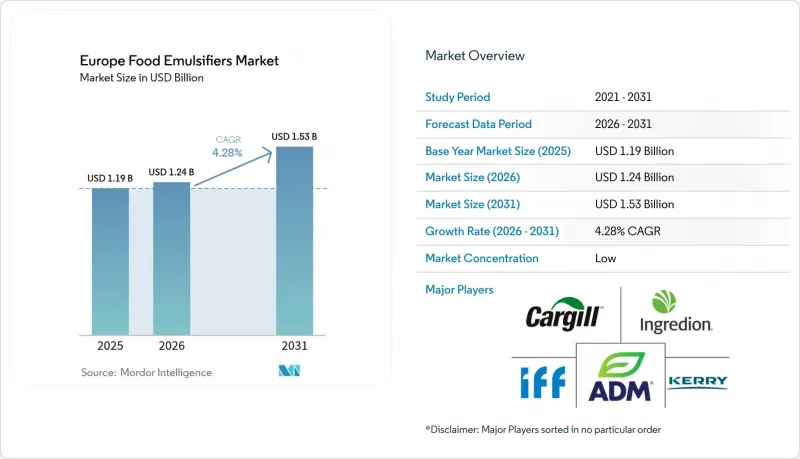
This report is Segmented by Product Type (Mono-, Di-Glycerides and Derivatives, Lecithin, and More), Source (Plant-Derived, Animal-Derived), Application (Bakery, Dairy and Frozen Desserts, Confectionery, Meat/Poultry/Seafood, and More), and Geography (Germany, United Kingdom, Italy, France, Spain, Netherlands, Rest of Europe). Market Forecasts are Provided in Terms of Value (USD).
Europe Food Emulsifiers Market Trends and Insights
Rising Consumption of Processed and Convenience Foods
Urbanization and the growth of dual-income households are driving the demand for ready meals, sauces, and dressings-all categories that heavily depend on emulsifiers. According to the Agriculture and Horticulture Development Board data from 2025, retail sales of chicken convenience meals was 38% in the United Kingdom. For example, mayonnaise and salad dressings use egg yolk or lecithin to stabilize oil-water interfaces, while frozen pizzas and lasagnas rely on mono-diglycerides to prevent cheese separation during reheating. The UK and Germany have the highest per-capita spending on convenience foods, a trend further supported by the increasing penetration of e-commerce grocery platforms, which favor shelf-stable, pre-portioned formats. However, the market is stabilizing through premiumization. Organic frozen meals and plant-based ready-to-eat options are gaining shelf space, with these products often requiring more emulsifiers per serving to replicate the texture of traditional formulations. Furthermore, the shift toward smaller pack sizes-driven by the increase in single-person households-raises emulsifier intensity per kilogram of finished product due to higher surface-area-to-volume ratios.
Expansion in Bakery and Confectionery Sectors
The bakery sector continues to serve as the foundation of the industry, but its growth is branching out. Industrial bread and biscuit manufacturers are increasingly using emulsifier blends, such as mono-diglycerides combined with DATEM. This approach enhances product softness and reduces staling, effectively lowering returns and waste. Meanwhile, artisan bakeries are exploring lecithin to meet clean-label requirements while maintaining the crumb structure in sourdough and whole-grain loaves. In the confectionery segment, chocolate and praline producers are seeking alternatives to polyglycerol polyricinoleate (PGPR) that provide similar viscosity reduction without the association with palm oil. Germany and France lead this segment, collectively accounting for over 40% of bakery and confectionery emulsifier consumption. Consumers are increasingly choosing organic or high-protein options, which require advanced emulsification solutions. Spain's confectionery sector is benefiting from a recovery in tourism, boosting seasonal production of turron and polvorones, both of which rely on sorbitan esters to prevent fat bloom. In Italy, the gelato industry is adopting mono-diglycerides to improve overrun and freeze-thaw stability. This shift is further accelerated by rising energy costs, which are encouraging longer cold-storage durations.
Strict EU Regulations on Food Additives
The European Food Safety Authority (EFSA) regularly re-evaluates approved additives, and its recent assessments have introduced stricter acceptable daily intake (ADI) limits for certain emulsifiers, such as titanium dioxide (E171) and specific polysorbates. Although most mainstream emulsifiers remain approved, the regulatory environment is becoming increasingly stringent. The EU's "Farm to Fork" strategy seeks to reduce pesticide use by 50% by 2030. While primarily focused on pesticide reduction, this strategy indirectly impacts oilseed cultivation practices, potentially increasing costs for organic or low-residue lecithin. Additionally, compliance with traceability requirements, like the EU Deforestation Regulation, adds administrative complexity for palm-oil-derived emulsifiers, even when sourced from certified sustainable plantations. Brands face challenges when substituting emulsifiers, as this requires stability testing and sensory panels, a process that can take 6 to 12 months. Regulatory uncertainty also discourages investment in new emulsifier chemistries. If an ingredient is re-evaluated within five years of commercialization, the return on research and development (R&D) investments is reduced. Smaller suppliers, often lacking dedicated regulatory affairs teams, are at a disadvantage. This situation may accelerate market consolidation, favoring multinationals with in-house EFSA liaison capabilities.
Other drivers and restraints analyzed in the detailed report include:
- Shift Toward Clean-Label and Plant-Based Emulsifiers
- Innovation in Functional Foods, Including Sports Nutrition and High-Protein Products
- Heightened Price Volatility for Vegetable Oils and Lecithin, Driven by War-Related Supply Shocks
For complete list of drivers and restraints, kindly check the Table Of Contents.
Segment Analysis
In 2025, lecithin captured 33.02% of the product market share, supported by its GRAS status, multifunctionality, and alignment with clean-label trends. While soy lecithin remains a cost-effective choice, sunflower and rapeseed variants are increasingly favored in premium bakery products and plant-based dairy alternatives. Mono- and di-glycerides are expected to grow at a 6.02% CAGR through 2031, making them the fastest-growing product type. Their versatility is notable: they not only act as emulsifiers but also serve as dough conditioners, anti-staling agents, and aerators in whipped toppings. Bakery professionals prefer distilled monoglycerides for their higher active content and neutral flavor, while ice cream manufacturers rely on acetylated monoglycerides to enhance freeze-thaw stability.
Sorbitan esters, while catering to niche applications, are valued for high-end uses such as reducing chocolate viscosity, aerating cake batter, and producing non-dairy whipped creams, where their thermal stability justifies premium pricing. Polyglycerol esters, though used in smaller volumes, are critical for low-fat spreads and reduced-calorie dressings, as they stabilize emulsions more efficiently than lecithin. The "Others" category includes emerging chemistries like sucrose esters and enzymatically modified lecithins, which attract formulators seeking innovative functionalities or cleaner labels. Palsgaard's 2024 patent for a heat-resistant polyglycerol ester blend underscores ongoing innovation in this segment, focusing on bakery applications that emphasize oven-spring and crumb softness.
Complete Report Scope:
- By Product Type
- Mono-, Di-glycerides, and Derivatives
- Lecithin
- Sorbitan Esters
- Polyglycerol Esters
- Others
- By Source
- Plant-derived
- Animal-derived
- By Application
- Bakery
- Dairy and Frozen Desserts
- Confectionery
- Meat, Poultry and Seafood
- Beverages
- Sauces, Dressings and Spreads
- Plant-based Meat and Dairy Alternatives
- By Geography
- Germany
- United Kingdom
- Italy
- France
- Spain
- Netherlands
- Rest of Europe
List of Companies Covered in this Report:
- International Flavors and Fragrances Inc.
- Cargill Incorporated
- Archer Daniels Midland Company
- Ingredion Incorporated
- Kerry Group plc
- Palsgaard A/S
- BASF SE
- Tate & Lyle PLC
- Corbion NV
- Lonza Group AG
- Puratos Group NV
- Oleon NV
- AAK AB
- Bunge Limited
- Wilmar International Ltd.
- DSM-Firmenich AG
- Lasenor Emul SL
- Riken Vitamin Co. Ltd.
- LECICO GmbH
- Beldem SA
- Evonik Industries AG
- CP Kelco
Additional Benefits:
- The market estimate (ME) sheet in Excel format
- 3 months of analyst support
TABLE OF CONTENTS
1 INTRODUCTION
- 1.1 Study Assumptions & Market Definition
- 1.2 Scope of the Study
2 RESEARCH METHODOLOGY
3 EXECUTIVE SUMMARY
4 MARKET LANDSCAPE
- 4.1 Market Overview
- 4.2 Market Drivers
- 4.2.1 Rising consumption of processed and convenience foods
- 4.2.2 Expansion in bakery and confectionery sectors
- 4.2.3 Innovation in functional foods, including sports nutrition and high-protein products
- 4.2.4 Shift toward clean-label and plant-based emulsifiers
- 4.2.5 R&D investments for multi-functional emulsifiers
- 4.2.6 Increasing use in margarine, spreads, and ice cream for shelf-life extension
- 4.3 Market Restraints
- 4.3.1 Strict EU regulations on food additives
- 4.3.2 Heightened price volatility for vegetable oils and lecithin, driven by war-related supply shocks
- 4.3.3 Disrupted sunflower seed and oilseed supply
- 4.3.4 Competition from alternative stabilizers and texturizers
- 4.4 Supply Chain Analysis
- 4.5 Regulatory Outlook
- 4.6 Porter's Five Forces
- 4.6.1 Threat of New Entrants
- 4.6.2 Bargaining Power of Buyers/Consumers
- 4.6.3 Bargaining Power of Suppliers
- 4.6.4 Threat of Substitute Products
- 4.6.5 Intensity of Competitive Rivalry
5 MARKET SIZE AND GROWTH FORECASTS (VALUE)
- 5.1 By Product Type
- 5.1.1 Mono-, Di-glycerides, and Derivatives
- 5.1.2 Lecithin
- 5.1.3 Sorbitan Esters
- 5.1.4 Polyglycerol Esters
- 5.1.5 Others
- 5.2 By Source
- 5.2.1 Plant-derived
- 5.2.2 Animal-derived
- 5.3 By Application
- 5.3.1 Bakery
- 5.3.2 Dairy and Frozen Desserts
- 5.3.3 Confectionery
- 5.3.4 Meat, Poultry and Seafood
- 5.3.5 Beverages
- 5.3.6 Sauces, Dressings and Spreads
- 5.3.7 Plant-based Meat and Dairy Alternatives
- 5.4 By Geography
- 5.4.1 Germany
- 5.4.2 United Kingdom
- 5.4.3 Italy
- 5.4.4 France
- 5.4.5 Spain
- 5.4.6 Netherlands
- 5.4.7 Rest of Europe
6 COMPETITIVE LANDSCAPE
- 6.1 Market Concentration
- 6.2 Strategic Moves
- 6.3 Market Ranking Analysis
- 6.4 Company Profiles (includes Global-level Overview, Market-level Overview, Core Segments, Financials (if available), Strategic Information, Market Rank/Share, Products & Services, Recent Developments)
- 6.4.1 International Flavors and Fragrances Inc.
- 6.4.2 Cargill Incorporated
- 6.4.3 Archer Daniels Midland Company
- 6.4.4 Ingredion Incorporated
- 6.4.5 Kerry Group plc
- 6.4.6 Palsgaard A/S
- 6.4.7 BASF SE
- 6.4.8 Tate & Lyle PLC
- 6.4.9 Corbion NV
- 6.4.10 Lonza Group AG
- 6.4.11 Puratos Group NV
- 6.4.12 Oleon NV
- 6.4.13 AAK AB
- 6.4.14 Bunge Limited
- 6.4.15 Wilmar International Ltd.
- 6.4.16 DSM-Firmenich AG
- 6.4.17 Lasenor Emul SL
- 6.4.18 Riken Vitamin Co. Ltd.
- 6.4.19 LECICO GmbH
- 6.4.20 Beldem SA
- 6.4.21 Evonik Industries AG
- 6.4.22 CP Kelco
7 MARKET OPPORTUNITIES AND FUTURE OUTLOOK

