PUBLISHER: Mordor Intelligence | PRODUCT CODE: 2121447

PUBLISHER: Mordor Intelligence | PRODUCT CODE: 2121447
US Food Emulsifiers - Market Share Analysis, Industry Trends & Statistics, Growth Forecasts (2026 - 2031)
According to Mordor Intelligence, the United States food emulsifiers market size is expected to grow from USD 0.83 billion in 2025 to USD 0.87 billion in 2026 and is forecast to reach USD 1.09 billion by 2031 at 4.72% CAGR over 2026-2031.
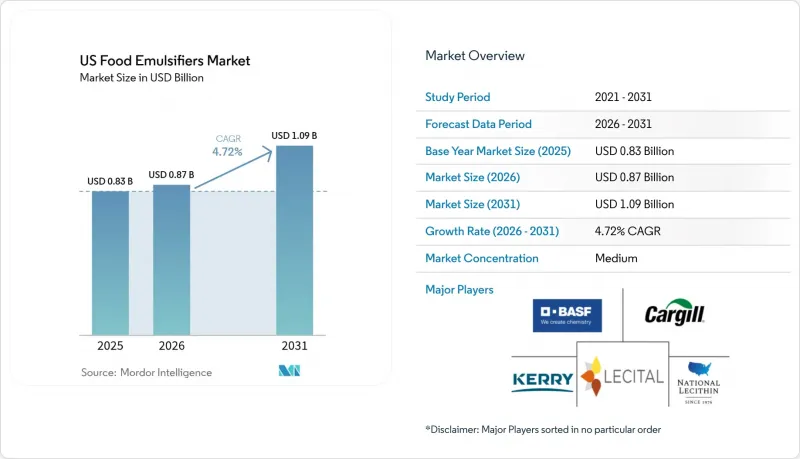
This report is Segmented by Product Type (Mono-Di-Glycerides and Derivatives, Lecithin, Sorbate Esters, and Other Emulsifiers), Form (Powder and Liquid), Source (Plant, Synthetic/Bio-based, and Animal), and Application (Bakery and Confectionery, Dairy and Desserts. Beverages, Meat and Meat Products, and More). Market Sizing is Presented in USD Value Terms for all the Abovementioned Segments.
US Food Emulsifiers Market Trends and Insights
Rising demand for texture-enhanced processed foods in the U.S.
Consumer demand for premium textures in processed foods is driving advanced applications of emulsifiers beyond their traditional stabilization functions. According to the Institute of Food Technologists, texture is a critical factor influencing purchasing decisions. In response, manufacturers are leveraging hydrocolloids and specialized emulsifiers to develop sensory profiles that replicate artisanal preparation methods. Ultra-shear technology, funded by USDA NIFA research grants, enables food processors to produce stable emulsions without synthetic additives, addressing both texture enhancement and clean label requirements. This technology's capability to process liquid foods with minimal thermal exposure delivers unique sensory attributes while extending shelf life. This is particularly beneficial for plant-based protein beverages, where achieving consistent texture remains a formulation challenge. The integration of texture science and processing innovation positions emulsifiers as strategic tools for premium product differentiation rather than basic functional ingredients.
Growing health consciousness fueling demand for low-fat and fat-replacer ingredients
Health-conscious consumers are influencing emulsifier demand by prioritizing reduced-fat formulations that retain premium sensory attributes. Soy protein isolate has positioned itself as a multifunctional ingredient, delivering both emulsification and fat replacement benefits, particularly in applications like ice cream. Its foaming and gelling properties enable manufacturers to lower fat content while maintaining texture integrity. The FDA's updated "healthy" claim definition, effective February 2025, introduces specific criteria for food group equivalents and nutrient thresholds, driving manufacturers to innovate with fat-replacing emulsifiers. This regulatory shift presents a significant opportunity for plant-based emulsifiers, which address fat reduction, align with clean label trends, and enhance nutritional profiles. The competitive advantage lies in emulsifiers' ability to sustain product performance while supporting health claims, enabling premium pricing in a crowded market.
Allergen concerns from soy-based emulsifiers
Although soy lecithin remains a widely used food emulsifier, increasing regulatory scrutiny and allergen concerns are creating operational challenges for manufacturers. The University of Nebraska's Food Allergen Research and Resource Program indicates that while soy lecithin contains minimal soy proteins, most soy-allergic consumers are unaffected due to protein removal during production. However, the FDA's Food Allergen Labeling and Consumer Protection Act mandates soy lecithin labeling, with limited exemptions such as for release agents. This regulatory requirement has heightened consumer awareness, driving demand for alternative emulsifiers. Businesses focusing on sunflower lecithin and other plant-based substitutes are well-positioned to capitalize on this shift. Research highlights the effectiveness of modified sunflower lecithin in stabilizing nanoemulsions, particularly for omega-3 delivery applications. The strategic priority for manufacturers is to develop cost-effective, functionally equivalent alternatives that comply with allergen labeling regulations while maintaining competitive pricing against established soy-based systems.
Other drivers and restraints analyzed in the detailed report include:
- Innovation in functional foods and nutraceutical snacks
- Boom in premium and artisanal ice cream and dessert market
- Increasing demand for emulsifier-free, whole food-based products
For complete list of drivers and restraints, kindly check the Table Of Contents.
Segment Analysis
In 2025, mono- and di-glycerides accounted for 34.68% of the U.S. food emulsifiers market, driven by their adaptability and cost efficiency. The specialty "others" category, encompassing PGPR, sucrose esters, and cellulose nanocrystal systems, is anticipated to grow at a 5.88% CAGR, fueled by the increasing alignment of plant-based claims with performance requirements. The transition of lecithin from soy to sunflower is accelerating, while sorbate esters are gaining adoption in acidic confectionery applications due to their pH-specific solubility, which outperforms competing materials.
Meanwhile, pickering emulsions are disrupting traditional approaches, enabling niche suppliers to secure high-value contracts within the U.S. food emulsifiers market. Chocolate manufacturers are leveraging proprietary blends of PGPR and lecithin to reduce dependency on cocoa butter and manage price fluctuations. This strategy not only delivers cost advantages but also enhances texture control. Suppliers that combine application laboratories with flexible pilot production lines are effectively shortening product development cycles and establishing long-term supply agreements.
Powder products captured 66.35% of the U.S. food emulsifiers market share in 2025, thanks to ambient-temperature stability and automated dry-mix handling in mega-bakery plants. Yet liquid formats clock a 5.42% CAGR as ready-to-use dispersions cut batching times and eliminate dust concerns. Microfluidization studies show liquid lecithin achieving narrower droplet curves than high-pressure valve homogenization, boosting mouthfeel and oxidative stability in omega-3 fortified drinks
As flexible packaging gains popularity among co-packers, totes of liquid mono-glycerides improve plant throughput. Conversely, powders remain indispensable in premix sachets and dry bakery blends where water activity limits microbial growth. This balanced demand keeps both formats central to the U.S. food emulsifiers market, though capital spending trends favor incremental liquid capacity in the next planning cycle.
Complete Report Scope:
- By Product Type
- Mono- Di-Glycerides and Derivatives
- Lecithin
- Sorbate Esters
- Other Emulsifier
- By Form
- Powder
- Liquid
- By Source
- Plant
- Synthetic/Bio-based
- Animal
- By Application
- Bakery and Confectionery
- Dairy and Desserts
- Beverages
- Meat and Meat Products
- Soups, Sauces, and Dressings
- Other Applications
List of Companies Covered in this Report:
- Lecital LLC
- National Lecithin Inc
- Cargill, Incorporated
- Kerry Group plc
- BASF SE
- Archer Daniels Midland Company
- Ingredion Incorporated
- Bunge Limited
- Lipoid GmbH (American Lecithin Company)
- Palsgaard A/S
- Louis Dreyfus Holding B.V.
- The Scoular Company
- Ciranda, Inc.
- Tate and Lyle PLC
- AAK AB
- International Flavors & Fragrances Inc.
- Lasenor Emul S.L.
- Avril Group
- Patco Products LLC
- Estelle Chemicals Pvt Ltd.
Additional Benefits:
- The market estimate (ME) sheet in Excel format
- 3 months of analyst support
TABLE OF CONTENTS
1 INTRODUCTION
- 1.1 Study Assumptions and Market Definition
- 1.2 Scope of the Study
2 RESEARCH METHODOLOGY
3 EXECUTIVE SUMMARY
4 MARKET LANDSCAPE
- 4.1 Market Overview
- 4.2 Market Drivers
- 4.2.1 Rising demand for texture-enhanced processed foods in the U.S.
- 4.2.2 Growing health Consciousness fueling demand for low-fat and fat-replacer ingredients
- 4.2.3 Innovation in functionaluctional foods and nutraceutical snacks
- 4.2.4 Boom in premium and artisanal ice cream and dessert market
- 4.2.5 Widespread use in fat-soluble vitamin fortified food
- 4.2.6 Emulsifier role in enhancing freeze-thaw stability in frozen foods
- 4.3 Market Restraints
- 4.3.1 Allergen concerns from soy-based emulsifiers
- 4.3.2 Increaing demand for emulsifier-free, whole food-based products
- 4.3.3 Stringent FDA compliance requirements for emulsifier approvals
- 4.3.4 Limitation on use of certain emulsifiers in specific food categories
- 4.4 Supply Chain Analysis
- 4.5 Regulatory Outlook
- 4.6 Porters Five Forces
- 4.6.1 Threat of New Entrants
- 4.6.2 Bargaining Power of Buyers/Consumers
- 4.6.3 Bargaining Power of Suppliers
- 4.6.4 Threat of Substitute Products
- 4.6.5 Intensity of Competitive Rivalry
5 MARKET SIZE AND GROWTH FORECASTS (VALUE)
- 5.1 By Product Type
- 5.1.1 Mono- Di-Glycerides and Derivatives
- 5.1.2 Lecithin
- 5.1.3 Sorbate Esters
- 5.1.4 Other Emulsifier
- 5.2 By Form
- 5.2.1 Powder
- 5.2.2 Liquid
- 5.3 By Source
- 5.3.1 Plant
- 5.3.2 Synthetic/Bio-based
- 5.3.3 Animal
- 5.4 By Application
- 5.4.1 Bakery and Confectionery
- 5.4.2 Dairy and Desserts
- 5.4.3 Beverages
- 5.4.4 Meat and Meat Products
- 5.4.5 Soups, Sauces, and Dressings
- 5.4.6 Other Applications
6 COMPETITIVE LANDSCAPE
- 6.1 Market Concentration
- 6.2 Strategic Moves
- 6.3 Market Ranking Analysis
- 6.4 Company Profiles (includes Global-level Overview, Market-level Overview, Core Segments, Financials (if available), Strategic Information, Market Rank/Share, Products and Services, Recent Developments)
- 6.4.1 Lecital LLC
- 6.4.2 National Lecithin Inc
- 6.4.3 Cargill, Incorporated
- 6.4.4 Kerry Group plc
- 6.4.5 BASF SE
- 6.4.6 Archer Daniels Midland Company
- 6.4.7 Ingredion Incorporated
- 6.4.8 Bunge Limited
- 6.4.9 Lipoid GmbH (American Lecithin Company)
- 6.4.10 Palsgaard A/S
- 6.4.11 Louis Dreyfus Holding B.V.
- 6.4.12 The Scoular Company
- 6.4.13 Ciranda, Inc.
- 6.4.14 Tate and Lyle PLC
- 6.4.15 AAK AB
- 6.4.16 International Flavors & Fragrances Inc.
- 6.4.17 Lasenor Emul S.L.
- 6.4.18 Avril Group
- 6.4.19 Patco Products LLC
- 6.4.20 Estelle Chemicals Pvt Ltd.
7 MARKET OPPORTUNITIES AND FUTURE OUTLOOK

