PUBLISHER: Mordor Intelligence | PRODUCT CODE: 2123149

PUBLISHER: Mordor Intelligence | PRODUCT CODE: 2123149
Freight Forwarding - Market Share Analysis, Industry Trends & Statistics, Growth Forecasts (2026 - 2031)
According to Mordor Intelligence, the freight forwarding market size is expected to grow from USD 572.25 billion in 2025 to USD 602.58 billion in 2026 and is forecast to reach USD 776.04 billion by 2031 at 5.19% CAGR over 2026-2031.
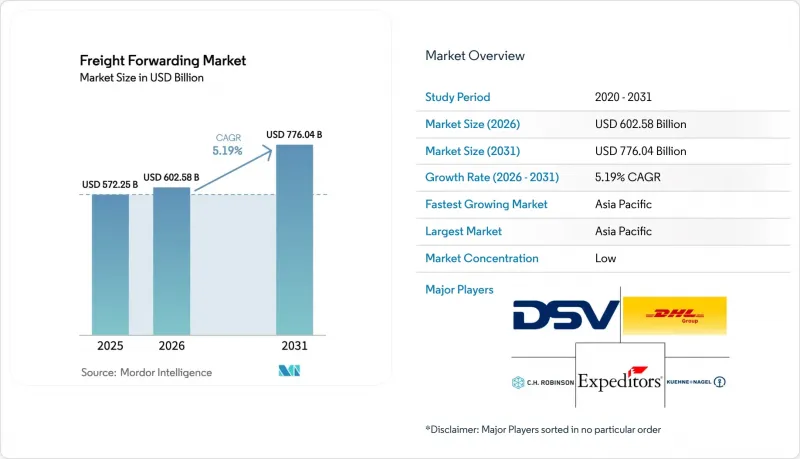
This report is Segmented by Mode of Transport (Air Freight Forwarding and More), Enterprise Size (Large Enterprises and More), Forwarder Model (Traditional Asset-Light Forwarders and More), End-User Industry (Retail & E-Commerce, Automotive, Chemicals, and More), and Geography (North America, South America, Europe, Asia-Pacific, and More). The Market Forecasts are Provided in Terms of Value (USD).
Global Freight Forwarding Market Trends and Insights
Cross-Border E-Commerce Parcel Boom
Global cross-border parcels reached 2.1 billion in 2024 and are expected to exceed 3 billion by 2027, fragmenting full-container traffic into small consignments that need rapid consolidation. Forwarders now build parcel hubs and last-mile alliances to uphold 48-hour delivery windows in Southeast Asia. Regulatory frameworks such as the World Customs Organization's cross-border e-commerce standard drive investment in automated duty calculation that trims clearance delays. Providers unable to furnish real-time inventory visibility risk displacement by digital-native competitors. The freight forwarding market is therefore tilting toward flexible, data-rich operators that can optimize cost and speed simultaneously.
End-to-End Shipment Visibility Adoption
More than 12 million IoT container sensors were active in ocean trade by early 2025, feeding control-tower platforms that predict port congestion and customs holds. Machine-learning analytics help shippers re-route cargo before delays escalate, an advantage that cuts detention fees in temperature-sensitive pharma lanes. Blockchain bills of lading shorten letter-of-credit cycles and deter documentation fraud, yet widespread adoption is slowed by the need for carrier and customs interoperability. Forwarders that integrate these tools enhance trust and command premium rates in the freight forwarding market.
Port Congestion and Container Imbalances
Average dwell times at Los Angeles and Long Beach climbed to 6.2 days in early 2025, up from 4.8 days in 2023, while empty-container repositioning costs rose 22% in 2024. Structural imbalances create surplus boxes in import-heavy regions and scarcity in export zones, driving up detention fees. Inland depots and container-sharing pacts mitigate some expense, yet chassis shortages and rail yard congestion remain persistent bottlenecks that weigh on the freight forwarding market.
Other drivers and restraints analyzed in the detailed report include:
- Near-Shoring and China-Plus-One Trade Shifts
- Cold-Chain Investment for Pharma and Food
- Global Driver and Warehouse Labor Shortage
For complete list of drivers and restraints, kindly check the Table Of Contents.
Segment Analysis
Ocean freight forwarding retained a 61.77% freight forwarding market share in 2025, driven by cost efficiency on dense lanes. Yet multimodal and intermodal forwarding is advancing at a 6.40% CAGR (2026-2031) as shippers balance speed, cost, and carbon impact. Less-than-container load volumes increase with e-commerce fragmentation, widening consolidation complexity. Road forwarding connects last-mile nodes, but driver shortages and fuel volatility tilt inland moves toward rail where infrastructure allows. Air forwarding protects semiconductor and pharmaceutical supply lines, although capacity caps and carbon surcharges temper growth. Rail corridors such as the China-Europe Railway Express offer 15- to 20-day transits that fill the gap between air and ocean.
The freight forwarding market is restructuring networks to blend ocean trunk haul with rail or air final legs, reducing buffer inventory without incurring full air premiums. Digital cost-time simulators guide mode selection based on stockout penalties and inventory carrying costs. Regulatory pressure from the IMO Carbon Intensity Indicator spurs modal shifts toward lower-emission combinations, especially for non-urgent cargo. Forwarders that orchestrate seamless handoffs and provide unified visibility capture share as shippers exit single-mode contracts.
Large enterprises contributed 68.50% of forwarding revenue in 2025, leveraging volume to negotiate contract rates, but SMEs are expanding at a 6.53% CAGR (2026-2031) as digital tools democratize access. Historically, SMEs lacked the scale to secure competitive pricing or manage customs intricacies. Platforms such as Flexport aggregate fragmented demand, provide instant quotes, and automate documentation, removing broker dependency and helping SMEs expand faster.
As the freight forwarding market evolves, large shippers still prize tailored solutions and account teams, yet they pilot digital dashboards to benchmark incumbent service. A two-tier dynamic emerges: SMEs value transparency and speed, whereas large accounts prioritize relationship continuity. Providers that deliver self-service portals alongside white-glove expertise can span both clusters, capturing incremental volumes without diluting service quality.
Complete Report Scope:
- By Mode of Transport
- Ocean Freight Forwarding
- Full Container Load (FCL)
- Less-Than-Container Load (LCL)
- Road Freight Forwarding
- Full Truck Load (FTL)
- Less-Than-Truck Load (LTL)
- Air Freight Forwarding
- Rail Freight Forwarding
- Multimodal and Intermodal Forwarding
- Ocean Freight Forwarding
- By Enterprise Size
- Small and Medium Enterprises
- Large Enterprises
- By Forwarder Model
- Traditional Asset-Light Forwarders
- Digital-First / Online Platforms
- Hybrid Asset-Enabled Forwarders
- By End-user Industry
- Industrial and Manufacturing
- Retail and E-commerce
- Healthcare and Pharmaceuticals
- Oil, Gas and Energy
- Food and Beverages
- Automotive
- Chemicals
- Other End-users
- By Geography
- North America
- United States
- Canada
- Mexico
- South America
- Brazil
- Argentina
- Chile
- Rest of South America
- Europe
- Germany
- United Kingdom
- France
- Spain
- Italy
- Netherlands
- Russia
- Rest of Europe
- Asia-Pacific
- China
- India
- Japan
- South Korea
- Singapore
- Vietnam
- Indonesia
- Australia
- Rest of Asia-Pacific
- Middle East and Africa
- Saudi Arabia
- United Arab Emirates
- Turkey
- South Africa
- Nigeria
- Egypt
- Rest of Middle East and Africa
- North America
Geography Analysis
Asia-Pacific generated 36.49% of forwarding revenue in 2025 and is set to grow at a 7.80% CAGR between 2026-2031, the quickest regional climb in the freight forwarding market. China remains the largest single origin, yet Vietnam, India, and Indonesia collect rising investment under China-plus-one diversification. Singapore and Hong Kong anchor regional consolidations thanks to superior port efficiency and trade finance ecosystems. Japan and South Korea ship high-value electronics and automotive parts, while Australia ships bulk commodities and absorbs e-commerce imports.
North America remains an import-heavy destination, but chronic port congestion and labor scarcity inflate handling costs. Shippers divert to Gulf and East Coast gateways and expand cross-border rail through Mexico under USMCA provisions. Canada's forwarding flows align with energy and automotive trade, while Mexico benefits from near-shoring that relocates parts of electronics and auto production from Asia.
Europe holds a mature forwarding base centered on Germany, the Netherlands, and the United Kingdom. Brexit-induced customs friction and warehouse labor shortages moderate growth. Scandinavia and Central and Eastern Europe gain niche volumes through specialized corridors such as pharma and automotive parts. South America, the Middle East, and Africa account for smaller slices but rise as infrastructure upgrades and trade pacts improve connectivity, enlarging the freight forwarding market.
- A.P. Moller - Maersk
- C.H. Robinson
- CIMC Wetrans Logistics
- CMA CGM Group (including CEVA Logistics)
- DACHSER
- DHL Group
- DSV A/S
- Expeditors International of Washington, Inc.
- FedEx
- GEODIS
- Hellmann Worldwide Logistics
- Kerry Logistics Network, Ltd.
- Kintetsu World Express
- Kuehne+Nagel
- Lineage, Inc.
- LX Pantos
- Nippon Express Co., Ltd.
- Rhenus Logistics
- Sinotrans, Ltd.
- Toll Group
- Uber Freight LLC
- United Parcel Service of America, Inc.
- XPO, Inc.
- Yusen Logistics Co., Ltd.
Additional Benefits:
- The market estimate (ME) sheet in Excel format
- 3 months of analyst support
TABLE OF CONTENTS
1 Introduction
- 1.1 Study Assumptions and Market Definition
- 1.2 Scope of the Study
2 Research Methodology
3 Executive Summary
4 Market Landscape
- 4.1 Market Overview
- 4.2 Market Drivers
- 4.2.1 Cross-Border E-Commerce Parcel Boom
- 4.2.2 End-to-End Shipment-Visibility Adoption
- 4.2.3 Near-Shoring and "China-Plus-One" Trade Shifts
- 4.2.4 Cold-Chain Investment for Pharma and Food
- 4.2.5 Shipper ESG Targets and Carbon-Pricing Demand
- 4.2.6 Generative-AI Dynamic Load-Matching
- 4.3 Market Restraints
- 4.3.1 Port Congestion and Container Imbalances
- 4.3.2 Global Driver and Warehouse-Labor Shortage
- 4.3.3 Geopolitical Flashpoints and Route Risk
- 4.3.4 Tightening De-Minimis Thresholds and Compliance Burden
- 4.4 Value / Supply-Chain Analysis
- 4.5 Regulatory Landscape
- 4.6 Technological Outlook
- 4.7 Porter's Five Forces Analysis
- 4.7.1 Threat of New Entrants
- 4.7.2 Bargaining Power of Buyers
- 4.7.3 Bargaining Power of Suppliers
- 4.7.4 Threat of Substitutes
- 4.7.5 Intensity of Competitive Rivalry
- 4.8 Pricing Analysis
- 4.9 Impact of Geopolitical Events
5 Market Size and Growth Forecasts (Value)
- 5.1 By Mode of Transport
- 5.1.1 Ocean Freight Forwarding
- 5.1.1.1 Full Container Load (FCL)
- 5.1.1.2 Less-Than-Container Load (LCL)
- 5.1.2 Road Freight Forwarding
- 5.1.2.1 Full Truck Load (FTL)
- 5.1.2.2 Less-Than-Truck Load (LTL)
- 5.1.3 Air Freight Forwarding
- 5.1.4 Rail Freight Forwarding
- 5.1.5 Multimodal and Intermodal Forwarding
- 5.1.1 Ocean Freight Forwarding
- 5.2 By Enterprise Size
- 5.2.1 Small and Medium Enterprises
- 5.2.2 Large Enterprises
- 5.3 By Forwarder Model
- 5.3.1 Traditional Asset-Light Forwarders
- 5.3.2 Digital-First / Online Platforms
- 5.3.3 Hybrid Asset-Enabled Forwarders
- 5.4 By End-user Industry
- 5.4.1 Industrial and Manufacturing
- 5.4.2 Retail and E-commerce
- 5.4.3 Healthcare and Pharmaceuticals
- 5.4.4 Oil, Gas and Energy
- 5.4.5 Food and Beverages
- 5.4.6 Automotive
- 5.4.7 Chemicals
- 5.4.8 Other End-users
- 5.5 By Geography
- 5.5.1 North America
- 5.5.1.1 United States
- 5.5.1.2 Canada
- 5.5.1.3 Mexico
- 5.5.2 South America
- 5.5.2.1 Brazil
- 5.5.2.2 Argentina
- 5.5.2.3 Chile
- 5.5.2.4 Rest of South America
- 5.5.3 Europe
- 5.5.3.1 Germany
- 5.5.3.2 United Kingdom
- 5.5.3.3 France
- 5.5.3.4 Spain
- 5.5.3.5 Italy
- 5.5.3.6 Netherlands
- 5.5.3.7 Russia
- 5.5.3.8 Rest of Europe
- 5.5.4 Asia-Pacific
- 5.5.4.1 China
- 5.5.4.2 India
- 5.5.4.3 Japan
- 5.5.4.4 South Korea
- 5.5.4.5 Singapore
- 5.5.4.6 Vietnam
- 5.5.4.7 Indonesia
- 5.5.4.8 Australia
- 5.5.4.9 Rest of Asia-Pacific
- 5.5.5 Middle East and Africa
- 5.5.5.1 Saudi Arabia
- 5.5.5.2 United Arab Emirates
- 5.5.5.3 Turkey
- 5.5.5.4 South Africa
- 5.5.5.5 Nigeria
- 5.5.5.6 Egypt
- 5.5.5.7 Rest of Middle East and Africa
- 5.5.1 North America
6 Competitive Landscape
- 6.1 Market Concentration
- 6.2 Strategic Moves
- 6.3 Market Share Analysis
- 6.4 Company Profiles (includes Global level Overview, Market level overview, Core Segments, Financials as available, Strategic Information, Market Rank/Share for key companies, Products and Services, Recent Developments)
- 6.4.1 A.P. Moller - Maersk
- 6.4.2 C.H. Robinson
- 6.4.3 CIMC Wetrans Logistics
- 6.4.4 CMA CGM Group (including CEVA Logistics)
- 6.4.5 DACHSER
- 6.4.6 DHL Group
- 6.4.7 DSV A/S
- 6.4.8 Expeditors International of Washington, Inc.
- 6.4.9 FedEx
- 6.4.10 GEODIS
- 6.4.11 Hellmann Worldwide Logistics
- 6.4.12 Kerry Logistics Network, Ltd.
- 6.4.13 Kintetsu World Express
- 6.4.14 Kuehne+Nagel
- 6.4.15 Lineage, Inc.
- 6.4.16 LX Pantos
- 6.4.17 Nippon Express Co., Ltd.
- 6.4.18 Rhenus Logistics
- 6.4.19 Sinotrans, Ltd.
- 6.4.20 Toll Group
- 6.4.21 Uber Freight LLC
- 6.4.22 United Parcel Service of America, Inc.
- 6.4.23 XPO, Inc.
- 6.4.24 Yusen Logistics Co., Ltd.
7 Market Opportunities and Future Outlook
- 7.1 White-space and Unmet-need Assessment

