PUBLISHER: Mordor Intelligence | PRODUCT CODE: 2125609

PUBLISHER: Mordor Intelligence | PRODUCT CODE: 2125609
Europe IT Services - Market Share Analysis, Industry Trends & Statistics, Growth Forecasts (2026 - 2031)
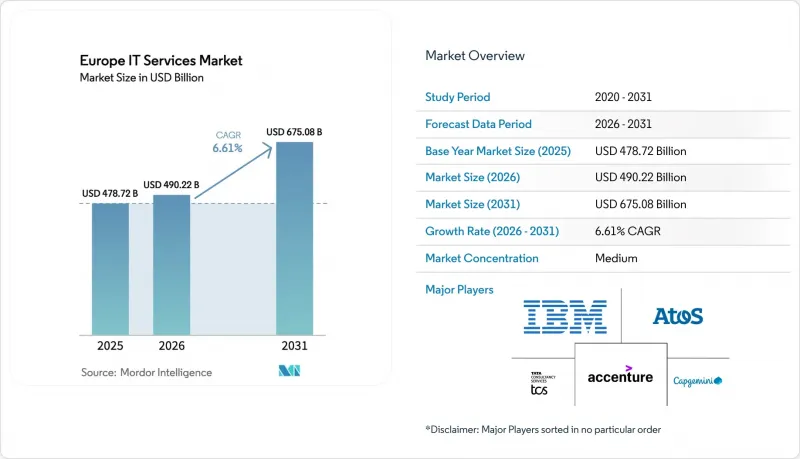
According to Mordor Intelligence, the Europe IT services market size is projected to be USD 478.72 billion in 2025, USD 490.22 billion in 2026 and reach USD 675.08 billion by 2031, growing at a CAGR of 6.61% from 2026 to 2031.
This report is Segmented by Service Type (IT Consulting and Implementation, IT Outsourcing, and More), Enterprise Size (Small and Medium Enterprises and Large Enterprises), Deployment Model (Onshore, Nearshore, and Offshore), End-User Vertical (BFSI, Manufacturing, Government, Healthcare, Retail, Telecom, and More), and Geography. The Market Forecasts are Provided in Terms of Value (USD).
Europe IT Services Market Trends and Insights
Surging Enterprise-Wide Cloud Migration
Cloud adoption jumped after the NIS2 Directive obliged essential entities to maintain alternate processing sites, making multi-cloud redundancy a legal necessity rather than a best practice. German industrial firms are moving sensitive workloads to Gaia-X-aligned sovereign clouds while keeping non-critical data on global hyperscalers. The Digital Decade program targets 75% cloud usage among European companies by 2030, sustaining a pipeline of lift-and-shift and modernization projects. Vendors able to combine SAP expertise with container-based microservices are winning large transformation mandates. Multi-cloud complexity also unlocks follow-on demand for FinOps, observability, and inter-cloud security gateways, strengthening long-term managed-services revenues.
Shift to Managed Security Amid EU-Wide Cyber-Threat Directives
The NIS2 Directive expanded the scope of regulated entities from roughly 2,000 to more than 160,000 organizations in January 2025. Mandatory 24-hour breach reporting and supply-chain risk mapping overloaded in-house security teams, pushing buyers toward Managed Security Service Providers that can deliver round-the-clock SOC monitoring and zero-trust design. Sector guides from France's ANSSI and Germany's BSI standardized tender specifications, cutting procurement ambiguity and accelerating deal closure. Fixed-fee "compliance-as-a-service" bundles appeal to mid-market firms that lack chief information-security officers, converting ad-hoc audits into predictable subscriptions.
Talent Scarcity and Wage Inflation in Key Delivery Hubs
Eurostat recorded 500,000 unfilled ICT posts in 2025 and median developer pay in Germany rose 8.2% year-on-year, eroding nearshore cost advantages. Wage spikes of 9% in Poland and Romania squeezed vendors locked into fixed-price contracts signed during the low-inflation era. Brain drain toward North America compounds shortages, forcing providers to automate tier-1 support through generative-AI chatbots and prioritize high-margin advisory work. These stopgaps, however, only partly offset the structural talent gap, trimming Europe IT services market growth potential.
Other drivers and restraints analyzed in the detailed report include:
- Corporate Urgency to Modernize SAP and Legacy ERP Before 2027 Support Sunset
- EU CSRD-Linked ESG-Reporting Services Boosting Consulting Demand
- Geopolitical Data-Sovereignty Barriers (Schrems II, AI Act)
For complete list of drivers and restraints, kindly check the Table Of Contents.
Segment Analysis
Managed Security Services sits atop growth rankings with a 6.72% CAGR to 2031 even though Cloud and Platform Services controlled a 33.74% Europe IT services market share in 2025. Mandatory threat-monitoring duties under NIS2 and DORA make 24x7 SOC coverage a board-level concern, converting discretionary security pilots into non-negotiable opex. Vendors that embed continuous compliance checks into ERP rollouts and cloud migrations capture incremental wallet share.
Consulting and Implementation revenue is buoyed by SAP S/4HANA conversions, CSRD-linked ESG platform buildouts, and European Health Data Space integrations. ITO and BPO lines are converging as robotic process automation and AI-driven document extraction reshape back-office deals, while Extended Detection and Response platforms push security spending from perimeter defense into predictive threat hunting.
Large Enterprises generated 60.36% of 2025 revenue thanks to multi-year global support deals, yet Small and Medium Enterprises are on course for a 6.96% CAGR through 2031. EU Digital Decade funds and Germany's Digital Now grants cover up to 50% of eligible cloud costs, lowering adoption hurdles. Pre-configured SaaS bundles shorten deployment cycles, but integrations, data migration and cyber-posture assessments still require external expertise, expanding opportunity for modular service catalogs.
A secondary growth lever is consultancy-led "digital maturity" diagnostics, which unlock public subsidies and channel spend toward solution providers already accredited under national voucher schemes. This creates recurring advisory assignments alongside initial implementation work.
Complete Report Scope:
- By Service Type
- IT Consulting and Implementation
- IT Outsourcing (ITO)
- Business Process Outsourcing (BPO)
- Managed Security Services
- Cloud and Platform Services
- By Enterprise Size
- Small and Medium Enterprises (SMEs)
- Large Enterprises
- By Deployment Model
- Onshore Delivery
- Nearshore Delivery
- Offshore Delivery
- By End-User Vertical
- BFSI
- Manufacturing
- Government and Public Sector
- Healthcare and Life-Sciences
- Retail and Consumer Goods
- Telecom and Media
- Logistics and Transport
- Energy and Utilities
- Other End-User Verticals
- By Country
- United Kingdom
- Germany
- France
- Italy
- Spain
- Rest of Europe
List of Companies Covered in this Report:
- Accenture plc
- Capgemini SE
- IBM Consulting
- Atos SE
- Tata Consultancy Services Ltd
- Cognizant Technology Solutions Corp.
- Infosys Ltd
- Wipro Ltd
- CGI Inc.
- Sopra Steria Group SA
- DXC Technology Co.
- NTT DATA Europe and LATAM
- Tietoevry Oyj
- EVRYTHNG Group AB
- Fujitsu Services Ltd
- Orange Business Services
- Swisscom Ltd (Enterprise Services)
- Telefonica Tech
- GFT Technologies SE
- Reply SpA
- Endava plc
- Luxoft (DXC Technology)
- Kyndryl Holdings Inc.
- HCLTech Ltd
- NCC Group plc
Additional Benefits:
- The market estimate (ME) sheet in Excel format
- 3 months of analyst support
TABLE OF CONTENTS
1 INTRODUCTION
- 1.1 Study Assumptions and Market Definition
- 1.2 Scope of the Study
2 RESEARCH METHODOLOGY
3 EXECUTIVE SUMMARY
4 MARKET LANDSCAPE
- 4.1 Market Overview
- 4.2 Market Drivers
- 4.2.1 Surging Enterprise-Wide Cloud Migration
- 4.2.2 Demand For Cost-Optimised ITO And BPO Contracts
- 4.2.3 Shift To Managed Security Amid EU-Wide Cyber-Threat Directives
- 4.2.4 AI-Driven Vendor-Selection Platforms Accelerating Outsourcing
- 4.2.5 Corporate Urgency To Modernise SAP And Legacy ERP Before 2027 Support Sunset
- 4.2.6 EU CSRD-Linked ESG-Reporting Services Boosting Consulting Demand
- 4.3 Market Restraints
- 4.3.1 Talent Scarcity And Wage Inflation In Key Delivery Hubs
- 4.3.2 Geopolitical Data-Sovereignty Barriers (Schrems II, AI Act)
- 4.3.3 Prolonged Client-Decision Cycles Owing To Macro-Uncertainty
- 4.3.4 Rising Carbon-Footprint Penalties On Energy-Intensive Data Centres
- 4.4 Value Chain Analysis
- 4.5 Regulatory Landscape
- 4.6 Technological Outlook
- 4.7 Porter's Five Forces Analysis
- 4.7.1 Threat of New Entrants
- 4.7.2 Bargaining Power of Suppliers
- 4.7.3 Bargaining Power of Buyers
- 4.7.4 Threat of Substitutes
- 4.7.5 Industry Rivalry
5 MARKET SIZE AND GROWTH FORECASTS (VALUE)
- 5.1 By Service Type
- 5.1.1 IT Consulting and Implementation
- 5.1.2 IT Outsourcing (ITO)
- 5.1.3 Business Process Outsourcing (BPO)
- 5.1.4 Managed Security Services
- 5.1.5 Cloud and Platform Services
- 5.2 By Enterprise Size
- 5.2.1 Small and Medium Enterprises (SMEs)
- 5.2.2 Large Enterprises
- 5.3 By Deployment Model
- 5.3.1 Onshore Delivery
- 5.3.2 Nearshore Delivery
- 5.3.3 Offshore Delivery
- 5.4 By End-User Vertical
- 5.4.1 BFSI
- 5.4.2 Manufacturing
- 5.4.3 Government and Public Sector
- 5.4.4 Healthcare and Life-Sciences
- 5.4.5 Retail and Consumer Goods
- 5.4.6 Telecom and Media
- 5.4.7 Logistics and Transport
- 5.4.8 Energy and Utilities
- 5.4.9 Other End-User Verticals
- 5.5 By Country
- 5.5.1 United Kingdom
- 5.5.2 Germany
- 5.5.3 France
- 5.5.4 Italy
- 5.5.5 Spain
- 5.5.6 Rest of Europe
6 COMPETITIVE LANDSCAPE
- 6.1 Market Concentration
- 6.2 Strategic Moves
- 6.3 Market Share Analysis
- 6.4 Company Profiles (includes Global-level overview, Market-level overview, Core Segments, Financials, Strategic Information, Market Rank/Share, Products and Services, Recent Developments)
- 6.4.1 Accenture plc
- 6.4.2 Capgemini SE
- 6.4.3 IBM Consulting
- 6.4.4 Atos SE
- 6.4.5 Tata Consultancy Services Ltd
- 6.4.6 Cognizant Technology Solutions Corp.
- 6.4.7 Infosys Ltd
- 6.4.8 Wipro Ltd
- 6.4.9 CGI Inc.
- 6.4.10 Sopra Steria Group SA
- 6.4.11 DXC Technology Co.
- 6.4.12 NTT DATA Europe and LATAM
- 6.4.13 Tietoevry Oyj
- 6.4.14 EVRYTHNG Group AB
- 6.4.15 Fujitsu Services Ltd
- 6.4.16 Orange Business Services
- 6.4.17 Swisscom Ltd (Enterprise Services)
- 6.4.18 Telefonica Tech
- 6.4.19 GFT Technologies SE
- 6.4.20 Reply SpA
- 6.4.21 Endava plc
- 6.4.22 Luxoft (DXC Technology)
- 6.4.23 Kyndryl Holdings Inc.
- 6.4.24 HCLTech Ltd
- 6.4.25 NCC Group plc
7 MARKET OPPORTUNITIES AND FUTURE OUTLOOK
- 7.1 White-space and Unmet-need Assessment

