
PUBLISHER: Mordor Intelligence | PRODUCT CODE: 1910599

PUBLISHER: Mordor Intelligence | PRODUCT CODE: 1910599
North America Construction - Market Share Analysis, Industry Trends & Statistics, Growth Forecasts (2026 - 2031)
North America Construction Market size in 2026 is estimated at USD 3.89 trillion, growing from 2025 value of USD 3.69 trillion with 2031 projections showing USD 5.06 trillion, growing at 5.42% CAGR over 2026-2031.
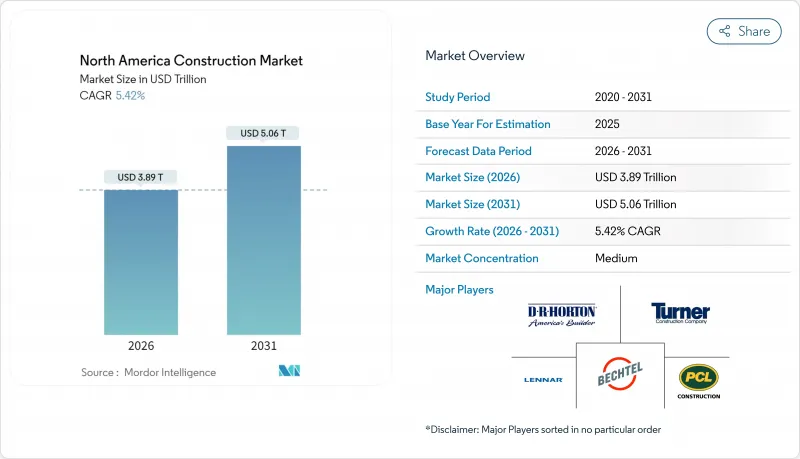
Public stimulus, a rebounding U.S. housing cycle, surging data-center builds, and aggressive grid-hardening mandates together redefine demand patterns, moving activity away from routine repair toward capacity-building projects that require specialized skill sets. The Flatiron-Dragados merger and similar large-scale integrations elevate competitive stakes, while prefabrication and mass-timber solutions gather momentum as contractors seek schedule certainty amid chronic skilled-labor shortages. Federal and provincial incentives linked to semiconductor manufacturing, renewable power, and resiliency upgrades multiply private co-investment, tightening supply in critical trades and inflating bid prices. At the same time, climate-linked insurance premiums and e-permitting backlogs create localized headwinds that firms must navigate to capture margin.
North America Construction Market Trends and Insights
Expansionary U.S. & Canadian Infrastructure Stimulus (IIJA, CHIPS, IRA)
Federal laws such as the IIJA, CHIPS and Science Act, and Inflation Reduction Act are injecting hundreds of billions of dollars into transportation, semiconductor plants, and clean-energy assets, generating multi-year backlogs for heavy civil contractors. The 40,000-plus projects already awarded under IIJA alone validate a structural demand shift away from cyclical resurfacing toward transformative builds requiring advanced materials and digital project controls. Canadian provinces mirror the push with USD 231 billion in planned major projects supported by USD 58 billion in public-private partnerships, ensuring cross-border capacity constraints persist. Because every federal construction dollar is crowding in close to three private dollars in sectors like chip fabrication, the stimulus effect will echo well past initial appropriations. Contractors capable of EPC delivery and compliance reporting are best positioned to monetize the pipeline.
Rebound in Single-Family Housing Starts on Falling Mortgage Rates
Lower mortgage rates expected in 2026 underpin a modest rebound in single-family starts to 1.01 million units, adding stability to the North America construction market even as multifamily developers battle financing friction. Demand stems from a 1.5 million-unit structural housing deficit that forces buyers to new builds when resale inventory remains tight. Builders in land-constrained metros wield pricing power, whereas over-supplied regions witness discounting and margin compression. Although regulatory costs now absorb 24% of closing prices, easing credit spreads should partially offset the burden, supporting steady production. The segment's resilience offers contractors a volume hedge as office pipelines retrench.
Skilled-Labor Shortages Inflating Bid Prices
A projected 501,000-worker deficit in 2024 left mechanical, electrical, and plumbing subcontractors with record overtime and soaring recruiter fees. More than 20% of the construction workforce is aged 55 or older, heightening the retirement cliff. Canada needs an additional 231,000 craft workers by 2034, mirroring U.S. constraints. Limited crews force contractors to walk away from jobs or lengthen schedules, pushing bid prices higher and eroding owner contingencies. New apprenticeship incentives may relieve pressure after 2027, yet the short-term supply gap remains acute.
Other drivers and restraints analyzed in the detailed report include:
- Surging Data-Center Builds Powering Industrial & Utility Demand
- Grid-Hardening & Micro-Grid Retrofits Mandated by Insurers
- High Financing Costs for Multifamily & Office Developments
For complete list of drivers and restraints, kindly check the Table Of Contents.
Segment Analysis
Infrastructure is expected to outpace all other sectors at a 7.67% CAGR, even though Residential retained the largest 2025 share. Roads, bridges, and transit projects funded under the IIJA create predictable multi-year workstreams, keeping civil crews at capacity. Energy and utility construction is buoyed by USD 2 billion in grid-hardening outlays that dovetail with battery storage mandates, while airport terminals draw USD 2.89 billion in fiscal 2025 federal grants.
Residential demand hinges on the single-family rebound and chronic inventory shortages; the North America construction market size linked to single-family housing is forecast to advance by 4% in 2026, absorbing skilled trades that might otherwise anchor infrastructure labor pools. Commercial performance is mixed: data-center floor space is rocketing, but office towers face vacancy-driven pauses. Industrial builds related to near-shoring partly offset retail footfalls, unifying a complex but generally upward trajectory for the North America construction market.
Although new builds still capture 69.35% of 2025 revenue, renovation shows faster growth amid aging assets and sustainability retrofits. Building owners facing carbon-pricing rules prefer refurbishments that embed electrification, smart controls, and resilience features rather than raze-and-replace. Insurer-mandated wildfire hardening alone represents more than USD 4 billion in annual retrofit opportunity, lifting the North America construction market size for renovation steadily through 2031.
New Construction pipelines remain elevated thanks to semiconductor fabs and logistics hubs, but access to skilled labor and materials volatility push schedules to the right. Contractors leveraging integrated design-build platforms protect margins, yet smaller builders struggle with cash-flow gaps. Over time, owners may increasingly favor adaptive reuse and vertical extensions, balancing the North America construction market share between greenfield and brownfield activities.
The North America Construction Market Report is Segmented by Sector (Residential, Commercial, Infrastructure), by Construction Type (New Construction, Renovation), by Construction Method (Conventional On-Site, Modern Methods of Construction), by Investment Source (Public, Private), and by Geography (United States, Canada, Mexico). The Market Forecasts are Provided in Terms of Value (USD).
List of Companies Covered in this Report:
- Bechtel Corporation
- Turner Construction Co.
- D.R. Horton Inc.
- Lennar Corporation
- PCL Construction Group Inc.
- Kiewit Corporation
- Hochtief USA Inc.
- The Whiting-Turner Contracting Co.
- Hensel Phelps Construction Co.
- Tutor Perini Corp.
- Toll Brothers Inc.
- NVR Inc.
- Graham Construction (Canada)
- SNC-Lavalin Group Inc.
- Aecon Group Inc.
- Fluor Corporation
- Skanska USA
- Clark Construction Group
- EllisDon Corp.
- Granite Construction Inc.
Additional Benefits:
- The market estimate (ME) sheet in Excel format
- 3 months of analyst support
TABLE OF CONTENTS
1 Introduction
- 1.1 Study Assumptions & Market Definition
- 1.2 Scope of the Study
2 Research Methodology
3 Executive Summary
4 Market Landscape
- 4.1 Market Overview
- 4.2 Market Drivers
- 4.2.1 Expansionary US & Canadian infrastructure stimulus (IIJA, CHIPS, IRA)
- 4.2.2 Rebound in single-family housing starts on falling mortgage rates
- 4.2.3 Surging data-center builds powering industrial & utility demand
- 4.2.4 Grid-hardening & micro-grid retrofits mandated by insurers
- 4.2.5 Mass-timber & modular methods shortening schedules & lowering CO2
- 4.2.6 Near-shoring-led industrial corridors along US-CAN-MEX gateways
- 4.3 Market Restraints
- 4.3.1 Skilled-labor shortages inflating bid prices
- 4.3.2 High financing costs for multifamily & office developments
- 4.3.3 Climate-risk insurance premium volatility
- 4.3.4 Municipal e-permitting backlogs delaying starts
- 4.4 Value / Supply-Chain Analysis
- 4.4.1 Overview
- 4.4.2 Real Estate Developers and Contractors - Key Quantitative and Qualitative Insights
- 4.4.3 Architectural and Engineering Companies - Key Quantitative and Qualitative Insights
- 4.4.4 Building Material and Equipment Companies - Key Quantitative and Qualitative Insights
- 4.5 Government Initiatives & Vision
- 4.6 Regulatory Landscape
- 4.7 Technological Outlook
- 4.8 Industry Attractiveness - Porter's Five Force Analysis
- 4.8.1 Bargaining Power of Suppliers
- 4.8.2 Bargaining Power of Consumers
- 4.8.3 Threat of New Entrants
- 4.8.4 Threat of Substitutes
- 4.8.5 Intensity of Competitive Rivalry
- 4.9 Pricing (Construction Materials) and Construction Cost (Materials, Labour, Equipment) Analysis
- 4.10 Comparison of Key Industry Metrics of the United Kingdom with Other Countries
- 4.11 Key Upcoming/Ongoing Projects (with a focus on Mega Projects)
5 Market Size & Growth Forecasts(Value, In USD Billion)
- 5.1 By Sector
- 5.1.1 Residential
- 5.1.1.1 Apartments/Condominiums
- 5.1.1.2 Villas/Landed Houses
- 5.1.2 Commercial
- 5.1.2.1 Office
- 5.1.2.2 Retail
- 5.1.2.3 Industrial and Logistics
- 5.1.2.4 Others
- 5.1.3 Infrastructure
- 5.1.3.1 Transportation Infrastructure (Roadways, Railways, Airways, others)
- 5.1.3.2 Energy & Utilities
- 5.1.3.3 Others
- 5.1.1 Residential
- 5.2 By Construction Type
- 5.2.1 New Construction
- 5.2.2 Renovation
- 5.3 By Construction Method
- 5.3.1 Conventional On-Site
- 5.3.2 Modern Methods of Construction (Prefabricated, Modular, etc)
- 5.4 By Investment Source
- 5.4.1 Public
- 5.4.2 Private
- 5.5 By Geography
- 5.5.1 United States
- 5.5.2 Canada
- 5.5.3 Mexico
6 Competitive Landscape
- 6.1 Market Concentration
- 6.2 Strategic Moves
- 6.3 Market Share Analysis
- 6.4 Company Profiles (includes Global level Overview, Market level overview, Core Segments, Financials as available, Strategic Information, Products & Services, and Recent Developments)
- 6.4.1 Bechtel Corporation
- 6.4.2 Turner Construction Co.
- 6.4.3 D.R. Horton Inc.
- 6.4.4 Lennar Corporation
- 6.4.5 PCL Construction Group Inc.
- 6.4.6 Kiewit Corporation
- 6.4.7 Hochtief USA Inc.
- 6.4.8 The Whiting-Turner Contracting Co.
- 6.4.9 Hensel Phelps Construction Co.
- 6.4.10 Tutor Perini Corp.
- 6.4.11 Toll Brothers Inc.
- 6.4.12 NVR Inc.
- 6.4.13 Graham Construction (Canada)
- 6.4.14 SNC-Lavalin Group Inc.
- 6.4.15 Aecon Group Inc.
- 6.4.16 Fluor Corporation
- 6.4.17 Skanska USA
- 6.4.18 Clark Construction Group
- 6.4.19 EllisDon Corp.
- 6.4.20 Granite Construction Inc.
7 Market Opportunities & Future Outlook

