
PUBLISHER: Mordor Intelligence | PRODUCT CODE: 1910851

PUBLISHER: Mordor Intelligence | PRODUCT CODE: 1910851
Europe Telematics - Market Share Analysis, Industry Trends & Statistics, Growth Forecasts (2026 - 2031)
The Europe telematics market is expected to grow from 24.49 million installed units in 2025 to 28.16 million installed units in 2026 and is forecast to reach 56.63 million installed units by 2031 at 14.97% CAGR over 2026-2031.
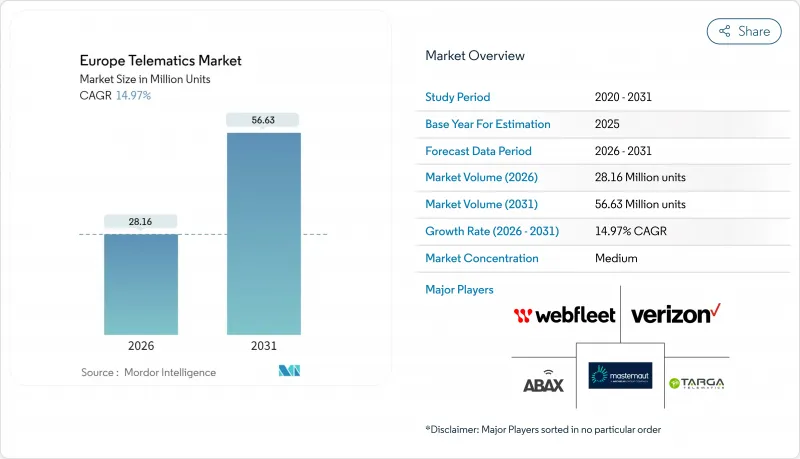
Growth is underpinned by synchronized European Union (EU) mandates, original-equipment-manufacturer (OEM) connectivity strategies, and fast-moving fleet-digitization programs that pull telematics from a discretionary add-on to a core mobility infrastructure layer. Rising embedded connectivity in passenger cars, the ongoing logistics boom, and the regulatory migration from 2G/3G to 4G/5G collectively set a robust baseline for the Europe telematics market, while declining sensor costs broaden adoption beyond large fleets. Competitive intensity is reshaping around direct OEM data pipes, evidenced by Volkswagen Group's line-fit partnerships, even as aftermarket specialists position themselves with cross-fleet analytics to defend share. Data privacy obligations and retrofit complexity temper rollout speed, but overall momentum remains firmly positive thanks to overlapping technology, regulatory, and business case catalysts across the continent.
Europe Telematics Market Trends and Insights
EU eCall and Smart Tachograph Compliance Timeline
The Europe telematics market receives a direct uplift from synchronized EU directives that stipulate Next Generation eCall readiness and Smart Tachograph 2 installation across vans above 2.5 tonnes. Hardware refresh cycles concentrate around the July 2026 tachograph deadline and the January 2027 4G/5G eCall cut-over, giving providers reliable demand visibility while allowing bundling of compliance modules with higher-margin analytics services. As operators consolidate procurement to meet these immovable milestones, solution vendors benefit from fewer stakeholder objections and clearer budget approvals, effectively flattening lengthy sales funnels and accelerating unit run-rates across the Europe telematics market.
Rapid OEM Shift to Embedded Connectivity Platforms
OEMs now view connected-vehicle data as a strategic asset for lifetime customer monetization. Partnerships such as Targa Telematics and Volkswagen Group demonstrate a structural pivot: line-fit modules ship with the vehicle, streamlining fleet onboarding, enabling weekly feature drops, and reducing support queries tied to aftermarket device faults. Embedded channels also unlock proprietary diagnostics, over-the-air (OTA) updates, and energy-management controls, extending revenue streams long after initial sale. Consequently, the Europe telematics market increasingly rewards providers that master OEM data ingestion and analytic enrichment at scale.
High Retrofit and Integration Costs for Mixed Fleets
European fleets seldom buy homogenous vehicle batches; age, make, and engine technology vary widely. Installing disparate black-box devices leads to data silos and support churn, especially for owner-operators juggling thin profit margins. Integration expenses roll beyond hardware, driver onboarding, firmware updates, and legacy CAN-bus quirks consume scarce operating capital. Consequently, smaller fleets defer deployments or restrict rollouts to regulatory minimums, shaving a potential rate off the Europe telematics market CAGR in the near term.
Other drivers and restraints analyzed in the detailed report include:
- E-commerce and Last-Mile Logistics Optimization Push
- Falling Connectivity and Sensor Costs for Fleet Owners
- Data-Privacy and GDPR-Driven Vendor Liability Risk
For complete list of drivers and restraints, kindly check the Table Of Contents.
Segment Analysis
Commercial vehicles accounted for 64.21% of the Europe telematics market share in 2025, delivering predictable ROI through fuel saving, route adherence, and driver-behavior improvements. Demand stays resilient as regulatory reporting aligns with freight-capacity expansion across pan-European corridors, anchoring the Europe telematics market size to a stable, heavy-duty foundation. Buses and coaches add incremental revenue as electrified public-transport fleets require battery-state-of-charge monitoring and depot-charging orchestration, tasks unserved by legacy ticketing systems.
Passenger cars, while smaller today, post the highest growth pace at a 16.79% CAGR to 2031 as embedded SIM penetration and usage-based insurance (UBI) unlock consumer segments. Active UBI policies are set to climb from 13.0 million in 2023 to 17.6 million in 2028, funneling fresh data volumes into actuarial models that reward safe driving with tangible premium discounts. Light commercial vehicles (LCVs) bridge both worlds, absorbing passenger-car electronics while satisfying business-grade logistics metrics, ensuring sustained double-digit adoption rates throughout the forecast window.
Fleet-management and asset-tracking platforms held 37.12% of the Europe telematics market size in 2025, reflecting mature value proofs around fuel costs, maintenance scheduling, and duty-of-care compliance. Continuous feature enrichment, video-based driver coaching, cargo-temperature validation, and multi-modal dashboard aggregation, keeps renewal rates high among large logistics operators.
Insurance and usage-based telematics, however, top the growth chart at a 15.61% CAGR as actuarial models migrate from static demographics to real-time behavioral scoring. Italy alone hosts 9.5 million active insurance-telematics policies, propagating best practices to Germany, the UK, and France. Safety-and-security sub-verticals ride mandatory eCall adoption, while remote diagnostics gain traction as OEMs expose prognostic code libraries to third-party developers, widening the solutions funnel across the Europe telematics market.
The Europe Telematics Market Report is Segmented by Vehicle Type (Commercial Vehicles and Passenger Cars), Solution Type (Fleet Management and Asset Tracking, and More), Technology (Embedded, Tethered/Smartphone-Integrated, and Aftermarket Black-Box), Deployment Mode (OEM Line-Fit Platforms and Aftermarket Service Providers), and Geography. The Market Forecasts are Provided in Terms of Volume (Units).
List of Companies Covered in this Report:
- Webfleet Solutions B.V.
- Targa Telematics S.p.A.
- Verizon Communications Inc. (Verizon Connect)
- ABAX UK Ltd.
- Masternaut Limited
- Gurtam Inc.
- MiX Telematics Limited
- Mercedes-Benz Group AG
- Volvo Group
- Scania AB
- MAN Truck and Bus SE
- DAF Trucks N.V.
- Robert Bosch GmbH
- Continental AG
- Trimble Inc.
- CalAmp Corp.
- Geotab Inc.
- Teletrac Navman Group Ltd.
- AddSecure AB
- Microlise Group PLC
- Trakm8 Holdings PLC
- OCTO Telematics S.p.A.
- Transics International BVBA
Additional Benefits:
- The market estimate (ME) sheet in Excel format
- 3 months of analyst support
TABLE OF CONTENTS
1 INTRODUCTION
- 1.1 Study Assumptions and Market Definition
- 1.2 Scope of the Study
2 RESEARCH METHODOLOGY
3 EXECUTIVE SUMMARY
4 MARKET LANDSCAPE
- 4.1 Market Overview
- 4.2 Market Drivers
- 4.2.1 EU eCall and Smart Tachograph compliance timeline
- 4.2.2 Rapid OEM shift to embedded connectivity platforms
- 4.2.3 E-commerce and last-mile logistics optimisation push
- 4.2.4 Falling connectivity and sensor costs for fleet owners
- 4.2.5 Next-Gen (4G/5G) eCall migration mandate
- 4.2.6 HDV CO2 monitoring rules nudging eco-driving analytics
- 4.3 Market Restraints
- 4.3.1 High retrofit and integration costs for mixed fleets
- 4.3.2 Data-privacy and GDPR-driven vendor liability risk
- 4.3.3 2G/3G sunset forcing premature hardware replacement
- 4.3.4 Shortage of telematics data-science talent
- 4.4 Regulatory Landscape
- 4.5 Technological Outlook
- 4.6 Porter's Five Forces Analysis
- 4.6.1 Bargaining Power of Suppliers
- 4.6.2 Bargaining Power of Buyers
- 4.6.3 Threat of New Entrants
- 4.6.4 Threat of Substitute Products
- 4.6.5 Intensity of Competitive Rivalry
- 4.7 Impact of Macroeconomic Factors on the Market
5 MARKET SIZE AND GROWTH FORECASTS (UNITS)
- 5.1 By Vehicle Type
- 5.1.1 Commercial Vehicles (LCV, MCV, HCV, Buses)
- 5.1.2 Passenger Cars
- 5.2 By Solution Type
- 5.2.1 Fleet Management and Asset Tracking
- 5.2.2 Safety and Security (eCall, SVT)
- 5.2.3 Insurance / Usage-Based Telematics
- 5.2.4 Infotainment and Navigation
- 5.2.5 Remote Diagnostics and Predictive Maintenance
- 5.3 By Technology
- 5.3.1 Embedded
- 5.3.2 Tethered / Smartphone-Integrated
- 5.3.3 Aftermarket Black-Box
- 5.4 By Deployment Mode
- 5.4.1 OEM Line-Fit Platforms
- 5.4.2 Aftermarket Service Providers
- 5.5 By Country
- 5.5.1 United Kingdom
- 5.5.2 Germany
- 5.5.3 France
- 5.5.4 Italy
- 5.5.5 Spain
- 5.5.6 Netherlands
- 5.5.7 Sweden
- 5.5.8 Norway
- 5.5.9 Denmark
- 5.5.10 Finland
- 5.5.11 Poland
- 5.5.12 Russia
- 5.5.13 Rest of Europe
6 COMPETITIVE LANDSCAPE
- 6.1 Market Concentration
- 6.2 Strategic Moves
- 6.3 Market Share Analysis
- 6.4 Company Profiles (includes Global level Overview, Market level overview, Core Segments, Financials as available, Strategic Information, Market Rank/Share for key companies, Products and Services, and Recent Developments)
- 6.4.1 Webfleet Solutions B.V.
- 6.4.2 Targa Telematics S.p.A.
- 6.4.3 Verizon Communications Inc. (Verizon Connect)
- 6.4.4 ABAX UK Ltd.
- 6.4.5 Masternaut Limited
- 6.4.6 Gurtam Inc.
- 6.4.7 MiX Telematics Limited
- 6.4.8 Mercedes-Benz Group AG
- 6.4.9 Volvo Group
- 6.4.10 Scania AB
- 6.4.11 MAN Truck and Bus SE
- 6.4.12 DAF Trucks N.V.
- 6.4.13 Robert Bosch GmbH
- 6.4.14 Continental AG
- 6.4.15 Trimble Inc.
- 6.4.16 CalAmp Corp.
- 6.4.17 Geotab Inc.
- 6.4.18 Teletrac Navman Group Ltd.
- 6.4.19 AddSecure AB
- 6.4.20 Microlise Group PLC
- 6.4.21 Trakm8 Holdings PLC
- 6.4.22 OCTO Telematics S.p.A.
- 6.4.23 Transics International BVBA
7 MARKET OPPORTUNITIES AND FUTURE OUTLOOK
- 7.1 White-space and Unmet-Need Assessment

