
PUBLISHER: Mordor Intelligence | PRODUCT CODE: 2044009

PUBLISHER: Mordor Intelligence | PRODUCT CODE: 2044009
Asia-Pacific Enterprise Resource Planning - Market Share Analysis, Industry Trends & Statistics, Growth Forecasts (2026 - 2031)
The Asia-Pacific Enterprise Resource Planning Market size is expected to grow from USD 12.57 billion in 2025 to USD 14.47 billion in 2026 and is forecast to reach USD 25.39 billion by 2031 at a 12.37% CAGR over 2026-2031.
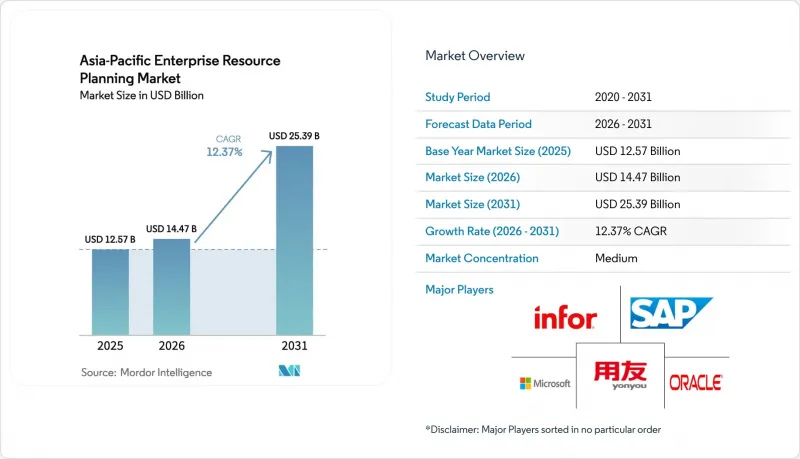
Rapid uptake of cloud-native suites, formal cloud-first policies, and the embedding of artificial intelligence into core workflows are widening the addressable base beyond large manufacturers into highly regulated public-sector agencies and small retailers. Government frameworks that mandate e-invoicing, unified data registries, and sovereign cloud hosting have shortened decision cycles and redirected information-technology budgets toward modern enterprise resource planning platforms. Vendors are racing to certify local data centers, pre-integrate with national identity wallets, and expose application programming interfaces that enable start-ups to build vertical extensions, intensifying the competitive landscape. The convergence of demographic pressures, mobile-first workstyles, and low-code configuration tools is further lowering adoption barriers for resource-constrained small and medium enterprises.
Asia-Pacific Enterprise Resource Planning Market Trends and Insights
Rising Adoption of Cloud-Native Architectures Among Asia-Pacific Enterprises
Public-sector mandates are cascading into private procurement cycles. Japan's government cloud portfolio expanded from 671 to 2,918 systems between 2024 and 2025, a 335% surge, after centralized deadlines required agencies to vacate legacy data centers. Australia activated a whole-of-government cloud policy in 2026 that compels agencies to embed cloud economics in every new digital investment, driving hyperscaler partner certifications. Singapore migrated 213 systems to commercial clouds across 41 agencies, pushing more than 80% of eligible workloads off the government's private cloud. These exemplars demonstrate measurable reductions in release cycles and operating costs, persuading financial institutions and retailers to follow similar modernization blueprints in the APAC enterprise resource planning market.
Government-Led Digital Transformation Initiatives Across Emerging Asian Economies
National blueprints now tie gross domestic product targets to digital economy output, ensuring sustained budget allocations for unified data backbones and artificial intelligence-ready enterprise resource planning foundations. Beijing's Digital China 2025 Action Plan aims for core digital industries to exceed 10% of GDP while expanding compute capacity beyond 300 exaflops, creating predictable demand for domestically hosted, standards-based platforms. The India-Japan Digital Partnership 2.0, signed in 2025, codifies collaboration on interoperability of digital public infrastructure, artificial intelligence governance, and semiconductor value chains, accelerating cross-border system integration projects. Singapore's Smart Nation 2.0 recorded a 11.2% compound annual growth rate over the past five years in its digital economy, with 9 in 10 firms adopting at least one digital tool in 2024. Such policies compress adoption timelines for modern suites and favor vendors able to certify local data residency while integrating with e-procurement platforms and digital-identity rails in the Asia-Pacific ERP market.
Shortage of Skilled ERP Implementation Partners in Tier-2 Asian Cities
Consultancy talent remains concentrated in metro hubs, leaving manufacturers in provincial clusters with long wait times and premium travel charges. A survey of 605 Vietnamese small and medium enterprises showed sustained usage plunged to 35% after 18 months without an internal champion. Malaysia's New Industrial Master Plan flags the same skills gap as a barrier to smart-factory ambitions, prompting the government to earmark intervention funds for training. Vendors offer remote configuration portals and templated rollouts, yet these often limit deep customization in the Asia-Pacific ERP market.
Other drivers and restraints analyzed in the detailed report include:
- Accelerated Post-Pandemic Push Toward Remote Work and Mobile-First Workflows
- AI-Driven Analytics Driving Demand for Modern ERP Suites
- Data Sovereignty Regulations Limiting Cross-Border Cloud Deployments
For complete list of drivers and restraints, kindly check the Table Of Contents.
Segment Analysis
Cloud-native suites owned 46.1% of the Asia-Pacific enterprise resource planning market share in 2025. Mobile-first architectures are forecast to post a 12.7% CAGR through 2031 as distributed workforces demand smartphone parity. The market for cloud-native modules is expanding as public agencies migrate from on-premises SAP ECC and Oracle E-Business Suite before their support sunsets. Enterprises value microservices that allow phased cutovers, avoiding risky big-bang switches. Mobile-first design reduces end-user training overhead and accelerates approval cycles, a boon for retailers reconciling omnichannel inventory.
Vendor strategies illustrate the shift. Japan's Digital Agency slashed release cycles from six months to 48 hours by adopting scaled agile frameworks and automated quality gates. Microsoft and SAP target 40,000 mid-market firms for ECC migrations that bundle built-in artificial intelligence co-pilots. Workday's December 2025 purchases of Sana and Pipedream deliver 3,000 pre-built connectors, enabling enterprises to embed conversational agents without heavy custom code.
Finance and accounting retained 31.5% of the Asia-Pacific enterprise resource planning market share in 2025, yet human capital management is on track for a 12.9% CAGR. Mandatory e-invoicing and real-time tax remittance keep finance at the core, but demographic headwinds make workforce intelligence equally strategic. The Asia-Pacific enterprise resource planning market for payroll and talent modules is growing as Japan's My Number Card and Singapore's Singpass APIs enable systems to pull verified identity and benefits data in real time.
Government deployments set precedents. Singapore's VISION platform, spanning 100,000 public officers, cut processing time by 30% after automating hire-to-retire workflows. Infosys applies its Topaz artificial intelligence methodology to Workday rollouts, claiming measurable gains in close rates and retention. These examples reinforce that talent analytics and predictive attrition models are now board-level priorities. Additionally, integrating AI-driven insights into ERP systems enables organizations to make more informed, strategic decisions.
The Asia-Pacific Enterprise Resource Planning Market Report is Segmented by Architecture (Cloud-Native Suite, Mobile-First ERP, and More), Business Function (Finance and Accounting, and More), Deployment Model (On-Premise, and Cloud), Organization Size (Large Enterprises, and Small and Medium Enterprises), Industry Vertical (Manufacturing, BFSI, and More), and Geography. The Market Forecasts are Provided in Terms of Value (USD).
List of Companies Covered in this Report:
- SAP SE
- Microsoft Corporation
- Oracle Corporation
- Unit4 N.V.
- IFS AB
- Infor Inc.
- Sage Group Plc
- Workday Inc.
- SYSPRO (Pty) Ltd.
- Yonyou Network Technology Co. Ltd.
- Ramco Systems Ltd.
- Kingdee International Software Group Company Limited
- Epicor Software Corporation
- Fujistu Limited
- NEC Corporation
- Zoho Corporation Pvt. Ltd.
- HashMicro Pte. Ltd.
- MYOB Group Pty. Ltd.
- Pronto Software Limited
- QAD Inc.
Additional Benefits:
- The market estimate (ME) sheet in Excel format
- 3 months of analyst support
TABLE OF CONTENTS
1 INTRODUCTION
- 1.1 Study Assumptions and Market Definition
- 1.2 Scope of the Study
2 RESEARCH METHODOLOGY
3 EXECUTIVE SUMMARY
4 MARKET LANDSCAPE
- 4.1 Market Overview
- 4.2 Market Drivers
- 4.2.1 Rising Adoption of Cloud-Native Architectures Among Asia-Pacific Enterprises
- 4.2.2 Government-led Digital Transformation Initiatives Across Emerging Asian Economies
- 4.2.3 Accelerated Post-pandemic Push Toward Remote Work and Mobile-first Workflows
- 4.2.4 Growing Ecosystem of Local ISV Extensions Enabling Industry-specific Customizations
- 4.2.5 Integration of AI-driven Analytics Driving Demand for Modern ERP Suites
- 4.2.6 Increasing Venture Capital Funding for Vertical SaaS Startups in Asia-Pacific
- 4.3 Market Restraints
- 4.3.1 Increasing Venture Capital Funding for Vertical SaaS Startups in Asia-Pacific
- 4.3.2 Shortage of Skilled ERP Implementation Partners in Tier-2 Asian Cities
- 4.3.3 Data Sovereignty Regulations Limiting Cross-border Cloud Deployments
- 4.3.4 Fragmented SME Market With Low IT Budgets Slowing Cloud ERP Adoption
- 4.4 Impact of Macroeconomic Factors on the Market
- 4.5 Industry Value Chain Analysis
- 4.6 Regulatory Landscape
- 4.7 Technological Outlook
- 4.8 Porter's Five Forces Analysis
- 4.8.1 Bargaining Power of Suppliers
- 4.8.2 Bargaining Power of Buyers
- 4.8.3 Threat of New Entrants
- 4.8.4 Threat of Substitutes
- 4.8.5 Intensity of Competitive Rivalry
5 MARKET SIZE AND GROWTH FORECASTS (VALUE)
- 5.1 By Architecture
- 5.1.1 Cloud-Native Suite
- 5.1.2 Mobile-First ERP
- 5.1.3 Social / Collaborative ERP
- 5.1.4 Two-Tier / Edge ERP
- 5.2 By Business Function
- 5.2.1 Finance and Accounting
- 5.2.2 Supply-Chain and Operations
- 5.2.3 Human Capital Management
- 5.2.4 Customer Relationship and Commerce
- 5.2.5 Manufacturing Execution and Quality
- 5.3 By Deployment Model
- 5.3.1 On-Premise
- 5.3.2 Cloud
- 5.4 By Organization Size
- 5.4.1 Large Enterprises
- 5.4.2 Small and Medium Enterprises
- 5.5 By Industry Vertical
- 5.5.1 Manufacturing
- 5.5.2 Retail and E-commerce
- 5.5.3 BFSI
- 5.5.4 Government and Public Sector
- 5.5.5 IT and Telecom
- 5.5.6 Healthcare and Life Sciences
- 5.5.7 Other Industry Verticals
- 5.6 By Geography
- 5.6.1 China
- 5.6.2 India
- 5.6.3 Japan
- 5.6.4 South Korea
- 5.6.5 Australia and New Zealand
- 5.6.6 Rest of Asia-Pacific
6 COMPETITIVE LANDSCAPE
- 6.1 Market Concentration
- 6.2 Strategic Moves
- 6.3 Market Share Analysis
- 6.4 Company Profiles (includes Global Level Overview, Market Level Overview, Core Segments, Financials as available, Strategic Information, Market Rank/Share, Products and Services, Recent Developments)
- 6.4.1 SAP SE
- 6.4.2 Microsoft Corporation
- 6.4.3 Oracle Corporation
- 6.4.4 Unit4 N.V.
- 6.4.5 IFS AB
- 6.4.6 Infor Inc.
- 6.4.7 Sage Group Plc
- 6.4.8 Workday Inc.
- 6.4.9 SYSPRO (Pty) Ltd.
- 6.4.10 Yonyou Network Technology Co. Ltd.
- 6.4.11 Ramco Systems Ltd.
- 6.4.12 Kingdee International Software Group Company Limited
- 6.4.13 Epicor Software Corporation
- 6.4.14 Fujistu Limited
- 6.4.15 NEC Corporation
- 6.4.16 Zoho Corporation Pvt. Ltd.
- 6.4.17 HashMicro Pte. Ltd.
- 6.4.18 MYOB Group Pty. Ltd.
- 6.4.19 Pronto Software Limited
- 6.4.20 QAD Inc.
7 MARKET OPPORTUNITIES AND FUTURE OUTLOOK
- 7.1 White-Space and Unmet-Need Assessment

