
PUBLISHER: Mordor Intelligence | PRODUCT CODE: 2044022

PUBLISHER: Mordor Intelligence | PRODUCT CODE: 2044022
E-commerce ERP Integration - Market Share Analysis, Industry Trends & Statistics, Growth Forecasts (2026 - 2031)
The E-commerce enterprise resource planning integration market size is projected to expand from USD 14.21 billion in 2025 and USD 15.21 billion in 2026 to USD 21.31 billion by 2031, registering a CAGR of 6.98% between 2026 and 2031.
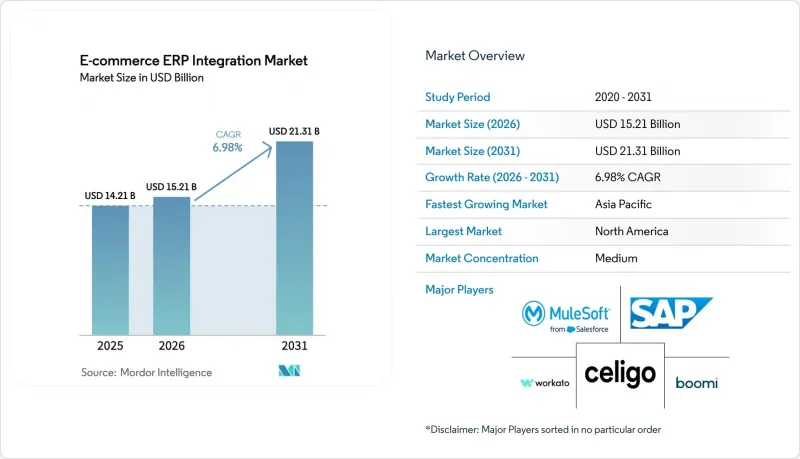
Rising omnichannel retail expectations, real-time tax-compliant invoicing, and the shift toward composable digital commerce are reshaping integration from a back-office IT task into a board-level priority. Mandatory e-invoicing rules across the European Union and India, the rapid spread of headless commerce storefronts, and mounting service-level penalties on global marketplaces are driving retailers to seek low-latency middleware capable of orchestrating thousands of API calls per second. Cloud deployments dominate as subscription economics align integration spending with transaction peaks, while low-code iPaaS tools democratize connectivity for resource-constrained teams. Competitive intensity stems from vendors that bundle integration with ERP suites and from specialists that differentiate through pre-built connectors for niche applications.
Global E-commerce ERP Integration Market Trends and Insights
Proliferation of Headless Commerce Architectures
Headless commerce decouples the storefront from back-end logic, allowing brands to deploy multiple touchpoints, such as web, voice, and IoT interfaces, simultaneously. This architecture significantly increases the number of API endpoints, requiring middleware to handle three to five times as many calls per transaction as traditional monolithic platforms. Retailers adopting headless frameworks often prefer Integration Platform as a Service (iPaaS) solutions that include certified connectors for platforms such as Shopify Plus, BigCommerce, and others. The increased volume of API calls introduces data-consistency challenges, particularly when discrepancies arise in cart contents or delivery estimates across different channels. To address these issues, integration vendors are incorporating real-time monitoring capabilities and adopting outcome-based pricing models that align with transaction throughput, ensuring seamless operations and improved reliability for retailers.
Rising Adoption of SaaS-Based ERP Suites Among Mid-Market Retailers
Mid-market merchants are increasingly transitioning from outdated on-premise Enterprise Resource Planning (ERP) systems to modern cloud-based suites such as SAP S/4HANA Cloud, Oracle NetSuite, and Microsoft Dynamics 365. These cloud solutions offer native commerce connectors that significantly reduce project timelines by enabling retailers to synchronize orders across various web stores and marketplaces in a matter of weeks rather than months. By shifting infrastructure costs to vendors, these solutions also help businesses optimize their operational expenses. Additionally, continuous updates provided by these platforms ensure that connector compatibility is maintained over time. However, the multi-tenant nature of cloud deployments introduces data residency and compliance challenges, particularly for businesses operating in regions with stringent data protection regulations. This has led to a growing demand for region-specific deployment options that address these compliance concerns while maintaining the efficiency and scalability of cloud-based ERP systems.
Legacy On-Premise ERP Customizations Hindering Standardized Connectors
Years of bespoke code in on-premise ERP landscapes create brittle and highly customized data models that off-the-shelf connectors cannot easily accommodate. Retailers often face significant challenges and incur substantial consulting fees to map these custom fields, workflows, and processes to normalized schemas required for modern systems. This complexity frequently delays cloud migration projects by an estimated 6 to 12 months, as businesses work to ensure compatibility and minimize disruptions. The difficulty is further compounded when multiple ERP instances are deployed across different regions, requiring integration platforms to maintain and manage parallel connectors for what ideally should function as a unified system. These challenges highlight the critical need for robust planning and execution strategies to streamline the migration process and ensure operational continuity.
Other drivers and restraints analyzed in the detailed report include:
- Mandatory E-Invoicing and Taxation Compliance Integrations
- Growth of Omnichannel Retail Requiring Unified Inventory Visibility
- Data Security and Compliance Concerns Around Cross-Border Flows
For complete list of drivers and restraints, kindly check the Table Of Contents.
Segment Analysis
Cloud-based solutions accounted for 54.23% of 2025 revenue as retailers gravitated toward elastic scaling during holiday peaks and avoided hardware refresh cycles. The hybrid approach is forecast to rise at a 7.58% CAGR, balancing on-premise control for sensitive finance modules with cloud speed for customer-facing commerce services. The E-commerce enterprise resource planning integration market size for hybrid deployments is projected to widen as edge runtimes in stores support local order processing and later synchronize with central ERPs, mitigating connectivity outages. Second-generation hybrid platforms route data dynamically based on real-time latency and compliance thresholds, integrating edge devices, private clouds, and public SaaS endpoints in a single policy domain.
Organizations still running fully on-premises middleware cite data sovereignty rules and long depreciation cycles for existing servers. Yet, rising maintenance costs and limited talent pools accelerate the pivot toward managed services. Vendors now bundle continuous security updates, micro-segmented network controls, and AI-driven anomaly detection to ease the transition. These value-adds, combined with subscription pricing, make cloud and hybrid offerings increasingly attractive, especially for merchants operating across multiple tax regimes and payment ecosystems.
SMEs accounted for 62.14% of 2025 revenue, underscoring how low-code iPaaS subscriptions starting at USD 300 per month unlock enterprise-grade capabilities for smaller budgets. Template libraries compress deployment to as little as 6 weeks, enabling rapid pivots to new sales channels and fulfillment partners. Larger retailers, while fewer in number, drive high-value custom projects that fuse omnichannel orchestration with proprietary pricing algorithms. Both cohorts, however, pursue a bimodal strategy: pre-built connectors for commodity processes and bespoke coding for differentiating workflows.
The vendor landscape mirrors this dichotomy. Pure-play iPaaS firms add enterprise governance modules, role-based access, versioned API gateways, and SOC 2 attestations to penetrate the upper tier, while traditional middleware suites introduce drag-and-drop designers to defend mid-market share. These converging roadmaps reduce technology gaps, making pricing, support, and vertical expertise the main buying criteria. Consequently, the market continues to broaden its appeal across company sizes without sacrificing depth for complex rollouts.
The E-Commerce Enterprise Resource Planning Integration Market Report is Segmented by Deployment Mode (Cloud-Based, On-Premise, and Hybrid), Organization Size (Large Enterprises, and Small and Medium Enterprises), Industry Vertical (Retail and Consumer Goods, and More), Integration Approach (API Integration, Custom / Bespoke Integration, and More), and Geography. The Market Forecasts are Provided in Terms of Value (USD).
Geography Analysis
Asia-Pacific accounted for 29.37% of global revenue in 2025, driven by digital-first consumers in China, India, and Southeast Asia who expect uninterrupted commerce across super-apps, chat, and social video. Local payment rails like India's Unified Payments Interface process billions of monthly transactions, requiring ERP connectors that reconcile micro-payments in near real time. Africa, expanding its market, relies on mobile money systems such as M-Pesa, prompting vendors to build adapters for USSD-based confirmations and offline synchronization when cellular coverage lapses.
North America and Europe generate the largest absolute spend. Retailers are moving beyond order synchronization to advanced use cases such as real-time carbon footprint tracking and AI-driven delivery routing. The European Union's phased ViDA mandate accelerates investment in tax-compliant invoice data bridges, while U.S. merchants integrate state-level sales tax engines alongside Buy Now Pay Later services. Middle Eastern economies, especially Saudi Arabia and the United Arab Emirates, channel public funds into omnichannel infrastructure, demanding connectors that blend local gateways with global logistics APIs.
Geography-specific data privacy laws fragment architecture choices. . The EU-US Data Privacy Framework, enacted in 2023, legitimizes transatlantic data transfers. However, ongoing legal challenges cast doubt on its longevity. As a precaution, retailers are crafting hybrid architectures, ready to shift to on-premise processing should the framework face invalidation. China's localization rules compel in-country ERP hosting, Europe enforces rigorous consent tracking under GDPR, and Russia mandates domestic data storage. Integration platforms answer with location-aware routing that respects residency without compromising performance. Emerging markets also push for offline-first runtimes capable of queuing transactions at the edge, an area where only a few vendors currently excel, signaling untapped growth opportunities.
- Celigo, Inc.
- Boomi, Inc.
- MuleSoft LLC
- Jitterbit, Inc.
- Workato, Inc.
- SnapLogic, Inc.
- Microsoft Corporation
- SAP SE
- Oracle Corporation
- IBM Corporation
- SPS Commerce, Inc.
- TrueCommerce, Inc.
- Magic Software Enterprises Ltd.
- nChannel, Inc.
- Patchworks Integration Ltd.
- Adeptia, Inc.
- Cleo Communcations, Inc.
- HighJump Software Inc. (Korber AG)
- Dscartes Systems Group Inc.
- Flowgear (Pty) Ltd.
Additional Benefits:
- The market estimate (ME) sheet in Excel format
- 3 months of analyst support
TABLE OF CONTENTS
1 INTRODUCTION
- 1.1 Study Assumptions and Market Definition
- 1.2 Scope of the Study
2 RESEARCH METHODOLOGY
3 EXECUTIVE SUMMARY
4 MARKET LANDSCAPE
- 4.1 Market Overview
- 4.2 Market Drivers
- 4.2.1 Proliferation of Headless Commerce Architectures
- 4.2.2 Rising Adoption of SaaS-Based ERP Suites Among Mid-Market Retailers
- 4.2.3 Mandatory E-Invoicing and Taxation Compliance Integrations
- 4.2.4 Growth of Omnichannel Retail Requiring Unified Inventory Visibility
- 4.2.5 Surge in Marketplace Sellers Integrating ERP to Meet SLA Penalties
- 4.2.6 Low-Code iPaaS Platforms Lowering Integration Complexity and Cost
- 4.3 Market Restraints
- 4.3.1 Legacy On-Premise ERP Customizations Hindering Standardized Connectors
- 4.3.2 Data Security and Compliance Concerns Around Cross-Border Flows
- 4.3.3 High TCO for Complex Multi-Site Rollouts in Emerging Markets
- 4.3.4 Shortage of Skilled Integration Architects and Middleware Developers
- 4.4 Impact of Macroeconomic Factors on the Market
- 4.5 Industry Value Chain Analysis
- 4.6 Regulatory Landscape
- 4.7 Technological Outlook
- 4.8 Porter's Five Forces Analysis
- 4.8.1 Bargaining Power of Suppliers
- 4.8.2 Bargaining Power of Buyers
- 4.8.3 Threat of New Entrants
- 4.8.4 Threat of Substitutes
- 4.8.5 Intensity of Competitive Rivalry
5 MARKET SIZE AND GROWTH FORECASTS (VALUE)
- 5.1 By Deployment Mode
- 5.1.1 Cloud-Based
- 5.1.2 On-Premise
- 5.1.3 Hybrid
- 5.2 By Organization Size
- 5.2.1 Large Enterprises
- 5.2.2 Small and Medium Enterprises
- 5.3 By Industry Vertical
- 5.3.1 Retail and Consumer Goods
- 5.3.2 Manufacturing
- 5.3.3 Healthcare
- 5.3.4 Logisitcs and Transportation
- 5.3.5 Other Industry Verticals
- 5.4 By Integration Approach
- 5.4.1 API Integration
- 5.4.2 Middleware / ESB
- 5.4.3 Custom / Bespoke Integration
- 5.4.4 Integration Platform as a Service (iPaaS)
- 5.5 By Geography
- 5.5.1 North America
- 5.5.1.1 United States
- 5.5.1.2 Canada
- 5.5.1.3 Mexico
- 5.5.2 Europe
- 5.5.2.1 United Kingdom
- 5.5.2.2 Germany
- 5.5.2.3 France
- 5.5.2.4 Italy
- 5.5.2.5 Spain
- 5.5.2.6 Rest of Europe
- 5.5.3 Asia-Pacific
- 5.5.3.1 China
- 5.5.3.2 Japan
- 5.5.3.3 India
- 5.5.3.4 South Korea
- 5.5.3.5 Rest of Asia-Pacific
- 5.5.4 South America
- 5.5.4.1 Brazil
- 5.5.4.2 Argentina
- 5.5.4.3 Rest of South America
- 5.5.5 Middle East and Africa
- 5.5.5.1 Middle East
- 5.5.5.1.1 United Arab Emirates
- 5.5.5.1.2 Saudi Arabia
- 5.5.5.1.3 Rest of Middle East
- 5.5.5.2 Africa
- 5.5.5.2.1 South Africa
- 5.5.5.2.2 Egypt
- 5.5.5.2.3 Rest of Africa
- 5.5.5.1 Middle East
- 5.5.1 North America
6 COMPETITIVE LANDSCAPE
- 6.1 Market Concentration
- 6.2 Strategic Moves
- 6.3 Market Share Analysis
- 6.4 Company Profiles (includes Global Level Overview, Market Level Overview, Core Segments, Financials as available, Strategic Information, Market Rank/Share, Products and Services, Recent Developments)
- 6.4.1 Celigo, Inc.
- 6.4.2 Boomi, Inc.
- 6.4.3 MuleSoft LLC
- 6.4.4 Jitterbit, Inc.
- 6.4.5 Workato, Inc.
- 6.4.6 SnapLogic, Inc.
- 6.4.7 Microsoft Corporation
- 6.4.8 SAP SE
- 6.4.9 Oracle Corporation
- 6.4.10 IBM Corporation
- 6.4.11 SPS Commerce, Inc.
- 6.4.12 TrueCommerce, Inc.
- 6.4.13 Magic Software Enterprises Ltd.
- 6.4.14 nChannel, Inc.
- 6.4.15 Patchworks Integration Ltd.
- 6.4.16 Adeptia, Inc.
- 6.4.17 Cleo Communcations, Inc.
- 6.4.18 HighJump Software Inc. (Korber AG)
- 6.4.19 Dscartes Systems Group Inc.
- 6.4.20 Flowgear (Pty) Ltd.
7 MARKET OPPORTUNITIES AND FUTURE OUTLOOK
- 7.1 White-Space and Unmet-Need Assessment

