PUBLISHER: Mordor Intelligence | PRODUCT CODE: 2044219

PUBLISHER: Mordor Intelligence | PRODUCT CODE: 2044219
Africa Facility Management - Market Share Analysis, Industry Trends & Statistics, Growth Forecasts (2026 - 2031)
Africa Facility Management Market size in 2026 is estimated at USD 103.57 billion, growing from 2025 value of USD 92.52 billion with 2031 projections showing USD 182.07 billion, growing at 11.95% CAGR over 2026-2031.
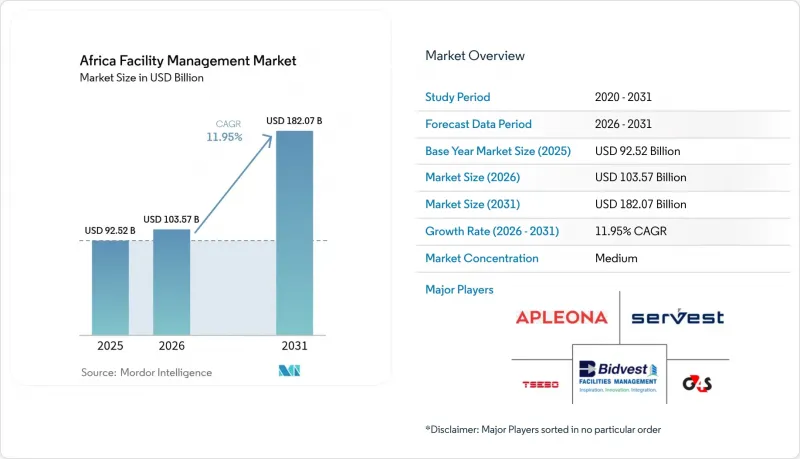
This momentum reflects accelerating infrastructure investment, the growing preference for outsourced service models, and tightening regulatory frameworks that reward professional standards in building operations. Nigeria's 29.47% share gives it an outsized influence on regional demand, while South Africa and Egypt provide scale, financing depth, and policy stability that attract international providers. Outsourced contracts now account for 67.3% of value thanks to cost-saving synergies and performance guarantees that appeal to private and public owners alike. The commercial segment remains the largest end-user at 40.2% share, though industrial and process facilities are expanding fastest as mining and energy projects add complex sites that demand specialized technical expertise. Technology integration, particularly IoT-enabled building management systems and AI-driven predictive maintenance, underpins margin protection in an inflationary cost environment and positions early adopters to win outcome-based tenders across the Africa facility management market.
Africa Facility Management Market Trends and Insights
Outsourcing Momentum
Organizations across the continent increasingly outsource non-core building operations to unlock capital, standardize processes, and access specialized talent pools. Nigeria's 2024 Presidential Directive on Local Content Compliance rewards bidders that demonstrate domestic workforce development, encouraging local FM firms to form joint ventures with global specialists. Botswana's experience with hospital service outsourcing illustrates measurable gains in quality metrics that offset incremental cost, reinforcing the case for managed contracts in public health infrastructure. Contracting models have shifted toward multi-year agreements that bundle technical and support services under performance guarantees, subsequently reducing renegotiation friction and improving budget predictability for asset owners. Facility managers now embed service-level-based key performance indicators that align payment schedules with uptime, energy savings, and user comfort, promoting transparent value delivery. As success stories circulate across peer networks, more boards view outsourcing as a strategic lever rather than a cost-cutting experiment, driving deal volumes in the Africa facility management market.
Technology Integration
IoT sensors, cloud analytics, and AI diagnostics enable remote monitoring, automated fault detection, and predictive maintenance that extend asset life while curbing unplanned downtime. Field evidence shows smart building controls can cut average site energy draw by 36.8 kW during sensor failure scenarios, mitigating utility volatility. South African pilots using energyAI's software recorded 10-15% operating cost savings by combining equipment telemetry with weather and tariff feeds to optimize HVAC cycles. Providers that embed digital twins and mobile work-order platforms differentiate by offering live dashboards, automated compliance logs, and data-backed capital planning recommendations. However, the limited pool of technicians versed in data analytics and OT-IT convergence slows large-scale rollouts outside major metros. Training alliances with technical universities and vendor academies are therefore emerging as competitive necessities for firms intent on capturing technology-weighted contracts within the Africa facility management market.
Rising Operational Costs
Currency devaluation and imported material reliance have pushed Nigerian construction input prices up by 200% since 2023, squeezing FM service margins and forcing renegotiations of long-term contracts. Cement, steel, and skilled labor rates doubled over the same period, while utilities tariffs escalated due to global energy volatility. Providers answer with dynamic pricing clauses, bulk-buy partnerships, and substitution of locally sourced consumables to limit pass-through risk. Some firms leverage remote supervision and sensor-based inspections to lower technician travel expenses, partially offsetting inflation pressure in the Africa facility management market. Yet, persistent logistics bottlenecks and fuel cost spikes threaten cash-flow predictability and limit smaller vendors' ability to fund tech upgrades.
Other drivers and restraints analyzed in the detailed report include:
- ESG-Aligned Solutions
- Demand for Integrated FM
- Cultural Resistance to Outsourcing
For complete list of drivers and restraints, kindly check the Table Of Contents.
Segment Analysis
Hard services retained a 60.20% share of the Africa facility management market in 2025, anchored by mechanical, electrical, and plumbing maintenance that ensures operational uptime for critical building systems. Mandatory fire-life-safety testing, HVAC optimization, and elevator inspections position technical trades as non-discretionary budget items across commercial towers and industrial plants. Asset owners prioritize hard services when pursuing occupancy certificates and insurance renewals, supporting stable demand even during economic slowdowns. Meanwhile, digital asset registers and condition-based monitoring bolster recurring revenue streams by embedding data-centric workflows into maintenance cycles.
Soft services chart the fastest trajectory with 14.54% CAGR as employers link workplace experience to talent retention and brand perception. Security and office support top growth subsectors because rising urban crime rates and hybrid work models heighten the need for access control, reception management, and concierge services. Cleaning and waste services integrate green chemicals and robotics to meet ESG benchmarks while cutting manual labor intensity. Predictive scheduling triggered by occupancy sensors minimizes overtime, keeps air-quality metrics within health guidelines, and lifts satisfaction scores. This convergence of wellness and efficiency pulls a larger spending envelope toward soft services, gradually narrowing the revenue gap with hard services in the Africa facility management market size.
Africa Facility Management Market is Segmented by Service Type (Hard Services, and Soft Services), Offering Type (In-House, and Outsourced), End-User Industry (Commercial, Hospitality, Institutional and Public Infrastructure, Healthcare, Industrial and Process, and More), and Country. The Market Forecasts are Provided in Terms of Value (USD).
List of Companies Covered in this Report:
- Bidvest Facilities Management
- Apleona GmbH
- Tsebo Facilities Solution
- Servest Africa
- G4S Africa
- EFS Facilities Management Africa
- Global PFI Facilities Management Ltd.
- Contrack Facilities Management S.A.E.
- Broll Nigeria
- Alpha Mead Group
- Integrico (Pty) Ltd.
- Benchmark Facilities Management
- Emdad Facility Management
- Grandeur Real-Estate Company
- Eliezer Group
Additional Benefits:
- The market estimate (ME) sheet in Excel format
- 3 months of analyst support
TABLE OF CONTENTS
1 INTRODUCTION
- 1.1 Study Assumptions and Market Definition
- 1.2 Scope of the Study
2 RESEARCH METHODOLOGY
3 EXECUTIVE SUMMARY
4 MARKET LANDSCAPE
- 4.1 Market Overview
- 4.1.1 Current Occupancy Rates
- 4.1.2 Profitability Rates of Major FM Players
- 4.1.3 Workforce Indicators - Labor Participation
- 4.1.4 Facility Management Market Share (%) by Service Type
- 4.1.5 Facility Management Market Share (%) by Hard Services
- 4.1.6 Facility Management Market Share (%) by Soft Services
- 4.1.7 Urbanization and Population Growth in Major Metros
- 4.1.8 Sector Investment Priorities in Africa Infrastructure Pipeline
- 4.1.9 Regulatory Drivers Specific to Labour and Safety Standards
- 4.2 Market Drivers
- 4.2.1 Outsourcing momentum
- 4.2.2 Technology integration
- 4.2.3 ESG-aligned solutions
- 4.2.4 Demand for integrated FM
- 4.2.5 Expansion of Special Economic Zones (SEZs)
- 4.2.6 Insurance-driven compliance mandates
- 4.3 Market Restraints
- 4.3.1 Rising operational costs
- 4.3.2 Cultural resistance to outsourcing
- 4.3.3 Skills gap in digital FM technologies
- 4.3.4 Volatile foreign-exchange rates impacting contract viability
- 4.4 Value Chain Analysis
- 4.5 PESTEL Analysis
- 4.6 Regulatory and Legislative Framework for Market Entrants
- 4.7 Impact of Macroeconomic Indicators on FM Demand
- 4.8 Porter's Five Forces Analysis
- 4.8.1 Bargaining Power of Suppliers
- 4.8.2 Bargaining Power of Buyers
- 4.8.3 Threat of New Entrants
- 4.8.4 Threat of Substitute Services
- 4.8.5 Intensity of Competitive Rivalry
- 4.9 Investment and Funding Analysis
5 MARKET SIZE AND GROWTH FORECASTS (VALUES)
- 5.1 By Service Type
- 5.1.1 Hard Services
- 5.1.1.1 Asset Management
- 5.1.1.2 MEP and HVAC Services
- 5.1.1.3 Fire Systems and Safety
- 5.1.1.4 Other Hard FM Services
- 5.1.2 Soft Services
- 5.1.2.1 Office Support and Security
- 5.1.2.2 Cleaning Services
- 5.1.2.3 Catering Services
- 5.1.2.4 Other Soft FM Services
- 5.1.1 Hard Services
- 5.2 By Offering Type
- 5.2.1 In-house
- 5.2.2 Outsourced
- 5.2.2.1 Single FM
- 5.2.2.2 Bundled FM
- 5.2.2.3 Integrated FM
- 5.3 By End-user Industry
- 5.3.1 Commercial (IT and Telecom, Retail and Warehouses)
- 5.3.2 Hospitality (Hotels, Eateries, Large-scale Restaurants)
- 5.3.3 Institutional and Public Infrastructure (Govt, Education, Transportation)
- 5.3.4 Healthcare (Public and Private Facilities)
- 5.3.5 Industrial and Process (Manufacturing, Energy, Mining)
- 5.3.6 Other End-user Industries (Multi-housing, Entertainment, Sports and Leisure)
- 5.4 By Country
- 5.4.1 South Africa
- 5.4.2 Egypt
- 5.4.3 Nigeria
- 5.4.4 Rest of Africa
6 COMPETITIVE LANDSCAPE
- 6.1 Market Concentration
- 6.2 Strategic Moves
- 6.3 Market Share Analysis
- 6.4 Company Profiles (includes Global level Overview, Market level overview, Core Segments, Financials as available, Strategic Information, Market Rank/Share for key companies, Products and Services, and Recent Developments)
- 6.4.1 Bidvest Facilities Management
- 6.4.2 Apleona GmbH
- 6.4.3 Tsebo Facilities Solution
- 6.4.4 Servest Africa
- 6.4.5 G4S Africa
- 6.4.6 EFS Facilities Management Africa
- 6.4.7 Global PFI Facilities Management Ltd.
- 6.4.8 Contrack Facilities Management S.A.E.
- 6.4.9 Broll Nigeria
- 6.4.10 Alpha Mead Group
- 6.4.11 Integrico (Pty) Ltd.
- 6.4.12 Benchmark Facilities Management
- 6.4.13 Emdad Facility Management
- 6.4.14 Grandeur Real-Estate Company
- 6.4.15 Eliezer Group
7 MARKET OPPORTUNITIES AND FUTURE TRENDS
- 7.1 White-space and Unmet-Need Assessment
- 7.2 Technology-led Integrated FM (IoT, BMS, AI-based Predictive Maintenance)
- 7.3 ESG-compliant FM Solutions Demand
- 7.4 Future Service-Model Shifts (Outcome-based Contracts)

