PUBLISHER: Mordor Intelligence | PRODUCT CODE: 2097257

PUBLISHER: Mordor Intelligence | PRODUCT CODE: 2097257
Middle East Facility Management - Market Share Analysis, Industry Trends & Statistics, Growth Forecasts (2026 - 2031)
According to Mordor Intelligence, the Middle East facility management market size is projected to expand from USD 78.25 billion in 2025 and USD 88.84 billion in 2026 to USD 163.73 billion by 2031, registering a CAGR of 13.53% between 2026 and 2031.
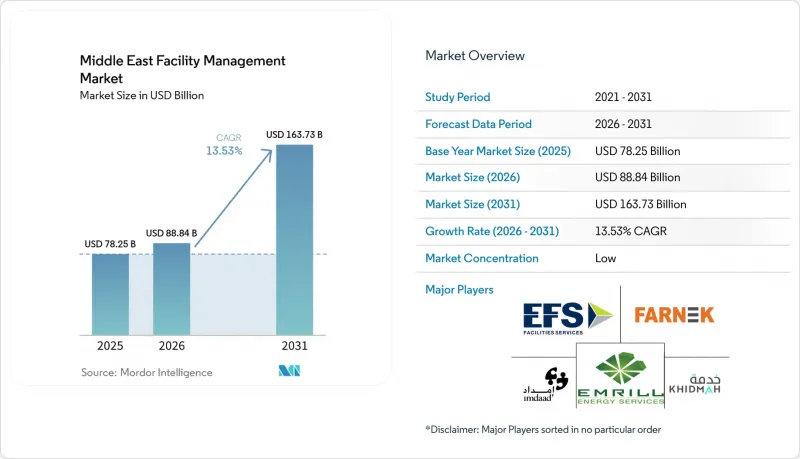
This report is Segmented by Service Type (Hard Services, Soft Services), Offering Type (In-House, Outsourced), End-User Industry (Commercial, Hospitality, Institutional and Public Infrastructure, Healthcare, Industrial and Process, and More), and Geography (Saudi Arabia, United Arab Emirates, Rest of Middle East). The Market Forecasts are Provided in Terms of Value (USD).
Middle East Facility Management Market Trends and Insights
Vision 2030 And Giga-Project Asset Handovers
Saudi Arabia's transition from construction to operational asset management is reshaping the Middle East's facility management landscape, particularly across its ambitious giga-projects. With a project pipeline surpassing USD 1 trillion, initiatives like NEOM, Red Sea Global, and King Salman International Airport are not just milestones but catalysts. Each handover amplifies the demand for services ranging from engineering support to lifecycle oversight. This evolution underscores a pivotal shift: post-occupancy work now extends into long-term service contracts, aligning with the asset's entire lifecycle. Furthermore, as handovers occur, developer expectations evolve. There is a pronounced shift towards partners adept at managing data, ensuring uptime, and meeting performance targets. NEOM, for instance, emphasizes advanced requirements such as digital twin integration and ongoing data exchange, setting a high bar for vendors lacking robust digital capabilities. Consequently, as these projects evolve, larger, tech-savvy providers are poised to dominate the Middle East's facility management arena, reaping the rewards of their strategic positioning.
Outsourcing Shift Toward Integrated And Outcome-Based Contracts
In the Middle East, the facility management market is witnessing a notable shift. Traditionally, contracts were often fragmented, focusing on single services. However, there is a clear trend moving towards outsourced and integrated solutions. By 2025, a significant 68.65% of the market revenue was generated from outsourced deliveries, highlighting its dominance, especially for large assets in the region. What is evolving is the format of these contracts. Owners are now favoring a singular provider capable of managing everything, from hard and soft services to sustainability needs and reporting duties. This trend is particularly pronounced in mega-projects and government-linked procurements. Here, tenders are increasingly emphasizing multi-service integration, digital solutions, and tangible results, moving beyond just labor supply. As a result, contracts are not only growing in value but also in duration. There is a marked preference for providers boasting established systems and governance. Even with clients tightening their belts on costs, this shift is broadening the opportunities within the Middle East's facility management landscape.
Price-Driven Tendering And Margin Compression
In the Middle East facility management market, public-sector and large developer contracts often favor the lowest bid, creating a recurring pricing challenge. Mid-tier providers grapple with this issue, as they juggle labor, compliance, and technology costs while contending with aggressive pricing in standardized service lines. The immediate fallout is diminished margins, but the broader consequence is a hesitance to invest in platforms, automation, and predictive maintenance. This dynamic results in a divided market: well-capitalized operators chase premium contracts, while smaller firms find themselves anchored to labor-intensive tasks, stifling their potential for innovation. Furthermore, price-driven procurement complicates the transition to outcome-based service models, even when the benefits of long-term lifecycle savings are evident. Without a shift in procurement frameworks towards prioritizing quality, uptime, and performance metrics, the Middle East facility management market will struggle to elevate its value.
Other drivers and restraints analyzed in the detailed report include:
- Smart-Building, CAFM, And Predictive Maintenance Adoption
- Energy-Efficiency And Green-Building Compliance Demand
- Skilled Labor Shortages And Nationalization Pressures
For complete list of drivers and restraints, kindly check the Table Of Contents.
Segment Analysis
In 2025, hard services accounted for 60.76% of the Middle East's facility management market, underscoring the region's engineering-centric asset base. Gulf commercial towers, hospitals, airports, hotels, industrial sites, and mixed-use developments rely heavily on MEP systems, HVAC, fire safety, and asset performance support. Given the region's climate, there is heightened demand on cooling and mechanical systems, leading to more frequent maintenance cycles and costlier failures compared to milder climates. The specification of new projects increasingly incorporates asset data, commissioning standards, and monitoring obligations into the operating model even before occupancy. A prime example of this evolution is NEOM's digital twin requirement, linking hard-service responsibilities with real-time asset visibility and long-term performance management.
Soft services are emerging as the quicker-growing segment of the Middle East's facility management market, boasting a projected CAGR of 14.76% through 2031. This growth is buoyed by an expanding hospitality sector, outsourcing in education and government campuses, and a broader demand for cleaning, security, catering, and workplace support. Demonstrating the industry's shift, Farnek introduced a hybrid cleaning unit that merges human teams with autonomous robotic cleaners, achieving coverage of up to 5,000 sq ft per hour. Emrill's sustainability initiative, with 143 continuous improvement measures in 2024, successfully reduced emissions by 640 tCO2e and conserved 2.25 million liters of water, highlighting the trend of bundling soft services with environmental performance commitments rather than confining them to routine tasks.
Complete Report Scope:
- By Service Type
- Hard Services
- Asset Management
- MEP and HVAC Services
- Fire Systems and Safety
- Other Hard FM Services
- Soft Services
- Office Support and Security
- Cleaning Services
- Catering Services
- Other Soft FM Services
- Hard Services
- By Offering Type
- In-house
- Outsourced
- Single FM
- Bundled FM
- Integrated FM
- By End-user Industry
- Commercial (IT and Telecom, Retail and Warehouses, etc.)
- Hospitality (Hotels, Eateries, Large-scale Restaurants)
- Institutional and Public Infrastructure (Govt, Education, Transportation)
- Healthcare (Public and Private Facilities)
- Industrial and Process (Manufacturing, Energy, Mining)
- Other End-user Industries (Multi-housing, Entertainment, Sports and Leisure)
- By Region
- Saudi Arabia
- United Arab Emirates
- Kuwait
- Bahrain
- Rest of Middle East
List of Companies Covered in this Report:
- Emrill Services LLC
- EFS Facilities Services Group LLC
- Farnek Services LLC
- Imdaad LLC
- Khidmah LLC
- Enova Facilities Management Services LLC
- Transguard Group LLC
- Musanadah Facilities Management Company
- Saudi Facility Management Company (FMTECH)
- Muheel Services for Maintenance and Operations LLC
- Initial Saudi Group
- Al Shirawi Facilities Management LLC
- Etisalat Facilities Management LLC
- United Facilities Management
- QBG Facilities Management Group
- ENGIE Cofely Energy Services LLC
- CBRE Group, Inc.
- Jones Lang LaSalle Incorporated
- Serco Group plc
- ISS A/S
Additional Benefits:
- The market estimate (ME) sheet in Excel format
- 3 months of analyst support
TABLE OF CONTENTS
1 INTRODUCTION
- 1.1 Study Assumptions and Market Definition
- 1.2 Scope of the Study
2 RESEARCH METHODOLOGY
3 EXECUTIVE SUMMARY
4 MARKET LANDSCAPE
- 4.1 Market Overview
- 4.2 Impact of Macroeconomic Factors on the Market
- 4.3 Market Drivers
- 4.3.1 Vision 2030 and Giga-Project Asset Handovers
- 4.3.2 Outsourcing Shift Toward Integrated and Outcome-Based Contracts
- 4.3.3 Smart-Building, CAFM, and Predictive Maintenance Adoption
- 4.3.4 Energy-Efficiency and Green-Building Compliance Demand
- 4.3.5 Mission-Critical FM Demand From Data Centers and Digital Infrastructure
- 4.3.6 Commissioning-to-Operations Soft-Landing Needs in Mega Developments
- 4.4 Market Restraints
- 4.4.1 Price-Driven Tendering and Margin Compression
- 4.4.2 Skilled Labor Shortages and Nationalization Pressures
- 4.4.3 Cybersecurity and System-Interoperability Risk in Connected Buildings
- 4.4.4 Public-Sector Payment Delays and Multi-Agency Procurement Friction
- 4.5 Industry Value Chain Analysis
- 4.6 Regulatory Landscape
- 4.7 Technological Outlook
- 4.8 Porter's Five Forces Analysis
- 4.8.1 Bargaining Power of Suppliers
- 4.8.2 Bargaining Power of Buyers
- 4.8.3 Threat of New Entrants
- 4.8.4 Threat of Substitutes
- 4.8.5 Competitive Rivalry
5 MARKET SIZE AND GROWTH FORECASTS (VALUE)
- 5.1 By Service Type
- 5.1.1 Hard Services
- 5.1.1.1 Asset Management
- 5.1.1.2 MEP and HVAC Services
- 5.1.1.3 Fire Systems and Safety
- 5.1.1.4 Other Hard FM Services
- 5.1.2 Soft Services
- 5.1.2.1 Office Support and Security
- 5.1.2.2 Cleaning Services
- 5.1.2.3 Catering Services
- 5.1.2.4 Other Soft FM Services
- 5.1.1 Hard Services
- 5.2 By Offering Type
- 5.2.1 In-house
- 5.2.2 Outsourced
- 5.2.2.1 Single FM
- 5.2.2.2 Bundled FM
- 5.2.2.3 Integrated FM
- 5.3 By End-user Industry
- 5.3.1 Commercial (IT and Telecom, Retail and Warehouses, etc.)
- 5.3.2 Hospitality (Hotels, Eateries, Large-scale Restaurants)
- 5.3.3 Institutional and Public Infrastructure (Govt, Education, Transportation)
- 5.3.4 Healthcare (Public and Private Facilities)
- 5.3.5 Industrial and Process (Manufacturing, Energy, Mining)
- 5.3.6 Other End-user Industries (Multi-housing, Entertainment, Sports and Leisure)
- 5.4 By Region
- 5.4.1 Saudi Arabia
- 5.4.2 United Arab Emirates
- 5.4.3 Kuwait
- 5.4.4 Bahrain
- 5.4.5 Rest of Middle East
6 COMPETITIVE LANDSCAPE
- 6.1 Market Concentration
- 6.2 Strategic Moves
- 6.3 Market Share Analysis
- 6.4 Company Profiles (includes Global Level Overview, Market Level Overview, Core Segments, Financials as available, Strategic Information, Market Rank/Share, Products and Services, Recent Developments)
- 6.4.1 Emrill Services LLC
- 6.4.2 EFS Facilities Services Group LLC
- 6.4.3 Farnek Services LLC
- 6.4.4 Imdaad LLC
- 6.4.5 Khidmah LLC
- 6.4.6 Enova Facilities Management Services LLC
- 6.4.7 Transguard Group LLC
- 6.4.8 Musanadah Facilities Management Company
- 6.4.9 Saudi Facility Management Company (FMTECH)
- 6.4.10 Muheel Services for Maintenance and Operations LLC
- 6.4.11 Initial Saudi Group
- 6.4.12 Al Shirawi Facilities Management LLC
- 6.4.13 Etisalat Facilities Management LLC
- 6.4.14 United Facilities Management
- 6.4.15 QBG Facilities Management Group
- 6.4.16 ENGIE Cofely Energy Services LLC
- 6.4.17 CBRE Group, Inc.
- 6.4.18 Jones Lang LaSalle Incorporated
- 6.4.19 Serco Group plc
- 6.4.20 ISS A/S
7 MARKET OPPORTUNITIES AND FUTURE OUTLOOK
- 7.1 White-space and Unmet-Need Assessment

