PUBLISHER: Mordor Intelligence | PRODUCT CODE: 2100738

PUBLISHER: Mordor Intelligence | PRODUCT CODE: 2100738
North America Hard Facility Management - Market Share Analysis, Industry Trends & Statistics, Growth Forecasts (2026 - 2031)
According to Mordor Intelligence, the North America hard facility management market size is projected to expand from USD 245.43 billion in 2025 and USD 254.44 billion in 2026 to USD 304.68 billion by 2031, registering a CAGR of 3.68% between 2026 and 2031.
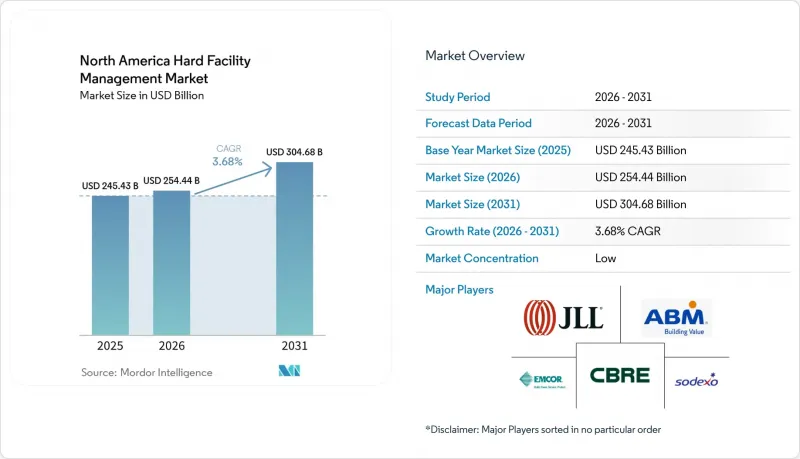
This report is Segmented by Hard FM Services Type (MEP and HVAC Maintenance Services, Enterprise Asset Management, and More Hard FM Services), End User (Commercial, Institutional, Public/Infrastructure, Industrial, and More End Users), and Geography (United States, Canada). The Market Forecasts are Provided in Terms of Value (USD).
North America Hard Facility Management Market Trends and Insights
High HVAC Services Demand In The United States
In North America, HVAC maintenance stands out as the predominant recurring task in the hard facility management market. This is largely due to the diverse climate across the United States, which consistently tests the resilience of mechanical systems. The imperative to uphold standards in ventilation, filtration, and indoor air quality fuels a steady demand for services. This demand is further amplified by the aging commercial building stock, where older systems necessitate more frequent testing, repairs, and proactive replacement planning. Research highlighted a significant gap, identifying HVAC technicians as critically understaffed. The findings pointed to a staggering 139,000 annual job openings in the United States, coupled with a dwindling talent pipeline. This scenario accentuates the value of service providers boasting self-performing labor capabilities. Consequently, firms in the North American hard facility management market that can ensure technician availability across expansive portfolios are enjoying enhanced pricing power and improved client retention.
Building Decarbonization And Performance Standards Accelerating Retrofits
Building performance regulations are mandating retrofit work as a necessary expenditure for many large facilities. This trend not only bolsters the North American hard facility management market but also extends both the duration and technical scope of contracts. New York City's Local Law 97 has heightened the urgency for heating system replacements, electrical upgrades, and consistent compliance support in large buildings. Meanwhile, Oregon's Building Performance Standard, effective January 1, 2025, introduces statewide operating and maintenance mandates. These new requirements particularly benefit providers skilled in commissioning and energy performance. On a federal level, the Federal Building Performance Standard is steering agencies towards eliminating on-site fossil fuel emissions in government-owned buildings. This federal directive not only underscores the importance of retrofitting but also signals a prolonged demand for such services in government facilities. As a result of these regulatory shifts, the North American hard facility management market is gravitating towards outcome-based agreements. These agreements seamlessly integrate mechanical maintenance, electrification assistance, and energy performance oversight.
Skilled Trades Shortages And Wage Inflation
North America's hard facility management market grapples with a significant constraint: a shortage of licensed HVAC technicians, electricians, and plumbers. Research projected that by 2030, the United States could see 2.1 million unfilled skilled trades positions, leading to potential annual economic losses of USD 1 trillion. This underscores the structural nature of the labor gap, rather than it being a fleeting issue. Hard FM providers find themselves in competition with construction, manufacturing, and energy sectors for these skilled workers. Often, these sectors entice talent with higher starting salaries or more appealing project-based pay. Consequently, labor costs surge at a pace that outstrips the reset rate of many fixed-fee service contracts, squeezing profit margins even amidst steady demand. As a result, the North American hard facility management market is leaning towards firms that prioritize apprenticeship pipelines, in-house training, and direct labor models, rather than over-relying on spot subcontracting.
Other drivers and restraints analyzed in the detailed report include:
- AI Data Center Buildout Raising Mission-Critical Mechanical And Electrical Demand
- Smart Building and Predictive Maintenance Adoption
- High Upfront Retrofit And Digitalization Costs
For complete list of drivers and restraints, kindly check the Table Of Contents.
Segment Analysis
Enterprise Asset Management (EAM) is emerging as the fastest-growing segment in North America's hard facility management market, with projections indicating a robust CAGR of 5.80% from 2026 to 2031. This trend underscores a pivotal shift: moving from reactive maintenance and fragmented work orders to integrated platforms. These platforms seamlessly merge asset records, sensor data, compliance tasks, and lifecycle planning. Major occupiers are leveraging these systems to minimize downtime, ensuring maintenance, documentation, and reporting are streamlined within a cohesive framework. Highlighting the trend, CBRE reported a facilities management revenue of USD 20,645 million in 2025, showcasing the trend of large enterprises merging physical maintenance with data-driven oversight. Further emphasizing this direction, ABM's platform, ABM Connect, garnered recognition on Fast Company's 2026 list, underscoring the rising commercial significance of software-driven facility intelligence.
In 2025, MEP and HVAC maintenance services commanded a dominant 60.00% share of North America's hard facility management market, underscoring their pivotal role in the region's revenue landscape. This prominence is a testament to the extensive installed base of HVAC systems, electrical assets, and associated controls spanning commercial, institutional, and industrial properties. The demand for these services remains robust, directly influencing occupant comfort, indoor air quality, equipment reliability, and adherence to regulatory standards. Furthermore, as decarbonization initiatives gain traction, contracts that once centered on routine maintenance are increasingly encompassing retrofit and monitoring tasks. While other hard FM services, such as fire safety and technical systems, may be smaller in scale, their consistent demand is anchored in safety obligations and replacement cycles, rather than being seen as discretionary expenses.
Complete Report Scope:
- By Hard FM Services Type
- MEP (Mechanical, Electrical, Plumbing), and HVAC Maintenance services
- Enterprise Asset Management
- Other Hard FM Services
- By End User
- Commercial
- Institutional
- Public/Infrastructure
- Industrial
- Other End Users
- By Country
- United States
- Canada
List of Companies Covered in this Report:
- CBRE Group, Inc.
- Jones Lang LaSalle Incorporated
- ABM Industries Incorporated
- EMCOR Group, Inc.
- Sodexo, Inc.
- Johnson Controls International plc
- Cushman & Wakefield plc
- Carrier Global Corporation
- Jacobs Solutions Inc.
- AECOM
- GDI Integrated Facility Services Inc.
- Black & McDonald Limited
- Dexterra Group Inc.
- ISS Facility Services, Inc.
- UG2 LLC
- U.S. Facilities, Inc.
- ATCO Frontec Ltd.
Additional Benefits:
- The market estimate (ME) sheet in Excel format
- 3 months of analyst support
TABLE OF CONTENTS
1 INTRODUCTION
- 1.1 Study Assumptions and Market Definition
- 1.2 Scope of the Study
2 RESEARCH METHODOLOGY
3 EXECUTIVE SUMMARY
4 MARKET LANDSCAPE
- 4.1 Market Overview
- 4.2 Impact of Macroeconomic Factors on the Market
- 4.3 Market Drivers
- 4.3.1 High HVAC Services Demand in the United States
- 4.3.2 Building Decarbonization and Performance Standards Accelerating Retrofits
- 4.3.3 Smart Building and Predictive Maintenance Adoption
- 4.3.4 Rise in Infrastructure and Institutional Asset Renewal Across the Region
- 4.3.5 AI Data Center Buildout Raising Mission-Critical Mechanical and Electrical Demand
- 4.3.6 Return-to-Office Concentration in Premium Buildings Raising Uptime Requirements
- 4.4 Market Restraints
- 4.4.1 Skilled Trades Shortages and Wage Inflation
- 4.4.2 Fragmented Regulations and Compliance Burden
- 4.4.3 High Upfront Retrofit and Digitalization Costs
- 4.4.4 Grid Equipment and Transformer Bottlenecks Delaying Electrical Upgrades
- 4.5 Industry Value Chain Analysis
- 4.6 Regulatory Landscape
- 4.7 Technological Outlook
- 4.8 Industry Attractiveness
- 4.9 Porter's Five Forces Analysis
- 4.9.1 Bargaining Power of Suppliers
- 4.9.2 Bargaining Power of Buyers
- 4.9.3 Threat of New Entrants
- 4.9.4 Threat of Substitutes
- 4.9.5 Intensity of Competitive Rivalry
5 MARKET SIZE AND GROWTH FORECASTS (VALUE)
- 5.1 By Hard FM Services Type
- 5.1.1 MEP (Mechanical, Electrical, Plumbing), and HVAC Maintenance services
- 5.1.2 Enterprise Asset Management
- 5.1.3 Other Hard FM Services
- 5.2 By End User
- 5.2.1 Commercial
- 5.2.2 Institutional
- 5.2.3 Public/Infrastructure
- 5.2.4 Industrial
- 5.2.5 Other End Users
- 5.3 By Country
- 5.3.1 United States
- 5.3.2 Canada
6 COMPETITIVE LANDSCAPE
- 6.1 Market Concentration
- 6.2 Strategic Moves
- 6.3 Market Share Analysis
- 6.4 Company Profiles (includes Global Level Overview, Market Level Overview, Core Segments, Financials as available, Strategic Information, Market Rank/Share, Products and Services, Recent Developments)
- 6.4.1 CBRE Group, Inc.
- 6.4.2 Jones Lang LaSalle Incorporated
- 6.4.3 ABM Industries Incorporated
- 6.4.4 EMCOR Group, Inc.
- 6.4.5 Sodexo, Inc.
- 6.4.6 Johnson Controls International plc
- 6.4.7 Cushman & Wakefield plc
- 6.4.8 Carrier Global Corporation
- 6.4.9 Jacobs Solutions Inc.
- 6.4.10 AECOM
- 6.4.11 GDI Integrated Facility Services Inc.
- 6.4.12 Black & McDonald Limited
- 6.4.13 Dexterra Group Inc.
- 6.4.14 ISS Facility Services, Inc.
- 6.4.15 UG2 LLC
- 6.4.16 U.S. Facilities, Inc.
- 6.4.17 ATCO Frontec Ltd.
7 MARKET OPPORTUNITIES AND FUTURE OUTLOOK
- 7.1 White-Space and Unmet-Need Assessment

