
PUBLISHER: Mordor Intelligence | PRODUCT CODE: 2061521

PUBLISHER: Mordor Intelligence | PRODUCT CODE: 2061521
Medical Tourism - Market Share Analysis, Industry Trends & Statistics, Growth Forecasts (2026 - 2031)
According to Mordor Intelligence, the medical tourism market size was valued at USD 93.72 billion in 2025 and is estimated to grow from USD 110.97 billion in 2026 to reach USD 258.32 billion by 2031, at a CAGR of 18.41% during the forecast period (2026-2031).
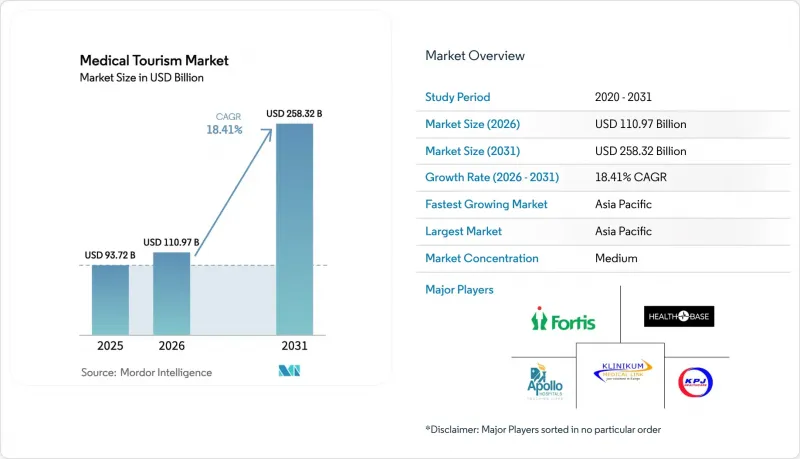
This report is Segmented by Treatment Type (Dental, Cardiovascular, and More), Service Provider (Public Hospitals, and More), Type (Inbound, Outbound, and Domestic), and Geography (North America, Europe, Asia-Pacific, Middle East and Africa, and South America). Market Forecasts are Provided in Terms of Value (USD).
Global Medical Tourism Market Trends and Insights
Escalating Treatment and Insurance Costs in High-Income Nations
U.S. per-capita health spending reached USD 12,555 in 2022, nearly twice Canada's USD 6,207, a gap that has not narrowed because administrative overhead and pharmaceutical pricing in North America remain structurally higher. Rising deductibles and co-pays are prompting insured and self-pay patients to consider bundled packages overseas, where a bariatric procedure in Mexico costs USD 4,000-8,000, compared to USD 15,000-25,000 in the United States, resulting in a 60-70% savings after accounting for airfare. Dental crowns exhibit parallel trends, underscoring the high volume of dental tourists traveling to Mexico, Turkey, and Costa Rica. Because this pressure is systemic rather than cyclical, outbound patient volumes from high-income countries are unlikely to recede during the forecast period, reinforcing medical tourism market growth..
Expansion of Internationally Accredited Specialty Hospitals
The number of Joint Commission International (JCI)-accredited facilities in the Asia-Pacific and Middle East regions has doubled since 2020, indicating the widespread adoption of universal infection-control and patient-safety protocols. Hospitals that secure early accreditation, such as Bumrungrad International, which treats 600,000 patients from 190 countries annually, leverage that badge to command premium pricing and partner with global insurers. Cleveland Clinic Abu Dhabi and Riyadh's King Salman Medical City are following a similar approach, positioning Gulf Cooperation Council hubs to attract oncology and cardiac cases from Europe and Africa, further strengthening the medical tourism market.
Post-Procedure Continuity of Care Challenges
A 2024 survey showed 62% of U.S. orthopedic surgeons decline follow-up for procedures done abroad, citing implant quality and liability concerns. Destination hospitals are mitigating this via 90-day virtual follow-ups bundled in their packages; Apollo and Fortis embed video consults and remote monitoring devices to bridge the gap. Yet insurance exclusions for complications remain common, deterring older or comorbid patients and capping the upper end of the medical tourism market.
Other drivers and restraints analyzed in the detailed report include:
- Reduced Waiting Lists for Elective Surgeries Abroad
- Growing Adoption of Advanced Medical Technologies in Destination Countries
- Cross-Border Medical Record Interoperability Gaps
For complete list of drivers and restraints, kindly check the Table Of Contents.
List of Companies Covered in this Report:
- Aditya Birla Memorial Hospital
- Anadolu Medical Center
- Apollo Hospitals
- Asian Heart Institute
- Bangkok Dusit Medical Services (Bangkok Hospital)
- BB Health Solutions
- Bumrungrad International Hospital
- Cleveland Clinic
- DentalPro
- Fortis Healthcare
- Healthbase
- Johns Hopkins Medicine International
- Klinikum Medical Link
- KPJ Healthcare Berhad
- Mayo Clinic
- MedRetreat
- Mount Elizabeth Hospital
- NTT Medical Center Tokyo
- Prince Court Medical Centre
- Raffles Medical Group
Additional Benefits:
- The market estimate (ME) sheet in Excel format
- 3 months of analyst support
TABLE OF CONTENTS
1 Introduction
- 1.1 Study Assumptions & Market Definition
- 1.2 Scope of the Study
2 Research Methodology
3 Executive Summary
4 Market Landscape
- 4.1 Market Overview
- 4.2 Market Drivers
- 4.2.1 Escalating Treatment and Insurance Costs in High-Income Nations
- 4.2.2 Expansion of Internationally Accredited Specialty Hospitals
- 4.2.3 Reduced Waiting Lists for Elective Surgeries Abroad
- 4.2.4 Growing Adoption of Advanced Medical Technologies In Destination Countries
- 4.2.5 Integration of AI-Enabled Virtual Second-Opinion Platforms
- 4.2.6 Emergence of Faith-Based Halal and Wellness-Centric Healthcare Clusters
- 4.3 Market Restraints
- 4.3.1 Post-Procedure Continuity of Care Challenges
- 4.3.2 Cross-Border Medical Record Interoperability Gaps
- 4.3.3 Rising International Scrutiny of Cosmetic Surgery Carbon Footprint
- 4.3.4 Increasing Visa Policy Uncertainty in Key Destination Markets
- 4.4 Value / Supply-Chain Analysis
- 4.5 Regulatory Landscape
- 4.6 Technological Outlook
- 4.7 Porter's Five Forces Analysis
- 4.7.1 Threat Of New Entrants
- 4.7.2 Bargaining Power Of Buyers
- 4.7.3 Bargaining Power Of Suppliers
- 4.7.4 Threat Of Substitute Products
- 4.7.5 Intensity Of Competitive Rivalry
5 Market Size & Growth Forecasts (Value, USD)
- 5.1 By Treatment Type
- 5.1.1 Dental Treatment
- 5.1.2 Cardiovascular Treatment
- 5.1.3 Orthopedic Treatment
- 5.1.4 Cosmetic & Aesthetic Treatment
- 5.1.5 Fertility Treatment
- 5.1.6 Cancer Treatment
- 5.1.7 Neurology Treatment
- 5.1.8 Bariatric Treatment
- 5.1.9 Ophthalmic Treatment
- 5.1.10 Other Treatments
- 5.2 By Service Provider
- 5.2.1 Public Hospitals
- 5.2.2 Private Hospitals & Clinic Chains
- 5.2.3 Facilitator & Concierge Agencies
- 5.3 By Type
- 5.3.1 Inbound International Medical Tourism
- 5.3.2 Outbound International Medical Tourism
- 5.3.3 Domestic Medical Tourism
- 5.4 Geography
- 5.4.1 North America
- 5.4.1.1 United States
- 5.4.1.2 Canada
- 5.4.1.3 Mexico
- 5.4.2 Europe
- 5.4.2.1 Germany
- 5.4.2.2 United Kingdom
- 5.4.2.3 France
- 5.4.2.4 Italy
- 5.4.2.5 Spain
- 5.4.2.6 Rest Of Europe
- 5.4.3 Asia-Pacific
- 5.4.3.1 China
- 5.4.3.2 Japan
- 5.4.3.3 India
- 5.4.3.4 Australia
- 5.4.3.5 South Korea
- 5.4.3.6 Rest Of Asia-Pacific
- 5.4.4 Middle East And Africa
- 5.4.4.1 GCC
- 5.4.4.2 South Africa
- 5.4.4.3 Rest Of Middle East And Africa
- 5.4.5 South America
- 5.4.5.1 Brazil
- 5.4.5.2 Argentina
- 5.4.5.3 Rest Of South America
- 5.4.1 North America
6 Competitive Landscape
- 6.1 Market Concentration
- 6.2 Market Share Analysis
- 6.3 Company Profiles {(Includes Global Level Overview, Market Level Overview, Core Segments, Financials as Available, Strategic Information, Market Rank/Share for Key Companies, Products & Services, and Recent Developments)}
- 6.3.1 Aditya Birla Memorial Hospital
- 6.3.2 Anadolu Medical Center
- 6.3.3 Apollo Hospitals
- 6.3.4 Asian Heart Institute
- 6.3.5 Bangkok Dusit Medical Services (Bangkok Hospital)
- 6.3.6 BB Health Solutions
- 6.3.7 Bumrungrad International Hospital
- 6.3.8 Cleveland Clinic
- 6.3.9 DentalPro
- 6.3.10 Fortis Healthcare Limited
- 6.3.11 Healthbase
- 6.3.12 Johns Hopkins Medicine International
- 6.3.13 Klinikum Medical Link
- 6.3.14 KPJ Healthcare Berhad
- 6.3.15 Mayo Clinic
- 6.3.16 MedRetreat
- 6.3.17 Mount Elizabeth Hospital
- 6.3.18 NTT Medical Center Tokyo
- 6.3.19 Prince Court Medical Centre
- 6.3.20 Raffles Medical Group
7 Market Opportunities & Future Outlook
- 7.1 White-Space & Unmet-Need Assessment

