PUBLISHER: Mordor Intelligence | PRODUCT CODE: 2072730

PUBLISHER: Mordor Intelligence | PRODUCT CODE: 2072730
United States Medical Tourism - Market Share Analysis, Industry Trends & Statistics, Growth Forecasts (2026 - 2031)
According to Mordor Intelligence, the united states medical tourism market size is projected to be USD 11.72 billion in 2025, USD 12.99 billion in 2026, and reach USD 21.73 billion by 2031, growing at a CAGR of 10.85% from 2026 to 2031.
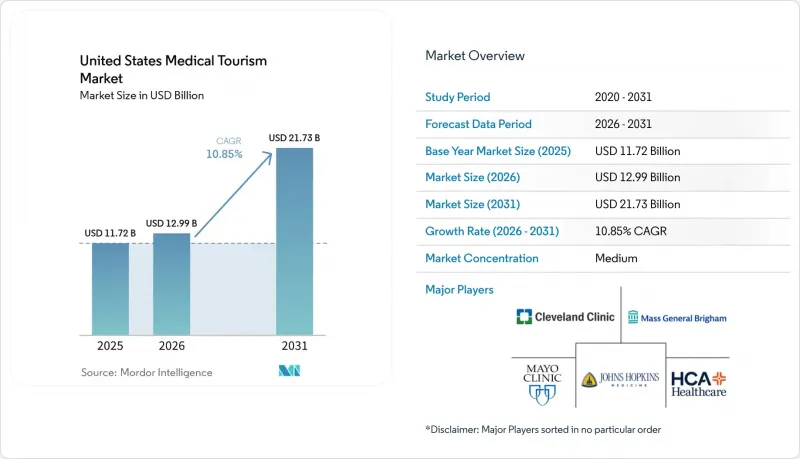
This report is Segmented by Treatment Type (Dental, Cosmetic & Aesthetic, Fertility, Orthopedic, Cardiovascular, Ophthalmic, Bariatric, Neurology, Cancer, Other Treatments), Service Provider (Domestic US Hospitals, Cross-Border Specialty Hospitals, Facilitators & Concierge Agencies, Telehealth Platforms), and Type (Inbound, Outbound, Domestic Self-Pay). Market Forecasts are in Value (USD).
United States Medical Tourism Market Trends and Insights
Rising Domestic Out-Of-Pocket Costs Accelerate Outbound Flows
Healthcare affordability pressure has moved beyond a policy issue and now directly affects patient behavior inside the United States medical tourism market. Total healthcare costs for an average American family reached USD 35,119 in 2025, and outpatient facility costs rose 8.5% in the same year, which reinforced the financial strain around nonemergency procedures. Employer-sponsored coverage is also leaving many families exposed, since 72% of covered workers faced out-of-pocket maximums above USD 3,000 for single coverage and 21% faced more than USD 6,000. That burden is steering many middle-income patients toward self-pay travel for dental, aesthetic, bariatric, and fertility procedures, especially when benefit plans exclude coverage or require difficult prior approvals. The practical effect is that affordability pressure is not just reducing care access, it is redirecting demand into organized outbound channels and informal cross-border care pathways. This makes cost stress one of the clearest volume drivers in the United States medical tourism market, especially for procedures that patients can delay, compare, and finance on their own.
U.S. Cross-Border Price Arbitrage For Elective Procedures
Price gaps between domestic and foreign treatment remain one of the main commercial engines of the United States medical tourism market. Gastric sleeve gastrectomy costs USD 15,000-25,000 in the United States compared with USD 4,000-6,500 in Mexico, and domestic pre-authorization often takes 3 to 6 months versus 1 to 4 weeks abroad. Mexico also received 1.4 million patients from the United States and Canada by the end of 2024, which reinforced its role as the most important destination in Latin America and one of the largest globally. Baja California alone generates an estimated USD 2 billion annually from medical tourism, and 60% of its 4.5 million annual health-related visitors come from the United States, which shows how deeply integrated this corridor has become. Competitive advantage in this corridor now depends on proximity, bilingual coordination, U.S.-facing logistics, and telehealth support, not only on price. The result is that the U.S.-Mexico route increasingly functions as a cross-border care system with its own referral logic, patient expectations, and repeat-demand patterns.
Fragmented Post-Procedure Follow-Up Across Jurisdictions
Post-procedure continuity remains one of the clearest operational weaknesses in the United States medical tourism market. Patients who travel abroad for surgery often return to a domestic system where the original provider is outside the legal, clinical, and administrative reach of their local care network. U.S. physicians are not obligated to manage complications from procedures they did not perform, and many patients must arrange specialist follow-up on their own after returning home. This burden falls hardest on patients who traveled for cost reasons without using a structured facilitator or hospital-linked navigation model. The CDC has already stated that outbound treatment planning should include return follow-up care, which shows that the risk is recognized even if it is not consistently managed in practice.
Other drivers and restraints analyzed in the detailed report include:
- Expansion Of Accredited Telehealth-Led Second Opinions
- Growth Of Digitally Coordinated Care Navigation And Concierge Models
- Limited Insurance Reimbursement For Outbound Treatment
For complete list of drivers and restraints, kindly check the Table Of Contents.
Segment Analysis
Cosmetic & Aesthetic Treatment held the largest share at 26.31% in 2025, which made it the leading treatment category in the United States medical tourism market. The American Society of Plastic Surgeons reported 1.6 million cosmetic surgical procedures and 28.5 million minimally invasive treatments in the United States in 2024, with cosmetic surgical volume up 1% and minimally invasive procedures up 3%. That sustained demand helps explain why outbound travel remains active for price-sensitive body contouring and breast procedures, while inbound demand still exists for patients seeking the safety profile and specialist reputation of U.S. board-certified surgeons. South Korea also drew more U.S. patients in 2025, with arrivals rising 70.4% to 173,000 and more than 62% of foreign patients receiving dermatology treatment, which signals that premium aesthetic care abroad is attracting a distinct U.S. segment.
Dental Treatment remained the second-largest category and the highest-volume outbound procedure group in the United States medical tourism industry. The CDC reported that an estimated 550,000 U.S. patients traveled to Mexico for dental care in 2024, largely because implants and full-mouth restoration are far cheaper there than in the domestic system. Orthopedic and bariatric procedures also hold an important place because patients can compare prices, plan travel, and avoid domestic delays more easily than in emergency care. Fertility Treatment is the fastest-growing category, with the United States medical tourism market size for this segment projected to expand at a 12.38% CAGR through 2031, supported by strong cross-border demand from patients who face high domestic costs and limited coverage. Cancer Treatment remains the anchor of inbound demand because pioneering oncology programs, advanced diagnostic depth, and complex care coordination remain concentrated in major U.S. academic centers. This mix shows that treatment demand in the United States medical tourism market spans both price-led outbound travel and capability-led inbound travel rather than leaning only in one direction.
Complete Report Scope:
- By Treatment Type
- Dental Treatment
- Cosmetic & Aesthetic Treatment
- Fertility Treatment
- Orthopedic Treatment
- Cardiovascular Treatment
- Ophthalmic Treatment
- Bariatric Treatment
- Neurology Treatment
- Cancer Treatment
- Other Treatments
- By Service Provider
- Domestic U.S. Hospitals & Health Systems
- Cross-Border Specialty Hospitals
- Medical Tourism Facilitators & Concierge Agencies
- Telehealth Second-Opinion Platforms
- By Type
- Inbound Medical Tourism to the United States
- Outbound Medical Tourism from the United States
- Domestic Self-Pay Medical Travel within the United States
List of Companies Covered in this Report:
- Ascension
- Banner Health
- Baylor Scott & White Health
- Cedars-Sinai
- Cleveland Clinic
- CommonSpirit Health
- Dana-Farber Cancer Institute
- HCA Healthcare
- Houston Methodist
- Johns Hopkins Medicine International
- Mass General Brigham
- Mayo Clinic
- Mayo Clinic International
- NewYork-Presbyterian
- Nicklaus Children?s Hospital
- Orlando Health
- Stanford Health Care
- UCLA Health
Additional Benefits:
- The market estimate (ME) sheet in Excel format
- 3 months of analyst support
TABLE OF CONTENTS
1 Introduction
- 1.1 Study Assumptions & Market Definition
- 1.2 Scope of the Study
2 Research Methodology
3 Executive Summary
4 Market Landscape
- 4.1 Market Overview
- 4.2 Market Drivers
- 4.2.1 Rising Domestic Out-Of-Pocket Costs and Employer Benefit Gaps
- 4.2.2 U.S. Cross-Border Price Arbitrage for Elective Procedures
- 4.2.3 Expansion of Accredited Telehealth-Led Second Opinions
- 4.2.4 Growth of Digitally Coordinated Care Navigation and Concierge Models
- 4.2.5 Capacity Shortages and Waiting-Time Spillover into Private Self-Pay Care
- 4.2.6 Cross-Border Fertility, Dental, and Aesthetic Demand from U.S. Residents
- 4.3 Market Restraints
- 4.3.1 Fragmented Post-Procedure Follow-Up Across Jurisdictions
- 4.3.2 Limited Insurance Reimbursement for Outbound Treatment
- 4.3.3 State-Level Licensing and Malpractice Complexity
- 4.3.4 Provider Trust Issues Around Outcome Transparency and Bundled Pricing
- 4.4 Value Chain Analysis
- 4.5 Regulatory Landscape
- 4.6 Technological Outlook
- 4.7 Porter's Five Forces Analysis
- 4.7.1 Threat of New Entrants
- 4.7.2 Bargaining Power of Buyers
- 4.7.3 Bargaining Power of Suppliers
- 4.7.4 Threat of Substitute Products
- 4.7.5 Intensity of Competitive Rivalry
5 Market Size & Growth Forecasts (Value, USD)
- 5.1 By Treatment Type
- 5.1.1 Dental Treatment
- 5.1.2 Cosmetic & Aesthetic Treatment
- 5.1.3 Fertility Treatment
- 5.1.4 Orthopedic Treatment
- 5.1.5 Cardiovascular Treatment
- 5.1.6 Ophthalmic Treatment
- 5.1.7 Bariatric Treatment
- 5.1.8 Neurology Treatment
- 5.1.9 Cancer Treatment
- 5.1.10 Other Treatments
- 5.2 By Service Provider
- 5.2.1 Domestic U.S. Hospitals & Health Systems
- 5.2.2 Cross-Border Specialty Hospitals
- 5.2.3 Medical Tourism Facilitators & Concierge Agencies
- 5.2.4 Telehealth Second-Opinion Platforms
- 5.3 By Type
- 5.3.1 Inbound Medical Tourism to the United States
- 5.3.2 Outbound Medical Tourism from the United States
- 5.3.3 Domestic Self-Pay Medical Travel within the United States
6 Competitive Landscape
- 6.1 Market Concentration
- 6.2 Market Share Analysis
- 6.3 Company Profiles {(Includes Global level Overview, Market level overview, Core Segments, Financials as available, Strategic Information, Market Rank/Share for key companies, Products & Services, and Recent Developments)}
- 6.3.1 Ascension
- 6.3.2 Banner Health
- 6.3.3 Baylor Scott & White Health
- 6.3.4 Cedars-Sinai
- 6.3.5 Cleveland Clinic
- 6.3.6 CommonSpirit Health
- 6.3.7 Dana-Farber Cancer Institute
- 6.3.8 HCA Healthcare
- 6.3.9 Houston Methodist
- 6.3.10 Johns Hopkins Medicine International
- 6.3.11 Mass General Brigham
- 6.3.12 Mayo Clinic
- 6.3.13 Mayo Clinic International
- 6.3.14 NewYork-Presbyterian
- 6.3.15 Nicklaus Children?s Hospital
- 6.3.16 Orlando Health
- 6.3.17 Stanford Health Care
- 6.3.18 UCLA Health
7 Market Opportunities & Future Outlook
- 7.1 White-Space & Unmet-Need Assessment

