
PUBLISHER: Mordor Intelligence | PRODUCT CODE: 2061522

PUBLISHER: Mordor Intelligence | PRODUCT CODE: 2061522
Europe Peas - Market Share Analysis, Industry Trends & Statistics, Growth Forecasts (2026 - 2031)
According to Mordor Intelligence, the europe peas market size was valued at USD 4.0 billion in 2025 and is anticipated to grow from USD 4.15 billion in 2026 to USD 5.0 billion by 2031, registering a CAGR of 3.8% over 2026-2031.
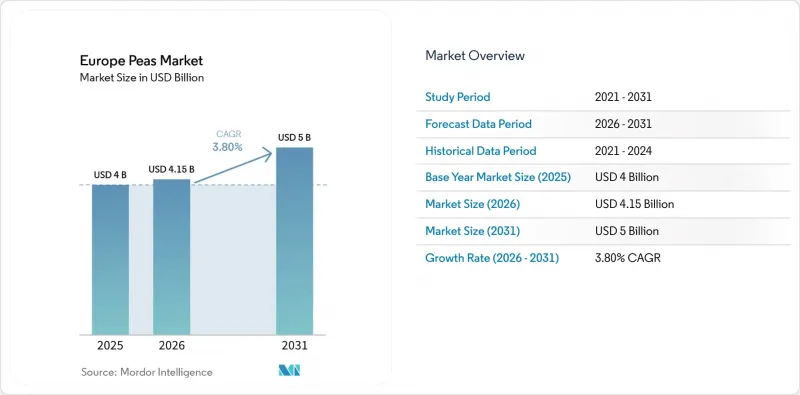
This report is Segmented by Geography (Russia, Ukraine, France, Spain, Netherland, and More). The Report Includes Production Analysis (Volume), Consumption Analysis (Value and Volume), Import Analysis (Value and Volume), Export Analysis (Value and Volume), Wholesale Price Trend Analysis and Forecast, List of Key Players, and More. The Market Forecasts are Provided in Terms of Value (USD) and Volume (Metric Tons).
Europe Peas Market Trends and Insights
Escalating Demand from Compound-Feed Manufacturers
European poultry and aquaculture mills accelerated soybean meal substitution with pea protein concentrates in 2025, attracted by 22-24% crude protein and superior amino acid digestibility. In 2024-2025, global feed compounders diversified rations due to biosecurity risks from African Swine Fever (ASF). To reduce reliance on high-risk soybean sources and manage input costs, feed mills increased field pea inclusion (up to 120 g/kg in starter rations). Poland's mills increased their forward contracts for domestic peas, locking in supply and insulating budgets from volatility on the Chicago Board of Trade. French, German, and Dutch feed producers adopted multi-origin strategies that blend local peas with Canadian imports to meet precise digestibility targets. This structural switch is anticipated to sustain incremental pea offtake regardless of short-term price gyrations.
Rising Vegan and Flexitarian Adoption in Europe
Consumer demand for clean-label, allergen-free diets has driven investments in a pea protein isolate facility in Sweden, which was supported by the European Investment Bank (EIB) in 2025. Pea protein isolates, favored for their hypoallergenic properties and improved taste technology, account for over 50% of the market share. Ingredient buyers in France and Germany embedded local-sourcing clauses into procurement contracts to trim scope 3 emissions. Equinom's Manna platform delivered ultra-high-protein pea genetics that entered field trials in 2024, narrowing the functional gap with soy isolates. Retail penetration of dairy alternatives featuring pea protein rose across Germany's top supermarket chains in 2025.
Volatile farm-gate prices linked to French Marche a Terme International de France (MATIF) pulse futures
In 2025, physical pea prices in Europe exhibited significant volatility due to a projected drought in Canada and ongoing risks to Ukrainian exports. These factors discouraged forward selling and constrained acreage growth in marginal growing regions of France. Although Belgium and Germany typically align with French price benchmarks, a widening local basis has increasingly pressured feed-mill margins. Smaller cooperatives, which often lack expertise in specialized derivatives, have faced heightened cash-flow challenges during sharp price declines. While processors manage risk through calendar spreads and origin diversification, growers without access to advanced hedging tools remain highly vulnerable. This sustained price volatility continues to hinder near-term acreage expansion, despite supportive EU policies promoting plant-based proteins.
Other drivers and restraints analyzed in the detailed report include:
- Mandatory Nitrogen-Fixing Crop Rotations under the European Union Common Agricultural Policy
- Growth of Pea-Based Protein Extraction Capacity
- Tight European Union Pesticide Maximum Residue Level Regulations for Dry Peas
For complete list of drivers and restraints, kindly check the Table Of Contents.
Additional Benefits:
- The market estimate (ME) sheet in Excel format
- 3 months of analyst support
TABLE OF CONTENTS
1 Introduction
- 1.1 Study Assumptions and Market Definition
- 1.2 Scope of the Study
2 Research Methodology
3 Executive Summary
4 Market Landscape
- 4.1 Market Overview
- 4.2 Market Drivers
- 4.2.1 Escalating demand from compound-feed manufacturers
- 4.2.2 Rising vegan and flexitarian adoption in Europe
- 4.2.3 Mandatory nitrogen-fixing crop rotations under the European Union (EU) Common Agricultural Policy (CAP)
- 4.2.4 Growth of pea-based protein extraction capacity
- 4.2.5 Climate-change-resilient acreage shifts toward pulses
- 4.2.6 Carbon-credit premiums for legume cultivation
- 4.3 Market Restraints
- 4.3.1 Volatile farm-gate prices linked to French Marche a Terme International de France (MATIF) pulse futures
- 4.3.2 Tight European Union pesticide maximum residue level regulations for dry peas
- 4.3.3 Logistics bottlenecks at Black Sea ports
- 4.3.4 Limited on-farm storage infrastructure in Eastern Europe
- 4.4 Opportunities
- 4.5 Challenges
- 4.6 Value Chain Analysis
- 4.7 Technologies and usage of AI in the Industry
- 4.8 Input Market Analysis
- 4.8.1 Seeds
- 4.8.2 Fertilizers
- 4.8.3 Crop Protection Chemicals
- 4.9 Distribution Channel Analysis
- 4.10 Market Sentiment Analysis
- 4.11 PESTLE Analysis
5 Market Size and Growth Forecast (Value and Volume)
- 5.1 By Geography
- 5.1.1 Russia
- 5.1.1.1 Production Analysis (Area Harvested, Yield, and Production Volume)
- 5.1.1.1.1 Consumption Analysis (Consumption Value and Volume)
- 5.1.1.1.2 Import Market Analysis (Import Value, Volume, and Key Supplying Markets)
- 5.1.1.1.3 Export Market Analysis (Export Value, Volume, and Key Destination Markets)
- 5.1.1.1.4 Wholesale Price Trend Analysis and Forecast
- 5.1.1.1.5 Regulatory Framework
- 5.1.1.1.6 List of Key Players
- 5.1.1.1.7 Logistics and Infrastructure
- 5.1.1.1.8 Seasonality Analysis
- 5.1.1.2 Ukraine
- 5.1.1.2.1 Production Analysis (Area Harvested, Yield, and Production Volume)
- 5.1.1.2.2 Consumption Analysis (Consumption Value and Volume)
- 5.1.1.2.3 Import Market Analysis (Import Value, Volume, and Key Supplying Markets)
- 5.1.1.2.4 Export Market Analysis (Export Value, Volume, and Key Destination Markets)
- 5.1.1.2.5 Wholesale Price Trend Analysis and Forecast
- 5.1.1.2.6 Regulatory Framework
- 5.1.1.2.7 List of Key Players
- 5.1.1.2.8 Logistics and Infrastructure
- 5.1.1.2.9 Seasonality Analysis
- 5.1.1.3 France
- 5.1.1.3.1 Production Analysis (Area Harvested, Yield, and Production Volume)
- 5.1.1.3.2 Consumption Analysis (Consumption Value and Volume)
- 5.1.1.3.3 Import Market Analysis (Import Value, Volume, and Key Supplying Markets)
- 5.1.1.3.4 Export Market Analysis (Export Value, Volume, and Key Destination Markets)
- 5.1.1.3.5 Wholesale Price Trend Analysis and Forecast
- 5.1.1.3.6 Regulatory Framework
- 5.1.1.3.7 List of Key Players
- 5.1.1.3.8 Logistics and Infrastructure
- 5.1.1.3.9 Seasonality Analysis
- 5.1.1.4 Spain
- 5.1.1.4.1 Production Analysis (Area Harvested, Yield, and Production Volume)
- 5.1.1.4.2 Consumption Analysis (Consumption Value and Volume)
- 5.1.1.4.3 Import Market Analysis (Import Value, Volume, and Key Supplying Markets)
- 5.1.1.4.4 Export Market Analysis (Export Value, Volume, and Key Destination Markets)
- 5.1.1.4.5 Wholesale Price Trend Analysis and Forecast
- 5.1.1.4.6 Regulatory Framework
- 5.1.1.4.7 List of Key Players
- 5.1.1.4.8 Logistics and Infrastructure
- 5.1.1.4.9 Seasonality Analysis
- 5.1.1.5 Netherlands
- 5.1.1.5.1 Production Analysis (Area Harvested, Yield, and Production Volume)
- 5.1.1.5.2 Consumption Analysis (Consumption Value and Volume)
- 5.1.1.5.3 Import Market Analysis (Import Value, Volume, and Key Supplying Markets)
- 5.1.1.5.4 Export Market Analysis (Export Value, Volume, and Key Destination Markets)
- 5.1.1.5.5 Wholesale Price Trend Analysis and Forecast
- 5.1.1.5.6 Regulatory Framework
- 5.1.1.5.7 List of Key Players
- 5.1.1.5.8 Logistics and Infrastructure
- 5.1.1.5.9 Seasonality Analysis
- 5.1.1.6 Germany
- 5.1.1.6.1 Production Analysis (Area Harvested, Yield, and Production Volume)
- 5.1.1.6.2 Consumption Analysis (Consumption Value and Volume)
- 5.1.1.6.3 Import Market Analysis (Import Value, Volume, and Key Supplying Markets)
- 5.1.1.6.4 Export Market Analysis (Export Value, Volume, and Key Destination Markets)
- 5.1.1.6.5 Wholesale Price Trend Analysis and Forecast
- 5.1.1.6.6 Regulatory Framework
- 5.1.1.6.7 List of Key Players
- 5.1.1.6.8 Logistics and Infrastructure
- 5.1.1.6.9 Seasonality Analysis
- 5.1.1.7 Italy
- 5.1.1.7.1 Production Analysis (Area Harvested, Yield, and Production Volume)
- 5.1.1.7.2 Consumption Analysis (Consumption Value and Volume)
- 5.1.1.7.3 Import Market Analysis (Import Value, Volume, and Key Supplying Markets)
- 5.1.1.7.4 Export Market Analysis (Export Value, Volume, and Key Destination Markets)
- 5.1.1.7.5 Wholesale Price Trend Analysis and Forecast
- 5.1.1.7.6 Regulatory Framework
- 5.1.1.7.7 List of Key Players
- 5.1.1.7.8 Logistics and Infrastructure
- 5.1.1.7.9 Seasonality Analysis
- 5.1.1.8 Poland
- 5.1.1.8.1 Production Analysis (Area Harvested, Yield, and Production Volume)
- 5.1.1.8.2 Consumption Analysis (Consumption Value and Volume)
- 5.1.1.8.3 Import Market Analysis (Import Value, Volume, and Key Supplying Markets)
- 5.1.1.8.4 Export Market Analysis (Export Value, Volume, and Key Destination Markets)
- 5.1.1.8.5 Wholesale Price Trend Analysis and Forecast
- 5.1.1.8.6 Regulatory Framework
- 5.1.1.8.7 List of Key Players
- 5.1.1.8.8 Logistics and Infrastructure
- 5.1.1.8.9 Seasonality Analysis
- 5.1.1.9 Romania
- 5.1.1.9.1 Production Analysis (Area Harvested, Yield, and Production Volume)
- 5.1.1.9.2 Consumption Analysis (Consumption Value and Volume)
- 5.1.1.9.3 Import Market Analysis (Import Value, Volume, and Key Supplying Markets)
- 5.1.1.9.4 Export Market Analysis (Export Value, Volume, and Key Destination Markets)
- 5.1.1.9.5 Wholesale Price Trend Analysis and Forecast
- 5.1.1.9.6 Regulatory Framework
- 5.1.1.9.7 List of Key Players
- 5.1.1.9.8 Logistics and Infrastructure
- 5.1.1.9.9 Seasonality Analysis
- 5.1.1.1 Production Analysis (Area Harvested, Yield, and Production Volume)
- 5.1.1 Russia
6 End Use and Application
- 6.1 Primary Applications and Emerging Applications
- 6.2 Consumption Breakdown by Industries
7 Competitive Landscape
- 7.1 Overview of the Competition
- 7.2 Recent Developments
- 7.3 Market Concentration Analysis
- 7.4 List of Stakeholders
- 7.4.1 Roquette Freres
- 7.4.2 Emsland-Starke GmbH
- 7.4.3 AGT Food and Ingredients Inc.
- 7.4.4 Archer-Daniels-Midland Company
- 7.4.5 Cargill Incorporated
- 7.4.6 Cosucra Groupe Warcoing SA
- 7.4.7 Louis Dreyfus Company B.V.
- 7.4.8 Bunge Limited
- 7.4.9 Lantmannen ek for
- 7.4.10 Ingredion Incorporated
- 7.4.11 Sotexpro SAS
- 7.4.12 Kerry Group plc
- 7.4.13 DSM-Firmenich AG
- 7.4.14 Glanbia Nutritionals
- 7.4.15 Prinova Group LLC
8 Market Opportunities and Future Outlook

