
PUBLISHER: Mordor Intelligence | PRODUCT CODE: 2061579

PUBLISHER: Mordor Intelligence | PRODUCT CODE: 2061579
Africa Peas - Market Share Analysis, Industry Trends & Statistics, Growth Forecasts (2026 - 2031)
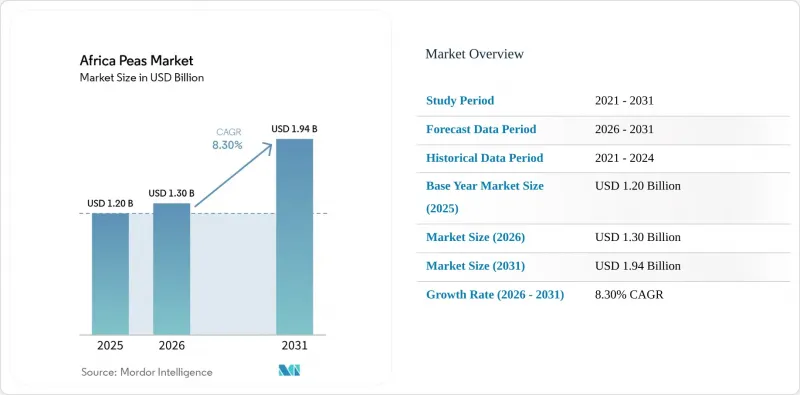
According to Mordor Intelligence, the africa peas market size is projected to grow from USD 1.20 billion in 2025 to USD 1.30 billion in 2026 and is projected to reach USD 1.94 billion by 2031, registering a CAGR of 8.3% during 2026-2031.
This report is Segmented by Country (Ethiopia, Kenya, South Africa, and Tanzania). The Market Forecasts are Provided in Terms of Value (USD) and Volume (Metric Tons) for all the Above Segments.
Africa Peas Market Trends and Insights
Rising Demand for Plant-Based Protein
Urban consumers in Africa are gradually adopting plant-based diets, driven by increasing awareness of nutrition, affordability, and sustainability. Pea protein is emerging as a favored choice due to its high protein content, digestibility, and suitability for processed foods like snacks and bakery products. Food manufacturers are incorporating pea protein into their formulations to address clean-label and allergen-free demands. This shift in consumption patterns is boosting domestic demand and aligning African supply with global plant-based food trends, creating more stable and diversified opportunities for pea producers.
Government Crop-Diversification Incentives
Government-supported crop diversification initiatives across Africa are promoting the inclusion of field peas in cereal-based farming systems to enhance soil fertility and support sustainable agricultural practices. These initiatives emphasize pulse-based crop rotations to reduce reliance on monocropping and strengthen climate-resilient farming systems. According to AGRA's Agrifood Systems Transformation 2024 report, published in 2025, Eastern Africa experienced a 26% increase in pulse crop yield performance compared to the previous decade, driven by improved seed adoption and enhanced agronomic practices. The growing emphasis on diversification and improving pulse productivity is fostering expanded field pea cultivation and contributing to the long-term growth of the Africa peas market.
Price Volatility Tied to Global Trade Swings
Price volatility in the Africa peas market is significantly impacted by sudden changes in global trade policies and supply conditions. Export demand is heavily concentrated in a limited number of key international markets, leaving producers susceptible to abrupt tariff adjustments, import restrictions, and policy reversals. Variations in supply from major producing countries further exacerbate price instability in global markets. Due to the lack of well-established commodity exchanges and hedging mechanisms in many African regions, farmers and traders face exposure to unpredictable price fluctuations. This uncertainty hinders long-term investments in productivity-enhancing inputs and restricts producers' ability to plan consistent production cycles.
Other drivers and restraints analyzed in the detailed report include:
- Expansion of Pea Ingredients in Bakery and Snack Products
- Adoption of Solar-Powered Micro-Irrigation
- Limited Pest-Proof Storage Infrastructure
For complete list of drivers and restraints, kindly check the Table Of Contents.
Additional Benefits:
- The market estimate (ME) sheet in Excel format
- 3 months of analyst support
TABLE OF CONTENTS
1 Introduction
- 1.1 Study Assumptions and Market Definition
- 1.2 Scope of the Study
2 Research Methodology
3 Executive Summary
4 Market Landscape
- 4.1 Market Overview
- 4.2 Market Drivers
- 4.2.1 Rising demand for plant-based protein
- 4.2.2 Government crop-diversification incentives
- 4.2.3 Expansion of pea ingredients in bakery and snack products
- 4.2.4 Adoption of solar-powered micro-irrigation
- 4.2.5 Ag-fintech input-credit platforms for pulse growers
- 4.2.6 African Continental Free Trade Area (AfCFTA) boosting intra-African pulse trade
- 4.3 Market Restraints
- 4.3.1 Price volatility tied to global trade swings
- 4.3.2 Limited pest-proof storage infrastructure
- 4.3.3 Slow release of heat-tolerant pea varieties
- 4.3.4 Land competition from faster-maturing cowpea
- 4.4 Opportunities
- 4.5 Challenges
- 4.6 Value Chain Analysis
- 4.7 Technologies and usage of AI in the Industry
- 4.8 Input Market Analysis
- 4.8.1 Seeds
- 4.8.2 Fertilizers
- 4.8.3 Crop Protection Chemicals
- 4.9 Distribution Channel Analysis
- 4.10 Market Sentiment Analysis
- 4.11 PESTLE Analysis
5 Market Size and Growth Forecast (Value and Volume)
- 5.1 By Geography
- 5.1.1 Africa
- 5.1.1.1 Ethiopia
- 5.1.1.1.1 Production Analysis (Area Harvested, Yield, and Production Volume)
- 5.1.1.1.2 Consumption Analysis (Consumption Value and Volume)
- 5.1.1.1.3 Import Market Analysis (Import Value, Volume, and Key Supplying Markets)
- 5.1.1.1.4 Export Market Analysis (Export Value, Volume, and Key Destination Markets)
- 5.1.1.1.5 Wholesale Price Trend Analysis and Forecast
- 5.1.1.1.6 Regulatory Framework
- 5.1.1.1.7 List of Key Players
- 5.1.1.1.8 Logistics and Infrastructure
- 5.1.1.1.9 Seasonality Analysis
- 5.1.1.2 Kenya
- 5.1.1.2.1 Production Analysis (Area Harvested, Yield, and Production Volume)
- 5.1.1.2.2 Consumption Analysis (Consumption Value and Volume)
- 5.1.1.2.3 Import Market Analysis (Import Value, Volume, and Key Supplying Markets)
- 5.1.1.2.4 Export Market Analysis (Export Value, Volume, and Key Destination Markets)
- 5.1.1.2.5 Wholesale Price Trend Analysis and Forecast
- 5.1.1.2.6 Regulatory Framework
- 5.1.1.2.7 List of Key Players
- 5.1.1.2.8 Logistics and Infrastructure
- 5.1.1.2.9 Seasonality Analysis
- 5.1.1.3 South Africa
- 5.1.1.3.1 Production Analysis (Area Harvested, Yield, and Production Volume)
- 5.1.1.3.2 Consumption Analysis (Consumption Value and Volume)
- 5.1.1.3.3 Import Market Analysis (Import Value, Volume, and Key Supplying Markets)
- 5.1.1.3.4 Export Market Analysis (Export Value, Volume, and Key Destination Markets)
- 5.1.1.3.5 Wholesale Price Trend Analysis and Forecast
- 5.1.1.3.6 Regulatory Framework
- 5.1.1.3.7 List of Key Players
- 5.1.1.3.8 Logistics and Infrastructure
- 5.1.1.3.9 Seasonality Analysis
- 5.1.1.4 Tanzania
- 5.1.1.4.1 Production Analysis (Area Harvested, Yield, and Production Volume)
- 5.1.1.4.2 Consumption Analysis (Consumption Value and Volume)
- 5.1.1.4.3 Import Market Analysis (Import Value, Volume, and Key Supplying Markets)
- 5.1.1.4.4 Export Market Analysis (Export Value, Volume, and Key Destination Markets)
- 5.1.1.4.5 Wholesale Price Trend Analysis and Forecast
- 5.1.1.4.6 Regulatory Framework
- 5.1.1.4.7 List of Key Players
- 5.1.1.4.8 Logistics and Infrastructure
- 5.1.1.4.9 Seasonality Analysis
- 5.1.1.1 Ethiopia
- 5.1.1 Africa
6 End Use and Application
- 6.1 Primary Applications and Emerging Applications
- 6.2 Consumption Breakdown by Industries
7 Competitive Landscape
- 7.1 Overview of the Competition
- 7.2 Recent Developments
- 7.3 Market Concentration Analysis
8 Market Opportunity and Future Outlook

