PUBLISHER: Mordor Intelligence | PRODUCT CODE: 2061648

PUBLISHER: Mordor Intelligence | PRODUCT CODE: 2061648
Fats And Oils - Market Share Analysis, Industry Trends & Statistics, Growth Forecasts (2026 - 2031)
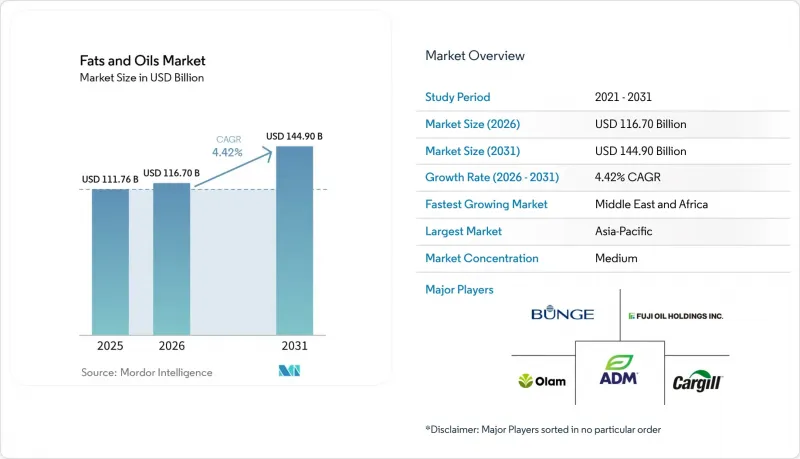
According to Mordor Intelligence, the fats and oils market size is expected to grow from USD 111.76 billion in 2025 to USD 116.70 billion in 2026 and is forecast to reach USD 144.90 billion by 2031 at 4.42% CAGR over 2026-2031.
This report is Segmented by Type (Fats, Oils), Application (Food, Industrial, Animal Feed), Source (Plant-Based, Animal-Based), and Geography (North America, Europe, Asia-Pacific, South America, Middle East & Africa). The Market Forecasts are Provided in Terms of Value (USD).
Global Fats And Oils Market Trends and Insights
Rising Demand for Processed and Packaged Food
Driven by a focus on functional properties and clean label demands, the processed food industry's evolution is reshaping the fats and oils market. In 2024, U.S. processed food exports hit USD 38.84 billion, with Canada, Mexico, the European Union, Japan, and South Korea as primary markets, as reported by the USDA Foreign Agriculture Service . Manufacturers, like Cargill with its 2022 launch of coconut-based pastry margarine, are crafting specialized fats for bakery uses. These fats aim for precise melting profiles and oxidative stability, all while steering clear of trans fats. Such innovations cater to the rising consumer demand for healthier choices, enabling firms to cut down on saturated fats, uphold product quality, and strategically position their products in premium segments by highlighting enhanced functional and nutritional benefits.
Expanding Applications in Biodiesel Production
The biodiesel market is under pressure due to limited feedstock availability, which has caused production to fall short of its capacity. In the United States, 160 biodiesel plants have a combined capacity of 2.7 billion gallons per year, as reported by the Agricultural Marketing Resource Center . However, this capacity is not fully utilized because of feedstock constraints. To address this issue, companies are turning to alternative feedstocks like waste cooking oils (WCOs), which account for approximately 17 million tons of global supply annually. The industry has introduced advanced pretreatment technologies to improve the quality of degraded oils by reducing their free fatty acid content. These advancements not only make biodiesel production more efficient but also support circular economy practices by repurposing waste materials.
Fluctuating Raw Material Prices and Supply Chain Disruptions
In April 2025, the FAO oilseed price index rose by 3.7 points (3.5%) compared to the previous month, reaching its highest level in eleven months. Meanwhile, the oilmeal and vegetable oil indices dropped by 1.1 points (1.2%) and 3.7 points (2.3%) respectively. The oils and fats market continues to face significant challenges, driven by factors such as the Russia-Ukraine conflict, which has disrupted sunflower oil supplies, and labor shortages in Malaysia, which have impacted palm oil production. To address these issues, food manufacturers are making adjustments by reformulating products, sourcing oils from different suppliers, and using flexible formulations that allow ingredient substitutions. These ongoing disruptions and supply chain issues are expected to influence market trends and pricing in the near future.
Other drivers and restraints analyzed in the detailed report include:
- Technological Advancements in Oil Extraction and Processing
- Increasing Popularity of Plant-Based Diets
- Health Issues Associated with Trans-Fats Consumption
For complete list of drivers and restraints, kindly check the Table Of Contents.
Segment Analysis
In 2025, the oils segment held a leading 54.92% share of the market and is expected to grow at a faster pace than the overall market, with a projected CAGR of 5.44% from 2026 to 2031, compared to the market's growth rate of 4.42%. This strong growth is driven by the extensive use of vegetable oils across food and industrial applications, especially in biodiesel production. The importance of this segment is evident from significant investments in processing facilities, such as the upcoming oilseed crushing plant near Perth, Australia, developed by Cargill and CBH Group.
The fats segment, although smaller in market share, is seeing notable progress in the development of specialty products. Manufacturers are focusing on creating fats with specific functional benefits while removing trans fats. For example, in September 2024, Volac Wilmar introduced Mega-Fat 70, a rumen-protected fat product designed for dairy cattle. This product, which contains 70% palmitic and 20% oleic fatty acids, is aimed at improving milk production and supporting cattle health.
Geography Analysis
In 2025, Asia-Pacific is expected to hold a dominant 39.89% share of the global oils and fats market. This is mainly due to its strong palm oil production and the growing food processing industry. Indonesia and Malaysia play key roles in shaping global market trends through their palm oil industries. The Malaysian Palm Oil Board predicts that crude palm oil prices will range between MYR 4,000 and MYR 4,300 per ton in 2025. Additionally, Indonesia's upcoming 40% biodiesel blending mandate (B40) is likely to impact the global palm oil supply and keep prices high throughout 2025. In India, Adani Wilmar plans to expand its distribution network to 1 million direct outlets within three years, focusing on rural areas, which highlights the region's improving distribution infrastructure.
The Middle East and Africa are forecasted to grow at the fastest rate, with a 6.74% CAGR from 2026 to 2031, despite having a smaller market share currently. This growth is driven by advancements in food processing, increased biodiesel usage, and rising edible oil consumption. North America and Europe remain key markets. In the U.S., the growing biodiesel industry is boosting demand for vegetable oils. Farmers are increasing canola production to meet renewable fuel needs, supported by investments from energy and agriculture companies in farming and processing infrastructure. In Europe, regulations on trans fats and sustainability are encouraging the development of healthier fat alternatives.
South America continues to play a crucial role in the global supply chain through its soybean oil production, with Brazil's agricultural sector making significant contributions to global exports. Cargill's acquisition of SJC Bioenergia in Brazil strengthens its renewable energy operations, showing the increasing link between renewable energy and the oils and fats market. These regional developments underline the interconnected nature of the global market, where policy changes, such as Indonesia's biodiesel mandates, can have a significant impact on global prices and supply availability.
- Cargill Incorporated
- Bunge Limited
- Archer Daniels Midland Company
- Olam Group
- Fuji Oil Holdings Inc.
- Wilmar International Ltd
- Musim Mas Holdings
- AAK AB
- Louis Dreyfus Company
- IOI Corporation Berhad
- Sime Darby Plantation
- Kuala Lumpur Kepong Berhad
- Mewah Group
- Marico Ltd
- Kerry Group plc
- J-Oil Mills Inc.
- Viterra Ltd
- COFCO Oils & Oilseeds
- Associated British Foods (ABF Ingredients)
- Richardson International
Additional Benefits:
- The market estimate (ME) sheet in Excel format
- 3 months of analyst support
TABLE OF CONTENTS
1 INTRODUCTION
- 1.1 Study Assumptions and Market Definition
- 1.2 Scope of the Study
2 RESEARCH METHODOLOGY
3 EXECUTIVE SUMMARY
4 MARKET LANDSCAPE
- 4.1 Market Overview
- 4.2 Market Drivers
- 4.2.1 Rising Demand for Processed and Packaged Food
- 4.2.2 Expanding Applications in Biodiesel Production
- 4.2.3 Technological Advancements in Oil Extraction and Processing
- 4.2.4 Incresing Popularity of Plant-Based Diets
- 4.2.5 Growth of the Food Service Industry Drives the Demand for Cooking Oils and Fats
- 4.2.6 Growing Health Consciousness among Consumers Drives the Demand for Healthier Oil Alternatives
- 4.3 Market Restraints
- 4.3.1 Fluctuating Raw Material Prices and Supply Chain Disruptions
- 4.3.2 Health Issues Associated with Trans-Fats Consumption
- 4.3.3 Strict Government Regulations on Trans-fat Content in Food Products
- 4.3.4 Environmental Concerns Related to Palm Oil Production and Deforestation
- 4.4 Supply Chain Analysis
- 4.5 Regulatory Outlook
- 4.6 Porter's Five Forces
- 4.6.1 Threat of New Entrants
- 4.6.2 Bargaining Power of Buyers/Consumers
- 4.6.3 Bargaining Power of Suppliers
- 4.6.4 Threat of Substitute Products
- 4.6.5 Intensity of Competitive Rivalry
5 MARKET SIZE AND GROWTH FORECASTS (VALUE)
- 5.1 By Type
- 5.1.1 Fats
- 5.1.1.1 Butter
- 5.1.1.2 Tallow
- 5.1.1.3 Lard
- 5.1.1.4 Specialty Fats
- 5.1.2 Oils
- 5.1.2.1 Soybean Oil
- 5.1.2.2 Rapeseed Oil
- 5.1.2.3 Palm Oil
- 5.1.2.4 Coconut Oil
- 5.1.2.5 Olive Oil
- 5.1.2.6 Cotton Seed Oil
- 5.1.2.7 Sunflower Seed Oil
- 5.1.2.8 Others
- 5.1.1 Fats
- 5.2 By Application
- 5.2.1 Food
- 5.2.1.1 Confectionary
- 5.2.1.2 Bakery
- 5.2.1.3 Dairy Products
- 5.2.1.4 Others
- 5.2.2 Industrial
- 5.2.3 Animal Feed
- 5.2.1 Food
- 5.3 By Source
- 5.3.1 Plant-based
- 5.3.2 Animal-based
- 5.4 By Geography
- 5.4.1 North America
- 5.4.1.1 United States
- 5.4.1.2 Canada
- 5.4.1.3 Mexico
- 5.4.1.4 Rest of North America
- 5.4.2 Europe
- 5.4.2.1 Germany
- 5.4.2.2 France
- 5.4.2.3 United Kingdom
- 5.4.2.4 Spain
- 5.4.2.5 Netherlands
- 5.4.2.6 Italy
- 5.4.2.7 Sweden
- 5.4.2.8 Poland
- 5.4.2.9 Belgium
- 5.4.2.10 Rest of Europe
- 5.4.3 Asia-Pacific
- 5.4.3.1 China
- 5.4.3.2 India
- 5.4.3.3 Japan
- 5.4.3.4 Australia
- 5.4.3.5 South Korea
- 5.4.3.6 Indonesia
- 5.4.3.7 Thailand
- 5.4.3.8 Singapore
- 5.4.3.9 Rest of Asia-Pacific
- 5.4.4 South America
- 5.4.4.1 Brazil
- 5.4.4.2 Argentina
- 5.4.4.3 Chile
- 5.4.4.4 Columbia
- 5.4.4.5 Peru
- 5.4.4.6 Rest of South America
- 5.4.5 Middle East & Africa
- 5.4.5.1 United Arab Emirates
- 5.4.5.2 South Africa
- 5.4.5.3 Nigeria
- 5.4.5.4 Saudi Arabia
- 5.4.5.5 Egypt
- 5.4.5.6 Morocco
- 5.4.5.7 Turkey
- 5.4.5.8 Rest of Middle East and Africa
- 5.4.1 North America
6 COMPETITIVE LANDSCAPE
- 6.1 Market Concentration
- 6.2 Strategic Moves
- 6.3 Market Share Analysis
- 6.4 Company Profiles (includes Global-level Overview, Market-level Overview, Core Segments, Financials (if available), Strategic Information, Market Rank/Share, Products and Services, Recent Developments)
- 6.4.1 Cargill Incorporated
- 6.4.2 Bunge Limited
- 6.4.3 Archer Daniels Midland Company
- 6.4.4 Olam Group
- 6.4.5 Fuji Oil Holdings Inc.
- 6.4.6 Wilmar International Ltd
- 6.4.7 Musim Mas Holdings
- 6.4.8 AAK AB
- 6.4.9 Louis Dreyfus Company
- 6.4.10 IOI Corporation Berhad
- 6.4.11 Sime Darby Plantation
- 6.4.12 Kuala Lumpur Kepong Berhad
- 6.4.13 Mewah Group
- 6.4.14 Marico Ltd
- 6.4.15 Kerry Group plc
- 6.4.16 J-Oil Mills Inc.
- 6.4.17 Viterra Ltd
- 6.4.18 COFCO Oils & Oilseeds
- 6.4.19 Associated British Foods (ABF Ingredients)
- 6.4.20 Richardson International
7 MARKET OPPORTUNITIES AND FUTURE OUTLOOK

