PUBLISHER: Mordor Intelligence | PRODUCT CODE: 2100489

PUBLISHER: Mordor Intelligence | PRODUCT CODE: 2100489
South America Fats and Oils - Market Share Analysis, Industry Trends & Statistics, Growth Forecasts (2026 - 2031)
According to Mordor Intelligence, South America fats and oils market size in 2026 is estimated at USD 31.14 billion, growing from 2025 value of USD 29.10 billion with 2031 projections showing USD 43.72 billion, growing at 7.02% CAGR over 2026-2031.
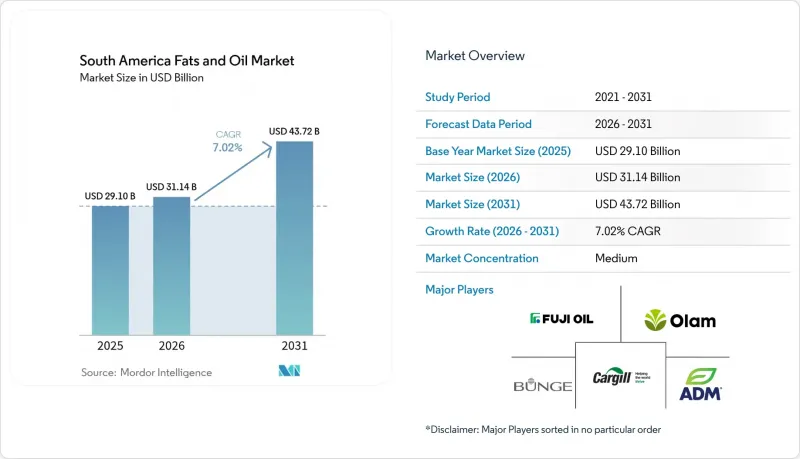
This report is Segmented by Type (Fats and Oils), by Application (Food, Industrial, and Animal Feed), and by Geography (Brazil, Argentina, Chile, Colombia, Peru, and Rest of South America). The Market Forecasts are Provided in Terms of Value (USD).
South America Fats and Oils Market Trends and Insights
Rising Demand for Biodiesel Feedstock
Brazil's biodiesel sector has fundamentally transformed traditional export-oriented oil markets into domestic industrial consumption markets. The country's industrial soybean oil consumption has increased by more than 100% in the past decade, with soybean oil making up 69% of biodiesel feedstock. This significant shift in domestic demand limits exportable supplies, despite projected soybean oil production reaching 12 million metric tons in 2024/25, restricting exports to 1.3 million tons. Argentina's Liga Bioenergetica legislation proposes increasing biodiesel mandates to B15 by January 2027, which may require expanded crushing capacity and feedstock diversification beyond soybean oil. The implementation of these mandates could reshape the regional supply chain dynamics. The broader regional shift toward higher blending mandates generates consistent industrial demand, resulting in premium pricing for vegetable oils and reduced export market volatility. This transformation indicates a long-term structural change in South American vegetable oil markets, with implications for global trade patterns and price dynamics.
Processed Food and Bakery Products Accelerate Demand
The growth of the processed food industry drives demand for specialized fat formulations that command premium pricing over commodity oils. The increasing complexity of processed food products requires tailored fat solutions with specific melting points, crystallization behaviors, and functional properties. Specialty fats for confectionery applications, particularly cocoa butter equivalents (CBE), are gaining importance as manufacturers seek cost-effective alternatives to cocoa butter while maintaining product quality. The use of high-oleic sunflower oil in sugar coating applications demonstrates how food processors are replacing palm oil with regional alternatives that offer better oxidative stability and clean-label attributes. The demand for premium bakery fats reflects consumer preference for healthier options and artisanal quality, with manufacturers adopting trans-fat-free formulations to meet regulatory requirements. This shift has led to the development of innovative fat blends that combine functionality with nutritional benefits, supporting the creation of premium baked goods that align with modern dietary preferences.
Health Concerns Regarding Saturated Trans Fats
Regulatory momentum against trans fats creates reformulation pressures that increase costs while potentially constraining certain traditional fat applications. Colombia implemented comprehensive trans fat regulations limiting industrial trans fats to 2g per 100g and banning partially hydrogenated oils (PHO), forcing manufacturers to reformulate products using alternative fat systems. Argentina's ANMAT updated food labeling requirements to enhance trans fat disclosure, while Venezuela implemented front-of-package warning labels that specifically highlight trans fat content above regulatory thresholds. The Pan American Health Organization (PAHO) trans fat elimination initiative creates region-wide pressure for policy harmonization, potentially accelerating regulatory timelines across smaller markets. Reformulation costs include ingredient substitution, process optimization, shelf-life testing, and consumer acceptance studies, creating barriers for smaller manufacturers while benefiting suppliers of trans-fat-free alternatives. The regulatory trend favors liquid oils and specialty fats that maintain functionality without hydrogenation, creating market opportunities for high-oleic varieties and structured fat systems.
Other drivers and restraints analyzed in the detailed report include:
- Expansion of Soybean-Crush Capacity
- Widespread Adoption of High-Oleic Oil in Food Processing
- Commodity-Price Volatility in Veg-Oil Complex
For complete list of drivers and restraints, kindly check the Table Of Contents.
Segment Analysis
The oils segment holds 81.56% market share in 2025, primarily due to soybean oil's established position in biodiesel production and food processing across South America. The fats segment is growing at a higher rate of 7.61% CAGR through 2031, supported by increasing demand in confectionery and bakery applications that require specific functional properties. Soybean oil remains the dominant oil type due to substantial regional production capacity and well-developed processing infrastructure. Coconut oil occupies premium market segments, particularly in health-focused consumer products and specialized food applications. Sunflower oil benefits from Argentina's production capabilities and the availability of high-oleic variants that provide specific advantages in food processing.
The fats segment includes butter, tallow, lard, and specialty fats. Animal-derived fats are increasingly used in biodiesel production as manufacturers diversify their feedstock options beyond vegetable oils. Specialty fats used in confectionery command higher prices due to their specific functional properties in chocolate and bakery products. Manufacturers are developing trans-fat-free formulations to meet health regulations. The segment's growth is supported by advances in enzymatic processing technology, which allows for the use of diverse raw materials, including high free fatty acid oils and waste-derived materials.
Complete Report Scope:
- By Type
- Fats
- Butter
- Tallow
- Lard
- Specialty Fats
- Oils
- Soybean Oil
- Palm Oil
- Coconut Oil
- Sunflower Seed Oil
- Other Oils
- Fats
- By Application
- Food
- Confectionary
- Bakery
- Dairy Products
- Margarine and Spreads
- Others
- Industrial
- Animal Feed
- Food
- Geography
- Brazil
- Argentina
- Chile
- Colombia
- Peru
- Rest of South America
List of Companies Covered in this Report:
- AAK AB
- Archer Daniels Midland Company
- Bunge Limited
- Cargill Incorporated
- Fuji Oil Holdings Inc.
- Olam International Limited
- Sime Darby Plantation Berhad
- Agropalma S.A.
- Aceitera General Deheza S.A.
- Wilmar International Ltd.
- Louis Dreyfus Company
- COFCO International
- Granol Industria
- Algar Agro
- Molinos Rio de la Plata
- Vicentin S.A.I.C.
- Oleoplan S.A.
- Grupo Nutresa (Comercial Colombia)
- JBS (Tallow Division)
- CBI Industria de Oleos
Additional Benefits:
- The market estimate (ME) sheet in Excel format
- 3 months of analyst support
TABLE OF CONTENTS
1 INTRODUCTION
- 1.1 Study Assumptions and market definition
- 1.2 Scope of the study
2 RESEARCH METHODOLOGY
3 EXECUTIVE SUMMARY
4 MARKET LANDSCAPE
- 4.1 Market Overview
- 4.2 Market Drivers
- 4.2.1 Rising demand for biodiesel feedstock
- 4.2.2 Processed food and bakery products accelerate the demand
- 4.2.3 Expansion of soybean-crush capacity
- 4.2.4 Widespread adoption of high-oleic oil in the food processing
- 4.2.5 Government-backed sustainable initiatives
- 4.2.6 Surge in vegan and health-concious lifestyle
- 4.3 Market Restraints
- 4.3.1 Health concerns regarding saturated trans fats
- 4.3.2 Commodity-price volatility in the veg-oil complex
- 4.3.3 Northern-Brazil port and storage bottlenecks
- 4.3.4 Reformulation costs from trans-fat phase-outs
- 4.4 Supply-Chain Analysis
- 4.5 Regulatory and Technological Outlook
- 4.6 Porters Five Force Analysis
- 4.6.1 Threat of New Entrants
- 4.6.2 Bargaining Power of Buyers/Consumers
- 4.6.3 Bargaining Power of Suppliers
- 4.6.4 Threat of Substitute Products
- 4.6.5 Intensity of Competitive Rivalry
5 MARKET SIZE AND GROWTH FORECASTS (VALUE)
- 5.1 By Type
- 5.1.1 Fats
- 5.1.1.1 Butter
- 5.1.1.2 Tallow
- 5.1.1.3 Lard
- 5.1.1.4 Specialty Fats
- 5.1.2 Oils
- 5.1.2.1 Soybean Oil
- 5.1.2.2 Palm Oil
- 5.1.2.3 Coconut Oil
- 5.1.2.4 Sunflower Seed Oil
- 5.1.2.5 Other Oils
- 5.1.1 Fats
- 5.2 By Application
- 5.2.1 Food
- 5.2.1.1 Confectionary
- 5.2.1.2 Bakery
- 5.2.1.3 Dairy Products
- 5.2.1.4 Margarine and Spreads
- 5.2.1.5 Others
- 5.2.2 Industrial
- 5.2.3 Animal Feed
- 5.2.1 Food
- 5.3 Geography
- 5.3.1 Brazil
- 5.3.2 Argentina
- 5.3.3 Chile
- 5.3.4 Colombia
- 5.3.5 Peru
- 5.3.6 Rest of South America
6 COMPETITIVE LANDSCAPE
- 6.1 Most Active Companies
- 6.2 Market Positioning Analysis
- 6.3 Company Profiles
- 6.3.1 AAK AB
- 6.3.2 Archer Daniels Midland Company
- 6.3.3 Bunge Limited
- 6.3.4 Cargill Incorporated
- 6.3.5 Fuji Oil Holdings Inc.
- 6.3.6 Olam International Limited
- 6.3.7 Sime Darby Plantation Berhad
- 6.3.8 Agropalma S.A.
- 6.3.9 Aceitera General Deheza S.A.
- 6.3.10 Wilmar International Ltd.
- 6.3.11 Louis Dreyfus Company
- 6.3.12 COFCO International
- 6.3.13 Granol Industria
- 6.3.14 Algar Agro
- 6.3.15 Molinos Rio de la Plata
- 6.3.16 Vicentin S.A.I.C.
- 6.3.17 Oleoplan S.A.
- 6.3.18 Grupo Nutresa (Comercial Colombia)
- 6.3.19 JBS (Tallow Division)
- 6.3.20 CBI Industria de Oleos
7 MARKET OPPORTUNITIES AND FUTURE OUTLOOK

