PUBLISHER: Mordor Intelligence | PRODUCT CODE: 2100487

PUBLISHER: Mordor Intelligence | PRODUCT CODE: 2100487
Europe Fats and Oils - Market Share Analysis, Industry Trends & Statistics, Growth Forecasts (2026 - 2031)
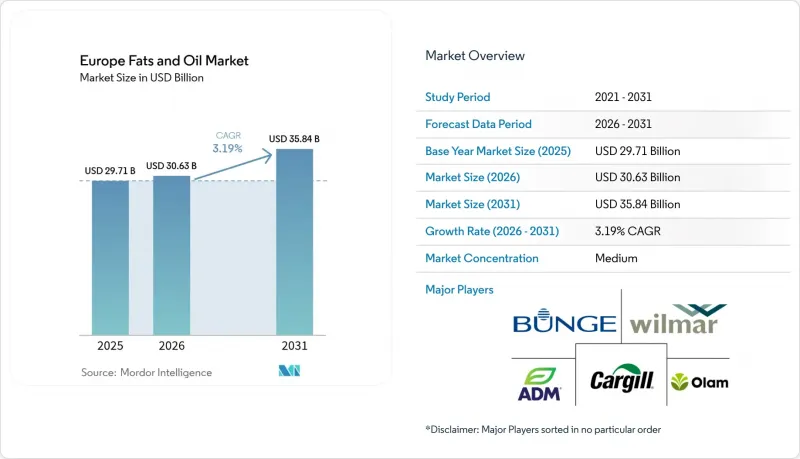
According to Mordor Intelligence, the Europe fats and Oils Market size was valued at USD 29.71 billion in 2025 and estimated to grow from USD 30.63 billion in 2026 to reach USD 35.84 billion by 2031, at a CAGR of 3.19% during the forecast period (2026-2031).
This report is Segmented by Product Type (Fats and Oil), Application (Food, Industrial, and Animal Feed), Source (Plant-Based and Animal-Based), and Geography (Germany, United Kingdom, France, Italy, Spain, Russia, Netherlands, Switzerland, Belgium, Austria, Portugal, Denmark, and Rest of Europe). Market Forecasts are Provided in Terms of Value (USD)
Europe Fats and Oils Market Trends and Insights
Increasing use of specialty fats in bakery and confectionery applications
European bakery and confectionery manufacturers are increasingly substituting cocoa butter with lauric and non-lauric specialty fats to address input-cost fluctuations and enhance shelf life without refrigeration. Lauric fats, derived from sources such as palm kernel oil and coconut oil, are known for their sharp melting profiles and are commonly used in confectionery coatings. Non-lauric fats, on the other hand, are sourced from oils like soybean and rapeseed and are valued for their stability and neutral flavor. According to Codex Alimentarius standards, specialty fats are permitted in chocolate-flavored coatings as long as they do not exceed 5 percent vegetable fat by weight. This regulation significantly influences product development and labeling strategies across the European Union, as manufacturers must carefully balance compliance with cost efficiency and product quality. The trend is particularly evident in Germany, where discount retailers such as Aldi and Lidl have expanded their private-label praline offerings using specialty fats. These products are priced 30 to 40 percent lower than premium brands, compelling established manufacturers to reformulate their products. The use of specialty fats allows these retailers to maintain competitive pricing while offering products with extended shelf life and consistent quality, further intensifying competition in the market.
Progress in fat modification technologies
Progress in fat modification technologies has driven the adoption of enzymatic interesterification as the preferred method for restructuring triglycerides. This method avoids the production of trans fats and glycidyl esters, addressing health concerns and process-contaminant issues that have limited the use of chemical interesterification and partial hydrogenation. For instance, Novozymes offers Lipozyme TL 100L, a lipase enzyme that enables CO2 reductions of up to 22%, allowing mid-sized refiners to implement enzymatic processes without requiring capital-intensive batch reactors. The advancement of this technology is particularly evident in the Netherlands and Denmark, where co-location with crushing plants facilitates the interesterification of crude oil immediately after degumming. This process not only preserves tocopherols but also reduces oxidative rancidity during storage, showcasing the benefits of modern fat modification techniques.
Strict European Union labeling and food safety regulations
Strict European Union labeling and food safety regulations pose challenges to the fats and oils market, as manufacturers must frequently reformulate products, invest in testing, and implement detailed traceability systems to meet compliance requirements across member states. The EU enforces specific compositional limits and disclosure standards for lipids. For instance, Regulation (EU) 2019/649 limits industrially produced trans fats in foods to a maximum of 2 g per 100 g of fat. This compels processors to replace partially hydrogenated oils with alternative fat systems and conduct expensive validation trials. For fats and oils suppliers, these regulatory demands increase compliance costs, including laboratory analysis, certification, label redesign, and segregated logistics for varying formulations. Smaller producers and exporters face significant challenges, as non-compliance, such as contamination, inaccurate nutritional declarations, or improper origin labeling, can disrupt distribution across the entire EU market.
Other drivers and restraints analyzed in the detailed report include:
- Growing preference for clean-label and natural ingredients
- Rising demand for organic and non-GMO products
- Sustainability issues associated with palm oil
For complete list of drivers and restraints, kindly check the Table Of Contents.
Segment Analysis
Oils held 59.21% of the Europe Fats and Oils Market in 2025 and are forecast to expand at 5.48% CAGR through 2031. The demand for oils in Europe is driven by consumer preferences for healthier cooking options and Mediterranean-style diets, which prioritize olive, rapeseed, and sunflower oils due to their high content of unsaturated fatty acids. Additionally, clean-label requirements are fostering interest in cold-pressed, organic, and non-GMO oils, while sustainability objectives encourage the use of regionally sourced oilseeds and certified supply chains. The growing popularity of home cooking, increased salad consumption, and premium flavored oils further contribute to this demand. Food manufacturers are also incorporating functional oils enriched with omega fatty acids and vitamins into ready meals, infant nutrition, and dietary supplements. These factors collectively drive innovation toward minimally processed oils with enhanced nutritional profiles.
The fats segment is experiencing growth primarily due to the demand from bakery, confectionery, and plant-based product manufacturers for fats with specific melting behavior, aeration, and texture. Specialty fats, including cocoa butter equivalents, structured vegetable fats, and dairy alternatives, are crucial for applications such as pastries, fillings, chocolate, and vegan cheese or meat substitutes. The ongoing reformulation efforts to eliminate trans fats and optimize saturated fat levels are also driving the adoption of modified fat systems created through fractionation and enzymatic processing. Additionally, the demand for premium indulgent products and functional spreads is increasing the need for customized fat blends that meet sensory quality, regulatory, and nutritional requirements.
Complete Report Scope:
- By Product Type
- Fats
- Butter
- Tallow
- Lard
- Specialty Fats
- Oils
- Soybean Oil
- Rapeseed Oil
- Palm Oil
- Coconut Oil
- Olive Oil
- Cotton Seed Oil
- Sunflower Seed Oil
- Others
- Fats
- By Application
- Food
- Confectionery
- Bakery
- Dairy Products
- Others
- Industrial
- Animal Feed
- Food
- By Source
- Plant-based
- Animal-based
- By Geography
- Germany
- United Kingdom
- France
- Italy
- Spain
- Russia
- Netherlands
- Switzerland
- Belgium
- Austria
- Portugal
- Denmark
- Rest of Europe
List of Companies Covered in this Report:
- Cargill, Incorporated
- Bunge Limited
- Archer Daniels Midland Company
- Wilmar International Limited
- Olam International Ltd.
- AAK AB
- Fuji Oil Holdings Inc.
- Louis Dreyfus Company B.V.
- Avril Group (Saipol)
- Associated British Foods plc
- Mewah International Inc.
- Musim Mas Holdings
- Deoleo S.A.
- Aveno NV
- Vandeputte Group
- KTC Edibles Ltd.
- Aigremont NV
- Anglo Eastern Plantations PLC
- SD Guthrie International
- M.P. Evans
Additional Benefits:
- The market estimate (ME) sheet in Excel format
- 3 months of analyst support
TABLE OF CONTENTS
1 INTRODUCTION
- 1.1 Study Assumptions and Market Definition
- 1.2 Scope of the Study
2 RESEARCH METHODOLOGY
3 EXECUTIVE SUMMARY
4 MARKET LANDSCAPE
- 4.1 Market Overview
- 4.2 Market Drivers
- 4.2.1 Increasing use of specialty fats in bakery and confectionery applications
- 4.2.2 Progress in fat modification technologies
- 4.2.3 Growing preference for clean-label and natural ingredients
- 4.2.4 Rising demand for organic and non-GMO products
- 4.2.5 Advancements in food processing technologies
- 4.2.6 Expanding adoption of plant-based diets
- 4.3 Market Restraints
- 4.3.1 Strict European Union labeling and food safety regulations
- 4.3.2 Health concerns related to animal-derived fats
- 4.3.3 Sustainability issues associated with palm oil
- 4.3.4 Allergen risks and nutritional constraints
- 4.4 Supply Chain Analysis
- 4.5 Regulatory Outlook
- 4.6 Porter's Five Forces
- 4.6.1 Threat of New Entrants
- 4.6.2 Bargaining Power of Buyers/Consumers
- 4.6.3 Bargaining Power of Suppliers
- 4.6.4 Threat of Substitute Products
- 4.6.5 Intensity of Competitive Rivalry
5 MARKET SIZE AND GROWTH FORECASTS (VALUE)
- 5.1 By Product Type
- 5.1.1 Fats
- 5.1.1.1 Butter
- 5.1.1.2 Tallow
- 5.1.1.3 Lard
- 5.1.1.4 Specialty Fats
- 5.1.2 Oils
- 5.1.2.1 Soybean Oil
- 5.1.2.2 Rapeseed Oil
- 5.1.2.3 Palm Oil
- 5.1.2.4 Coconut Oil
- 5.1.2.5 Olive Oil
- 5.1.2.6 Cotton Seed Oil
- 5.1.2.7 Sunflower Seed Oil
- 5.1.2.8 Others
- 5.1.1 Fats
- 5.2 By Application
- 5.2.1 Food
- 5.2.1.1 Confectionery
- 5.2.1.2 Bakery
- 5.2.1.3 Dairy Products
- 5.2.1.4 Others
- 5.2.2 Industrial
- 5.2.3 Animal Feed
- 5.2.1 Food
- 5.3 By Source
- 5.3.1 Plant-based
- 5.3.2 Animal-based
- 5.4 By Geography
- 5.4.1 Germany
- 5.4.2 United Kingdom
- 5.4.3 France
- 5.4.4 Italy
- 5.4.5 Spain
- 5.4.6 Russia
- 5.4.7 Netherlands
- 5.4.8 Switzerland
- 5.4.9 Belgium
- 5.4.10 Austria
- 5.4.11 Portugal
- 5.4.12 Denmark
- 5.4.13 Rest of Europe
6 COMPETITIVE LANDSCAPE
- 6.1 Market Concentration
- 6.2 Strategic Moves
- 6.3 Market Ranking Analysis
- 6.4 Company Profiles (includes Global-level Overview, Market-level Overview, Core Segments, Financials (if available), Strategic Information, Market Rank, Products, Recent Developments)
- 6.4.1 Cargill, Incorporated
- 6.4.2 Bunge Limited
- 6.4.3 Archer Daniels Midland Company
- 6.4.4 Wilmar International Limited
- 6.4.5 Olam International Ltd.
- 6.4.6 AAK AB
- 6.4.7 Fuji Oil Holdings Inc.
- 6.4.8 Louis Dreyfus Company B.V.
- 6.4.9 Avril Group (Saipol)
- 6.4.10 Associated British Foods plc
- 6.4.11 Mewah International Inc.
- 6.4.12 Musim Mas Holdings
- 6.4.13 Deoleo S.A.
- 6.4.14 Aveno NV
- 6.4.15 Vandeputte Group
- 6.4.16 KTC Edibles Ltd.
- 6.4.17 Aigremont NV
- 6.4.18 Anglo Eastern Plantations PLC
- 6.4.19 SD Guthrie International
- 6.4.20 M.P. Evans
7 MARKET OPPORTUNITIES AND FUTURE OUTLOOK

