PUBLISHER: Mordor Intelligence | PRODUCT CODE: 2100532

PUBLISHER: Mordor Intelligence | PRODUCT CODE: 2100532
Africa Fats and Oils - Market Share Analysis, Industry Trends & Statistics, Growth Forecasts (2026 - 2031)
According to Mordor Intelligence, the African oils and fats market size is expected to grow from USD 24.76 billion in 2025 to USD 26.01 billion in 2026 and is forecast to reach USD 33.29 billion by 2031 at 5.04% CAGR over 2026-2031.
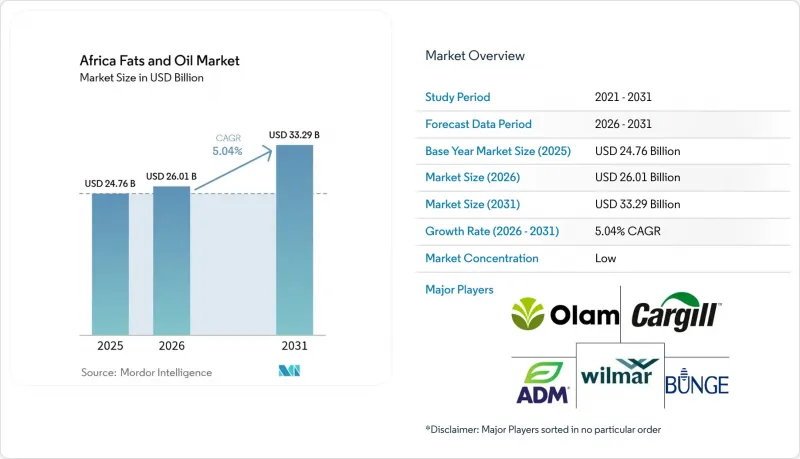
This report is Segmented by Product Type (Oils, Fats), Application (Food and Beverages: Bakery and Confectionery, Dairy, Snacks and Savory Products, Others; Animal Feed, Industrial, Other Applications), and Geography (Egypt, Ghana, Nigeria, South Africa, Rest of Africa). The Market Forecasts are Provided in Terms of Value (USD) and Volume (Tons).
Africa Fats and Oils Market Trends and Insights
Surge in demand from food & beverage processors
Across Africa, food and beverage manufacturers are increasingly turning to locally-sourced oils. This shift aims to mitigate currency exposure and supply chain risks, leading to a consolidation of processors around pivotal production hubs. In Nigeria, where the food processing sector constitutes 40% of the total manufacturing output, there's a notable pivot: an uptick in the use of locally-refined palm oil, sidelining its imported counterparts. Specialty fat formulations, crucial for enhancing shelf stability in tropical climates, are especially favored in bakery and confectionery applications. As urban populations burgeon and disposable incomes swell, there's a marked shift in processed food consumption patterns, leaning towards convenience products with intricate lipid profiles. This evolving landscape is further underscored by a push for regulatory compliance, especially with the emerging trans-fat elimination standards. Manufacturers are now on the lookout for reformulated oils that not only align with WHO guidelines but also uphold product functionality. Regional food behemoths, such as Bidco Africa, are amplifying their processing capabilities, catering to the burgeoning domestic markets and reducing their dependence on imported finished products.
Government-backed oilseed cultivation expansion programs
Governments in key African markets are implementing strategic initiatives to achieve oilseed self-sufficiency. These efforts aim to reduce import reliance while creating rural employment opportunities. For instance, Ethiopia, which currently meets less than 5% of its edible oil demand, is expanding sesame, sunflower, and groundnut cultivation under irrigation to address this gap. Similarly, Kenya demonstrates the economic potential of diversifying from traditional cash crops, with sunflower farming generating USD 770 per acre. These programs are advancing through integrated strategies that combine improved seed varieties, extension services, and guaranteed purchase agreements with local processors. Beyond increasing production volumes, these initiatives also facilitate technology transfer, as governments collaborate with international agribusiness firms to establish processing infrastructure. However, success rates vary significantly across countries. Nations offering comprehensive farmer support and strong market linkages achieve higher adoption rates compared to those focusing solely on production incentives.
Import-driven price volatility for key oilseeds
In late 2024, palm oil prices surged to near-record premiums over soyoil, highlighting the volatility faced by African processors due to currency devaluation and global commodity price fluctuations. By May 2024, food inflation in Nigeria had hit 40.66%, compelling households to allocate a staggering 97.4% of their income to food. This financial strain has led many to gravitate towards more affordable, unbranded food options. According to the Banque de France, there's an average 30% pass-through effect from commodity prices to consumer prices across Africa. Notably, while oils see a 9% pass-through rate, this has pronounced implications on affordability. Sub-Saharan Africa's vulnerability is underscored by its heavy import reliance: a striking 83% of the 6.5 million tonnes of imported oils and fats are palm oil. This dependence heightens the region's sensitivity to global price fluctuations. Further complicating matters, most imports are dollar-denominated, yet local sales transpire in depreciating currencies. This exchange rate volatility, coupled with the aforementioned challenges, places processors in a tight spot: they grapple with maintaining profit margins while ensuring product affordability. The result? During periods of heightened volatility, many processors resort to scaling back their processing volumes.
Other drivers and restraints analyzed in the detailed report include:
- Growing applications in biofuel and bio-lubricant blends
- Technological advancements in oil extraction and refining
- Inflation-led down-trading to unbranded oils
For complete list of drivers and restraints, kindly check the Table Of Contents.
Segment Analysis
In 2025, oils dominate with an 84.62% market share, underscoring their pivotal role in food and industry across Africa. Yet, the fats segment is on a growth trajectory, expanding at a 6.01% CAGR through 2031. This surge is fueled by premium-priced applications in cosmetics, pharmaceuticals, and bio-lubricants. As palm oil prices soar to near-record premiums, soybean oil seizes the moment, positioning itself as a cost-effective alternative for budget-conscious processors. While palm oil retains its lead in the oils category, thanks to its heat stability and extended shelf life in tropical climates, coconut oil rides the wave of urban health trends. Meanwhile, sunflower oil grapples with global supply challenges, with the USDA predicting a 10% dip in worldwide production for the 2024-25 period.
Specialty fats are carving out new value propositions, moving beyond mere cooking uses. In Uganda, innovations in shea butter processing are showcasing the potential for a staggering 300% output boost through advanced fractionation technology. The olive oil sector is gaining traction in North Africa, with Egypt eyeing 1,000 metric tons in exports for the 2023/24 crop year, bolstered by a domestic production of 40,000 tons, as reported by Olive Oil Times. The 'other oils' segment is witnessing a surge in interest, particularly in indigenous varieties like desert date seed oil. This oil, touted for its superior lubrication properties, is making waves in bio-lubricant applications, outshining conventional alternatives. This evolution signals a maturing market, with processors pivoting from mere commodity production to value-added applications, harnessing the rich biodiversity that Africa offers.
Complete Report Scope:
- Product Type
- Oils
- Soybean
- Canola
- Palm
- Coconut
- Olive
- Sunflower
- Others
- Fats
- Butter
- Lard
- Other Fats
- Oils
- Application
- Food and Beverages
- Bakery and Confectionery
- Dairy
- Snacks and Savory Products
- Others
- Animal Feed
- Industrial
- Other Applications
- Food and Beverages
- Geography
- Egypt
- Ghana
- Nigeria
- South Africa
- Rest of Africa
List of Companies Covered in this Report:
- Wilmar International Ltd
- Bunge Limited
- Archer Daniels Midland (ADM)
- Cargill Incorporated
- Olam Group
- Sime Darby Plantation Berhad
- Fuji Vegetable Oil Inc.
- Africa Palm Products (Pty) Ltd
- CEOCO (Pty) Ltd
- Supa Oils
- Golden Agri-Resources
- AAK AB
- Unilever PLC (Blue Band, Rama)
- Bidco Africa Ltd
- Dangote Industries Ltd (Edible Oils)
- PZ Wilmar Ltd
- Siat Nigeria Ltd
- Nampak Zimbabwe Ltd (Cairns Foods)
- National Oil Processing Company - Egypt
- Sunola Oil Mills - Tanzania
Additional Benefits:
- The market estimate (ME) sheet in Excel format
- 3 months of analyst support
TABLE OF CONTENTS
1 INTRODUCTION
- 1.1 Study Assumptions & Market Definition
- 1.2 Scope of the Study
2 RESEARCH METHODOLOGY
3 EXECUTIVE SUMMARY
4 MARKET LANDSCAPE
- 4.1 Market Overview
- 4.2 Market Drivers
- 4.2.1 Surge in demand from food & beverage processors
- 4.2.2 Government-backed oilseed cultivation expansion programs
- 4.2.3 Growing applications in biofuel and bio-lubricant blends
- 4.2.4 Technological advancements in oil extraction and refining
- 4.2.5 AfCFTA-driven intra-Africa trade incentives for specialty fats
- 4.2.6 Demand for sustainable and traceable supply chains
- 4.3 Market Restraints
- 4.3.1 Import-driven price volatility for key oilseeds
- 4.3.2 Inflation-led down-trading to unbranded oils
- 4.3.3 Evolving trans-fat cap regulations & compliance costs
- 4.3.4 Logistics gaps in cold-pressed niche-oil value chains
- 4.4 Supply Chain Analysis
- 4.5 Regulatory Outlook
- 4.6 Porter's Five Forces
- 4.6.1 Threat of New Entrants
- 4.6.2 Bargaining Power of Buyers/Consumers
- 4.6.3 Bargaining Power of Suppliers
- 4.6.4 Threat of Substitute Products
- 4.6.5 Intensity of Competitive Rivalry
5 MARKET SIZE AND GROWTH FORECAST (in Value and Volume)
- 5.1 Product Type
- 5.1.1 Oils
- 5.1.1.1 Soybean
- 5.1.1.2 Canola
- 5.1.1.3 Palm
- 5.1.1.4 Coconut
- 5.1.1.5 Olive
- 5.1.1.6 Sunflower
- 5.1.1.7 Others
- 5.1.2 Fats
- 5.1.2.1 Butter
- 5.1.2.2 Lard
- 5.1.2.3 Other Fats
- 5.1.1 Oils
- 5.2 Application
- 5.2.1 Food and Beverages
- 5.2.1.1 Bakery and Confectionery
- 5.2.1.2 Dairy
- 5.2.1.3 Snacks and Savory Products
- 5.2.1.4 Others
- 5.2.2 Animal Feed
- 5.2.3 Industrial
- 5.2.4 Other Applications
- 5.2.1 Food and Beverages
- 5.3 Geography
- 5.3.1 Egypt
- 5.3.2 Ghana
- 5.3.3 Nigeria
- 5.3.4 South Africa
- 5.3.5 Rest of Africa
6 COMPETITIVE LANDSCAPE
- 6.1 Market Concentration
- 6.2 Strategic Moves
- 6.3 Market Ranking Analysis
- 6.4 Company Profiles (includes Global-level Overview, Market-level Overview, Core Segments, Financials (if available), Strategic Information, Market Rank/Share, Products & Services, Recent Developments)
- 6.4.1 Wilmar International Ltd
- 6.4.2 Bunge Limited
- 6.4.3 Archer Daniels Midland (ADM)
- 6.4.4 Cargill Incorporated
- 6.4.5 Olam Group
- 6.4.6 Sime Darby Plantation Berhad
- 6.4.7 Fuji Vegetable Oil Inc.
- 6.4.8 Africa Palm Products (Pty) Ltd
- 6.4.9 CEOCO (Pty) Ltd
- 6.4.10 Supa Oils
- 6.4.11 Golden Agri-Resources
- 6.4.12 AAK AB
- 6.4.13 Unilever PLC (Blue Band, Rama)
- 6.4.14 Bidco Africa Ltd
- 6.4.15 Dangote Industries Ltd (Edible Oils)
- 6.4.16 PZ Wilmar Ltd
- 6.4.17 Siat Nigeria Ltd
- 6.4.18 Nampak Zimbabwe Ltd (Cairns Foods)
- 6.4.19 National Oil Processing Company - Egypt
- 6.4.20 Sunola Oil Mills - Tanzania
7 MARKET OPPORTUNITIES AND FUTURE OUTLOOK

