PUBLISHER: Mordor Intelligence | PRODUCT CODE: 2061699

PUBLISHER: Mordor Intelligence | PRODUCT CODE: 2061699
Africa Folding Carton - Market Share Analysis, Industry Trends & Statistics, Growth Forecasts (2026 - 2031)
According to Mordor Intelligence, the africa folding carton market size is expected to grow from USD 1.12 billion in 2025 to USD 1.21 billion in 2026 and is forecast to reach USD 1.72 billion by 2031 at a 7.29% CAGR over 2026-2031.
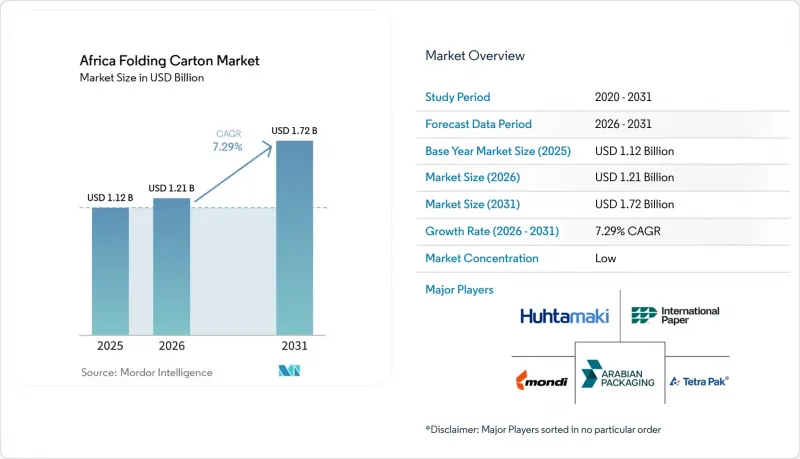
This report is Segmented by Material Type (Solid Bleached Sulfate, Folding Boxboard, Coated Unbleached Kraft, White Line Chipboard, and More), Printing Technology (Lithographic Printing, Gravure Printing, Digital Printing, and More), End-User Industry (Food and Beverage, E-Commerce and Retail-Ready Packaging, Tobacco and More), and Geography. The Market Forecasts are Provided in Terms of Value (USD).
Africa Folding Carton Market Trends and Insights
Growing Demand from the E-Commerce Sector
Smartphone adoption, improved last-mile logistics, and expanding payment gateways are fueling double-digit online retail growth in Nigeria, South Africa, Egypt, and Kenya. Brand owners shipping fashion, electronics, and personal-care items now require protective, visually distinct folding cartons that enhance unboxing experiences and withstand the rigors of parcel networks. QR-code traceability demanded by customs modernization programs under AfCFTA raises print-resolution requirements and favors converters able to integrate security features. Digital presses shorten design cycles, allowing rapid artwork refreshes for promotion-heavy online channels, while smaller average order quantities reduce the economic appeal of long offset runs. The structural pull from e-commerce therefore expands short-run volumes, supports higher margins on premium substrates, and bolsters the Africa folding carton market outlook.
Expansion of Food and Beverage Industry
Citrus exports from South Africa exceeded 164.5 million 15-kilogram-equivalent cartons in 2024, anchoring steady demand for moisture-resistant folding cartons that meet European phytosanitary rules. Nigeria and Kenya are witnessing rapid rollouts of quick-service restaurants that replace banned polystyrene clamshells with grease-resistant paperboard packaging. Rising disposable incomes across urban households accelerate packaged-meal adoption and diversify SKU counts, pushing converters toward flexible production lines that balance food-contact compliance with cost control. Export-oriented fruit, seafood, and meat processors also demand cartonboard that endures cold-chain humidity without delamination. These intertwined export and domestic consumption trends reinforce the central role of food and beverages in scaling the Africa folding carton market.
Volatility in Recycled Paper Pulp Prices
Recovered-paper exports from South Africa to Asia lifted domestic prices in late 2024, trimming Mpact's paper gross margin by 2.7% points despite volume gains. Urban collection networks funnel post-consumer fiber into export channels, leaving converters exposed to spot-market spikes when local mills compete for supply.Egypt's early-stage EPR program magnifies feedstock pressure by stipulating recycled-content labeling without parallel rural collection infrastructure. Long-term contracts with aggregators partly hedge costs, but smaller converters lack bargaining power. Until incremental capacity from initiatives such as Polysmart's USD 60 million Lagos plant stabilizes regional supply, pulp price swings will remain a material drag on the Africa folding carton market.
Other drivers and restraints analyzed in the detailed report include:
- Rising Adoption of Sustainable Packaging Regulations
- Rapid Growth of Quick-Commerce Dark Stores in Urban Hubs
- Skilled Technician Shortage Limiting Automation Uptake
For complete list of drivers and restraints, kindly check the Table Of Contents.
Segment Analysis
Folding Boxboard captured 38.43% of the African folding carton market in 2025, owing to its multi-ply architecture that balances rigidity and lightweighting. Solid Bleached Board is forecast to rise at an 8.06% CAGR, reflecting cosmetics and pharmaceutical brands' preference for pristine whiteness and hygienic fiber. Coated Unbleached Kraftboard is gaining traction among organic and fair-trade food producers eager to showcase natural aesthetics, while White-lined Chipboard remains the value option for dry-goods cartons despite narrower margin buffers.
Mondi's 253,000 hectares of FSC-certified forestry in South Africa secure a virgin fiber supply, supporting SBS availability and traceability claims. Concurrently, South Africa's recycled-content targets are stimulating investment in de-inking and dispersion systems that upgrade recovered fiber for food-grade applications, tightening the linkage between recycling infrastructure and material-mix evolution in the Africa folding carton industry.
List of Companies Covered in this Report:
- International Paper Company
- Gulf Printing and Packaging FZ-LLC
- Arabian Packaging Ltd.
- Al Ghurair Printing and Publishing LLC
- Emirates Printing Press LLC
- Al Bayader International LLC
- Tetra Pak International SA
- SIG Combibloc Group AG
- Smurfit WestRock plc
- Mondi plc
- Huhtamaki Oyj
- Ittihad Paper Mill LLC
- Prism Packaging Industries LLC
- Hotpack Packaging Industries LLC
- Trost Creative Packaging GmbH
Additional Benefits:
- The market estimate (ME) sheet in Excel format
- 3 months of analyst support
TABLE OF CONTENTS
1 INTRODUCTION
- 1.1 Study Assumptions and Market Definition
- 1.2 Scope of the Study
2 RESEARCH METHODOLOGY
3 EXECUTIVE SUMMARY
4 MARKET LANDSCAPE
- 4.1 Market Overview
- 4.2 Market Drivers
- 4.2.1 Premiumization of Food and Beverage Carton Demand
- 4.2.2 Expansion of E-commerce Fulfillment Networks
- 4.2.3 Government Sustainability Mandates for Recyclable Packaging
- 4.2.4 Rising Adoption of Digital Printing for Short-Run Jobs
- 4.2.5 Growth of Dubai Pharmaceutical Manufacturing Cluster
- 4.2.6 Surge in Duty-Free Retail Sales Boosting Carton Volumes
- 4.3 Market Restraints
- 4.3.1 Volatility in Virgin Fiber and Recovered Paper Prices
- 4.3.2 Limited Domestic Paperboard Production Capacity
- 4.3.3 Stringent Food-Contact Compliance Costs for SMEs
- 4.3.4 Substitution Threat From Flexible Packaging Formats
- 4.4 Industry Value Chain Analysis
- 4.5 Regulatory Landscape
- 4.6 Technological Outlook
- 4.7 Impact of Macroeconomic Factors on the Market
- 4.8 Porter's Five Forces Analysis
- 4.8.1 Threat of New Entrants
- 4.8.2 Bargaining Power of Suppliers
- 4.8.3 Bargaining Power of Buyers
- 4.8.4 Threat of Substitutes
- 4.8.5 Competitive Rivalry
5 MARKET SIZE AND GROWTH FORECASTS (VALUE)
- 5.1 By Material Type
- 5.1.1 Solid Bleached Sulfate
- 5.1.2 Folding Boxboard
- 5.1.3 Coated Unbleached Kraft
- 5.1.4 White Line Chipboard
- 5.1.5 Other Material Types
- 5.2 By Printing Technology
- 5.2.1 Lithographic Printing
- 5.2.2 Flexographic Printing
- 5.2.3 Digital Printing
- 5.2.4 Gravure Printing
- 5.2.5 Other Printing Technologies
- 5.3 By End-User Industry
- 5.3.1 Food and Beverage
- 5.3.2 Healthcare/Pharmaceuticals
- 5.3.3 Personal Care and Cosmetics
- 5.3.4 Electrical and Electronics
- 5.3.5 Household and Industrial Goods
- 5.3.6 Tobacco
- 5.3.7 E-commerce and Retail-ready Packaging
- 5.3.8 Other End-User Industries
- 5.4 By Geography
- 5.4.1 South Africa
- 5.4.2 Nigeria
- 5.4.3 Egypt
- 5.4.4 Rest of Africa
6 COMPETITIVE LANDSCAPE
- 6.1 Market Concentration
- 6.2 Strategic Moves
- 6.3 Market Share Analysis
- 6.4 Company Profiles (includes Global level Overview, Market level overview, Core Segments, Financials as available, Strategic Information, Market Rank/Share for key companies, Products and Services, and Recent Developments)
- 6.4.1 International Paper Company
- 6.4.2 Gulf Printing and Packaging FZ-LLC
- 6.4.3 Arabian Packaging Ltd.
- 6.4.4 Al Ghurair Printing and Publishing LLC
- 6.4.5 Emirates Printing Press LLC
- 6.4.6 Al Bayader International LLC
- 6.4.7 Tetra Pak International SA
- 6.4.8 SIG Combibloc Group AG
- 6.4.9 Smurfit WestRock plc
- 6.4.10 Mondi plc
- 6.4.11 Huhtamaki Oyj
- 6.4.12 Ittihad Paper Mill LLC
- 6.4.13 Prism Packaging Industries LLC
- 6.4.14 Hotpack Packaging Industries LLC
- 6.4.15 Trost Creative Packaging GmbH
7 MARKET OPPORTUNITIES AND FUTURE OUTLOOK
- 7.1 White-Space and Unmet-Need Assessment

