
PUBLISHER: Mordor Intelligence | PRODUCT CODE: 2062355

PUBLISHER: Mordor Intelligence | PRODUCT CODE: 2062355
Recycled Base Oil - Market Share Analysis, Industry Trends & Statistics, Growth Forecasts (2026 - 2031)
According to Mordor Intelligence, the recycled base oil market size was valued at USD 5.88 billion in 2025 and is estimated to grow from USD 6.22 billion in 2026 to reach USD 8.26 billion by 2031, at a CAGR of 5.83% during the forecast period (2026-2031).
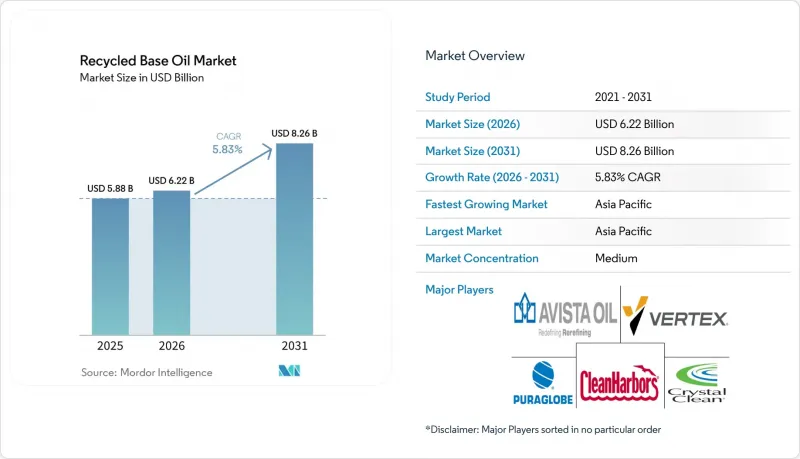
This report is Segmented by Feedstock Source (Used Motor/Engine Oil, and More), Refining Process (Hydrotreating/Hydro-refining, and More), Application (Lubricant and Grease Blending, Metal-Working Fluids, and More), End-User Industry (Automotive and Transportation OEM/Aftermarket, and More), and Geography (Asia-Pacific, North America, and More). The Market Forecasts are Provided in Terms of Value (USD).
Global Recycled Base Oil Market Trends and Insights
Increasing Regulations Mandating Recycled Content
State and national regulations are redefining lubricant specifications for public and private fleets. California requires state agencies to purchase lubricants containing at least 25% re-refined content, aligning with the U.S. EPA Comprehensive Procurement Guideline, while Colorado and Ireland introduced similar statutes in 2024 and 2025, respectively The European Commission reported that 61% of collected waste oil was regenerated into base stock in 2025, a significant increase from historical averages below 50%, reflecting a strong policy shift toward closed-loop regeneration. Updated FTC labeling standards now mandate explicit recycled-content disclosure, reducing greenwashing and improving the competitiveness of certified re-refiners in procurement processes. Collectively, these measures expand addressable demand and protect compliant re-refiners from commoditized pricing pressures.
Cost Advantage vs. Virgin Group I/II Base Oils
Throughout 2025, re-refined Group II oils traded at a noticeable discount compared to virgin counterparts, as re-refiners avoid crude-distillation costs and utilize heat recovery from light distillates. PurePath's thin-film hydrotreaters report 10-30% lower manufacturing costs per barrel, with additional energy savings through integrated vapor recovery. The cost advantage is more pronounced in Asia-Pacific, where imported virgin oils incur freight and tariff premiums. When carbon pricing mechanisms, such as the EU ETS and pilot schemes in Asia, are factored in, the lifecycle CO2 reductions of 37-82% achieved by re-refiners directly enhance margins.
Insufficient Re-Refining Capacity in Developing Regions
Emerging economies generate significant volumes of waste oil but lack adequate hydrotreating infrastructure. For example, China's nominal capacity of 709,000 tons operated at only 11.5% utilization in 2024, as small acid-clay plants failed to meet stricter permitting requirements. Similarly, India generated 3-4 million tons of waste oil in 2025, but formal re-refiners could process only 500,000 tons, leaving the majority to low-value fuel or export streams. Even with YUNITCO's 200,000-ton Yanbu expansion and a planned 100,000-ton Cairo facility, these projects will address less than 15% of regional waste oil generation, underscoring persistent capacity shortfalls.
Other drivers and restraints analyzed in the detailed report include:
- OEM Scope-3 Carbon-Cut Targets Favoring RRBO
- Thin-Film Hydrotreating Unlocking Group III RRBO
- Substitution Threat from Bio-Based Esters and PAGs
For complete list of drivers and restraints, kindly check the Table Of Contents.
Segment Analysis
Used motor and engine oil accounted for 46.22% of the recycled base oil market share in 2025, supported by established dealership and quick-lube collection networks. In comparison, fatty-acid distillates and other bio-oils are projected to grow at a 5.88% CAGR through 2031, representing the fastest growth among feedstocks. This increase is driven by low-carbon fuel standards that monetize renewable-content credits and encourage co-processing trials. China's waste-oil stream remains 90% engine-oil-derived as hazardous-waste tracking expands to steel and power industries.
Pilot blending 10-30% bio-oil with mineral re-refined base oil (RRBO) is producing hybrid base oils that meet API Group II/III specifications while qualifying for California LCFS credits. These pilot projects could scale commercially if credit values exceed USD 50 per ton CO2-equivalent. Specialty streams, such as transformer and marine oils, command premium margins when repurposed into closed-loop applications that utilities and shipping companies can audit.
Hydrotreating/hydro-refining accounted for 48.13% of the recycled base oil market size in 2025 and is expected to grow at a 6.03% CAGR through 2031. This growth is supported by investments in hydrogen units that enhance saturates and viscosity index to meet Group III standards. While acid-clay processes persist in cost-sensitive markets, they face increasing shutdown pressures due to tightening sulfur regulations. PURAGLOBE's thin-film-plus-hydrotreat process has set a new quality benchmark, achieving a viscosity index above 120 and sulfur levels below 10 ppm.
Clean Harbors' USD 210-220 million solvent de-asphalting retrofit is expected to produce 600N heavy base oil by 2028, opening opportunities in heavy-duty diesel and gear-oil markets. YUNITCO and Indian refiners are bypassing outdated neutral-clay systems and adopting hydrotreatment processes to align with Euro 6 lubricant standards.
Geography Analysis
Asia-Pacific generated 34.77% of global revenue in 2025 and will ascend at a 6.22% CAGR through 2031. China collected 5.108 million tons of waste oil valued at CNY 13.495 billion (USD 1.89 billion) in 2025, with projections of 5.322 million tons worth CNY 14.231 billion (USD 1.99 billion) in 2026. This growth is driven by digital hazardous-waste tracking and state-owned enterprise (SOE) joint ventures. India's 2026 MOUs between HPCL-Castrol and Indian Oil-Re Sustainability aim to establish 50,000-100,000-ton Group II+ hydrotreaters to reduce import dependency.
North America, while a mature market, is focusing on quality improvements. Clean Harbors processed 243 million gallons in 2025 and is investing in high-viscosity 600N production. Vertex Energy introduced Group III grades VTX-R4 and VTX-R6 in November 2025 from its Mobile, Alabama facility, targeting OEM carbon mandates.
Europe's 61% regeneration rate reflects regulatory pressures. PURAGLOBE's HyLube3 technology anchors Group III supply under a 12-year Shell offtake agreement, supporting the region's focus on high-quality recycled base oils.
The Middle-East and Africa hinge on capacity gap closures. YUNITCO's Yanbu expansion to 200,000 tons by 2026 and a 100,000-ton Cairo greenfield project by 2027 represent the region's largest investments but still address less than 15% of Gulf and North African waste-oil generation. In South America, Brazil's BRL 1 billion expansion by Lwart to 360 million liters per year highlights regional efforts, though neighboring countries remain reliant on imports.
- AVISTA OIL Deutschland GmbH
- CLEAN HARBORS, INC.
- Crystal Clean, Inc
- Exxon Mobil Corporation
- GFL Environmental Inc.
- Hemraj Petrochem Pvt. Ltd.
- Hydrodec Group
- Lwart Environmental Solutions
- Oil Salvage Ltd
- PURAGLOBE
- Shell plc
- Slicker Recycling
- Southern Oil
- Universal Lubricants
- Valvoline
- Vertex Energy
Additional Benefits:
- The market estimate (ME) sheet in Excel format
- 3 months of analyst support
TABLE OF CONTENTS
1 Introduction
- 1.1 Study Assumptions and Market Definition
- 1.2 Scope of the Study
2 Research Methodology
3 Executive Summary
4 Market Landscape
- 4.1 Market Overview
- 4.2 Market Drivers
- 4.2.1 Increasing regulations mandating recycled content
- 4.2.2 Cost advantage vs. virgin Group I/II base oils
- 4.2.3 OEM Scope-3 carbon-cut targets favouring RRBO
- 4.2.4 Thin-film hydrotreating unlocking Group III RRBO
- 4.2.5 Government fleet GPP recycled-content mandates
- 4.3 Market Restraints
- 4.3.1 Insufficient re-refining capacity in developing regions
- 4.3.2 Substitution threat from bio-based esters and PAGs
- 4.3.3 Basel-driven restrictions on used-oil exports
- 4.4 Value Chain Analysis
- 4.5 Regulatory Landscape
- 4.6 Porter's Five Forces
- 4.6.1 Bargaining Power of Suppliers
- 4.6.2 Bargaining Power of Buyers
- 4.6.3 Threat of New Entrants
- 4.6.4 Threat of Substitutes
- 4.6.5 Competitive Rivalry
5 Market Size and Growth Forecasts (Value)
- 5.1 By Feedstock Source
- 5.1.1 Used Motor/Engine Oil
- 5.1.2 In-Plant Process and Industrial Oils
- 5.1.3 Fatty-Acid Distillates and Bio-oils
- 5.1.4 Other Waste Oils (Marine, Transformer etc.)
- 5.2 By Refining Process
- 5.2.1 Hydrotreating/Hydro-refining
- 5.2.2 Acid-Clay Treating
- 5.2.3 Resin De-wax/De-color
- 5.2.4 Other Proprietary Processes (Revivoil, Vaxon, etc.)
- 5.3 By Application
- 5.3.1 Lubricant and Grease Blending
- 5.3.2 Metal-working Fluids (Cutting, Forming)
- 5.3.3 Hydraulic and Transformer Oils
- 5.3.4 Industrial Machinery Lubrication
- 5.3.5 Other Applications (Rubber Process, Process Oils)
- 5.4 By End-user Industry
- 5.4.1 Automotive and Transportation OEM/Aftermarket
- 5.4.2 Industrial Manufacturing and Heavy Equipment
- 5.4.3 Power Generation and Utilities
- 5.4.4 Oilfield and Drilling Services
- 5.4.5 Marine and Shipping
- 5.4.6 Other End-user Industries (Rail, Aviation, Defense)
- 5.5 By Geography
- 5.5.1 Asia-Pacific
- 5.5.1.1 China
- 5.5.1.2 India
- 5.5.1.3 Japan
- 5.5.1.4 South Korea
- 5.5.1.5 ASEAN Countries
- 5.5.1.6 Rest of Asia-Pacific
- 5.5.2 North America
- 5.5.2.1 United States
- 5.5.2.2 Canada
- 5.5.2.3 Mexico
- 5.5.3 Europe
- 5.5.3.1 Germany
- 5.5.3.2 United Kingdom
- 5.5.3.3 France
- 5.5.3.4 Italy
- 5.5.3.5 Spain
- 5.5.3.6 Russia
- 5.5.3.7 Rest of Europe
- 5.5.4 South America
- 5.5.4.1 Brazil
- 5.5.4.2 Argentina
- 5.5.4.3 Rest of South America
- 5.5.5 Middle-East and Africa
- 5.5.5.1 Saudi Arabia
- 5.5.5.2 South Africa
- 5.5.5.3 Rest of Middle-East and Africa
- 5.5.1 Asia-Pacific
6 Competitive Landscape
- 6.1 Market Concentration
- 6.2 Strategic Moves
- 6.3 Market Share (%)/Ranking Analysis
- 6.4 Company Profiles (includes Global level Overview, Market level overview, Core Segments, Financials as available, Strategic Information, Products and Services, and Recent Developments)
- 6.4.1 AVISTA OIL Deutschland GmbH
- 6.4.2 CLEAN HARBORS, INC.
- 6.4.3 Crystal Clean, Inc
- 6.4.4 Exxon Mobil Corporation
- 6.4.5 GFL Environmental Inc.
- 6.4.6 Hemraj Petrochem Pvt. Ltd.
- 6.4.7 Hydrodec Group
- 6.4.8 Lwart Environmental Solutions
- 6.4.9 Oil Salvage Ltd
- 6.4.10 PURAGLOBE
- 6.4.11 Shell plc
- 6.4.12 Slicker Recycling
- 6.4.13 Southern Oil
- 6.4.14 Universal Lubricants
- 6.4.15 Valvoline
- 6.4.16 Vertex Energy
7 Market Opportunities and Future Outlook
- 7.1 White-space and Unmet-Need Assessment

