PUBLISHER: Mordor Intelligence | PRODUCT CODE: 2063337

PUBLISHER: Mordor Intelligence | PRODUCT CODE: 2063337
Italy Chemical Warehousing - Market Share Analysis, Industry Trends & Statistics, Growth Forecasts (2026 - 2031)
According to Mordor Intelligence, the italy chemical warehousing market size is expected to increase from USD 1.54 billion in 2025 to USD 1.65 billion in 2026 and reach USD 2.01 billion by 2031, growing at a CAGR of 4.08% over 2026-2031.
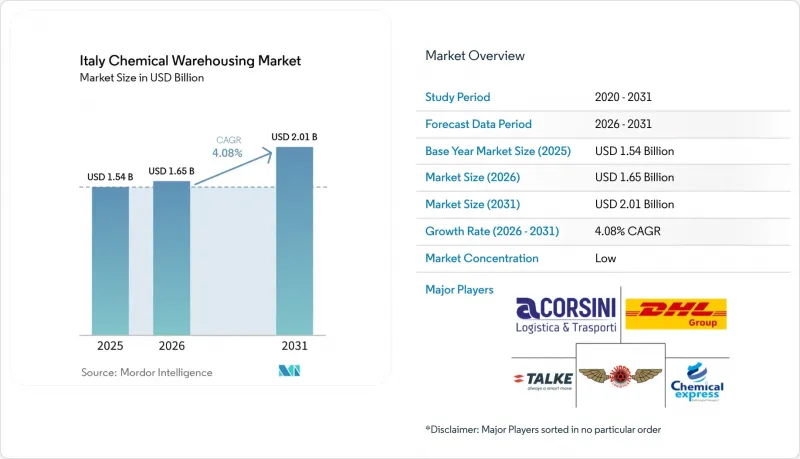
This report is Segmented by Warehouse Type (General Warehousing, Specialty Chemical Warehouse, Hazardous Materials (HAZMAT) Warehouses, and More), by Chemical Type (Flammable Liquids, Corrosives, Toxic Substances, and More), and by End-User Industry (Basic Chemicals Manufacturing, Agrochemicals, Food & Feed Additives, and More). The Market Forecasts are Provided in Terms of Value (USD Billion).
Italy Chemical Warehousing Market Trends and Insights
Pharmaceutical and Fine Chemicals Leadership
Export-led pharmaceuticals and Italy's specialization in fine and specialty chemicals continue to propel high-spec storage, including temperature-controlled and GMP-compliant areas that meet serialization and product integrity requirements in the Italy chemical warehousing market. In 2025, the pharmaceutical sector's 90% export orientation supported recurring demand for validated storage, customs-bonded zones, and quality-controlled staging aligned with global shipping lanes. CDMO capacity in Italy added higher-frequency product launches and small-batch complexity, requiring warehouses to add traceability, monitoring, and specialized handling for APIs and sensitive intermediates in the Italy chemical warehousing market. Third-party logistics providers are capitalizing on Lombardy's life sciences and chemical hubs by setting up dedicated pharma-grade operations near key research and manufacturing sites. The combined weight of pharma exports and fine chemicals strengthens demand visibility for premium storage across northern clusters in the Italy chemical warehousing market.
Strategic Mediterranean Trade Position
Port-led capacity additions reinforce Italy's import and transshipment role for chemicals and intermediates flowing between the Middle East, Europe, and North America in the Italy chemical warehousing market. Genoa's New Breakwater project is sized to accommodate ultra-large container vessels and increase throughput, with an investment of EUR 1.3 billion (USD 1.43 billion), supporting larger call sizes and scale economies from vessel upsizing. The import footprint ties into feedstock realities, given that a material share of Italy's chemical inputs are naphtha-based and linked to Middle Eastern supply chains, which underpins consistent inbound demand for port-area storage and drayage in the Italy chemical warehousing market. Livorno's Darsena Europa expansion, financed by the European Investment Bank at EUR 90 million (USD 99 million), provides additional container capacity and logistics optionality for specialty producers in Tuscany and central Italy. Trieste's rail-linked infrastructure, co-financed through European programs, aligns Adriatic flows with Central and Eastern European corridors, creating cross-border distribution opportunities for chemical warehousing in the Italy chemical warehousing market.
Bureaucratic Complexity and Permitting Delays
Permitting timelines for hazardous goods facilities remain lengthy because operators must satisfy multi-agency reviews and external emergency planning requirements under SEVESO III in the Italy chemical warehousing market. The 2026 deadline for upper-tier Seveso establishments to update safety reports adds pressure on internal resources, prioritizing compliance over expansion in the near term. Warehouses that handle flammable, corrosive, or toxic substances must account for risk scenarios and external event modeling, which complicates approvals and inspections in the Italy chemical warehousing market. These obligations can stretch project critical paths, especially for greenfield builds that also need land-use variances and municipal alignment. As a result, brownfield conversions and capacity expansions at existing sites are often favored to maintain momentum in the Italy chemical warehousing market.
Other drivers and restraints analyzed in the detailed report include:
- Specialty Chemicals Sector Growth
- Northern Industrial Triangle Development
- High Labor and Compliance Costs
For complete list of drivers and restraints, kindly check the Table Of Contents.
Segment Analysis
Specialty chemical warehouses held the largest share of 38.94% of the warehouse type in 2025, reflecting Italy's concentration in fine and specialty chemicals and the need for segregated, quality-assured storage in the Italy chemical warehousing market. Temperature-controlled facilities show the fastest expansion with 5.64% CAGR as pharma-related volumes require 2 to 8 degrees Celsius stability, validated storage zones, and audit trails to support export flows and clinical-to-commercial transitions in the Italian chemical warehousing market. Operators differentiate with dedicated Dangerous Goods management, documentation control, and product integrity assurance for small-batch, high-value shipments typical of biotech and advanced therapies. These requirements align with northern clusters where life sciences and specialty chemical producers scale production and export cycles. The Italy chemical warehousing market continues to reward sites that can combine GMP standards, risk controls for hazardous goods, and responsive service levels to manage frequent product refresh and short-lifecycle inventories.
Hazardous materials warehouses are pivotal for flammable, corrosive, toxic, and oxidizing substances, and regulatory regimes reinforce their demand, and circular economy flows in the Italy chemical warehousing market. In May 2025, TALKE opened a 20,000 square meter hazardous goods site at Filago within the Covestro Chemical Park, with preparations for Seveso permits and future tank and silo capacity, which underlines the long-term buildout of certified hazardous storage in Lombardy. The pivot to circular polymers and chemical recycling adds inbound and intermediate flows that require separation, traceability, and quality-control steps near refinery and polymer sites in the Italy chemical warehousing market. General-purpose warehousing remains relevant for packaged auxiliaries and consumer chemicals, although competition for logistics real estate encourages brownfield redevelopment close to major corridors. The Italy chemical warehousing industry, therefore, balances premium, compliance-heavy capacity with flexible general storage to serve a changing product portfolio.
List of Companies Covered in this Report:
- DHL Group
- Talke Logistics
- Den Hartogh Logistics
- Corsini Srl
- Chemical Express
- Kuehne + Nagel
- DSV
- Brenntag Italia
- Rhenus Logistics
- CEVA Logistics
- C.H. Robinson
- HOYER Group
- Bertschi AG
- Savino Del Bene
- Geodis
- Dachser Logistics
- Gruber Logistics
- Yusen Logistics
- Due Torri
- AIT Worldwide Logistics, Inc.
Additional Benefits:
- The market estimate (ME) sheet in Excel format
- 3 months of analyst support
TABLE OF CONTENTS
1 Introduction
- 1.1 Study Assumptions and Market Definition
- 1.2 Scope of the Study
2 Research Methodology
3 Executive Summary
4 Market Landscape
- 4.1 Market Overview
- 4.2 Market Drivers
- 4.2.1 Pharmaceutical and Fine Chemicals Leadership
- 4.2.2 Strategic Mediterranean Trade Position
- 4.2.3 Specialty Chemicals Sector Growth
- 4.2.4 Northern Industrial Triangle Development
- 4.2.5 Agrochemical Manufacturing Base
- 4.2.6 Green Transition and Bio-Based Chemicals
- 4.3 Market Restraints
- 4.3.1 Bureaucratic Complexity and Permitting Delays
- 4.3.2 Fragmented Logistics Network
- 4.3.3 High Labor and Compliance Costs
- 4.3.4 Limited Greenfield Land Availability
- 4.4 Value / Supply-Chain Analysis
- 4.5 Regulatory Landscape
- 4.6 Technological Outlook
- 4.7 Porter's Five Forces
- 4.7.1 Threat of New Entrants
- 4.7.2 Bargaining Power of Suppliers
- 4.7.3 Bargaining Power of Buyers
- 4.7.4 Threat of Substitutes
- 4.7.5 Competitive Rivalry
- 4.8 Impact of Geopolitical Events on the Market
- 4.9 Circular Economy Chemical Recycling
5 Market Size and Growth Forecasts (Value, USD Billion)
- 5.1 By Warehouse Type
- 5.1.1 General Warehousing
- 5.1.2 Specialty Chemical Warehouse
- 5.1.3 Hazardous Materials (HAZMAT) Warehouses
- 5.1.4 Temperature-Controlled Chemical Warehouses
- 5.2 By Chemical Type
- 5.2.1 Flammable Liquids
- 5.2.2 Corrosives
- 5.2.3 Toxic Substances
- 5.2.4 Oxidizers
- 5.2.5 Others
- 5.3 By End-user Industry
- 5.3.1 Basic Chemicals Manufacturing
- 5.3.2 Specialty Chemicals Manufacturing
- 5.3.3 Pharmaceuticals & Life Sciences
- 5.3.4 Agrochemicals
- 5.3.5 Paints, Coatings & Adhesives
- 5.3.6 Food & Feed Additives
- 5.3.7 Oil & Gas / Petrochemicals
- 5.3.8 Others
6 Competitive Landscape
- 6.1 Market Concentration
- 6.2 Strategic Moves
- 6.3 Market Share Analysis
- 6.4 Company Profiles (includes Global level Overview, Market level overview, Core Segments, Strategic Information, Products and Services, and Recent Developments)
- 6.4.1 DHL Group
- 6.4.2 Talke Logistics
- 6.4.3 Den Hartogh Logistics
- 6.4.4 Corsini Srl
- 6.4.5 Chemical Express
- 6.4.6 Kuehne + Nagel
- 6.4.7 DSV
- 6.4.8 Brenntag Italia
- 6.4.9 Rhenus Logistics
- 6.4.10 CEVA Logistics
- 6.4.11 C.H. Robinson
- 6.4.12 HOYER Group
- 6.4.13 Bertschi AG
- 6.4.14 Savino Del Bene
- 6.4.15 Geodis
- 6.4.16 Dachser Logistics
- 6.4.17 Gruber Logistics
- 6.4.18 Yusen Logistics
- 6.4.19 Due Torri
- 6.4.20 AIT Worldwide Logistics, Inc.
7 Market Opportunities and Future Outlook
- 7.1 White-space and Unmet-need Assessment

