PUBLISHER: Mordor Intelligence | PRODUCT CODE: 2063393

PUBLISHER: Mordor Intelligence | PRODUCT CODE: 2063393
Malaysia Electronics Manufacturing Services - Market Share Analysis, Industry Trends & Statistics, Growth Forecasts (2026 - 2031)
According to Mordor Intelligence, the malaysia electronics manufacturing services market is expected to grow from USD 5.11 billion in 2025 to USD 5.67 billion in 2026 and is forecasted to reach USD 9.01 billion by 2031 at 9.71% CAGR over 2026-2031.
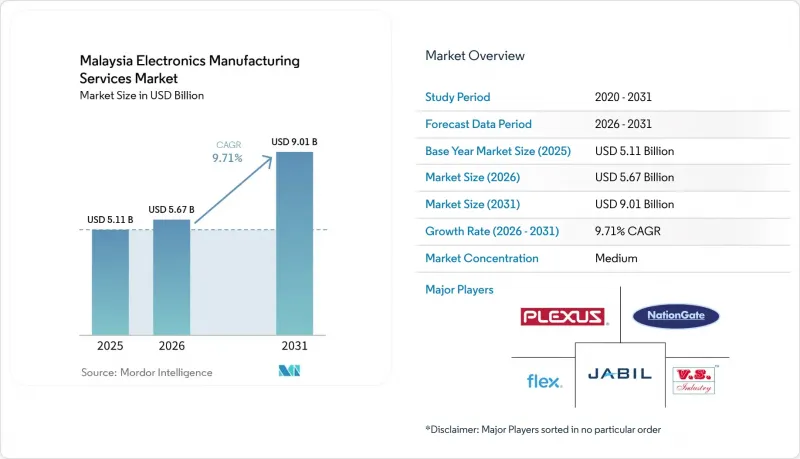
This report is Segmented by Service Type (Electronic Manufacturing Services, Engineering Services, and More), Business Model (Contract Manufacturing, and More), Manufacturing Process (Surface Mount Technology, Through-Hole Technology, and More), End-User (Mobile Devices, Consumer Electronics, and More), and Geography. The Market Forecasts are Provided in Terms of Value (USD).
Malaysia Electronics Manufacturing Services Market Trends and Insights
Growing Foreign Direct Investments in Penang EMS Corridor
Penang attracted MYR 12.5 billion (USD 3.2 billion) in approved investments during 1H 2025, 150% higher than the prior-year period, confirming its status as Malaysia's semiconductor hub. Intel, Infineon, and AT&S have multibillion-dollar expansion pipelines focused on chiplet integration and system-in-package solutions. Penang's dense network of machining vendors, cargo hubs, and universities lowers onboarding costs for new entrants and accelerates time-to-production. The state accounted for 45% of Malaysia's electronics exports in 2025, reinforcing the agglomeration benefits identified by MIDA.
Expansion of 5G Handset Exports from Malaysia
Southeast Asia shipped 25.6 million 5G smartphones in Q3 2025, with Malaysian assembly lines feeding both regional and Chinese final-integration sites. Flexible SMT lines dedicated to radio-frequency modules and multilayer boards drive quick-turn orders as brands push sub-USD 300 models to emerging markets. Electronics exports climbed 22.5% year-on-year in July 2025, powered partly by handset sub-assemblies. Contract manufacturers have responded by dedicating flexible SMT lines that switch between two-layer and eight-layer boards inside a single shift, allowing brands to release weekly firmware tweaks without disrupting takt time. The National Investment Aspirations framework grants 100% capital-allowance offsets for projects exceeding MYR 300 million (USD 76 million), effectively subsidizing reflow ovens and automatic optical-inspection systems that meet 5G traceability rules
Skilled Labour Shortages in Advanced Packaging
Malaysia must add 60,000 engineers by 2030, yet universities graduate only 5,000 relevant candidates annually, constraining throughput even as capital pours into advanced packaging lines. Wage inflation for experienced packaging engineers exceeded 12% in 2025, eroding cost advantages and forcing firms to design co-op programs whose curricula still lag industry needs by up to two years. To fill gaps, firms run accelerated six-month apprentice programs, but the compressed timeline means graduates often lack deep statistical-process-control skills, leading to higher scrap during ramp-up phases. Some EMS providers import talent from Taiwan and South Korea, yet expatriate packages can cost 40% more than local hires once housing and schooling allowances are included. Industry-academic consortia have drafted new curricula in micro-bump metallurgy and thermal-interface-material chemistry, but courses will not matriculate students until late-2027.
Other drivers and restraints analyzed in the detailed report include:
- Rising Demand for High-Mix, Low-Volume Production
- Supply-Chain Diversification Away from Mainland China
- Energy-Cost Volatility Affecting SMT Lines
For complete list of drivers and restraints, kindly check the Table Of Contents.
Segment Analysis
The segment held 42.73% of Malaysia electronics manufacturing services market share in 2025, anchored by PCB assembly for smartphones and industrial controls. Electromechanical assembly is forecast to expand at a 9.86% CAGR, powered by battery-management systems and wire-harness builds for electric vehicles. Malaysia's electronic manufacturing services market for box build is projected to grow exponentially between 2026 and 2031, driven by OEM demand for design-to-delivery accountability.
Providers differentiate through certifications- ISO 13485 for medical, IATF 16949 for automotive- that command premium pricing. Prototyping, logistics, and test-and-development services remain strategic footholds, enabling lock-in during early design decisions. Commoditized PCB assembly faces pricing pressure as low-cost markets attract high-volume work, but Malaysia's quality frameworks defend niches in aerospace, industrial, and medical builds.
In 2025, contract manufacturing accounted for a significant 60.91% of total revenue. This highlights the dominant role of contract manufacturing in the electronic manufacturing services market. As clients increasingly prioritize single-source accountability to expedite product cycles, hybrid and turnkey arrangements are projected to grow at a robust 10.13% CAGR. These arrangements offer streamlined processes and reduced complexities, making them attractive to businesses aiming for faster time-to-market. The Malaysia electronics manufacturing services market, particularly in turnkey engagements, is poised for steady growth through 2031, capitalizing on suppliers' advantages in component procurement and their embedded design expertise.
Jabil's investment of MYR 1 billion (USD 0.25 billion) in its Penang campus underscores its strategy to harness not just assembly revenue, but also design fees and logistics income. This significant investment reflects the company's commitment to expanding its capabilities and capturing a larger share of the value chain. The Penang campus is expected to serve as a hub for innovation and operational efficiency, further strengthening Jabil's market position. While Original Design Manufacturing (ODM) commands a smaller segment, it's gaining momentum, especially among brands venturing into wearables or smart-home categories that lack in-house engineering capabilities. This growth in ODM highlights the increasing demand for specialized design and manufacturing solutions in emerging product categories.
List of Companies Covered in this Report:
- Flex Ltd.
- Jabil Inc.
- Celestica Inc.
- Sanmina Corporation
- Plexus Corp
- Venture Corporation Ltd.
- Benchmark Electronics Inc.
- VS Industry Berhad
- NationGate Holdings Berhad
- Integrated Manufacturing Solutions Sdn Bhd
- SKP Resources Berhad
- EG Industries Berhad
- ATA IMS Berhad
- PIE Industrial Berhad
- Mi Technovation Berhad
- Inari Amertron Berhad
- Cape EMS Bhd
- Scanfil Plc
- Wistron Corporation
- Universal Scientific Industrial Co. Ltd.
Additional Benefits:
- The market estimate (ME) sheet in Excel format
- 3 months of analyst support
TABLE OF CONTENTS
1 INTRODUCTION
- 1.1 Study Assumptions and Market Definition
- 1.2 Scope of the Study
2 RESEARCH METHODOLOGY
3 EXECUTIVE SUMMARY
4 MARKET LANDSCAPE
- 4.1 Market Overview
- 4.2 Market Drivers
- 4.2.1 Growing Foreign Direct Investments in Penang's EMS Corridor
- 4.2.2 Expansion of 5G Handset Exports from Malaysia
- 4.2.3 Rising Demand for High-Mix, Low-Volume (HMLV) Production
- 4.2.4 Government Incentives Under National Investment Aspirations (NIA)
- 4.2.5 Supply-Chain Diversification Away from Mainland China
- 4.2.6 Emergence of Smart Factory 4.0 Adoption Among Tier-2 EMS
- 4.3 Market Restraints
- 4.3.1 Skilled Labour Shortages in Advanced Packaging
- 4.3.2 Energy-Cost Volatility Affecting SMT Lines
- 4.3.3 Currency Fluctuation Risk Versus USD-Denominated Components
- 4.3.4 Intensifying Regional Competition from Vietnam & Thailand
- 4.4 Industry Value Chain Analysis
- 4.5 Regulatory Landscape
- 4.6 Technological Outlook
- 4.7 Impact of Macroeconomic Factors on the Market
- 4.8 Porter's Five Forces Analysis
- 4.8.1 Threat of New Entrants
- 4.8.2 Bargaining Power of Suppliers
- 4.8.3 Bargaining Power of Buyers
- 4.8.4 Threat of Substitutes
- 4.8.5 Competitive Rivalry
5 MARKET SIZE AND GROWTH FORECASTS (VALUE)
- 5.1 By Service Types
- 5.1.1 Electronic Manufacturing Services
- 5.1.1.1 PCB Assembly
- 5.1.1.2 Electromechanical Assembly/Box Build
- 5.1.1.3 Prototyping
- 5.1.1.4 Other Electronic Manufacturing Services
- 5.1.2 Engineering Services
- 5.1.3 Test and Development Implementation
- 5.1.4 Logistics Services
- 5.1.5 Other Service Types
- 5.1.1 Electronic Manufacturing Services
- 5.2 By Business Model
- 5.2.1 Contract Manufacturing (CM)
- 5.2.2 Original Design Manufacturing (ODM)
- 5.2.3 Hybrid / Turnkey / Other Business Models
- 5.3 By Manufacturing Process
- 5.3.1 Surface Mount Technology (SMT)
- 5.3.2 Through-Hole Technology (THT)
- 5.3.3 Advanced Packaging / Hybrid Processes
- 5.4 By End-User
- 5.4.1 Mobile Devices (Smartphones and Tablets)
- 5.4.2 Consumer Electronics
- 5.4.3 Computer (PCs / Desktops / Laptops)
- 5.4.4 Industrial
- 5.4.5 Automotive
- 5.4.6 Communication
- 5.4.7 Lighting
- 5.4.8 Medical
- 5.4.9 Other End-Users
6 COMPETITIVE LANDSCAPE
- 6.1 Market Concentration
- 6.2 Strategic Moves
- 6.3 Market Share Analysis
- 6.4 Company Profiles (includes Global Level Overview, Market Level Overview, Core Segments, Financials as available, Strategic Information, Market Rank/Share, Products and Services, Recent Developments)
- 6.4.1 Flex Ltd.
- 6.4.2 Jabil Inc.
- 6.4.3 Celestica Inc.
- 6.4.4 Sanmina Corporation
- 6.4.5 Plexus Corp
- 6.4.6 Venture Corporation Ltd.
- 6.4.7 Benchmark Electronics Inc.
- 6.4.8 VS Industry Berhad
- 6.4.9 NationGate Holdings Berhad
- 6.4.10 Integrated Manufacturing Solutions Sdn Bhd
- 6.4.11 SKP Resources Berhad
- 6.4.12 EG Industries Berhad
- 6.4.13 ATA IMS Berhad
- 6.4.14 PIE Industrial Berhad
- 6.4.15 Mi Technovation Berhad
- 6.4.16 Inari Amertron Berhad
- 6.4.17 Cape EMS Bhd
- 6.4.18 Scanfil Plc
- 6.4.19 Wistron Corporation
- 6.4.20 Universal Scientific Industrial Co. Ltd.
7 MARKET OPPORTUNITIES AND FUTURE OUTLOOK
- 7.1 White-Space and Unmet-Need Assessment

