PUBLISHER: Mordor Intelligence | PRODUCT CODE: 2063753

PUBLISHER: Mordor Intelligence | PRODUCT CODE: 2063753
Cloud HCM Platform - Market Share Analysis, Industry Trends & Statistics, Growth Forecasts (2026 - 2031)
According to Mordor Intelligence, the cloud HCM platform market size is expected to increase from USD 10.94 billion in 2025 to USD 11.82 billion in 2026 and reach USD 17.50 billion by 2031, growing at an 8.15% CAGR over 2026-2031.
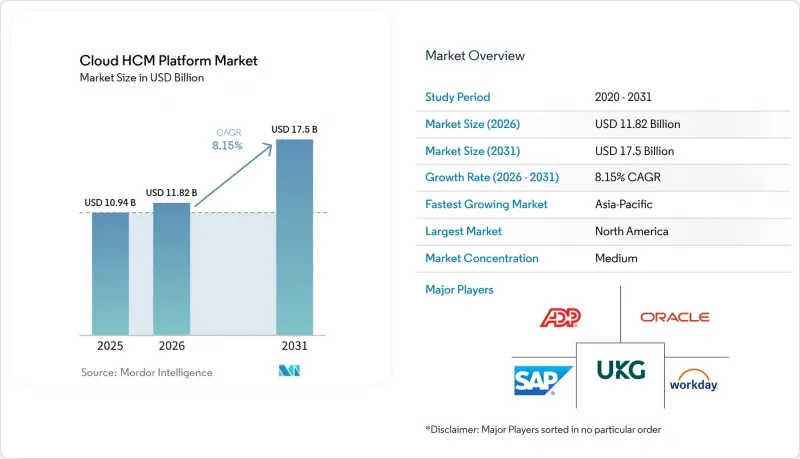
This report is Segmented by Deployment Model (Public Cloud, Private Cloud, and Hybrid Cloud), Organization Size (Large Enterprises, and Small and Medium Enterprises), Application (Core HR and Personnel Administration, Talent Acquisition and Onboarding, and More), Industry Vertical (Banking Financial Services and Insurance, and More), and Geography. The Market Forecasts are Provided in Terms of Value (USD).
Global Cloud HCM Platform Market Trends and Insights
Accelerating AI-Driven Skill Mapping and Talent Intelligence
Skill inference engines embedded in leading platforms now process billions of transactional datapoints to auto-tag employee capabilities, surface internal mobility paths, and shorten hiring cycles. Workday Skills Cloud alone analyzes more than 800 billion transactions annually, while SAP SuccessFactors Dynamic Skills framework lets organizations integrate third-party ontologies for niche roles. Specialized partners such as Censia and Phenom claim 40% faster passive-candidate discovery versus keyword search, enabling employers to redeploy existing staff into skill-adjacent roles and cut recruiting costs by one-quarter. The effect is felt most in technology, professional-services, and financial-services companies where average skill half-life has dropped to 2.5 years, making dynamic talent intelligence a board-level priority.
Rise of Skills-Based Workforce Planning in Large Enterprises
Cisco's 30 000-employee shift to skills-based planning and Merck's enterprise-wide skills taxonomy show how competencies are replacing static jobs as the unit of workforce design. Research indicates skills-based organizations realize 98% higher high-performer retention and 52% faster ramp-up for new hires. Platforms respond by embedding skills ontologies and AI-driven gap analytics directly into core HR. SAP's 2025 launch of Joule Studio enables HR teams to build custom agents that pinpoint skill gaps and recommend training without IT intervention. Manufacturing and healthcare firms that cross-train production or clinical staff report lower overtime and vacancy rates, although success depends on cleansing legacy data and validating taxonomies before go-live.
Data Residency Legislation Increasing Localization Costs
GDPR and a patchwork of national sovereignty rules require in-country hosting, forcing vendors to duplicate infrastructure and support teams. China's cybersecurity laws demand separate Chinese instances, while India and Indonesia contemplate similar mandates. Hybrid architectures, on-premises payroll with cloud talent modules, are emerging as cost-effective workarounds, yet dual licenses and complex data synchronization erode anticipated savings.
Other drivers and restraints analyzed in the detailed report include:
- Integration of Generative AI Copilots Into HCM User Interfaces
- Surge in Global Payroll Compliance Complexity
- Persistent Integration Bottlenecks With Legacy ERP Stacks
For complete list of drivers and restraints, kindly check the Table Of Contents.
Segment Analysis
Public cloud accounted for 56.41% of the cloud HCM platform market in 2025, reflecting Workday's multi-tenant SaaS model that delivers quarterly updates without on-premises hardware. Hybrid models hold growing appeal, expanding at a 10.64% CAGR as enterprises pair public-cloud talent modules with on-premises payroll to satisfy data-sovereignty statutes. Dual-license economics remain delicate, yet coexistence avoids the USD 6-12 million migration costs typical of large global rollouts.
Hybrid deployments increasingly rely on real-time connectors such as Oracle Human Data Loader and SAP Integration Suite, enabling daily synchronization while mitigating payroll-error risk. Third-party support firms offering discounted maintenance for legacy payroll further shift the cost-benefit calculus. Gartner expects 85% of enterprises to operate cloud-centered HR infrastructure by 2028, but regulated sectors will keep hybrid models for the long term. The cloud HCM platform market size for hybrid setups is therefore positioned to outpace overall growth as privacy mandates tighten.
Large enterprises held 68.04% revenue share in 2025, purchasing end-to-end suites spanning global payroll, analytics, and workforce management. SMEs, however, are growing at 11.02% CAGR, attracted to per-employee pricing that starts at USD 6 monthly and promises go-lives inside 90 days. The cloud HCM platform market size for SMEs is still small, yet rising quickly as lightweight suites bundle payroll, benefits, and time tracking to displace spreadsheets.
Vendors such as HiBob, Rippling, and Deel differentiate via intuitive mobile interfaces, IT-HR convergence, and embedded multi-country compliance. Despite tight budgets, 68% of SMEs prefer cloud deployments to avoid infrastructure costs, with 46% still citing implementation expense as a barrier. Freemium entry tiers and template-driven onboarding lower those hurdles, suggesting sustained double-digit SME adoption even as enterprise penetration plateaus.
Geography Analysis
North America generated 37.44% of 2025 revenue, anchored by high-value federal contracts such as the U.S. Office of Personnel Management's USD 100 million Workday award and the Department of Energy's USD 38 million Technology Modernization Fund-backed rollout. Canada and Mexico show steady uptake, supported by SAP Joule's 2025 Spanish-language payroll explanations. Vendor dominance is stark: Workday, SAP, and Oracle influence over 95% of enterprise decisions at firms with more than 5 000 employees, with Workday leading new-buyer consideration surveys.
Asia-Pacific is the fastest-growing territory at a 10.27% CAGR. Darwinbox's 9-times international revenue surge and Ramco Systems' 150-country payroll reach illustrate home-grown vendors scaling beyond regional borders. Japan's SmartHR leads domestic share with 70 000 tenants, while global providers must operate separate Chinese instances to comply with cybersecurity protocols, inflating localization costs. India's impending data-protection law and Indonesia's Regulation 71/2019 add to compliance complexity, steering buyers toward vendors with country-specific payroll modules.
Europe remains material despite slower expansion. GDPR and national sovereignty statutes compel in-country data centers, prompting Workday to commit EUR 175 million (USD 197 million) to an AI center in Dublin tailored for European customers. SAP's deep integration with S/4HANA and localized payroll spanning 50-plus countries sustains traction in Germany and France, while Oracle's E.ON win underlines growing acceptance in regulated utilities. South America, the Middle East, and Africa trail in absolute value yet gain momentum through government digitization mandates and mobile-first workforce management.
- Workday, Inc.
- SAP SE
- Oracle Corporation
- Automatic Data Processing, Inc.
- UKG Inc.
- Ceridian HCM Holding Inc.
- BambooHR LLC
- Paycom Software, Inc.
- Cornerstone OnDemand, Inc.
- PeopleStrategy, Inc.
- Rippling People Center, Inc.
- TriNet Group, Inc.
- Zenefits (YourPeople, Inc.)
- Gusto, Inc.
- Ramco Systems Limited
- Zoho Corporation Pvt. Ltd.
- The Sage Group plc
- Namely, Inc.
- HiBob Ltd.
- Darwinbox Digital Solutions Pvt. Ltd.
Additional Benefits:
- The market estimate (ME) sheet in Excel format
- 3 months of analyst support
TABLE OF CONTENTS
1 INTRODUCTION
- 1.1 Study Assumptions and Market Definition
- 1.2 Scope of the Study
2 RESEARCH METHODOLOGY
3 EXECUTIVE SUMMARY
4 MARKET LANDSCAPE
- 4.1 Market Overview
- 4.2 Market Drivers
- 4.2.1 Accelerating AI-Driven Skill Mapping and Talent Intelligence
- 4.2.2 Rise of Skills-Based Workforce Planning in Large Enterprises
- 4.2.3 Government Incentives for Cloud Migration of HR Systems
- 4.2.4 Surge in Global Payroll Compliance Complexity
- 4.2.5 Integration of Generative AI Copilots Into HCM User Interfaces
- 4.2.6 Expansion of Industry-Specific Cloud HCM Accelerators
- 4.3 Market Restraints
- 4.3.1 Data Residency Legislation Increasing Localization Costs
- 4.3.2 Persistent Integration Bottlenecks With Legacy ERP Stacks
- 4.3.3 High Total Cost of Ownership for Mid-Market Buyers
- 4.3.4 Vendor Lock-In Concerns Limiting Long-Term Contract Commitments
- 4.4 Industry Value Chain Analysis
- 4.5 Regulatory Landscape
- 4.6 Technological Outlook
- 4.7 Impact of Macroeconomic Factors on the Market
- 4.8 Porter's Five Forces Analysis
- 4.8.1 Threat of New Entrants
- 4.8.2 Bargaining Power of Suppliers
- 4.8.3 Bargaining Power of Buyers
- 4.8.4 Threat of Substitutes
- 4.8.5 Competitive Rivalry
5 MARKET SIZE AND GROWTH FORECASTS (VALUE)
- 5.1 By Deployment Model
- 5.1.1 Public Cloud
- 5.1.2 Private Cloud
- 5.1.3 Hybrid Cloud
- 5.2 By Organization Size
- 5.2.1 Large Enterprises
- 5.2.2 Small and Medium Enterprises (SMEs)
- 5.3 By Application
- 5.3.1 Core HR and Personnel Administration
- 5.3.2 Payroll and Compensation Management
- 5.3.3 Talent Acquisition and Onboarding
- 5.3.4 Workforce Management and Time Tracking
- 5.3.5 Learning and Development
- 5.3.6 Performance and Succession Management
- 5.3.7 HR Analytics and Planning
- 5.4 By Industry Vertical
- 5.4.1 Banking, Financial Services and Insurance
- 5.4.2 Healthcare and Life Sciences
- 5.4.3 IT and Telecommunications
- 5.4.4 Manufacturing
- 5.4.5 Retail and E-Commerce
- 5.4.6 Government and Public Sector
- 5.4.7 Education
- 5.4.8 Hospitality and Travel
- 5.4.9 Other Industry Verticals
- 5.5 By Geography
- 5.5.1 North America
- 5.5.1.1 United States
- 5.5.1.2 Canada
- 5.5.1.3 Mexico
- 5.5.2 South America
- 5.5.2.1 Brazil
- 5.5.2.2 Argentina
- 5.5.2.3 Rest of South America
- 5.5.3 Europe
- 5.5.3.1 Germany
- 5.5.3.2 France
- 5.5.3.3 United Kingdom
- 5.5.3.4 Italy
- 5.5.3.5 Spain
- 5.5.3.6 Russia
- 5.5.3.7 Rest of Europe
- 5.5.4 Asia-Pacific
- 5.5.4.1 China
- 5.5.4.2 Japan
- 5.5.4.3 India
- 5.5.4.4 South Korea
- 5.5.4.5 Australia and New Zealand
- 5.5.4.6 Southeast Asia
- 5.5.4.7 Rest of Asia-Pacific
- 5.5.5 Middle East
- 5.5.5.1 Saudi Arabia
- 5.5.5.2 United Arab Emirates
- 5.5.5.3 Turkey
- 5.5.5.4 Rest of Middle East
- 5.5.6 Africa
- 5.5.6.1 South Africa
- 5.5.6.2 Nigeria
- 5.5.6.3 Kenya
- 5.5.6.4 Rest of Africa
- 5.5.1 North America
6 COMPETITIVE LANDSCAPE
- 6.1 Market Concentration
- 6.2 Strategic Moves
- 6.3 Market Share Analysis
- 6.4 Company Profiles (includes Global Level Overview, Market Level Overview, Core Segments, Financials as available, Strategic Information, Market Rank/Share, Products and Services, Recent Developments)
- 6.4.1 Workday, Inc.
- 6.4.2 SAP SE
- 6.4.3 Oracle Corporation
- 6.4.4 Automatic Data Processing, Inc.
- 6.4.5 UKG Inc.
- 6.4.6 Ceridian HCM Holding Inc.
- 6.4.7 BambooHR LLC
- 6.4.8 Paycom Software, Inc.
- 6.4.9 Cornerstone OnDemand, Inc.
- 6.4.10 PeopleStrategy, Inc.
- 6.4.11 Rippling People Center, Inc.
- 6.4.12 TriNet Group, Inc.
- 6.4.13 Zenefits (YourPeople, Inc.)
- 6.4.14 Gusto, Inc.
- 6.4.15 Ramco Systems Limited
- 6.4.16 Zoho Corporation Pvt. Ltd.
- 6.4.17 The Sage Group plc
- 6.4.18 Namely, Inc.
- 6.4.19 HiBob Ltd.
- 6.4.20 Darwinbox Digital Solutions Pvt. Ltd.
7 MARKET OPPORTUNITIES AND FUTURE OUTLOOK
- 7.1 White-Space and Unmet-Need Assessment

