PUBLISHER: Mordor Intelligence | PRODUCT CODE: 2064518

PUBLISHER: Mordor Intelligence | PRODUCT CODE: 2064518
Compensation Management In BFSI - Market Share Analysis, Industry Trends & Statistics, Growth Forecasts (2026 - 2031)
According to Mordor Intelligence, the compensation management in BFSI market size is projected to be USD 6.57 billion in 2025, USD 6.95 billion in 2026, and reach USD 9.23 billion by 2031, growing at a CAGR of 5.83% from 2026 to 2031.
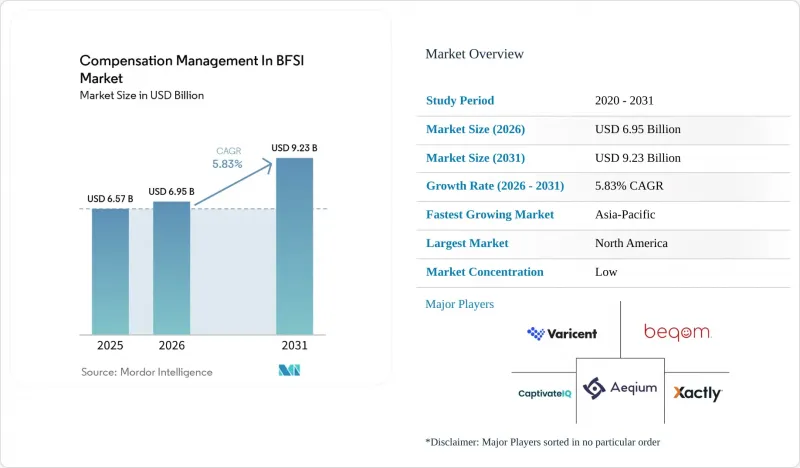
This report is Segmented by Component (Software, and Services), Compensation Functionality (Compensation Planning and Budgeting, and More), Deployment Mode (Cloud-Based, On-Premises, and Hybrid), Organization Size (Large Enterprises, and Small and Medium-Sized Enterprises), End-Use Industry (Banking, Insurance, and More), and Geography. The Market Forecasts are Provided in Terms of Value (USD).
Global Compensation Management In BFSI Market Trends and Insights
Cloud and Artificial Intelligence Adoption in Compensation Operations
The compensation management in BFSI market is moving away from record-keeping tools and toward platforms that support live scenario modeling, workflow automation, and stronger audit evidence. AI-enabled platforms are helping banks and insurers compress review cycles that once depended on weeks of spreadsheet consolidation into faster, more controlled workflows. This shift favors cloud delivery because vendors can push model updates, compliance checks, and decision-support features across client environments without the long upgrade cycles that often slow on-premises estates. It also underscores the importance of explainability, bias monitoring, and human oversight, as employment-related AI tools now face greater scrutiny in regulated environments. In practice, that gives an edge to vendors that already offer governed AI layers, rather than institutions trying to build ad hoc tools around fragmented compensation data.
Need to Manage Complex Variable Pay across Regulated Workforces
The compensation management in BFSI market continues to draw demand from the simple fact that variable pay in banking and insurance is harder to administer than in most other sectors. Financial institutions often manage short-term incentives, deferred awards, clawback provisions, multi-currency bonus pools, and long-term performance structures across multiple jurisdictions simultaneously. A May 2026 survey of financial services reward leaders found that 86% saw compensation system management as complex and 80% reported broader participation in incentive programs over the prior 3 years. As incentive eligibility expands beyond senior leaders and into larger employee populations, manual administration becomes harder to scale without higher error rates and weaker budget control. That is why the compensation management in BFSI market keeps benefiting from demand for plan modeling, automated calculation, and jurisdiction-aware administration that can absorb rising pay complexity without adding equal levels of operating risk.
Legacy System Integration and Data Fragmentation
The compensation management in BFSI market still faces its most persistent operational restraint in the form of legacy system integration and fragmented data estates. A May 2026 survey found that 66% of financial services compensation leaders saw multiple service providers as a barrier to accurate and consistent pay data, 64% worked across several regulatory environments, and 77% relied on multiple outsourcing partners across jurisdictions. That fragmentation limits the value of modern compensation software because forecasting, analytics, and scenario planning are only as reliable as the upstream finance, HR, and payroll feeds behind them. Zalaris showed how even a focused payroll modernization at Danske Bank required phased country rollouts and heavy change management to consolidate vendors and standardize processes across Nordic operations. A beqom case study on a global tier-1 bank also illustrated the scale of the issue, with more than 50 compensation components needing reconciliation across custom systems and Excel files before analytics could add full value.
Other drivers and restraints analyzed in the detailed report include:
- Tightening Incentive Pay Governance, Clawback, and Deferral Rules
- European Union Pay Transparency and Equal Pay Compliance Deadlines
- Sensitive Pay Data Privacy and Cybersecurity Constraints
For complete list of drivers and restraints, kindly check the Table Of Contents.
Segment Analysis
Software accounted for 63.12% of revenue in 2025, which kept the compensation management in BFSI market centered on configurable platforms that can absorb rule changes without full redevelopment. This lead reflected buyer preference for systems that can adapt to UK remuneration reform, EU pay transparency obligations, and evolving incentive plan structures, with less reliance on internal IT rebuilds. Within the software layer, demand has shifted toward tools that combine calculation accuracy with analytics, workflow control, and clear audit evidence for regulators and internal reviewers. That shift has made mid-market banks and insurers more willing to reconsider generic HR suites when they need deeper incentive compensation and deferred award functionality. The software-heavy structure also reflects how strongly the compensation management in BFSI market depends on rule engines that can be configured across jurisdictions rather than hard-coded around one local pay process.
Services are the fastest-growing component, with a projected CAGR of 8.06% through 2031, because many institutions still need implementation, integration, and advisory support before software can perform as intended. Services demand rises when compensation platforms must connect to core banking systems, HR master data, payroll engines, CRM tools, and finance ledgers that were never designed around a common pay data model. That makes consulting, system mapping, and phased rollout more expensive to replace than the software license itself, especially at large, regulated institutions. It also means service revenue is relatively durable in the compensation management in BFSI market because clients tend to retain providers that already understand their control environment and historical compensation architecture. In a market moving toward fewer, deeper platforms, that service dependency becomes a practical source of contract stickiness and vendor defense.
Incentive compensation management held the largest functionality share at 31.45% in 2025, which shows how much of the compensation management in BFSI market still revolves around variable pay administration. That position reflects the financial importance of incentive design across banking, insurance, advisory, and trading roles, where errors or payment delays can quickly affect revenue production and employee retention. The insurance side of the value chain reinforces that pattern, since commercial leaders continue to identify incentive compensation as a leading challenge in carrier operations. Dedicated ICM tools, therefore, remain central because they can manage complex formulas, disputes, exceptions, and split-credit rules with more consistency than broad HR modules. That keeps ICM at the core of buying decisions in the compensation management market in BFSI, even as firms also upgrade planning or analytics capabilities.
Compensation analytics and reporting is the fastest-growing functionality, with a CAGR of 6.11% through 2031, because compliance now depends on defensible tables, variance tracking, and timely evidence across several rule sets. Pay transparency, equal pay review, and material risk taker governance all rely on data structures that can explain outcomes, not just calculate them. That is pushing planning, bonus management, reporting, and pay equity monitoring closer together inside shared data models. Machine learning-based anomaly detection is also starting to influence product roadmaps, as buyers want compensation outliers flagged before decisions are finalized, rather than after reports are published. Over time, that makes analytics less of a standalone module and more of a control layer running through the broader compensation management in BFSI market.
Geography Analysis
North America held a 37.66% share in 2025, which gave the region the largest position in the compensation management in BFSI market size. The region benefits from the concentration of large financial institutions, broad federal and state oversight, and a mature vendor base for incentive compensation and broader pay governance tools. The United States remains the main demand center because banks, insurers, and capital markets firms face layered expectations on incentive governance, executive accountability, and pay data control. The region also shows a growing need for skills-based pay modeling as institutions compete for AI, cyber, and quantitative talent that does not cleanly fit within legacy compensation bands. Canada and Mexico remain smaller contributors, but both continue to support modernization demand as financial institutions expand digital HR and compensation processes.
Europe is the most regulation-heavy geography in the compensation management in BFSI market, and that raises both urgency and design complexity. The June 2026 pay transparency transposition deadline, UK remuneration reform, and national overlays such as Germany's IVV 5.0 have forced banks and insurers to review job architecture, reporting logic, and variable pay governance simultaneously. Germany stands out because industry discussion in May 2026 focused heavily on BRUBEG and IVV 5.0 implementation, pay transparency readiness, and ESG KPI integration into variable pay structures. That makes Europe a region where the compensation management in BFSI market share is shaped less by a single buying pattern and more by country-specific compliance design. South America remains at an earlier stage, led by Brazil, where banks have been more selective in adopting cloud-based incentive tools as they expand retail distribution and respond to new equal-pay reporting expectations.
Asia-Pacific is the fastest-growing region, with a projected CAGR of 6.49% through 2031, which keeps it central to the next phase of the compensation management in BFSI market. Demand in APAC reflects aggressive HR technology modernization across China, India, Australia, and Japan, as well as rising complexity in local pay governance and variable reward structures. Institutions in the region are moving toward systems that can support multi-entity reporting, localized rule sets, and broader integration with payroll and performance data. The Middle East and Africa are smaller in current revenue terms, but both regions are showing more momentum as Gulf banks align executive pay governance with global practices and South African firms address widening pay reporting expectations. Together, these trends support a broader geographic spread of adoption even though North America and Europe still hold the largest current weight in the compensation management in BFSI market.
- beqom SA
- Xactly Corporation
- Varicent Software Inc.
- PerformanceCentre, Inc.
- CaptivateIQ, Inc.
- Aeqium, Inc.
- HRsoft, Inc.
- Decusoft, Inc.
- PureFacts Financial Solutions
- Akeron S.r.l.
- Fintary Technologies, Inc.
- ComTrack Inc.
- Bentega AS
- Forma AI Inc.
- Iconixx Software Corporation
- Optymyze Pte. Ltd.
- Everstage Inc.
- Commissionly Limited
- CellarStone, Inc.
- Compport Private Limited
Additional Benefits:
- The market estimate (ME) sheet in Excel format
- 3 months of analyst support
TABLE OF CONTENTS
1 INTRODUCTION
- 1.1 Study Assumptions and Market Definition
- 1.2 Scope of the Study
2 RESEARCH METHODOLOGY
3 EXECUTIVE SUMMARY
4 MARKET LANDSCAPE
- 4.1 Market Overview
- 4.2 Market Drivers
- 4.2.1 Tightening Incentive Pay Governance, Clawback, and Deferral Rules
- 4.2.2 European Union Pay Transparency and Equal Pay Compliance Deadlines
- 4.2.3 Cloud and Artificial Intelligence Adoption in Compensation Operations
- 4.2.4 Need to Manage Complex Variable Pay Across Regulated Workforces
- 4.2.5 Insurance and Wealth Distribution Modernization
- 4.2.6 Skills-Based Pay Premiums for Artificial Intelligence, Cyber, Quant, and Regulatory Technology Talent
- 4.3 Market Restraints
- 4.3.1 Legacy System Integration and Data Fragmentation
- 4.3.2 Sensitive Pay Data Privacy and Cybersecurity Constraints
- 4.3.3 Cross-Jurisdiction Remuneration Rule Divergence
- 4.3.4 Auditability Burden for Deferred Awards and Equal-Value Job Mapping
- 4.4 Industry Value Chain Analysis
- 4.5 Regulatory Landscape
- 4.6 Technological Outlook
- 4.7 Impact of Macroeconomic Factors on the Market
- 4.8 Porter's Five Forces Analysis
- 4.8.1 Threat of New Entrants
- 4.8.2 Bargaining Power of Buyers
- 4.8.3 Bargaining Power of Suppliers
- 4.8.4 Threat of Substitutes
- 4.8.5 Industry Rivalry
5 MARKET SIZE AND GROWTH FORECASTS (VALUE)
- 5.1 By Component
- 5.1.1 Software
- 5.1.2 Services
- 5.1.2.1 Implementation and Integration Services
- 5.1.2.2 Consulting and Advisory Services
- 5.1.2.3 Support and Maintenance Services
- 5.2 By Compensation Functionality
- 5.2.1 Compensation Planning and Budgeting
- 5.2.2 Incentive Compensation Management
- 5.2.3 Bonus Management
- 5.2.4 Compensation Analytics and Reporting
- 5.2.5 Pay Equity and Transparency Management
- 5.2.6 Other Compensation Functionalities
- 5.3 By Deployment Mode
- 5.3.1 Cloud-Based
- 5.3.2 On-Premises
- 5.3.3 Hybrid
- 5.4 By Organization Size
- 5.4.1 Large Enterprises
- 5.4.2 Small and Medium-Sized Enterprises
- 5.5 By End-Use Industry
- 5.5.1 Banking
- 5.5.2 Insurance
- 5.5.3 Capital Markets and Asset Management
- 5.5.4 Credit Unions and Building Societies
- 5.6 By Geography
- 5.6.1 North America
- 5.6.1.1 United States
- 5.6.1.2 Canada
- 5.6.1.3 Mexico
- 5.6.2 South America
- 5.6.2.1 Brazil
- 5.6.2.2 Argentina
- 5.6.2.3 Chile
- 5.6.2.4 Rest of South America
- 5.6.3 Europe
- 5.6.3.1 United Kingdom
- 5.6.3.2 Germany
- 5.6.3.3 France
- 5.6.3.4 Italy
- 5.6.3.5 Spain
- 5.6.3.6 Russia
- 5.6.3.7 Rest of Europe
- 5.6.4 Asia-Pacific
- 5.6.4.1 China
- 5.6.4.2 Japan
- 5.6.4.3 India
- 5.6.4.4 South Korea
- 5.6.4.5 Australia
- 5.6.4.6 Rest of Asia-Pacific
- 5.6.5 Middle East
- 5.6.5.1 Saudi Arabia
- 5.6.5.2 United Arab Emirates
- 5.6.5.3 Turkey
- 5.6.5.4 Rest of Middle East
- 5.6.6 Africa
- 5.6.6.1 South Africa
- 5.6.6.2 Nigeria
- 5.6.6.3 Rest of Africa
- 5.6.1 North America
6 COMPETITIVE LANDSCAPE
- 6.1 Market Concentration
- 6.2 Strategic Moves
- 6.3 Market Share Analysis
- 6.4 Company Profiles (includes Global Level Overview, Market Level Overview, Core Segments, Financials as available, Strategic Information, Market Rank/Share, Products and Services, Recent Developments)
- 6.4.1 beqom SA
- 6.4.2 Xactly Corporation
- 6.4.3 Varicent Software Inc.
- 6.4.4 PerformanceCentre, Inc.
- 6.4.5 CaptivateIQ, Inc.
- 6.4.6 Aeqium, Inc.
- 6.4.7 HRsoft, Inc.
- 6.4.8 Decusoft, Inc.
- 6.4.9 PureFacts Financial Solutions
- 6.4.10 Akeron S.r.l.
- 6.4.11 Fintary Technologies, Inc.
- 6.4.12 ComTrack Inc.
- 6.4.13 Bentega AS
- 6.4.14 Forma AI Inc.
- 6.4.15 Iconixx Software Corporation
- 6.4.16 Optymyze Pte. Ltd.
- 6.4.17 Everstage Inc.
- 6.4.18 Commissionly Limited
- 6.4.19 CellarStone, Inc.
- 6.4.20 Compport Private Limited
7 MARKET OPPORTUNITIES AND FUTURE OUTLOOK
- 7.1 White-Space and Unmet-Need Assessment

