PUBLISHER: Mordor Intelligence | PRODUCT CODE: 2063895

PUBLISHER: Mordor Intelligence | PRODUCT CODE: 2063895
West Europe Renewable Energy - Market Share Analysis, Industry Trends & Statistics, Growth Forecasts (2026 - 2031)
According to Mordor Intelligence, the west europe renewable energy market size in terms of installed base is expected to increase from 461.75 gigawatt in 2025 to 505.80 gigawatt in 2026 and reach 803.91 gigawatt by 2031, growing at a CAGR of 9.71% over 2026-2031.
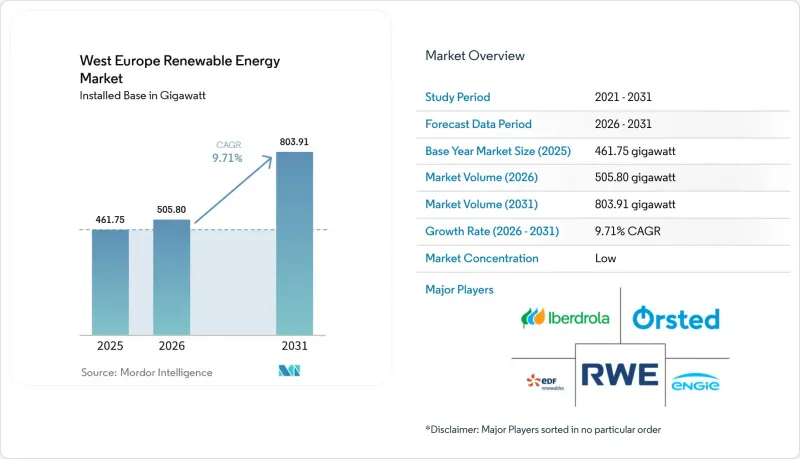
This report is Segmented by Technology (Solar Energy, Wind Energy, Hydropower, Bioenergy, Geothermal, Ocean Energy), End-User (Utilities, Commercial and Industrial, Residential), and Geography (Germany, United Kingdom, France, Ireland, Netherlands, Belgium, Luxembourg, Rest of West Europe). Market Forecasts are Provided in Terms of Volume (GW).
West Europe Renewable Energy Market Trends and Insights
EU Green Deal & 2030 Targets
The European Commission requires every member state to meet a 42.5% renewable-electricity share by 2030, with an aspirational 45% ceiling under REPowerEU. Germany's updated climate act mandates 80% renewable power by 2030, demanding a further 115 GW of solar and 30 GW of offshore wind beyond 2025 baselines. Ireland's 900 MW ORESS Tonn Nua award in December 2025 set a benchmark price of EUR 98.719/MWh, underpinning a 15.50% geographic CAGR. Sectoral sub-targets for renewable heat and transport intensify indirect electricity demand, while "renewables-go-to" areas promise to cut permitting lead-times from nine years to fewer than two. Developers that have already secured land in these zones gain a first-mover cost advantage.
Rapid LCOE Decline for Wind & Solar
Europe's average renewable LCOE fell 7% in 2025, with offshore wind in the North Sea dipping to EUR 50-60/MWh for 2026-bound projects . At EUR 80/tonne, emission-allowance costs add EUR 40-50/MWh to gas-plant dispatch, pivoting competitiveness toward renewables. However, U.K. Allocation Round 7 strike prices near GBP 73/MWh still left 75 of 82 pipeline projects without final investment decisions as of early 2026 . Corporate buyers increasingly prize revenue stability over absolute cost, as demonstrated by German on-site solar PPAs averaging 19-year terms seven years longer than off-site deals. The pattern reveals margin compression despite falling hardware costs, meaning grid access and price hedging now trump pure LCOE benchmarks.
Grid Congestion & Interconnection Bottlenecks
Europe's transmission redispatch costs reached EUR 4.3 billion in 2024 after 60 TWh of renewable output was curtailed or rerouted, while cross-border interconnector utilization stalled at 54 % against the 70 % target set by regulators. Germany's north-south corridor already curtails up to 8 TWh a year because offshore wind in Schleswig-Holstein overwhelms grid capacity to Bavarian demand centers . In the U.K., only 7 of 82 offshore-wind projects reached final investment decision by early 2026, exposing a 12.4 GW gap to the 55 GW 2030 goal because port and grid upgrades require 6-10 years longer than most financing windows. The Netherlands' TenneT delayed new North Sea connections until 2029 owing to onshore substation constraints, effectively capping annual additions at 1.5 GW versus the 3 GW pace needed to hit national targets. These bottlenecks elevate the strategic value of behind-the-meter solar and distributed batteries that bypass transmission queues altogether. Unless large-scale grid modernization accelerates, interconnection caps will continue to shave roughly 1.4 percentage points from forecast CAGR.
Other drivers and restraints analyzed in the detailed report include:
- Corporate PPAs Surge
- Battery-ready Co-location Mandates (2025 reform)
- Lengthy Permitting Procedures
For complete list of drivers and restraints, kindly check the Table Of Contents.
Segment Analysis
Ocean energy held a modest baseline yet is forecast to grow at 17.45% CAGR, the fastest rate among technologies in the West Europe renewable energy market . The segment benefits from the 30 MW HydroWing tidal array at Morlais and France's 250 MW pipeline moving from prototype toward multi-turbine arrays. Solar retained 46.63% of installed capacity in 2025 as sub-EUR 30/MWh LCOE kept project pipelines full, although land limits and curtailment headwinds slow incremental utility-scale builds. Wind power, bolstered by 15 MW turbines and floating foundations, remains the foundational bulk-capacity provider. Hydropower and bioenergy supply dispatchable stability, while CSP's share stays negligible owing to Europe's moderate direct normal irradiance.
Ocean assets also enable predictable diurnal output that eases evening ramps, helping transmission operators cut system costs by GBP 1.46 billion annually at 10 GW deployment. Vendor financing has shifted toward project-backed bonds once grid-support benefits are monetized under updated capacity-market rules. The confluence of tidal predictability, wave resource scale, and updated remuneration frameworks explains the accelerating contribution of ocean technologies to the West Europe renewable energy market size. Parallel pumped-storage hybrids, such as Iberdrola's 274 MW wind-plus-Tamega scheme, showcase how dispatchable renewables are expanding without adding new gas peakers.
List of Companies Covered in this Report:
- Orsted A/S
- Iberdrola SA
- EDF Renewables (Electricite de France)
- Engie SA
- RWE Renewables GmbH
- Vestas Wind Systems A/S
- Siemens Gamesa Renewable Energy SA
- TotalEnergies SE
- Enel Green Power SpA
- Statkraft AS
- General Electric Co. (GE Vernova)
- Renewable Energy Systems Ltd. (RES)
- Nordex SE
- ACCIONA Energia
- BayWa r.e. AG
- EDP Renovaveis
- Lightsource BP
- Equinor ASA
- JinkoSolar Holding Co. Ltd.
- Ecotricity Group Ltd.
Additional Benefits:
- The market estimate (ME) sheet in Excel format
- 3 months of analyst support
TABLE OF CONTENTS
1 Introduction
- 1.1 Study Assumptions & Market Definition
- 1.2 Scope of the Study
2 Research Methodology
3 Executive Summary
4 Market Landscape
- 4.1 Market Overview
- 4.2 Market Drivers
- 4.2.1 EU Green Deal & 2030 Targets
- 4.2.2 Rapid LCOE Decline for Wind & Solar
- 4.2.3 Corporate PPAs Surge
- 4.2.4 Battery-ready Co-location Mandates (2025 reform)
- 4.2.5 Hydrogen-linked Renewable Projects
- 4.2.6 Indexed CfD-style Auctions
- 4.3 Market Restraints
- 4.3.1 Grid Congestion & Interconnection Bottlenecks
- 4.3.2 Lengthy Permitting Procedures
- 4.3.3 Rare-earth & Installation Vessel Shortages
- 4.3.4 Farmland-use Opposition to Utility Solar
- 4.4 Supply-Chain Analysis
- 4.5 Regulatory Landscape
- 4.6 Technological Outlook
- 4.7 Porter's Five Forces
- 4.7.1 Bargaining Power of Suppliers
- 4.7.2 Bargaining Power of Buyers
- 4.7.3 Threat of New Entrants
- 4.7.4 Threat of Substitutes
- 4.7.5 Competitive Rivalry
5 Market Size & Growth Forecasts
- 5.1 By Technology
- 5.1.1 Solar Energy (PV and CSP)
- 5.1.2 Wind Energy (Onshore and Offshore)
- 5.1.3 Hydropower (Small, Large, PSH)
- 5.1.4 Bioenergy
- 5.1.5 Geothermal
- 5.1.6 Ocean Energy (Tidal and Wave)
- 5.2 By End-User
- 5.2.1 Utilities
- 5.2.2 Commercial and Industrial
- 5.2.3 Residential
- 5.3 By Geography
- 5.3.1 Germany
- 5.3.2 United Kingdom
- 5.3.3 France
- 5.3.4 Ireland
- 5.3.5 Netherlands
- 5.3.6 Belgium
- 5.3.7 Luxembourg
- 5.3.8 Rest of West Europe
6 Competitive Landscape
- 6.1 Market Concentration
- 6.2 Strategic Moves (M&A, JVs, Funding, PPAs)
- 6.3 Market Share Analysis (Market Rank/Share for key companies)
- 6.4 Company Profiles (includes Global-level Overview, Market-level Overview, Core Segments, Financials, Strategic Information, Products & Services, Recent Developments)
- 6.4.1 Orsted A/S
- 6.4.2 Iberdrola SA
- 6.4.3 EDF Renewables (Electricite de France)
- 6.4.4 Engie SA
- 6.4.5 RWE Renewables GmbH
- 6.4.6 Vestas Wind Systems A/S
- 6.4.7 Siemens Gamesa Renewable Energy SA
- 6.4.8 TotalEnergies SE
- 6.4.9 Enel Green Power SpA
- 6.4.10 Statkraft AS
- 6.4.11 General Electric Co. (GE Vernova)
- 6.4.12 Renewable Energy Systems Ltd. (RES)
- 6.4.13 Nordex SE
- 6.4.14 ACCIONA Energia
- 6.4.15 BayWa r.e. AG
- 6.4.16 EDP Renovaveis
- 6.4.17 Lightsource BP
- 6.4.18 Equinor ASA
- 6.4.19 JinkoSolar Holding Co. Ltd.
- 6.4.20 Ecotricity Group Ltd.
7 Market Opportunities & Future Outlook
- 7.1 White-Space & Unmet-Need Assessment

