PUBLISHER: Mordor Intelligence | PRODUCT CODE: 2063933

PUBLISHER: Mordor Intelligence | PRODUCT CODE: 2063933
China LED Chips - Market Share Analysis, Industry Trends & Statistics, Growth Forecasts (2026 - 2031)
According to Mordor Intelligence, the china lED chips market size is projected to be USD 8.84 billion in 2025, USD 9.63 billion in 2026, and reach USD 16.08 billion by 2031, growing at a CAGR of 10.8% from 2026 to 2031.
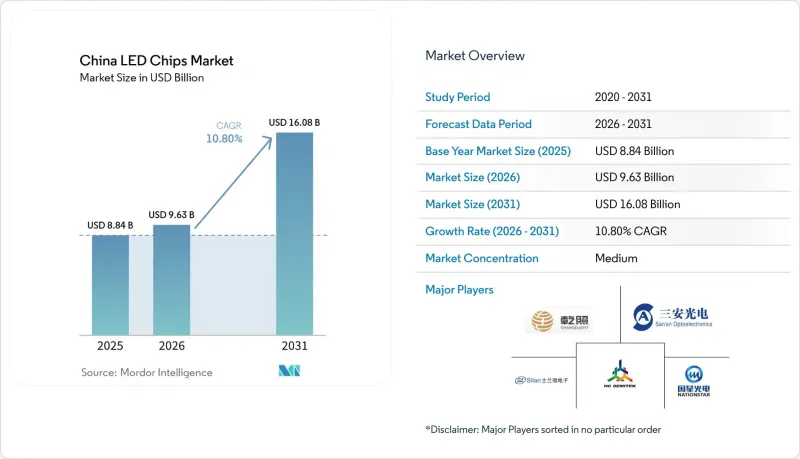
This report is Segmented by LED Chip Technology (Conventional LEDs, Mini-LED, Micro-LED), Semiconductor Material (GaN/InGaN, Algainp, Other Semiconductor Materials), and Application (General Lighting, Automotive, Backlighting/Displays, Consumer Electronics, Industrial/Specialty Lighting). The Market Forecasts are Provided in Terms of Value (USD).
China LED Chips Market Trends and Insights
Government Subsidies for Domestic Semiconductor Manufacturing
Phase III of the National IC Fund earmarked USD 47 billion in 2024, with 18% directed to compound semiconductors, lowering MOCVD reactor costs by up to 50% for qualified LED fabs.Provincial co-funding adds a further USD 8.5 billion, translating into rapid capacity gains and safeguarding near-term capital access. Subsidy recipients, however, must hit 90% domestic equipment usage and 15% annual productivity metrics by 2027, requirements that favor entrenched scale players. Sanan reported government grants equal to 22% of 2024 net income, underscoring continuing dependence. While the cash support accelerates volume, the performance thresholds strengthen the competitive moat around leaders and cull weaker entrants, shaping the medium-term structure of the China LED chips market.
Transition Toward High-Efficacy GaN-on-Si Epitaxy
Sanan and HC SemiTek expanded their combined GaN-on-Si fleet from 31 to 47 reactors between Q1 2025 and Q1 2026, attracted by 30-40% lower substrate cost and the die density gains inherent to 8-inch wafers.Buffer-layer engineering breakthroughs published in 2025 pushed yields to 91%, closing much of the gap with sapphire platforms. Although high-brightness segments still prefer sapphire for thermal reasons, GaN-on-Si enables low-cost lamps and mid-power backlighting, broadening addressable demand. Producers that master wafer bow management and thermal mismatch will unlock margin relief while extending the lifespan of conventional lines, thereby sustaining the growth momentum of the China LED chips market.
High Capital Expenditure for Micro-LED Mass Transfer
State-of-the-art laser or electrostatic transfer tools cost USD 12-18 million each yet deliver only 20-40% of the throughput that consumer economics require, pushing a single micro-LED line's capex above USD 50 million. Until tool speeds double and defect rates halve, mass-market wearables and TVs remain out of reach. For most domestic chipmakers, negative early-stage returns deter aggressive scaling, tempering the near-term uplift to the China LED chips market.
Other drivers and restraints analyzed in the detailed report include:
- Rapid Expansion of New-Energy Vehicle Headlamp Adoption
- Rising Demand for Mini-LED Backlighting in High-End TVs
- Overcapacity in Conventional LED Chip Lines
For complete list of drivers and restraints, kindly check the Table Of Contents.
Segment Analysis
Conventional LEDs generated 83% of 2025 revenue, anchoring the China LED chips market size despite 8-12% price compression. Mature 4-inch and 6-inch lines still deliver positive cash flow, subsidizing R&D into mini-LED and micro-LED. Mini-LED backlighting shipments reached 4.2 million TV units, translating into a significant uplift in die volumes. Should OLED panels fall below USD 300 for a 65-inch size by 2027, mini-LED could retrench to outdoor signage and professional monitors. Yet today's local dimming requirements and brightness advantages keep mini-LED on an expansion path that supports total unit growth in the China LED chips market.
Micro-LED, though contributing less than 2% of 2025 sales, is projected to grow at about 15.64% CAGR through 2031, the fastest among chip types. Wearable displays and automotive head-up units require the high brightness and extended lifetime that inorganic emitters provide. A 2025 Nature Photonics study validated efficiencies above 250 lm/W at sub-10 µm pitches, proving the physics while highlighting manufacturing hurdles. As mass-transfer improves, micro-LED could eventually shift revenue mix, but for the next three years, conventional LEDs will continue to bankroll technological migration across the China LED chips market.
List of Companies Covered in this Report:
- Sanan Optoelectronics Co., Ltd.
- HC SemiTek Corporation
- Xiamen Changelight Co., Ltd.
- Hangzhou Silan Microelectronics Co., Ltd.
- NationStar Optoelectronics Co., Ltd.
- Jiangsu Azure Lighting Technologies Co., Ltd.
- Focus Lightings Tech Co., Ltd.
- Zhejiang Keguang Electronics Co., Ltd. (KINGLIGHT)
- Advanced Optoelectronic Technology, Inc.
- Epistar Corporation
- Nichia Corporation
- Cree LED, an SGH Company
- Lumileds Holding B.V.
- OSRAM Opto Semiconductors GmbH
- Seoul Semiconductor Co., Ltd.
- Genesis Photonics Inc.
- Shenzhen Refond Optoelectronics Co., Ltd.
- Shenzhen MTC Co., Ltd.
- Unistars Corporation
- Tianjin Zhonghuan Semiconductor Co., Ltd.
Additional Benefits:
- The market estimate (ME) sheet in Excel format
- 3 months of analyst support
TABLE OF CONTENTS
1 INTRODUCTION
- 1.1 Study Assumptions and Market Definition
- 1.2 Scope of the Study
2 RESEARCH METHODOLOGY
3 EXECUTIVE SUMMARY
4 MARKET LANDSCAPE
- 4.1 Market Overview
- 4.2 Market Drivers
- 4.2.1 Rising Demand for Mini-LED Backlighting in High-End TVs
- 4.2.2 Government Subsidies for Domestic Semiconductor Manufacturing
- 4.2.3 Transition Toward High-Efficacy GaN-on-Si Epitaxy
- 4.2.4 Rapid Expansion of New-Energy Vehicle Headlamp Adoption
- 4.2.5 Localization Push Across Consumer Electronics Supply Chains
- 4.2.6 Integration of Micro-LED in Next-Gen Wearables
- 4.3 Market Restraints
- 4.3.1 Overcapacity in Conventional LED Chip Lines
- 4.3.2 High Capital Expenditure for Micro-LED Mass Transfer
- 4.3.3 Patent Litigation Risks with Foreign IP Holders
- 4.3.4 Volatility in Sapphire and Silicon Carbide Substrate Prices
- 4.4 Impact of Macroeconomic Factors on the Market
- 4.5 Industry Value Chain Analysis
- 4.6 Regulatory Landscape
- 4.7 Technological Outlook
- 4.8 Porter's Five Forces Analysis
- 4.8.1 Threat of New Entrants
- 4.8.2 Bargaining Power of Suppliers
- 4.8.3 Bargaining Power of Buyers
- 4.8.4 Threat of Substitutes
- 4.8.5 Competitive Rivalry
5 MARKET SIZE AND GROWTH FORECASTS (VALUE)
- 5.1 By LED Chip Technology
- 5.1.1 Conventional LEDs
- 5.1.2 Mini-LED
- 5.1.3 Micro-LED
- 5.2 By Semiconductor Material
- 5.2.1 GaN / InGaN
- 5.2.2 AlGaInP
- 5.2.3 Other Semiconductor Materials
- 5.3 By Application
- 5.3.1 General Lighting
- 5.3.2 Automotive
- 5.3.3 Backlighting / Displays
- 5.3.4 Consumer Electronics
- 5.3.5 Industrial / Specialty Lighting
6 COMPETITIVE LANDSCAPE
- 6.1 Market Concentration
- 6.2 Strategic Moves
- 6.3 Market Share Analysis
- 6.4 Company Profiles (includes Global Level Overview, Market Level Overview, Core Segments, Financials as available, Strategic Information, Market Rank/Share, Products and Services, Recent Developments)
- 6.4.1 Sanan Optoelectronics Co., Ltd.
- 6.4.2 HC SemiTek Corporation
- 6.4.3 Xiamen Changelight Co., Ltd.
- 6.4.4 Hangzhou Silan Microelectronics Co., Ltd.
- 6.4.5 NationStar Optoelectronics Co., Ltd.
- 6.4.6 Jiangsu Azure Lighting Technologies Co., Ltd.
- 6.4.7 Focus Lightings Tech Co., Ltd.
- 6.4.8 Zhejiang Keguang Electronics Co., Ltd. (KINGLIGHT)
- 6.4.9 Advanced Optoelectronic Technology, Inc.
- 6.4.10 Epistar Corporation
- 6.4.11 Nichia Corporation
- 6.4.12 Cree LED, an SGH Company
- 6.4.13 Lumileds Holding B.V.
- 6.4.14 OSRAM Opto Semiconductors GmbH
- 6.4.15 Seoul Semiconductor Co., Ltd.
- 6.4.16 Genesis Photonics Inc.
- 6.4.17 Shenzhen Refond Optoelectronics Co., Ltd.
- 6.4.18 Shenzhen MTC Co., Ltd.
- 6.4.19 Unistars Corporation
- 6.4.20 Tianjin Zhonghuan Semiconductor Co., Ltd.
7 MARKET OPPORTUNITIES AND FUTURE OUTLOOK
- 7.1 White-Space and Unmet-Need Assessment

