PUBLISHER: Mordor Intelligence | PRODUCT CODE: 2064347

PUBLISHER: Mordor Intelligence | PRODUCT CODE: 2064347
United States Mid-Power LED Package - Market Share Analysis, Industry Trends & Statistics, Growth Forecasts (2026 - 2031)
According to Mordor Intelligence, the united states mid-power LED package market size is projected to be USD 1.22 billion in 2025, USD 1.25 billion in 2026, and reach USD 1.46 billion by 2031, growing at a CAGR of 3.16% from 2026 to 2031.
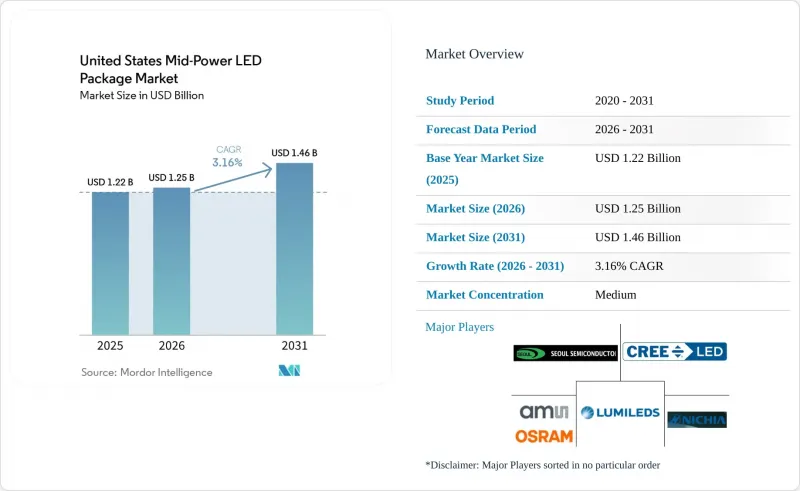
This report is Segmented by Power Range (0. 2 W To 0. 5 W, and 0. 5 W To Less Than 1 W), Package Architecture (Surface Mount Device, and Chip Scale Package), and Application (General Lighting, Automotive Lighting, Display and Backlighting, and Specialty and Niche). The Market Forecasts are Provided in Terms of Value (USD).
United States Mid-Power LED Package Market Trends and Insights
Rapid Adoption Of Energy-Efficient Lighting In Commercial Retrofits
Utility rebate programs now cover roughly three-quarters of U.S. electricity customers, and 2026 expansions added networked luminaires to eligible product lists, pushing building owners toward second-generation LED-to-LED upgrades. The Inflation Reduction Act raised the Section 179D write-off to USD 5.00 per square foot for projects that cut lighting energy by at least 25%, effectively lowering payback to under three years for high-CRI mid-power arrays. Warehouses replacing 400 W metal-halide fixtures with 150 W LED high bays report 60% energy savings and better vertical illumination, while the move to occupancy sensing and daylight harvesting increases emitter count per fitting. Higher emitter density boosts package demand even though total luminaire shipments have plateaued, sustaining the United States mid-power LED package market during a mature construction cycle. Regional programs in California and New York add stretch targets on flicker and chromaticity, driving uptake of premium bin grades that carry healthier margins for domestic suppliers.
Increasing LED Penetration In Automotive Exterior Lighting
Federal Motor Vehicle Safety Standard 108 now allows adaptive driving beams nationwide, prompting Ford, General Motors, and Stellantis to roadmap matrix headlamps across 2027 model-year light-trucks. Each module integrates 40-120 individually addressable mid-power LEDs, typically 0.5 W CSPs, that dim exact zones to avoid glare. LG Innotek targets USD 731 million in annual automotive-lighting sales by 2030 on the back of its Nexlide Pixel platform, which has already booked 146 orders spanning 88 vehicle models. Rear lamps are also migrating to segmented LEDs for animation and vehicle-to-vehicle signaling, doubling package counts versus static arrays. Because automakers require AEC-Q102 and 15-year warranties, ASPs remain insulated from the price compression hurting general-lighting grades, sustaining growth in the United States mid-power LED package market.
Price Erosion Owing To Intense Asian Competition
Average selling prices for mid-power packages fell 30-40% in the four years to 2025 as Chinese makers such as Nationstar and Everlight leveraged vertically integrated sapphire and epitaxy lines to push cash costs below USD 0.02 per 0.5 W part. A January 2026 spot hike for gold and copper wire prompted mainland suppliers to lift list prices by up to 10%, offering temporary relief to U.S. vendors, yet the structural cost gap persists. Luminaire OEMs therefore dual-source, procuring commodity SKUs offshore while reserving domestic suppliers for AEC-Q102 or ISO 13485 projects that carry 15-20% price premiums for traceability and custom binning. The tactic keeps margin pressure acute in retrofit channels, restraining the overall United States mid-power LED package market CAGR despite segment-specific tailwinds.
Other drivers and restraints analyzed in the detailed report include:
- Growing Use Of Horticultural Lighting By U.S. Vertical Farms
- Federal Incentives For Domestic Semiconductor Packaging Under CHIPS Act
- Thermal Management Challenges In Compact Luminaire Designs
For complete list of drivers and restraints, kindly check the Table Of Contents.
Segment Analysis
The 0.5 W to Less Than 1 W class accounted for 63.19% of 2025 revenue in the United States mid-power LED package market, and it is projected to expand at a 3.88% CAGR through 2031. Industrial facilities swapping 400 W metal-halide fittings for 150 W LED high bays typically use 24-36 of these mid-tier packages to achieve 18,000-22,000 lumens at 160 lm W-1 while maintaining junction temperatures below 75 °C with passive aluminum heat sinks. Horticultural arrays likewise favor this class because distributing photons across a larger emitter count minimizes canopy hotspots and simplifies spectral tuning via driver settings rather than fixture swaps.
Wearables and edge-lit signage rely on 0.2-0.5 W devices, but that slice is expanding more slowly as consumer miniaturization plateaus and automotive designers consolidate ambient modules into fewer mid-power chips to simplify harnessing. Specialty ultraviolet products are nudging power upward as disinfection protocols demand faster dose delivery. Nichia's 280 nm NCSU434D at 135 mW output exemplifies how once-low-power niches are converging toward mid-range wattages, reinforcing the core position of this class in the United States mid-power LED package industry.
List of Companies Covered in this Report:
- ams OSRAM AG
- Nichia Corporation
- Seoul Semiconductor Co., Ltd.
- Lumileds Holding B.V.
- Cree LED, a business of Smart Global Holdings
- Samsung Electronics Co., Ltd.
- Lite-On Technology Corporation
- Everlight Electronics Co., Ltd.
- Lextar Electronics Corporation
- LG Innotek Co., Ltd.
- Nationstar Optoelectronics Co., Ltd.
- Bridgelux, Inc.
- Dominant Opto Technologies Sdn. Bhd.
- Epistar Corporation
- Sanan Optoelectronics Co., Ltd.
- Toyoda Gosei Co., Ltd.
- Citizen Electronics Co., Ltd.
- Stanley Electric Co., Ltd.
- Osram Opto Semiconductors GmbH
- Refond Optoelectronics Co., Ltd.
Additional Benefits:
- The market estimate (ME) sheet in Excel format
- 3 months of analyst support
TABLE OF CONTENTS
1 INTRODUCTION
- 1.1 Study Assumptions and Market Definition
- 1.2 Scope of the Study
2 RESEARCH METHODOLOGY
3 EXECUTIVE SUMMARY
4 MARKET LANDSCAPE
- 4.1 Market Overview
- 4.2 Market Drivers
- 4.2.1 Rapid Adoption of Energy-Efficient Lighting in Commercial Retrofits
- 4.2.2 Increasing LED Penetration in Automotive Exterior Lighting
- 4.2.3 Growing Use of Horticultural Lighting by U.S. Vertical Farms
- 4.2.4 Federal Incentives for Domestic Semiconductor Packaging Under CHIPS Act
- 4.2.5 MiniLED Backlight Proliferation in High-End TVs and Monitors
- 4.2.6 Emergence of Tunable White Standards in WELL and LEED Buildings
- 4.3 Market Restraints
- 4.3.1 Price Erosion Owing to Intense Asian Competition
- 4.3.2 Thermal Management Challenges in Compact Luminaire Designs
- 4.3.3 Supply-Chain Risk From Indium and Gallium Price Volatility
- 4.3.4 Slow Standardization of CSP Reliability Testing Protocols
- 4.4 Regulatory Landscape
- 4.5 Technological Outlook
- 4.6 Impact of Macroeconomic Factors on the Market
- 4.7 Porter's Five Forces Analysis
- 4.7.1 Bargaining Power of Suppliers
- 4.7.2 Bargaining Power of Buyers
- 4.7.3 Threat of New Entrants
- 4.7.4 Threat of Substitutes
- 4.7.5 Intensity of Competitive Rivalry
5 MARKET SIZE AND GROWTH FORECASTS (VALUE)
- 5.1 By Power Range
- 5.1.1 0.2 W - 0.5 W
- 5.1.2 0.5 W - Less Than 1 W
- 5.2 By Package Architecture
- 5.2.1 SMD (Surface Mount Device)
- 5.2.1.1 2835
- 5.2.1.2 3014
- 5.2.1.3 3030
- 5.2.1.4 Others (3528, 3020, 5050 etc.)
- 5.2.2 CSP (Chip Scale Package)
- 5.2.1 SMD (Surface Mount Device)
- 5.3 By Application
- 5.3.1 General Lighting
- 5.3.2 Automotive Lighting
- 5.3.3 Display and Backlighting
- 5.3.4 Specialty / Niche
6 COMPETITIVE LANDSCAPE
- 6.1 Market Concentration
- 6.2 Strategic Moves
- 6.3 Market Share Analysis
- 6.4 Company Profiles (includes Global Level Overview, Market Level Overview, Core Segments, Financials as available, Strategic Information, Market Rank/Share, Products and Services, Recent Developments)
- 6.4.1 ams OSRAM AG
- 6.4.2 Nichia Corporation
- 6.4.3 Seoul Semiconductor Co., Ltd.
- 6.4.4 Lumileds Holding B.V.
- 6.4.5 Cree LED, a business of Smart Global Holdings
- 6.4.6 Samsung Electronics Co., Ltd.
- 6.4.7 Lite-On Technology Corporation
- 6.4.8 Everlight Electronics Co., Ltd.
- 6.4.9 Lextar Electronics Corporation
- 6.4.10 LG Innotek Co., Ltd.
- 6.4.11 Nationstar Optoelectronics Co., Ltd.
- 6.4.12 Bridgelux, Inc.
- 6.4.13 Dominant Opto Technologies Sdn. Bhd.
- 6.4.14 Epistar Corporation
- 6.4.15 Sanan Optoelectronics Co., Ltd.
- 6.4.16 Toyoda Gosei Co., Ltd.
- 6.4.17 Citizen Electronics Co., Ltd.
- 6.4.18 Stanley Electric Co., Ltd.
- 6.4.19 Osram Opto Semiconductors GmbH
- 6.4.20 Refond Optoelectronics Co., Ltd.
7 MARKET OPPORTUNITIES AND FUTURE OUTLOOK
- 7.1 White-Space and Unmet-Need Assessment

