
PUBLISHER: Mordor Intelligence | PRODUCT CODE: 2064447

PUBLISHER: Mordor Intelligence | PRODUCT CODE: 2064447
U.S. Healthcare IT - Market Share Analysis, Industry Trends & Statistics, Growth Forecasts (2026 - 2031)
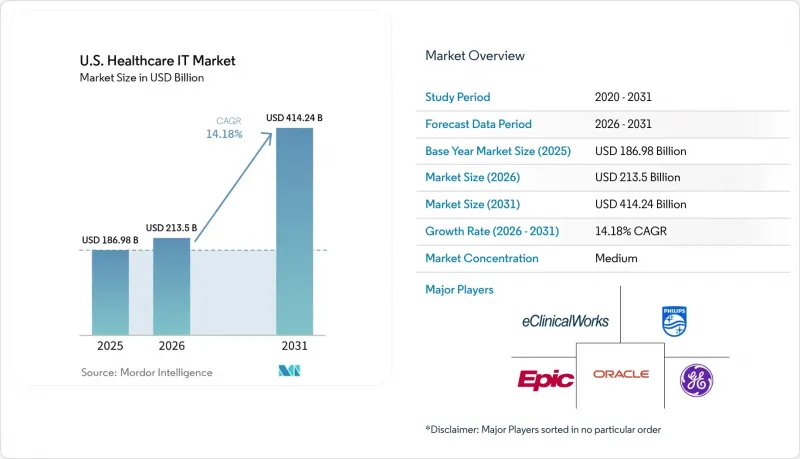
According to Mordor Intelligence, the u.S. healthcare iT market size is expected to increase from USD 186.98 billion in 2025 to USD 213.5 billion in 2026 and reach USD 414.24 billion by 2031, growing at a CAGR of 14.18% over 2026-2031.
This report is Segmented by Solution Type (Provider Solutions, Payer Solutions, IT Outsourcing), Component (Software, Hardware, Services), Deployment Model (On-Premises, Web-Based, Cloud/SaaS, Hybrid), End User (Providers, Payers, Life Sciences, and More), Application (Clinical Workflow, Administrative, and More), and Geography. The Market Forecasts are Provided in Terms of Value (USD).
U.S. Healthcare IT Market Trends and Insights
AI-Enabled Clinical and Administrative Workflow Automation
In the United States Healthcare IT market, health systems are prioritizing AI-driven solutions like ambient AI scribing and agentic orchestration to achieve measurable workflow improvements in clinical and administrative systems. Oracle Health introduced its Clinical AI Agent in March 2026, reporting significant physician time savings and reduced documentation efforts. As these capabilities integrate into enterprise EHRs, standalone tools face pricing pressures, while vendors with established platforms gain an advantage by linking automation to broader contracts. Regulatory momentum, such as HHS's HTI-5 proposed rule, further emphasizes the compliance value of AI-enabled data access.
Interoperability and Information-Blocking Compliance Mandates
Interoperability compliance in the United States Healthcare IT market has transitioned from a strategic goal to an operational necessity, with financial and certification penalties for non-compliance. HHS and OIG announced active enforcement of information-blocking penalties, while the HTI-5 proposal tightened exceptions and required legacy API updates for broader data exchange. This urgency drives sustained spending on TEFCA connectivity, FHIR upgrades, and interoperability middleware throughout the forecast period.
Cybersecurity and Privacy Burden
Cybersecurity challenges continue to restrain the United States Healthcare IT market as new APIs, cloud connections, and AI tools expand the attack surface organizations must manage. The average cost of a healthcare data breach reached USD 7.42 million in 2025, highlighting the financial impact. Cyber incidents, such as the Change Healthcare breach affecting 192.7 million individuals, demonstrate how third-party disruptions can compromise claims, payments, and care access.These challenges force health systems to prioritize spending on monitoring, identity controls, and incident response, slowing the adoption of new applications. Additionally, AI adoption adds governance complexities, further impacting market expansion.
Other drivers and restraints analyzed in the detailed report include:
- Shift to Value-Based Care and Population Health Analytics
- Electronic Prior Authorization and Payer API Buildout
- High Implementation Cost and Legacy Integration Complexity
For complete list of drivers and restraints, kindly check the Table Of Contents.
Segment Analysis
In 2025, Healthcare Provider Solutions accounted for 48.12% of the United States Healthcare IT market, driven by investments in clinical information systems, EHR platforms, revenue cycle tools, and patient-facing applications. Core clinical systems remain essential for documentation, orders, prescribing, and operational coordination, with updates focusing on AI integration, workflow redesign, cloud transitions, and interoperability.
Healthcare Payer Solutions is the fastest-growing segment, with a forecast CAGR of 15.20% through 2031, fueled by tools for prior authorization, care management, fraud analytics, and payment integrity. Federal compliance requirements are driving payer-side investments, aligning them with provider workflows.
In 2025, services dominated the United States Healthcare IT market with a 71.7% share, reflecting reliance on outsourcing, managed services, consulting, and revenue cycle operations. Large health systems prefer service-intensive models to manage infrastructure, cybersecurity, cloud migrations, and workflow transformations, ensuring operational risk is shared with external partners.
Software and Platforms, growing at a CAGR of 15.99% through 2031, are driven by AI-enabled EHRs, cloud analytics, and interoperability middleware. Buyers are increasing software investments to automate documentation, enhance patient access, and streamline workflows. Despite rapid software growth, services remain critical for integration, change management, and training, maintaining their role as the largest revenue contributor.
List of Companies Covered in this Report:
- Altera Digital Health
- Athenahealth
- eClinicalWorks LLC
- Epic Systems
- GE Healthcare
- Greenway Health
- Innovaccer
- Inovalon Holding Inc.
- InterSystems Corp.
- Koninklijke Philips
- Medical Information Technology, Inc.,
- Netsmart Technologies
- NextGen Healthcare
- Optum
- Oracle
- R1 RCM
- Surescripts LLC
- TruBridge Inc.
- Veradigm Inc.
- Waystar Holding Corp.
Additional Benefits:
- The market estimate (ME) sheet in Excel format
- 3 months of analyst support
TABLE OF CONTENTS
1 Introduction
- 1.1 Study Assumptions & Market Definition
- 1.2 Scope of the Study
2 Research Methodology
3 Executive Summary
4 Market Landscape
- 4.1 Market Overview
- 4.2 Market Drivers
- 4.2.1 AI-Enabled Clinical and Administrative Workflow Automation
- 4.2.2 Interoperability and Information-Blocking Compliance Mandates
- 4.2.3 Shift to Value-Based Care and Population Health Analytics
- 4.2.4 Continued Digitization of Provider Workflows and Patient Access
- 4.2.5 Electronic Prior Authorization and Payer API Buildout
- 4.2.6 Data-Liquidity Buildout Across Post-Acute and Behavioral Settings
- 4.3 Market Restraints
- 4.3.1 Cybersecurity And Privacy Burden
- 4.3.2 High Implementation Cost and Legacy Integration Complexity
- 4.3.3 AI Governance and Workflow-Level Liability Concerns
- 4.3.4 Sensitive-Data Consent Complexity in Specialty Care Exchange
- 4.4 Value / Supply-Chain Analysis
- 4.5 Regulatory Landscape
- 4.6 Technological Outlook
- 4.7 Porter's Five Forces Analysis
- 4.7.1 Threat of new entrants
- 4.7.2 Bargaining power of suppliers
- 4.7.3 Bargaining power of buyers
- 4.7.4 Threat of substitutes
- 4.7.5 Competitive rivalry
5 Market Size & Growth Forecasts (Value, USD)
- 5.1 By Solution & Service Type
- 5.1.1 Healthcare Provider Solutions
- 5.1.1.1 Clinical Information Systems
- 5.1.1.1.1 EHR / EMR Systems
- 5.1.1.1.2 Computerized Provider Order Entry Systems
- 5.1.1.1.3 Clinical Decision Support Systems
- 5.1.1.1.4 e-Prescribing Systems
- 5.1.1.1.5 Medication Administration / Pharmacy Information Systems
- 5.1.1.1.6 Laboratory Information Systems
- 5.1.1.1.7 Radiology Information Systems / PACS / VNA
- 5.1.1.1.8 Cardiology Information Systems
- 5.1.1.1.9 Other Specialty Departmental Systems
- 5.1.1.2 Non-clinical Provider Solutions
- 5.1.1.2.1 Revenue Cycle Management
- 5.1.1.2.2 Practice Management
- 5.1.1.2.3 Scheduling and Patient Flow Management
- 5.1.1.2.4 Workforce Management
- 5.1.1.2.5 Claims, Billing and Payment Collection
- 5.1.1.3 Patient-Facing and Virtual Care Solutions
- 5.1.1.3.1 Patient Portals
- 5.1.1.3.2 Telehealth / Virtual Care Platforms
- 5.1.1.3.3 Remote Patient Monitoring Platforms
- 5.1.1.3.4 Digital Front Door / Self-scheduling / Contact Center Tools
- 5.1.1.4 Data, Analytics and Interoperability Solutions
- 5.1.1.4.1 Health Information Exchange
- 5.1.1.4.2 Population Health Management
- 5.1.1.4.3 Care Management Platforms
- 5.1.1.4.4 Clinical Data Repositories / Data Platforms
- 5.1.1.4.5 Interoperability / FHIR / API Management
- 5.1.1.4.6 AI-enabled Documentation, Coding and Workflow Automation
- 5.1.1.1 Clinical Information Systems
- 5.1.2 Healthcare Payer Solutions
- 5.1.2.1 Claims Management
- 5.1.2.2 Care Management
- 5.1.2.3 Fraud, Waste and Abuse Analytics
- 5.1.2.4 Utilization Management / Prior Authorization
- 5.1.2.5 Member Engagement / CRM
- 5.1.2.6 Payment Integrity, Risk Adjustment and Quality Analytics
- 5.1.3 Healthcare IT Outsourcing and Managed Services
- 5.1.3.1 Revenue Cycle Outsourcing
- 5.1.3.2 IT Consulting and Implementation
- 5.1.3.3 Managed Infrastructure, Cloud and Security Services
- 5.1.3.4 Application Management and Support
- 5.1.3.5 Clinical Documentation and Coding Outsourcing
- 5.1.1 Healthcare Provider Solutions
- 5.2 By Component
- 5.2.1 Software and Platforms
- 5.2.2 Hardware, Devices and Infrastructure
- 5.2.3 Services
- 5.3 By Deployment Model
- 5.3.1 On-premises
- 5.3.2 Web-based / Hosted
- 5.3.3 Cloud-based / SaaS
- 5.3.4 Hybrid
- 5.4 By End User
- 5.4.1 Healthcare Providers
- 5.4.2 Healthcare Payers
- 5.4.3 Life Sciences and Research Organizations
- 5.4.4 Government and Public Health Agencies
- 5.4.5 Employers, Purchasers and TPAs
- 5.5 By Application / Workflow
- 5.5.1 Clinical Workflow Management
- 5.5.2 Financial and Administrative Workflow
- 5.5.3 Patient Engagement and Access
- 5.5.4 Data Exchange, Analytics and Intelligence
- 5.5.5 Imaging, Diagnostics and Departmental Informatics
6 Competitive Landscape
- 6.1 Market Concentration
- 6.2 Market Share Analysis
- 6.3 Company Profiles (includes Global level Overview, Market level overview, Core Segments, Financials as available, Strategic Information, Market Rank/Share for key companies, Products & Services, and Recent Developments)
- 6.3.1 Altera Digital Health Inc.
- 6.3.2 athenahealth Inc.
- 6.3.3 eClinicalWorks LLC
- 6.3.4 Epic Systems Corporation
- 6.3.5 GE HealthCare
- 6.3.6 Greenway Health LLC
- 6.3.7 Innovaccer
- 6.3.8 Inovalon Holding Inc.
- 6.3.9 InterSystems Corp.
- 6.3.10 Koninklijke Philips N.V.
- 6.3.11 Medical Information Technology, Inc.,
- 6.3.12 Netsmart Technologies Inc.
- 6.3.13 NextGen Healthcare Inc.
- 6.3.14 Optum Inc.
- 6.3.15 Oracle Corporation
- 6.3.16 R1 RCM Inc.
- 6.3.17 Surescripts LLC
- 6.3.18 TruBridge Inc.
- 6.3.19 Veradigm Inc.
- 6.3.20 Waystar Holding Corp.
7 Market Opportunities & Future Outlook
- 7.1 White-space and Unmet-need Assessment

