PUBLISHER: Mordor Intelligence | PRODUCT CODE: 2065426

PUBLISHER: Mordor Intelligence | PRODUCT CODE: 2065426
North America Discrete GPU - Market Share Analysis, Industry Trends & Statistics, Growth Forecasts (2026 - 2031)
According to Mordor Intelligence, the north america discrete GPU market size is projected to expand from USD 19.16 billion in 2025 and USD 21.98 billion in 2026 to USD 49.63 billion by 2031, registering a 17.69% CAGR between 2026 to 2031.
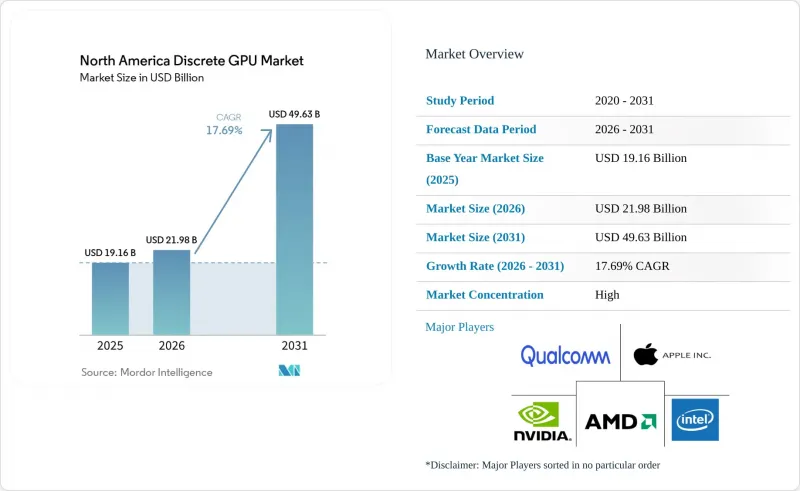
This report is Segmented by Device Application (Mobile Devices and Tablets, Pcs and Workstations, Servers and Datacenter Accelerators, and More), Memory Type (GDDR-Based GPUs and HBM-Based GPUs), Performance Tier (Low-Cost GPUs, Mainstream GPUs, High-Performance Consumer GPUs, and More), and Country (United States, Canada, and More). The Market Forecasts are Provided in Terms of Value (USD).
North America Discrete GPU Market Trends and Insights
Expanding AI and ML Workloads in Data Centers
North American hyperscalers are executing multi-gigawatt purchase frameworks that front-load deliveries of top-bin GPUs, locking in allocation across several silicon generations. AMD's 2026-2030 supply agreement with Meta vests equity warrants against shipment milestones, intertwining vendor balance sheets with customer roadmaps. NVIDIA's integration of Groq's LP30 into the Vera-Rubin platform splits clusters into high-throughput training GPUs and ultra-low-latency inference arrays, forcing rivals to compete on cost-per-token rather than raw FLOPS. New installations at the U.S. Department of Energy and the National Institute of Standards and Technology ensure a baseline of federally funded demand. CoreWeave and other independent cloud providers are broadening infrastructure footprints into secondary U.S. metros and Canadian provinces, further localizing GPU capacity.
Surging Demand for Real-Time Ray Tracing in AAA Gaming Titles
The RTX 50 Series enables multi-frame generation, quadrupling ray-traced frame rates, making real-time path tracing the default in big-budget titles. Intel's Arc Battlemage targets the USD 250-USD 400 band with second-generation ray-tracing cores, positioning the brand as a cost-conscious alternative, though software ecosystem gaps remain. Growth in cloud gaming compounds hardware pull-through as services such as GeForce NOW shift from shared to dedicated virtual GPUs per subscriber. Widespread adoption of 240 Hz and 360 Hz monitors compresses consumer upgrade cycles, anchoring premium desktop spend even as notebook demand migrates to integrated solutions.
Supply Chain Volatility of Advanced Nodes Capacity Constraints
TSMC's CoWoS packaging is the principal bottleneck, with HBM3 GPU lead times exceeding 6 months. Although pilot wafer output in Arizona has started, the lack of on-shore packaging still forces costly trans-Pacific loops. The U.S. International Technology Security and Innovation Fund is subsidizing new lines in Canada and Mexico, yet geopolitical and yield uncertainties persist. Samsung's delayed 3 nm ramp narrows alternative sourcing, further concentrating risk.
Other drivers and restraints analyzed in the detailed report include:
- Automotive OEM Shift to Centralized Zonal Architectures Demanding Discrete GPU Co-Processors for ADAS
- Rapid Growth of Cloud Gaming Platforms Requiring GPU Servers
- Rising ASPs Making High-End GPUs Unaffordable for Mainstream Consumers
For complete list of drivers and restraints, kindly check the Table Of Contents.
Segment Analysis
The servers and accelerators segment accounted for 40.11% of the North America discrete GPU market share in 2025, a position it is expected to reinforce with an 18.22% CAGR. This sub-sector remains the preferred deployment target for trillion-parameter model training and real-time inference clusters. The resulting procurement scale is attracting value-chain partners in optics, liquid cooling, and advanced packaging, deepening entry barriers. Consumer PCs and workstations, while still sizeable, face a substitution effect from Apple's integrated GPUs and Qualcomm-powered thin-and-light designs that meet most professional creation workloads without discrete cards.
Automotive ADAS nodes, though starting from a smaller base, exhibit the sharpest slope within the North America discrete GPU market, helped by zonal architectures that require safety-certified co-processors. Gaming consoles and handhelds adopt hybrid strategies, such as AMD Ryzen Z1 APUs paired with external GPU docks, blurring segment lines but keeping discrete revenue modest. Edge devices, industrial drones, and video collaboration appliances increasingly rely on Qualcomm system-on-chips, trimming prospective unit volumes for low-power discrete boards.
List of Companies Covered in this Report:
- NVIDIA Corporation
- Advanced Micro Devices Inc.
- Intel Corporation
- Qualcomm Technologies Inc.
- Apple Inc.
- Imagination Technologies Ltd.
- Arm Ltd.
- Samsung Electronics Co. Ltd.
- MediaTek Inc.
- Graphcore Ltd.
- Cerebras Systems Inc.
- Tenstorrent Inc.
- Broadcom Inc.
- ASUSTeK Computer Inc.
- Micro-Star International Co. Ltd.
- Gigabyte Technology Co. Ltd.
- Sapphire Technology Ltd.
- Zotac Technology Ltd.
Additional Benefits:
- The market estimate (ME) sheet in Excel format
- 3 months of analyst support
TABLE OF CONTENTS
1 INTRODUCTION
- 1.1 Study Assumptions and Market Definition
- 1.2 Scope of the Study
2 RESEARCH METHODOLOGY
3 EXECUTIVE SUMMARY
4 MARKET LANDSCAPE
- 4.1 Market Overview
- 4.2 Market Drivers
- 4.2.1 Surging Demand for Real-Time Ray Tracing in AAA Gaming Titles
- 4.2.2 Rapid Growth of Cloud Gaming Platforms Requiring GPU Servers
- 4.2.3 Expanding AI and ML Workloads in Data Centers
- 4.2.4 Increasing Penetration of High-Refresh-Rate E-Sports Monitors Raising GPU Upgrade Cycles
- 4.2.5 Government-Funded Semiconductor Initiatives Boosting Domestic GPU Manufacturing
- 4.2.6 Automotive OEM Shift to Centralized Zonal Architectures Demanding Discrete GPU Co-Processors for ADAS
- 4.3 Market Restraints
- 4.3.1 Supply Chain Volatility of Advanced Nodes Capacity Constraints
- 4.3.2 Rising ASPs Making High-End GPUs Unaffordable for Mainstream Consumers
- 4.3.3 Escalating Data Center Energy Regulations Limiting GPU Rack Density in Some U.S. States
- 4.3.4 Antitrust Scrutiny on GPU Vendor Bundling Practices Potentially Delaying Product Launches
- 4.4 Regulatory Landscape
- 4.5 Technological Outlook
- 4.6 Impact of Macroeconomic Factors on the Market
- 4.7 Porter's Five Forces Analysis
- 4.7.1 Threat of New Entrants
- 4.7.2 Bargaining Power of Buyers
- 4.7.3 Bargaining Power of Suppliers
- 4.7.4 Threat of Substitutes
- 4.7.5 Intensity of Competitive Rivalry
5 MARKET SIZE AND GROWTH FORECASTS (VALUE)
- 5.1 By Device Application
- 5.1.1 Mobile Devices and Tablets
- 5.1.2 PCs and Workstations
- 5.1.3 Servers and Datacenter Accelerators
- 5.1.4 Gaming Consoles and Handhelds
- 5.1.5 Automotive / ADAS
- 5.1.6 Other Embedded and Edge Devices
- 5.2 By Memory Type
- 5.2.1 GDDR-Based GPUs
- 5.2.2 HBM-Based GPUs
- 5.3 By Performance Tier
- 5.3.1 Low-Cost GPUs (Less than USD 100)
- 5.3.2 Mainstream GPUs (USD 100-USD 400)
- 5.3.3 High-Performance Consumer GPUs (USD 400-USD 1,200)
- 5.3.4 Data Center / AI Accelerator GPUs (Greater than USD 1,200)
- 5.4 By Counrty
- 5.4.1 United States
- 5.4.2 Canada
- 5.4.3 Mexico
6 COMPETITIVE LANDSCAPE
- 6.1 Market Concentration
- 6.2 Strategic Moves
- 6.3 Market Share Analysis
- 6.4 Company Profiles (includes Global Level Overview, Market Level Overview, Core Segments, Financials as available, Strategic Information, Market Rank/Share, Products and Services, Recent Developments)
- 6.4.1 NVIDIA Corporation
- 6.4.2 Advanced Micro Devices Inc.
- 6.4.3 Intel Corporation
- 6.4.4 Qualcomm Technologies Inc.
- 6.4.5 Apple Inc.
- 6.4.6 Imagination Technologies Ltd.
- 6.4.7 Arm Ltd.
- 6.4.8 Samsung Electronics Co. Ltd.
- 6.4.9 MediaTek Inc.
- 6.4.10 Graphcore Ltd.
- 6.4.11 Cerebras Systems Inc.
- 6.4.12 Tenstorrent Inc.
- 6.4.13 Broadcom Inc.
- 6.4.14 ASUSTeK Computer Inc.
- 6.4.15 Micro-Star International Co. Ltd.
- 6.4.16 Gigabyte Technology Co. Ltd.
- 6.4.17 Sapphire Technology Ltd.
- 6.4.18 Zotac Technology Ltd.
7 MARKET OPPORTUNITIES AND FUTURE OUTLOOK
- 7.1 White-Space and Unmet-Need Assessment

